 The reader experiences the dark side of the era through stories. A still from the movie ‘Oliver Twist’.
The world of literature is a curious place. The same stories keep appearing. At first, they seem like settings from a single work. However, if you broaden your perspective slightly, you'll see multiple works repeating similar structures. The protagonist is oppressed. Power is corrupt. Society is unjust. And finally, resistance emerges.
The names may differ, and the eras may vary from one work to another. Yet, the emotions readers feel are remarkably similar. This is the power of repetitive narrative. Literature does not unfold logic like an academic paper. Instead, it allows for repeated experiences of the same emotions. As these repetitions accumulate, readers naturally accept a particular worldview.
When Familiarity Feels Like Truth
At first, it's just one story. But when you encounter it multiple times, it starts to feel like common sense. Human cognition is susceptible to repetition. This is a phenomenon that psychologists observed long ago.
When people are exposed to the same content repeatedly, they first feel a sense of familiarity before questioning its factual accuracy. They then mistake familiarity for trust. Researchers call this phenomenon the "repetition effect."
When the same words are heard repeatedly, they sound more plausible. Literature naturally utilizes this mechanism. While some writers may intentionally calculate this, in many cases, similar stories emerge in succession within the cultural atmosphere.
Consider 19th-century European novels. It was a time of industrialization. Workers flocked to the cities, and the gap between rich and poor widened. Novels from this era repeatedly depict remarkably similar scenes.
The suffering of factory workers, the lives of impoverished families, the coldness of the wealthy class. Reading Charles Dickens' works, you'll find these scenes appearing incessantly. This is true in ‘Oliver Twist’ as well as in ‘Hard Times.’
Through these stories, readers experience the dark side of industrial society. Dickens was not the only one writing such stories. Victor Hugo, Émile Zola, and many other writers explored similar emotions.
Although they worked in different countries, the emotions readers felt were almost identical. As a result, a single image of industrial society was formed.
Readers Already Familiar with the Structure of Oppression, Resistance, and Liberation
Repetitive narratives also influence readers' judgment habits. Those who read novels frequently tend to use story structures even when observing reality. They try to determine who is the weaker party, who holds power, and who is corrupt. This is the natural functioning of the human brain.
Humans use story structures to understand complex realities. Stories have beginnings, conflicts, and resolutions. Characters are often divided into good and evil. Literature explains the world by utilizing this structure.
What's interesting is that when different works repeat similar emotions, readers accept those emotions as natural laws.
For example, consider the idea that "power corrupts." Historically, there have been many instances of power corruption. However, it's not always the case. Nevertheless, corrupt figures frequently appear in literature. When multiple works repeat this pattern, readers begin to perceive it as a fundamental rule of human society. Reality is far more complex, but the senses trained within stories influence judgments about reality.
There is one important point here. Repetitive narratives are not mere copies. The same story structures are transformed in various forms. In some works, a king appears as a tyrant. In others, a businessman becomes the antagonist. In yet other works, a government agency is depicted as the oppressor.
The superficial appearances differ. However, the emotions readers feel are the same. Oppression, resistance, liberation. As this emotional flow is repeated, readers become accustomed to a particular moral structure.
Literary scholars have been studying this phenomenon for a long time. The Russian literary theorist Vladimir Propp discovered a remarkable fact while analyzing folktales.
Upon investigating hundreds of folktales, he found that the story structures were almost identical. The protagonist leaves home. Faces trials. Receives help. Triumphs in the end. The characters' names change, but the structure is repeated.
Propp called this the "function" of a story. Human societies have been repeating stories with similar structures for a long time.
Repetition in literature is also connected to the culture as a whole. The self-perception of a society changes depending on the stories it repeats. American literature, for instance, features many tales of individual adventure. Stories set against the backdrop of a vast continent, with individuals embarking on journeys.
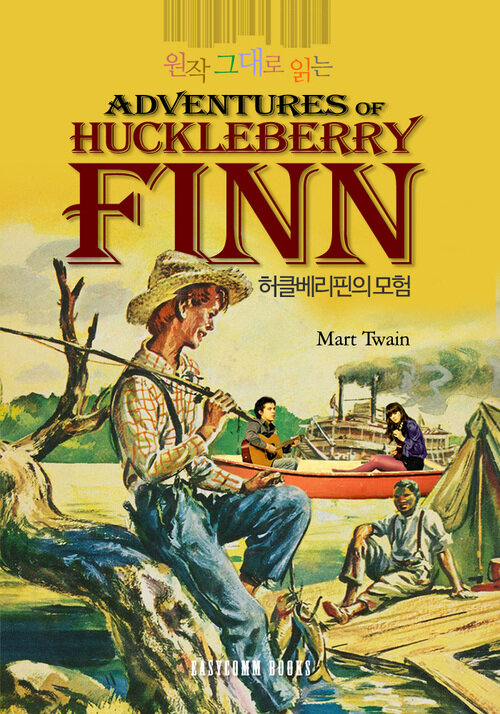 Cover of Mark Twain's The Adventures of Huckleberry Finn. Easycome Books.
Mark Twain's ‘The Adventures of Huckleberry Finn’ is a prime example. While seemingly a simple adventure story, this work embodies core elements of American culture: freedom, mobility, and individual decision-making. As such stories are repeated across numerous works, a singular cultural image is formed.
Japanese literature also features repetitive narratives. For instance, the theme of "the aesthetic of the defeated samurai" frequently appears. A samurai might lose a battle, but they uphold their honor until the very end. Such scenes are repeated in countless novels and films.
Literature is Just One Way of Interpreting the World
This sentiment can be seen in the works of Ryunosuke Akutagawa and continues in modern popular culture. Repeated stories ultimately create a singular aesthetic.
Repetition in literature can sometimes be dangerous. When a particular story structure becomes too dominant, it can lead to a simplistic interpretation of reality. Even complex social issues may be forced into a single narrative framework.
For example, if one tries to explain all problems through the "oppressor versus victim" structure, various elements of reality become invisible. The story structure can become a veil that obscures reality, rather than a tool for understanding it.
Therefore, a degree of distance is necessary when reading literature. Applying the emotions within a story directly to judgments about reality can be problematic. Literature is just one way of interpreting the world.
It is not the entirety of it. One must be particularly cautious when multiple works point in the same direction. Repetition strengthens persuasion. However, repetition does not guarantee truth.
Understanding this point will change how you view literature. You will begin to see not only the stories within individual works but also which stories are being repeated. Why do these emotions appear in multiple works? What kind of era's atmosphere has created this repetition? Such questions arise.
Literature is not mere entertainment. It is a device that trains the imagination of society. Repetitive narrative is the core technique of that training. It allows for repeated experiences of the same emotions, making them feel natural. This is why literature is quiet yet powerful. It lacks the direct force of laws or systems. However, it gradually changes the framework through which people understand the world in their minds.
Understanding this phenomenon makes the world of literature appear much more intriguing. A single work might just be a story. But when you observe the flow of the same emotions repeating over decades, you see a cultural force at play. Through that force, literature slowly moves the imagination of society.

◆ Songsan
Poet and researcher of history and philosophy. Former director of the Syngman Rhee Academy. Currently serves as a senior researcher at the Korean Modern and Contemporary History Research Association and as the representative of the philosophy forum Lyceum. He has published four poetry collections, co-translated 'Heroes of Cape Horn,' and published the historical psychology commentary 'Chosun That Became Myth' (2026). He is actively engaged in research and practice of liberal cultural movements. Songsan is a pen name.

 Iranian Foreign Ministry: "Continuing Message Exchanges with the U.S. and Activities of Mediating Countries"
Esmaeil Baghaei, Spokesperson for the Iranian Ministry of Foreign Affairs [Xinhua, Yonhap News file photo]Esmaeil Baghaei, spokesperson for the Iranian Ministry of Foreign Affairs, stated on the 26th
Iranian Foreign Ministry: "Continuing Message Exchanges with the U.S. and Activities of Mediating Countries"
Esmaeil Baghaei, Spokesperson for the Iranian Ministry of Foreign Affairs [Xinhua, Yonhap News file photo]Esmaeil Baghaei, spokesperson for the Iranian Ministry of Foreign Affairs, stated on the 26th
 President Yoon: "Do You Think You Are Safe from the Special Counsel?"... Final Statement Video Released
President Yoon Suk Yeol rebuking the special prosecutor on the 24th. [Court video / @birds_justice X account subtitle GIF] A video of President Yoon Suk Yeol's closing statement at his trial rega
President Yoon: "Do You Think You Are Safe from the Special Counsel?"... Final Statement Video Released
President Yoon Suk Yeol rebuking the special prosecutor on the 24th. [Court video / @birds_justice X account subtitle GIF] A video of President Yoon Suk Yeol's closing statement at his trial rega
 President Yoon, regarding the first-instance ruling on the Public Official Election Act: “An excessive political verdict that distorts the facts… We will appeal immediately.”
The first-instance sentencing hearing for President Yoon Suk Yeol regarding violations of the Public Official Election Act is being broadcast live at Seoul Station on the 27th. [Photo=Yonhap News]Pres
President Yoon, regarding the first-instance ruling on the Public Official Election Act: “An excessive political verdict that distorts the facts… We will appeal immediately.”
The first-instance sentencing hearing for President Yoon Suk Yeol regarding violations of the Public Official Election Act is being broadcast live at Seoul Station on the 27th. [Photo=Yonhap News]Pres
 WSJ: "SK Hynix ADR Premium Is a Sign of AI Trading Overheat"
Advertisement for SK Hynix ADR listing in New York's Times Square [Reuters=Yonhap News file photo]The Wall Street Journal (WSJ) has pointed out that the price of SK Hynix’s American Depositary Recei
WSJ: "SK Hynix ADR Premium Is a Sign of AI Trading Overheat"
Advertisement for SK Hynix ADR listing in New York's Times Square [Reuters=Yonhap News file photo]The Wall Street Journal (WSJ) has pointed out that the price of SK Hynix’s American Depositary Recei
 'Godfather of Japanese Mystery Novels' Keigo Higashino Passes Away After Battle with Cancer at 68
Famous Japanese mystery novelist Keigo Higashino [AFP=Yonhap News]It has been belatedly reported that Keigo Higashino, the "godfather of Japanese mystery novels" and author of bestsellers such as "The
'Godfather of Japanese Mystery Novels' Keigo Higashino Passes Away After Battle with Cancer at 68
Famous Japanese mystery novelist Keigo Higashino [AFP=Yonhap News]It has been belatedly reported that Keigo Higashino, the "godfather of Japanese mystery novels" and author of bestsellers such as "The
 [Park Pil-kyu Security Column] To the Ignorant Trying to Clothe a Beast in Sheep's Clothing
Rep. Kim Byung-joo of the Democratic Party of Korea [Photo=Yonhap News]“The Air Force Academy doesn't teach you how to fly a plane!” “The Army, Navy, and Air Force academies are exactly the
[Park Pil-kyu Security Column] To the Ignorant Trying to Clothe a Beast in Sheep's Clothing
Rep. Kim Byung-joo of the Democratic Party of Korea [Photo=Yonhap News]“The Air Force Academy doesn't teach you how to fly a plane!” “The Army, Navy, and Air Force academies are exactly the
 [Issue Diagnosis] Two Effects of the Election Petition Review
 [Photo] Evidence of Election Fraud Flooding U.S. Media… Trump Had 2.7 Million Votes Stolen
 [Video] U.S. Semiquincentennial Air Show... 'Art in the Sky' streaks across New York
 [Editorial Cartoon] A Draconian Law That Undermines Freedom of Expression

 List
List









