The view among international experts has spread that Iran is a ‘nuclear threshold state’ rather than a country that actually possesses nuclear weapons.
In 2015, the administration of U.S. President Barack Obama, along with the international community, signed the ‘Joint Comprehensive Plan of Action’ (JCPOA), also known as the Iran nuclear deal, to limit Iran’s nuclear development.
The agreement was participated in by the P5+1 countries—the United States, the United Kingdom, France, Germany, Russia, and China—and was evaluated as a product of diplomatic compromise to curb international nuclear proliferation.
JCPOA's Influence Weakened by U.S. Withdrawal
The core structure of the agreement was clear: Iran would strictly limit its nuclear program and accept international inspections, in exchange for the international community easing economic sanctions against Iran.
Iran agreed to limit uranium enrichment levels to below 3.67%, significantly reduce its stockpile of enriched uranium, and place its nuclear facilities under international monitoring. In this process, the International Atomic Energy Agency (IAEA) played a crucial role in continuously inspecting Iran’s nuclear activities.
Specific restrictions were also quite stringent. Iran limited its enrichment levels to a degree that would effectively make it impossible to produce highly enriched uranium necessary for nuclear weapons, and most of its enriched uranium had to be exported or diluted.
Furthermore, the number of centrifuges at Iran’s uranium enrichment facility, the Natanz Nuclear Facility, was significantly reduced, and the Fordow Fuel Enrichment Plant, an underground uranium enrichment facility, was converted for nuclear research purposes.
In addition, the IAEA was granted broad inspection authority, allowing it to monitor not only nuclear facilities but also nuclear-related supply chains. These restrictions were generally designed to be maintained for a period of 10 to 15 years.
However, the agreement sparked significant political debate within the United States. In particular, Republicans and some Middle Eastern allies criticized the agreement for not completely preventing Iran’s long-term nuclear armament capability.
Amidst these criticisms, in 2018, U.S. President Donald Trump declared the U.S. withdrawal from the JCPOA, calling it a “flawed deal,” and reimposed sanctions on Iran. Subsequently, the U.S. comprehensively intensified economic sanctions through its so-called ‘maximum pressure’ strategy.
The Trump administration’s decision to withdraw was based on three main reasons.
First, there was the issue of the so-called ‘sunset clause,’ which stipulated that Iran could expand its nuclear program again once the agreement’s restrictions expired.
Second, criticism was raised that the agreement did not sufficiently restrict Iran’s ballistic missile development.
Third, there were significant concerns that easing economic sanctions might instead strengthen Iran’s regional military activities, given its expanding military influence in the Middle East, including in Syria, Lebanon, and Yemen.
Following the U.S. withdrawal, the nuclear agreement rapidly weakened. Although Iran initially attempted to maintain the agreement, as U.S. sanctions intensified, it gradually began to violate the agreement's restrictions in stages.
Iran is a Threshold State, North Korea is Effectively a Nuclear Power
Iran increased its uranium enrichment concentration beyond the agreement’s standard, expanded its stockpile of enriched uranium, and reactivated some advanced centrifuges.
Some reports mentioned Iran’s production of highly enriched uranium at a 60% level, which is considered a stage quite close to the approximately 90% enrichment level required for nuclear weapons manufacturing.
Because of this, the view among international experts has spread that Iran is a ‘nuclear threshold state’ rather than a country that actually possesses nuclear weapons.
Indeed, according to internationally confirmed information to date, there is no official evidence that Iran has completed or possesses nuclear weapons. The IAEA has also never announced conclusive evidence that Iran has manufactured nuclear weapons.
Nevertheless, Iran’s nuclear issue has consistently been at the center of debate in international politics. Nuclear weapon development requires not only simple uranium enrichment but also the design of explosive devices and the actual nuclear testing phase.
Iran has not yet conducted any nuclear tests and remains within the framework of the ‘Nuclear Non-Proliferation Treaty’ (NPT). Conducting a nuclear test would effectively be a declaration of nuclear weapon possession and would significantly increase the risk of international sanctions and military responses.
In this regard, Iran’s situation is clearly different from North Korea’s. North Korea is evaluated as having effectively secured capabilities at the level of a nuclear-weapon state by conducting multiple nuclear tests.
Furthermore, North Korea has withdrawn from the NPT, while Iran remains within the treaty framework. Iran has maintained a certain negotiation structure with the international community through the nuclear agreement, but the management of North Korea’s nuclear issue is a much more difficult diplomatic challenge.
However, regardless of whether it possesses nuclear weapons, the fact that the possibility of Iran expanding its nuclear capability itself is the most sensitive issue in international politics remains unchanged.
Ultimately, the fundamental background to the repeatedly escalating tensions in the Middle East lies in this issue—that is, the international community’s suspicion and conflict over whether Iran possesses nuclear weapons or has the capability to acquire them. The political and military conflicts surrounding a potential Iran war also stem significantly from this nuclear issue.
Moreover, some strategists raise the possibility that this trend could lead to a chain reaction of clashes in the international security order surrounding the issue of nuclear proliferation.
In particular, analyses are consistently emerging regarding the possibility that after the Iran war ends, the U.S. may strongly press the North Korean nuclear issue again as its next strategic objective or consider military options.
North Korea, having already demonstrated its nuclear weapon capabilities through nuclear tests and possessing long-range missile capabilities, is considered one of the greatest long-term threats in U.S. security strategy.
Of course, whether a military conflict actually occurs depends on various variables. The strategic environment is vastly different from the Middle East because the Korean Peninsula is adjacent to major powers like China and Russia, and the security issues of allies like South Korea and Japan are directly linked.
Nevertheless, as long as the U.S. strategic principle of not tolerating nuclear proliferation remains in place, the possibility of North Korea re-emerging as the most dangerous powder keg of international security after Iran is substantial.
HanmiIlbo Editorial Department

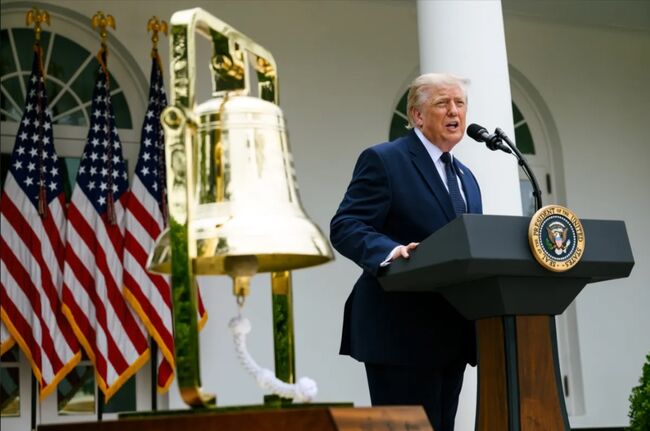 Trump pressures for rate cut again ahead of FOMC... "Should be the lowest in the world"
U.S. President Donald Trump. [Photo = The White House] U.S. President Donald Trump once again pressured the Federal Reserve, the U.S. central bank, to lower interest rates on the 27th (local time
Trump pressures for rate cut again ahead of FOMC... "Should be the lowest in the world"
U.S. President Donald Trump. [Photo = The White House] U.S. President Donald Trump once again pressured the Federal Reserve, the U.S. central bank, to lower interest rates on the 27th (local time
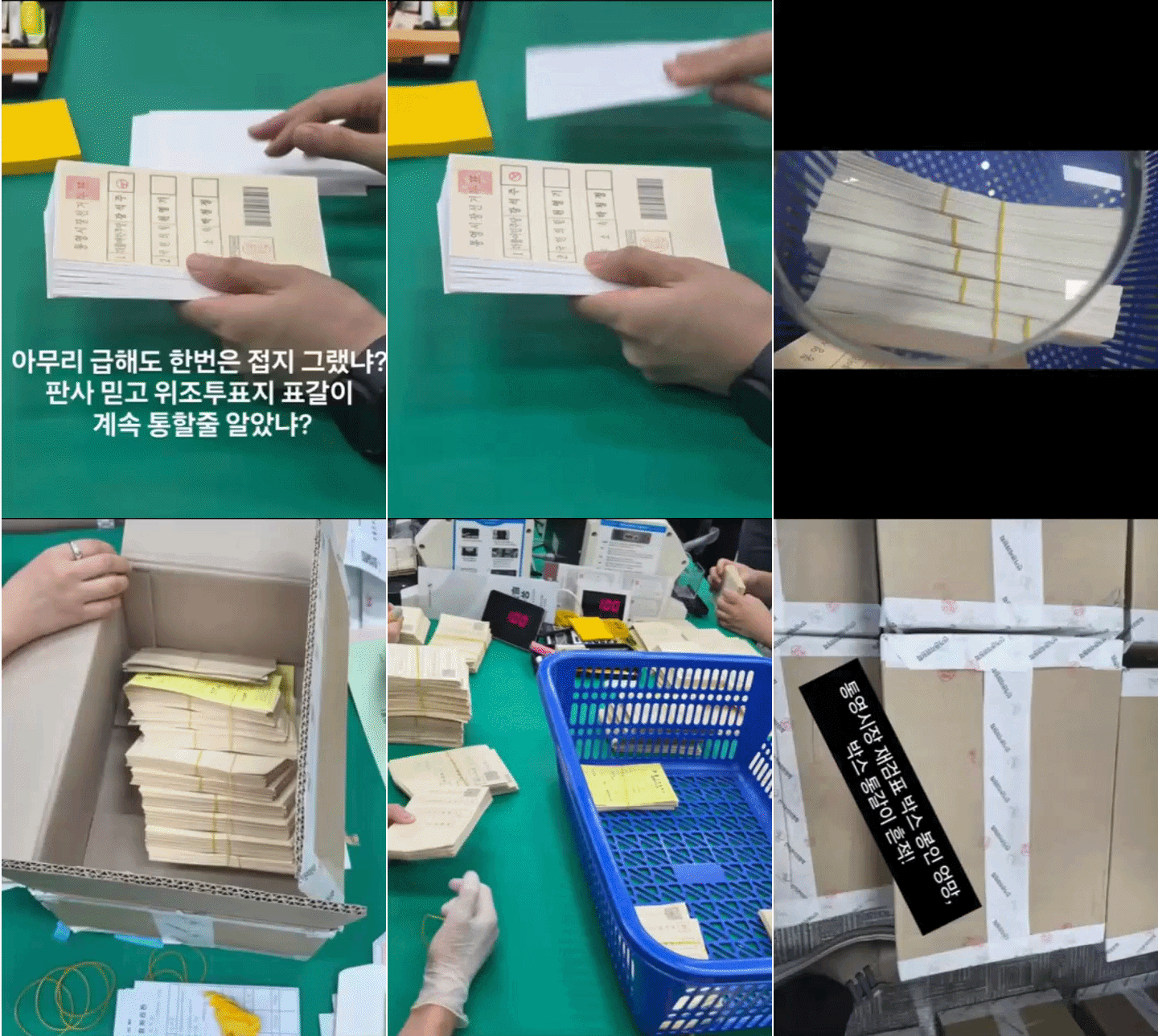 “Ignoring crisp ballots and damaged seals”… Tongyeong mayoral recount concludes with ‘no change in outcome,’ leaving suspicions and public outrage behind
Suspected counterfeit ballots discovered in Tongyeong [GIF from social media of Representative Hwang Kyo-ahn / Attorney Park Joo-hyun]During a recount of the Tongyeong mayoral election in South Gyeong
“Ignoring crisp ballots and damaged seals”… Tongyeong mayoral recount concludes with ‘no change in outcome,’ leaving suspicions and public outrage behind
Suspected counterfeit ballots discovered in Tongyeong [GIF from social media of Representative Hwang Kyo-ahn / Attorney Park Joo-hyun]During a recount of the Tongyeong mayoral election in South Gyeong
 President Yoon, regarding the first-instance ruling on the Public Official Election Act: “An excessive political verdict that distorts the facts… We will appeal immediately.”
The first-instance sentencing hearing for President Yoon Suk Yeol regarding violations of the Public Official Election Act is being broadcast live at Seoul Station on the 27th. [Photo=Yonhap News]Pres
President Yoon, regarding the first-instance ruling on the Public Official Election Act: “An excessive political verdict that distorts the facts… We will appeal immediately.”
The first-instance sentencing hearing for President Yoon Suk Yeol regarding violations of the Public Official Election Act is being broadcast live at Seoul Station on the 27th. [Photo=Yonhap News]Pres
 WSJ: "SK Hynix ADR Premium Is a Sign of AI Trading Overheat"
Advertisement for SK Hynix ADR listing in New York's Times Square [Reuters=Yonhap News file photo]The Wall Street Journal (WSJ) has pointed out that the price of SK Hynix’s American Depositary Recei
WSJ: "SK Hynix ADR Premium Is a Sign of AI Trading Overheat"
Advertisement for SK Hynix ADR listing in New York's Times Square [Reuters=Yonhap News file photo]The Wall Street Journal (WSJ) has pointed out that the price of SK Hynix’s American Depositary Recei
 'Godfather of Japanese Mystery Novels' Keigo Higashino Passes Away After Battle with Cancer at 68
Famous Japanese mystery novelist Keigo Higashino [AFP=Yonhap News]It has been belatedly reported that Keigo Higashino, the "godfather of Japanese mystery novels" and author of bestsellers such as "The
'Godfather of Japanese Mystery Novels' Keigo Higashino Passes Away After Battle with Cancer at 68
Famous Japanese mystery novelist Keigo Higashino [AFP=Yonhap News]It has been belatedly reported that Keigo Higashino, the "godfather of Japanese mystery novels" and author of bestsellers such as "The
 [Park Pil-kyu Security Column] To the Ignorant Trying to Clothe a Beast in Sheep's Clothing
Rep. Kim Byung-joo of the Democratic Party of Korea [Photo=Yonhap News]“The Air Force Academy doesn't teach you how to fly a plane!” “The Army, Navy, and Air Force academies are exactly the
[Park Pil-kyu Security Column] To the Ignorant Trying to Clothe a Beast in Sheep's Clothing
Rep. Kim Byung-joo of the Democratic Party of Korea [Photo=Yonhap News]“The Air Force Academy doesn't teach you how to fly a plane!” “The Army, Navy, and Air Force academies are exactly the
 [Issue Diagnosis] Two Effects of the Election Petition Review
 [Photo] Evidence of Election Fraud Flooding U.S. Media… Trump Had 2.7 Million Votes Stolen
 [Video] U.S. Semiquincentennial Air Show... 'Art in the Sky' streaks across New York
 [Editorial Cartoon] A Draconian Law That Undermines Freedom of Expression

 List
List