President Trump [Reuters=Yonhap News]
U.S. President Donald Trump on the 7th (local time) launched an alliance for joint military action by the United States and Latin American countries against criminal cartels in the Americas.
This appears to be a measure reflecting the Trump administration's plan to strengthen security cooperation with Western Hemisphere countries.
It is also interpreted as a move to emphasize that the Trump administration's strategic focus remains on the Western Hemisphere, even amid military clashes with Iran.
At the "Shield of the Americas" event held at the Doral Resort in Florida, with leaders from Latin American countries in attendance, President Trump said, "Many cartels have developed sophisticated military operational capabilities, and some are very highly developed. That is unacceptable."
He also accused Mexico of being a hotbed of cartel violence, claiming, "Mexican cartels are directing the bloodshed and chaos in this hemisphere."
President Trump stated, "The core of our agreement is a commitment to destroy evil cartels and terrorist networks by mobilizing deadly military force," adding that 17 countries are expected to participate in this alliance.
He emphasized, "The leaders gathered here are united with the conviction that we can no longer tolerate lawlessness in our hemisphere, and we will not tolerate it. The way to defeat these enemies is to unleash the power of our military."
After his remarks, President Trump signed a presidential proclamation to launch the "Alliance to Counter Cartels in the Americas" at the venue.
The proclamation stated that participating countries in the alliance would cooperate to strip criminal cartels in the Western Hemisphere of territorial control, funding, and access to resources. It also included provisions allowing the U.S. to train and mobilize allied forces to secure combat power.
Furthermore, it stipulated that the United States and its allies must "block threats from malicious foreign powers outside the Western Hemisphere."
The meeting was attended by heads of state from 12 countries, including Argentina, Bolivia, Chile, Costa Rica, the Dominican Republic, Ecuador, El Salvador, Guyana, Honduras, Panama, Paraguay, and Trinidad and Tobago.
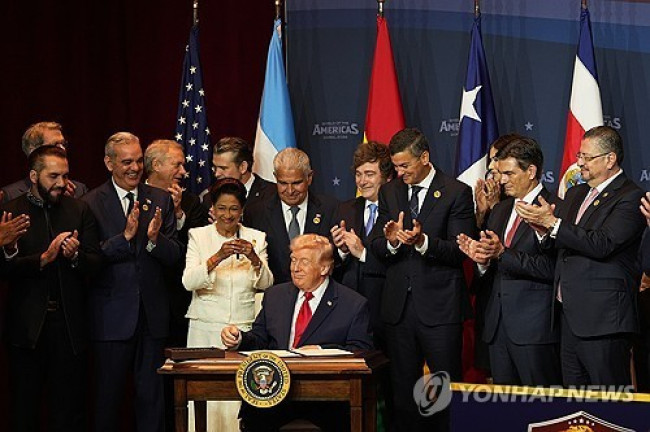 Trump signing the proclamation to launch the 'Alliance to Counter Cartels in the Americas' [AP=Yonhap News]
In his speech at the subsequent "Shield of the Americas" working luncheon, U.S. Secretary of State Marco Rubio said, "We are clearly focused on hemisphere security. While we are very strongly focused on opportunities for economic cooperation, we cannot achieve economic progress without security."
Kris Wammack, who was recently dismissed as Secretary of Homeland Security and appointed as a special envoy for "Shield of the Americas," expressed gratitude to President Trump for providing this opportunity, stating, "We want our hemisphere to be safer, more sovereign, and more prosperous."
She added that "Shield of the Americas" would focus on immigration control and economic cooperation going forward, and that she would share her personal mobile phone number with the participating heads of state to facilitate frequent communication.
The ongoing 8-day military operation against Iran, which began on the 28th of last month, has drawn criticism and concern from some of President Trump's supporters, who argue it deviates from the "America First" principle and a policy of minimizing overseas military intervention.
In this context, the Trump administration's emphasis on security cooperation with Latin American countries and the launch of an alliance to implement it appear to be a strategic move to appease supporters by highlighting that the security strategy is focused on the defense of the U.S. homeland and the Western Hemisphere.
Meanwhile, at the meeting on this day, President Trump reiterated that the United States and Venezuela have maintained smooth relations since the ousting of Venezuelan President Nicolás Maduro in January.
President Trump has repeatedly expressed his desire to apply the so-called "Venezuelan model" to the next leadership in Iran, where a military operation is underway, with a pro-U.S. regime maintaining friendly relations with the United States.
President Trump praised Interim Venezuelan President Delcy Rodríguez, stating, "She is doing a great job with us," and added, "They are making more money than ever before" through cooperation in the oil industry with the United States.
He further stated, "We expect historic transformation in Venezuela, and we anticipate great changes in Cuba soon as well."
President Trump said that Cuba, which has been cut off from oil and financial resources from Venezuela, is "in a dead end." He added, "They (Cuba) want to negotiate. They are negotiating with Marco (Secretary of State) and me and a few others."
He concluded by saying, "I think a very easy agreement can be reached with Cuba."

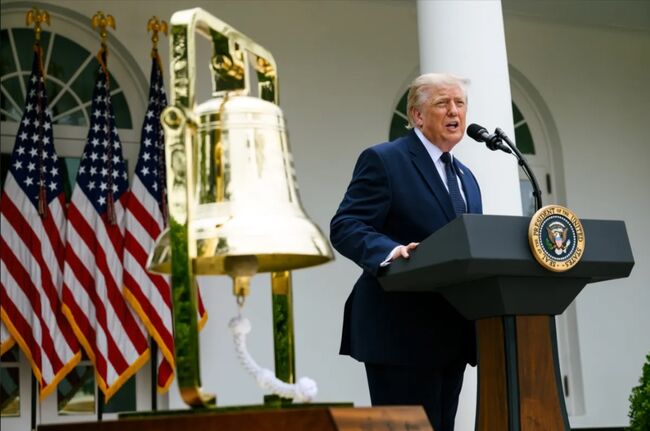 Trump pressures for rate cut again ahead of FOMC... "Should be the lowest in the world"
U.S. President Donald Trump. [Photo = The White House] U.S. President Donald Trump once again pressured the Federal Reserve, the U.S. central bank, to lower interest rates on the 27th (local time
Trump pressures for rate cut again ahead of FOMC... "Should be the lowest in the world"
U.S. President Donald Trump. [Photo = The White House] U.S. President Donald Trump once again pressured the Federal Reserve, the U.S. central bank, to lower interest rates on the 27th (local time
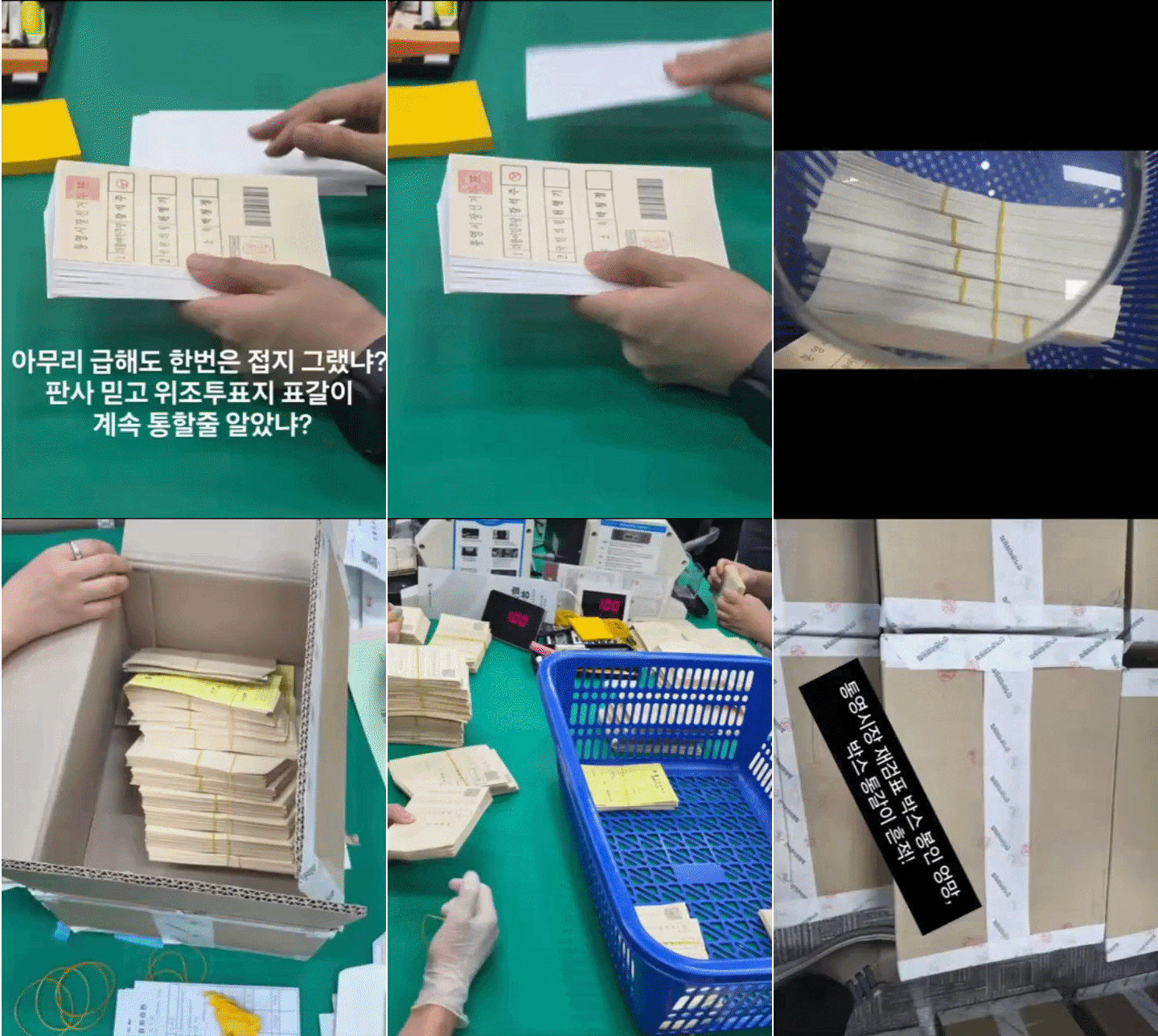 “Ignoring crisp ballots and damaged seals”… Tongyeong mayoral recount concludes with ‘no change in outcome,’ leaving suspicions and public outrage behind
Suspected counterfeit ballots discovered in Tongyeong [GIF from social media of Representative Hwang Kyo-ahn / Attorney Park Joo-hyun]During a recount of the Tongyeong mayoral election in South Gyeong
“Ignoring crisp ballots and damaged seals”… Tongyeong mayoral recount concludes with ‘no change in outcome,’ leaving suspicions and public outrage behind
Suspected counterfeit ballots discovered in Tongyeong [GIF from social media of Representative Hwang Kyo-ahn / Attorney Park Joo-hyun]During a recount of the Tongyeong mayoral election in South Gyeong
 President Yoon, regarding the first-instance ruling on the Public Official Election Act: “An excessive political verdict that distorts the facts… We will appeal immediately.”
The first-instance sentencing hearing for President Yoon Suk Yeol regarding violations of the Public Official Election Act is being broadcast live at Seoul Station on the 27th. [Photo=Yonhap News]Pres
President Yoon, regarding the first-instance ruling on the Public Official Election Act: “An excessive political verdict that distorts the facts… We will appeal immediately.”
The first-instance sentencing hearing for President Yoon Suk Yeol regarding violations of the Public Official Election Act is being broadcast live at Seoul Station on the 27th. [Photo=Yonhap News]Pres
 WSJ: "SK Hynix ADR Premium Is a Sign of AI Trading Overheat"
Advertisement for SK Hynix ADR listing in New York's Times Square [Reuters=Yonhap News file photo]The Wall Street Journal (WSJ) has pointed out that the price of SK Hynix’s American Depositary Recei
WSJ: "SK Hynix ADR Premium Is a Sign of AI Trading Overheat"
Advertisement for SK Hynix ADR listing in New York's Times Square [Reuters=Yonhap News file photo]The Wall Street Journal (WSJ) has pointed out that the price of SK Hynix’s American Depositary Recei
 'Godfather of Japanese Mystery Novels' Keigo Higashino Passes Away After Battle with Cancer at 68
Famous Japanese mystery novelist Keigo Higashino [AFP=Yonhap News]It has been belatedly reported that Keigo Higashino, the "godfather of Japanese mystery novels" and author of bestsellers such as "The
'Godfather of Japanese Mystery Novels' Keigo Higashino Passes Away After Battle with Cancer at 68
Famous Japanese mystery novelist Keigo Higashino [AFP=Yonhap News]It has been belatedly reported that Keigo Higashino, the "godfather of Japanese mystery novels" and author of bestsellers such as "The
 [Park Pil-kyu Security Column] To the Ignorant Trying to Clothe a Beast in Sheep's Clothing
Rep. Kim Byung-joo of the Democratic Party of Korea [Photo=Yonhap News]“The Air Force Academy doesn't teach you how to fly a plane!” “The Army, Navy, and Air Force academies are exactly the
[Park Pil-kyu Security Column] To the Ignorant Trying to Clothe a Beast in Sheep's Clothing
Rep. Kim Byung-joo of the Democratic Party of Korea [Photo=Yonhap News]“The Air Force Academy doesn't teach you how to fly a plane!” “The Army, Navy, and Air Force academies are exactly the
 [Issue Diagnosis] Two Effects of the Election Petition Review
 [Photo] Evidence of Election Fraud Flooding U.S. Media… Trump Had 2.7 Million Votes Stolen
 [Video] U.S. Semiquincentennial Air Show... 'Art in the Sky' streaks across New York
 [Editorial Cartoon] A Draconian Law That Undermines Freedom of Expression

 List
List