 Iranian Kurdish fighters from the Kurdistan Freedom Party (PAK) participate in training at a base outside Arbil, Iraq, on February 12. [Reuters/Yonhap News]
One day after the United States declared war on Iran, Iran's supreme leader Khamenei passed away.
Despite this, the US rained down countless artillery shells, devastating Iran's air defense network in just a few days. Iran is said to have lost the ability to retaliate with missiles, let alone counterattack.
Mercenaries in the Crossfire: The Kurds' Gamble
Iran is a large country. It is 7.5 times the size of the Korean Peninsula, and if you only consider its current land area, it is more than sixteen times larger. The capital, Tehran, is located deep inland within this vast nation.
It is 850-900 km in a straight line to the Persian Gulf. It takes 12 hours by car. It is also said to be a mountainous region with continuous mountain ranges. Within an hour's drive, there are mountains reaching 4000-5000 meters.
While the US President and Secretary of Defense have mentioned the possibility of deploying ground troops, it is by no means easy to directly attack such an enormous country without extraordinary resolve.
During President Bush's era, Baghdad was captured in the 'Operation Iraqi Freedom,' but did they not ultimately withdraw from Afghanistan, essentially handing over weapons to the Taliban?
Perhaps for this reason, instead of news about US troops directly entering, we are hearing reports that thousands of Kurdish fighters have launched ground operations from Iraq into Iranian territory.
They are said to be Iranian Kurdish militia fighters who have crossed into Iraqi territory. They are reportedly supporting Kurdish militias in western Iran with the aim of inciting a large-scale uprising within Iran.
This report, borrowed from Fox News, is what brought the 'Kurds' back into my attention and awareness.
The Kurds are acting as 'mercenaries' in a 'proxy war' for the US's attack on Iran, embarking on another adventure for independence against Iran.
During the Gulf War in April 1991, the US, UK, and France established a no-fly zone along the 36th parallel north latitude to respond to Iraq's harsh crackdown on its Kurdish population. As a result, the Kurdish autonomous region in Iraq was established.
The Anguish of a Nationless People is Terrible
In a word, the Kurds are a nation without a country. They are dispersed and reside in Turkey, Iran, Iraq, and Syria, but they have no homeland of their own.
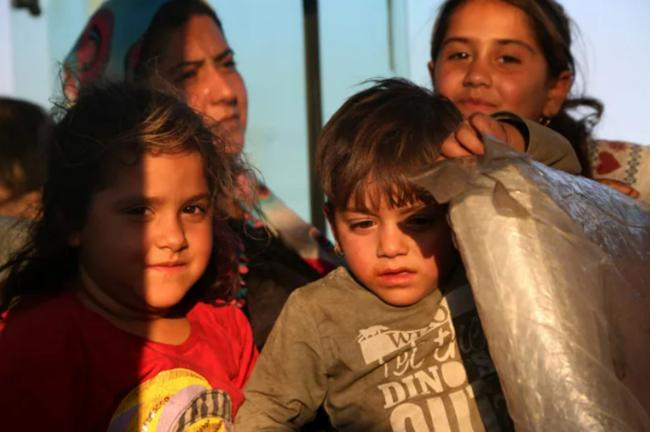 Kurdish refugees fleeing a Turkish invasion arrive at the Bardarash camp in Duhok, northern Iraq, in October 2019. [EPA/Yonhap News]
Their total population is estimated to be around 35 million, which is by no means small. In West Asia, they are the fourth largest ethnic group after Arabs, Turks, and Persians, and they speak their own Kurdish language. However, they do not have a country of their own.
It is said that there is a Kurdish autonomous state in the oil-rich northwestern region of Iraq. As mentioned earlier, this is a result of the period when Saddam Hussein initiated the Gulf War and was later ousted in the Iraq War. However, they still do not have a complete nation of their own.
Although I am not very familiar with Kurdish history, historically, they have suffered greatly due to their statelessness. During World War I, they believed Britain's promise of independence and contributed to the downfall of the Ottoman Empire, but they were ultimately 'betrayed.'
In the 1970s, during the Cold War, they were used as pawns between the pro-US Iran and the pro-Soviet Iraq of the time. At various historical junctures, they have experienced tragedies of massacring other ethnic groups and being massacred by them.
Furthermore, even among the Kurds, their dispersion across different countries has led to infighting and conflict among their own people, preventing them from establishing their own nation to this day.
The sorrow of being a nationless people is truly terrible.
When reading Choi In-hoon's problematic work 'Hwadu' (1994), one passage resonated deeply with me.
The author, Choi In-hoon, born in 1934, recalls that one of the first things that changed when he experienced liberation in the border town of Hoeryeong was that he was no longer beaten. He no longer had to endure physical punishment. He mentioned that people were beaten even in hospitals at that time.
I cannot recall the exact wording, but such a recollection certainly existed. 'Hwadu' is a novel composed entirely of reminiscences. While the latter part, where the author searches for traces of Jo Myung-hee in Russia after the dissolution of the Soviet Union, contains fictional elements, the earlier part is 'almost entirely factual.'
Being ruled and ruling are not good things. While it is better to have food and not starve than to starve without food, if humans are more than mere economic animals, it is not something to be happy about that Japanese rule led to increased rice production and the construction of schools.
Above all, people must be able to protect the dignity of their own lives, and the first prerequisite for that is to not have their country taken away.
We should not speak of the "sad history where my grandfather became a sad outcast as an orphan," as depicted in the poet Baek Seok's poem, as a good history. To avoid being beaten even when seeking medical attention for an illness, one must have their own country and be a citizen of that country.
'State' is the Minimum Condition for Protecting Human Dignity
Now, let us return to the story of the US attack on Iran.
Does this mean that Iran is a weaker nation being attacked by the 'imperialist' United States?
Is not that same Iran, in its relationship with the Kurdish people within its claimed territory, an imperialist power inheriting the Persian Empire?
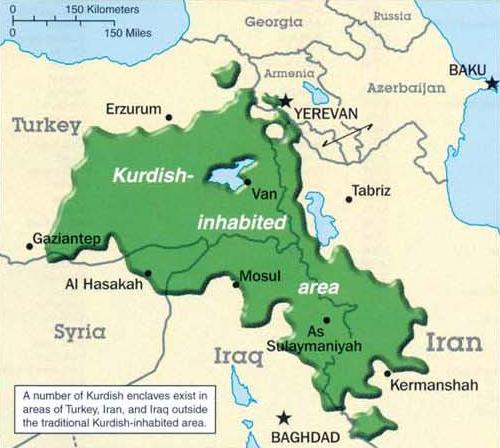 According to 2002 CIA data, Kurds reside in Turkey (18 million), Iran (8 million), Iraq (5 million), Syria (2 million), and other regions (2 million). [Map=CIA]
Not so long ago, at the end of World War II, a territorial dispute arose between Iran and the Soviet Union over Azerbaijan, and Iran appealed to the UN about this issue.
They claimed that the powerful Soviet Union was trying to seize their territory. However, that land rightfully belonged to the people of Azerbaijan, not to anyone else. While Iran might have been weaker than the Soviet Union, it was itself an 'imperialist' power, reigning over the weak.
Even today, 15 to 20 million Azeri people live in northern Iran, a population larger than that of Azerbaijan, a nation-state.
The reason for the less prominent separatist movements compared to the Kurds is that over a long period of assimilation, many have entered the ruling elite, and their religious differences are not significant, which is also a contributing factor.
However, this does not justify Iran's dominance over the Azeri people and their homeland.
Will the Kurdish fighters be able to establish their own nation this time? This is an important 'point of observation' for me as I watch the current war between the US and Iran.
Mahsa Amini, the victim whose death sparked the hijab protests in 2022, was a Kurdish woman named Jina Amini.
Furthermore, Elaheh Hosseinnejad, the victim of a murder that triggered large-scale women's protests in 2025, was a supporter of the 'Women, Life, Freedom' movement and was of East Azarbaijani descent.
Iran is not just a weak nation. The current Iran is a cruel theocratic dictatorship that has persisted for 47 years. It is a 'criminal state' that, along with other forces, committed 'election fraud' in the US in 2020, and it is a horrific country where the Islamic government has murdered 30,000 of its own citizens.
A government that so brutally murders its own citizens must fall. It cannot be justified by any logic. Nations that are dominated and massacred must be liberated.

◆ Professor Bang Min-ho
Ph.D. in Literature, Professor of Korean Language and Literature at Seoul National University. He is actively involved as the editor-in-chief of the quarterly literary magazine 'Mac' (since 2022), as well as a poet, novelist, and literary critic. His works include 'Lover Sim Cheong' (2015), 'Language of Pain' (2019), 'Revisiting Korean Criticism' (2021), and 'Seoul Literary Journeys' (2024).

 Iranian Foreign Ministry: "Continuing Message Exchanges with the U.S. and Activities of Mediating Countries"
Esmaeil Baghaei, Spokesperson for the Iranian Ministry of Foreign Affairs [Xinhua, Yonhap News file photo]Esmaeil Baghaei, spokesperson for the Iranian Ministry of Foreign Affairs, stated on the 26th
Iranian Foreign Ministry: "Continuing Message Exchanges with the U.S. and Activities of Mediating Countries"
Esmaeil Baghaei, Spokesperson for the Iranian Ministry of Foreign Affairs [Xinhua, Yonhap News file photo]Esmaeil Baghaei, spokesperson for the Iranian Ministry of Foreign Affairs, stated on the 26th
 President Yoon: "Do You Think You Are Safe from the Special Counsel?"... Final Statement Video Released
President Yoon Suk Yeol rebuking the special prosecutor on the 24th. [Court video / @birds_justice X account subtitle GIF] A video of President Yoon Suk Yeol's closing statement at his trial rega
President Yoon: "Do You Think You Are Safe from the Special Counsel?"... Final Statement Video Released
President Yoon Suk Yeol rebuking the special prosecutor on the 24th. [Court video / @birds_justice X account subtitle GIF] A video of President Yoon Suk Yeol's closing statement at his trial rega
 President Yoon, regarding the first-instance ruling on the Public Official Election Act: “An excessive political verdict that distorts the facts… We will appeal immediately.”
The first-instance sentencing hearing for President Yoon Suk Yeol regarding violations of the Public Official Election Act is being broadcast live at Seoul Station on the 27th. [Photo=Yonhap News]Pres
President Yoon, regarding the first-instance ruling on the Public Official Election Act: “An excessive political verdict that distorts the facts… We will appeal immediately.”
The first-instance sentencing hearing for President Yoon Suk Yeol regarding violations of the Public Official Election Act is being broadcast live at Seoul Station on the 27th. [Photo=Yonhap News]Pres
 WSJ: "SK Hynix ADR Premium Is a Sign of AI Trading Overheat"
Advertisement for SK Hynix ADR listing in New York's Times Square [Reuters=Yonhap News file photo]The Wall Street Journal (WSJ) has pointed out that the price of SK Hynix’s American Depositary Recei
WSJ: "SK Hynix ADR Premium Is a Sign of AI Trading Overheat"
Advertisement for SK Hynix ADR listing in New York's Times Square [Reuters=Yonhap News file photo]The Wall Street Journal (WSJ) has pointed out that the price of SK Hynix’s American Depositary Recei
 'Godfather of Japanese Mystery Novels' Keigo Higashino Passes Away After Battle with Cancer at 68
Famous Japanese mystery novelist Keigo Higashino [AFP=Yonhap News]It has been belatedly reported that Keigo Higashino, the "godfather of Japanese mystery novels" and author of bestsellers such as "The
'Godfather of Japanese Mystery Novels' Keigo Higashino Passes Away After Battle with Cancer at 68
Famous Japanese mystery novelist Keigo Higashino [AFP=Yonhap News]It has been belatedly reported that Keigo Higashino, the "godfather of Japanese mystery novels" and author of bestsellers such as "The
 [Park Pil-kyu Security Column] To the Ignorant Trying to Clothe a Beast in Sheep's Clothing
Rep. Kim Byung-joo of the Democratic Party of Korea [Photo=Yonhap News]“The Air Force Academy doesn't teach you how to fly a plane!” “The Army, Navy, and Air Force academies are exactly the
[Park Pil-kyu Security Column] To the Ignorant Trying to Clothe a Beast in Sheep's Clothing
Rep. Kim Byung-joo of the Democratic Party of Korea [Photo=Yonhap News]“The Air Force Academy doesn't teach you how to fly a plane!” “The Army, Navy, and Air Force academies are exactly the
 [Issue Diagnosis] Two Effects of the Election Petition Review
 [Photo] Evidence of Election Fraud Flooding U.S. Media… Trump Had 2.7 Million Votes Stolen
 [Video] U.S. Semiquincentennial Air Show... 'Art in the Sky' streaks across New York
 [Editorial Cartoon] A Draconian Law That Undermines Freedom of Expression

 List
List










