① Why India?
② Why Did Cars Go to India First?
③ Batteries Are Already Finding Answers in India
④ The Next Question for Semiconductors
⑤ Why Did Shipbuilding Break Away from China?
⑥ Companies Moved, But the Government Did Not
The Intersection of India, the Middle East, and Security Order
The shipbuilding industry was the first sector in Korean manufacturing to break away from China.
While automobiles and batteries are finding solutions in India, and semiconductors remain in the question phase, shipbuilding has effectively completed its post-China structure.
This cannot be explained by the competitiveness of individual companies alone. Shipbuilding is not a choice of the market, but an industry whose direction has been dictated by changes in the international order.
Chinese shipbuilding once dominated the global market with its price competitiveness.
However, shipbuilding is not a simple manufacturing industry. Ships are high-value assets that must operate for decades and involve safety, reliability, maintenance, and finance.
When security, sanctions, insurance, and shipping route risks are added to this, Chinese shipyards have gradually shifted from being a "cheap option" to a "risky option."
This change has been particularly rapid for energy carriers and vessels for military or quasi-military purposes.
At this point, the strengths of the Korean shipbuilding industry have re-emerged.
Technical capability and quality are fundamental, but most importantly, the fact that Korea is a manufacturing country with low political and security risks was decisive.
For shipbuilding, reliability takes precedence over delivery dates and prices.
While Chinese shipyards expanded their market share through pricing, Korean shipbuilders shifted their focus to LNG carriers, high-value-added vessels, and specialized ships.
As a result, a global order structure that excludes China has begun to form, with Korea at its center.
India is directly linked to this trend.
India is the world's fastest-growing energy consumer and a key country for Indian Ocean maritime traffic. It is also a party to border disputes with China.
For India, shipping and shipbuilding are not just industries but strategic assets. Its decision to reduce dependence on China and strengthen its maritime capabilities with reliable partners is natural.
Here, the position of Korean shipbuilding becomes clear.
China is India's competitor and a target of vigilance. In contrast, Korea is a shipbuilding powerhouse with advanced technology and no political or ethnic conflict assets.
In its relationship with India, Korean shipbuilding is one of the few options available for cooperation without security burdens. This logic operates more directly in shipbuilding than in automobiles or batteries.
The Middle East variable has also accelerated shipbuilding's move away from China.
As instability in energy transport routes increases, political neutrality and reliability become crucial for ship orders.
Chinese shipyards occupy a delicate position between the Middle East and the West, but Korean shipbuilders are perceived as relatively neutral and stable partners.
India, as a maritime hub connecting the Middle East and East Asia, lies at the center of this structure.
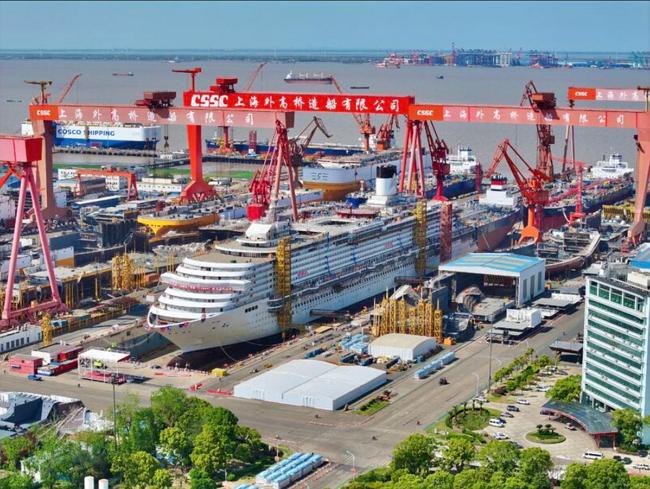 Overview of China State Shipbuilding Corporation shipyards in Shanghai, China. [Photo=Port News]
The fact that shipbuilding was the first to break away from China is highly significant.
This is evidence that Korean industries have naturally shifted away from sectors that do not require China, rather than declaring "China replacement."
Shipbuilding was an industry where the logic of security and reliability operated before market logic, and as a result, it adapted most quickly to the post-China order.
In the shipbuilding industry, India may not be a new large-scale consumer market. However, its significance as a strategic partner is immense.
India's national agenda of strengthening naval power, energy transport, and expanding port infrastructure is directly linked to shipbuilding.
At this point, shipbuilding needs to approach India not merely as a "demand source" but as a co-designer of the post-China maritime order.
The case of shipbuilding illustrates a conclusion that runs through this entire series.
In the process of designing the post-China era, the industries that move first are always those where reliability and security are more important than price.
Automobiles and batteries follow, and semiconductors are still standing at the threshold of choice.
The next installment will tie this flow together again. Companies are already moving based on India, so why is government strategy absent?
We will examine the reality of the policy vacuum and whether the post-China era can be left solely to private judgment.

 Iranian Foreign Ministry: "Continuing Message Exchanges with the U.S. and Activities of Mediating Countries"
Esmaeil Baghaei, Spokesperson for the Iranian Ministry of Foreign Affairs [Xinhua, Yonhap News file photo]Esmaeil Baghaei, spokesperson for the Iranian Ministry of Foreign Affairs, stated on the 26th
Iranian Foreign Ministry: "Continuing Message Exchanges with the U.S. and Activities of Mediating Countries"
Esmaeil Baghaei, Spokesperson for the Iranian Ministry of Foreign Affairs [Xinhua, Yonhap News file photo]Esmaeil Baghaei, spokesperson for the Iranian Ministry of Foreign Affairs, stated on the 26th
 President Yoon: "Do You Think You Are Safe from the Special Counsel?"... Final Statement Video Released
President Yoon Suk Yeol rebuking the special prosecutor on the 24th. [Court video / @birds_justice X account subtitle GIF] A video of President Yoon Suk Yeol's closing statement at his trial rega
President Yoon: "Do You Think You Are Safe from the Special Counsel?"... Final Statement Video Released
President Yoon Suk Yeol rebuking the special prosecutor on the 24th. [Court video / @birds_justice X account subtitle GIF] A video of President Yoon Suk Yeol's closing statement at his trial rega
 President Yoon, regarding the first-instance ruling on the Public Official Election Act: “An excessive political verdict that distorts the facts… We will appeal immediately.”
The first-instance sentencing hearing for President Yoon Suk Yeol regarding violations of the Public Official Election Act is being broadcast live at Seoul Station on the 27th. [Photo=Yonhap News]Pres
President Yoon, regarding the first-instance ruling on the Public Official Election Act: “An excessive political verdict that distorts the facts… We will appeal immediately.”
The first-instance sentencing hearing for President Yoon Suk Yeol regarding violations of the Public Official Election Act is being broadcast live at Seoul Station on the 27th. [Photo=Yonhap News]Pres
 WSJ: "SK Hynix ADR Premium Is a Sign of AI Trading Overheat"
Advertisement for SK Hynix ADR listing in New York's Times Square [Reuters=Yonhap News file photo]The Wall Street Journal (WSJ) has pointed out that the price of SK Hynix’s American Depositary Recei
WSJ: "SK Hynix ADR Premium Is a Sign of AI Trading Overheat"
Advertisement for SK Hynix ADR listing in New York's Times Square [Reuters=Yonhap News file photo]The Wall Street Journal (WSJ) has pointed out that the price of SK Hynix’s American Depositary Recei
 'Godfather of Japanese Mystery Novels' Keigo Higashino Passes Away After Battle with Cancer at 68
Famous Japanese mystery novelist Keigo Higashino [AFP=Yonhap News]It has been belatedly reported that Keigo Higashino, the "godfather of Japanese mystery novels" and author of bestsellers such as "The
'Godfather of Japanese Mystery Novels' Keigo Higashino Passes Away After Battle with Cancer at 68
Famous Japanese mystery novelist Keigo Higashino [AFP=Yonhap News]It has been belatedly reported that Keigo Higashino, the "godfather of Japanese mystery novels" and author of bestsellers such as "The
 [Park Pil-kyu Security Column] To the Ignorant Trying to Clothe a Beast in Sheep's Clothing
Rep. Kim Byung-joo of the Democratic Party of Korea [Photo=Yonhap News]“The Air Force Academy doesn't teach you how to fly a plane!” “The Army, Navy, and Air Force academies are exactly the
[Park Pil-kyu Security Column] To the Ignorant Trying to Clothe a Beast in Sheep's Clothing
Rep. Kim Byung-joo of the Democratic Party of Korea [Photo=Yonhap News]“The Air Force Academy doesn't teach you how to fly a plane!” “The Army, Navy, and Air Force academies are exactly the
 [Issue Diagnosis] Two Effects of the Election Petition Review
 [Photo] Evidence of Election Fraud Flooding U.S. Media… Trump Had 2.7 Million Votes Stolen
 [Video] U.S. Semiquincentennial Air Show... 'Art in the Sky' streaks across New York
 [Editorial Cartoon] A Draconian Law That Undermines Freedom of Expression

 List
List









