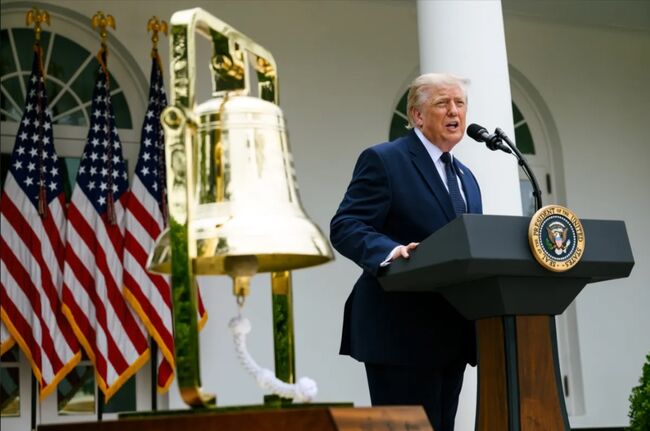
President Trump [EPA Yonhap News]
The U.S. Donald Trump administration's initiation of Section 301 investigations on March 11 (local time) against countries including South Korea and China can be seen as an attempt to build a justification for reinstating abolished retaliatory tariffs under a new guise.
Section 301 of the Trade Act grants the executive branch the authority to respond to "any act, policy, or practice of a foreign government that is unreasonable or discriminatory and burdens or restricts U.S. commerce" through measures such as imposing tariffs.
Unlike the retaliatory tariffs and 'fentanyl tariffs' based on the International Emergency Economic Powers Act (IEEPA), which the Supreme Court ruled as an "abuse of power" last month, the legal authority for Section 301 is clear.
This time, the investigation has been initiated for two reasons: "unfair trade practices associated with excess production capacity" and "production of goods through forced labor."
In a Federal Register notice announcing the Section 301 investigation, the Office of the U.S. Trade Representative (USTR) stated, "Major trading partners have developed production capacity that is out of sync with domestic and global demand," arguing that overcapacity has led to trade surpluses in these countries, and consequently, trade deficits for the United States.
It also pointed out that "surplus production in the market weakens the industrial ecosystems of other countries," thereby "jeopardizing jobs, investment, and supply chains in other economies."
The USTR listed aluminum, automobiles, batteries, cement, chemicals, electronics, energy products, glass, machinery, non-ferrous metals, paper, plastics, processed foods and beverages, robots, satellites, semiconductors, ships, solar modules, steel, and transportation equipment as areas of overproduction.
In essence, the argument is that the overproduction by countries targeted by the Section 301 investigation, particularly in these industries, has caused global trade imbalances and economic inefficiencies, and the U.S. industrial ecosystem and job market are bearing the full brunt of this damage.
This also signifies President Trump's intention to replace the bilateral retaliatory tariffs, imposed to boost U.S. manufacturing and job creation, with new tariffs levied through Section 301 investigations.
Section 301 investigations are used to address unfair trade practices by foreign governments and impose tariffs or other measures. In reality, however, they are often used by the U.S. administration as a tool to pressure foreign countries based on its own arbitrary judgment.
Ultimately, the intention is to temporarily replace retaliatory tariffs with a 10% 'global tariff' for 150 days, and to maintain tariffs on major countries by concluding the Section 301 investigations within this period.
Despite the ongoing war with Iran, the restoration of tariffs, a key economic policy of President Trump, is proceeding according to schedule.
Jamie Jameson Greer, USTR Deputy Assistant Representative, stated in a pre-briefing with the press on the same day, "The tools used may change due to court rulings or other circumstances, but the policy itself remains the same."
This statement explicitly reveals that the Section 301 investigation is being undertaken to fill the 'void' left by the retaliatory tariffs, which were invalidated by the Supreme Court ruling last month.
The Trump administration plans to conduct the Section 301 investigations as quickly as possible, as the validity period of the global tariff is set to expire in late July.
First, a joint committee of government departments will be formed to receive written comments from stakeholders. Submissions will begin around the 17th and close on the 15th of next month.
Subsequently, a public hearing will be held around May 5th. After receiving rebuttal comments for seven days, "responsive actions" will be determined, which could include tariffs, service fees, negotiations, or other measures, Greer explained.
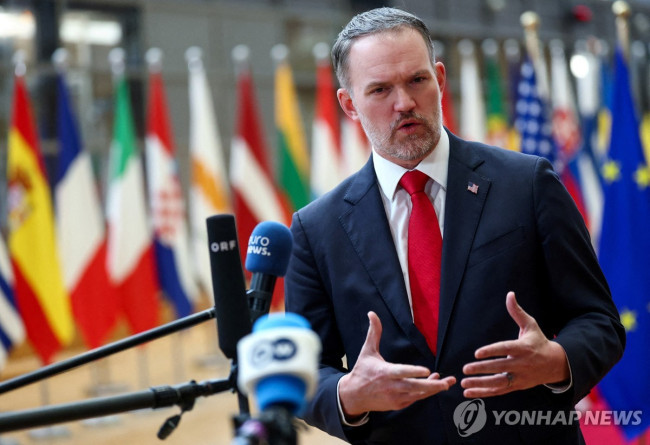 Jamie Jameson Greer, U.S. Trade Representative (USTR) Deputy Assistant Representative [Reuters=Yonhap News]
The Trump administration's Section 301 investigation was previously conducted against China during its first term. At that time, in addition to tariffs, the U.S. imposed a range of retaliatory measures, including strengthened foreign investment review by the Treasury Department and enhanced export controls by the Commerce Department.
The U.S. response measures, including tariff imposition, are expected to be announced as early as the first half of this year, before the global tariff expires.
When asked about the investigation period, Greer replied, "We are aware of the 150-day period," and added, "The goal is to reach a conclusion before the Section 122 tariffs (global tariffs) expire."
While he stated, "We cannot pre-judge the investigation results," it is difficult to take this at face value. Past precedents have repeatedly demonstrated that these investigations are often conducted with predetermined outcomes.
This can be inferred from the fact that South Korea, along with Japan, Taiwan, the European Union (EU), and India, all countries against which the Trump administration had imposed retaliatory tariffs and used them as leverage to sign trade agreements, are included as targets for the investigation based on the first reason, "overproduction."
If tariffs are imposed, it is expected that South Korea will face a restoration of tariffs to the level stipulated in the existing trade agreement with the U.S. and the joint fact sheet published based on it (15% retaliatory tariff).
When asked if existing trade agreements with investigated countries would be maintained, Greer responded, "The agreements remain intact," adding, "If responsive actions are proposed at the end of the process, the commitments made in those agreements will be considered."
However, the possibility of additional measures cannot be ruled out. Greer stated, "We anticipate additional Section 301 investigations (beyond the two reasons)," citing examples such as digital service taxes, drug pricing, access to fisheries markets, access to the rice market, and marine pollution.
He also said, "We anticipate additional country-specific Section 301 investigations, but we will not provide further details at this time."
It is interpreted that negotiations with various countries will take place while the Section 301 investigation proceeds, and during this process, there is a possibility of further investigations or measures being taken, such as those related to Coupang's case being investigated in South Korea for a massive personal data leak.
He also stated that they would examine whether there are issues such as subsidies for the relevant industries, suppression of domestic wages (to control export prices), non-commercial activities by state-owned or public enterprises, persistent market access barriers, financial suppression and currency practices, and lax environmental protection.
In other words, this can be interpreted as a warning that if even one "quibble" is found in this broad-ranging investigation, Section 301 tariffs will be imposed.
Separately, the Trump administration could also wield investigations under Section 232 of the Trade Expansion Act as a leverage for imposing item-specific tariffs. This provision is already applied to imports of automobiles, steel, and aluminum.
Greer stated, "We do not anticipate new Section 232 measures in the next few weeks," but added, "We will keep it as a potential option during this administration's term."

 Trump pressures for rate cut again ahead of FOMC... "Should be the lowest in the world"
U.S. President Donald Trump. [Photo = The White House] U.S. President Donald Trump once again pressured the Federal Reserve, the U.S. central bank, to lower interest rates on the 27th (local time
Trump pressures for rate cut again ahead of FOMC... "Should be the lowest in the world"
U.S. President Donald Trump. [Photo = The White House] U.S. President Donald Trump once again pressured the Federal Reserve, the U.S. central bank, to lower interest rates on the 27th (local time
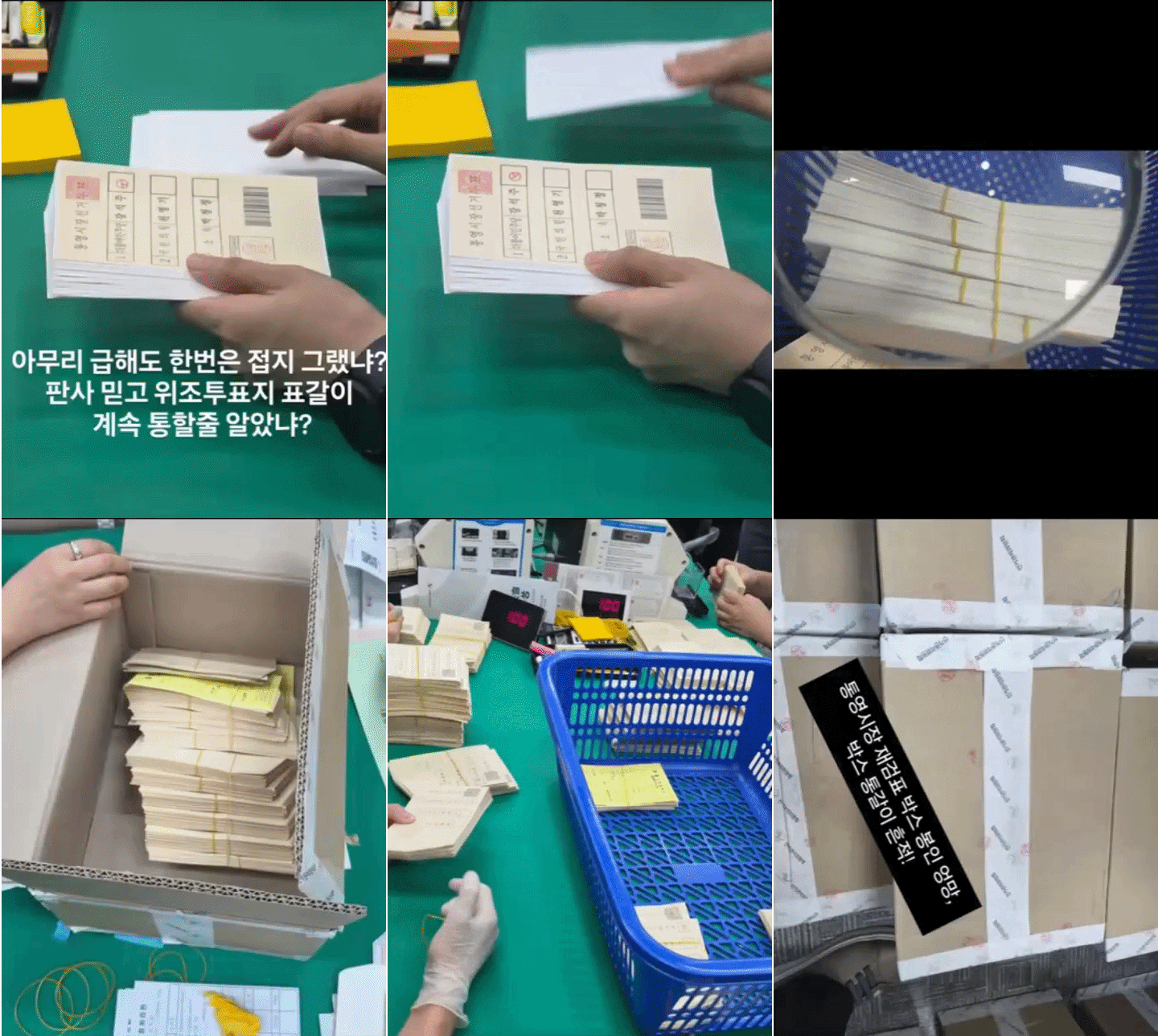 “Ignoring crisp ballots and damaged seals”… Tongyeong mayoral recount concludes with ‘no change in outcome,’ leaving suspicions and public outrage behind
Suspected counterfeit ballots discovered in Tongyeong [GIF from social media of Representative Hwang Kyo-ahn / Attorney Park Joo-hyun]During a recount of the Tongyeong mayoral election in South Gyeong
“Ignoring crisp ballots and damaged seals”… Tongyeong mayoral recount concludes with ‘no change in outcome,’ leaving suspicions and public outrage behind
Suspected counterfeit ballots discovered in Tongyeong [GIF from social media of Representative Hwang Kyo-ahn / Attorney Park Joo-hyun]During a recount of the Tongyeong mayoral election in South Gyeong
 President Yoon, regarding the first-instance ruling on the Public Official Election Act: “An excessive political verdict that distorts the facts… We will appeal immediately.”
The first-instance sentencing hearing for President Yoon Suk Yeol regarding violations of the Public Official Election Act is being broadcast live at Seoul Station on the 27th. [Photo=Yonhap News]Pres
President Yoon, regarding the first-instance ruling on the Public Official Election Act: “An excessive political verdict that distorts the facts… We will appeal immediately.”
The first-instance sentencing hearing for President Yoon Suk Yeol regarding violations of the Public Official Election Act is being broadcast live at Seoul Station on the 27th. [Photo=Yonhap News]Pres
 WSJ: "SK Hynix ADR Premium Is a Sign of AI Trading Overheat"
Advertisement for SK Hynix ADR listing in New York's Times Square [Reuters=Yonhap News file photo]The Wall Street Journal (WSJ) has pointed out that the price of SK Hynix’s American Depositary Recei
WSJ: "SK Hynix ADR Premium Is a Sign of AI Trading Overheat"
Advertisement for SK Hynix ADR listing in New York's Times Square [Reuters=Yonhap News file photo]The Wall Street Journal (WSJ) has pointed out that the price of SK Hynix’s American Depositary Recei
 'Godfather of Japanese Mystery Novels' Keigo Higashino Passes Away After Battle with Cancer at 68
Famous Japanese mystery novelist Keigo Higashino [AFP=Yonhap News]It has been belatedly reported that Keigo Higashino, the "godfather of Japanese mystery novels" and author of bestsellers such as "The
'Godfather of Japanese Mystery Novels' Keigo Higashino Passes Away After Battle with Cancer at 68
Famous Japanese mystery novelist Keigo Higashino [AFP=Yonhap News]It has been belatedly reported that Keigo Higashino, the "godfather of Japanese mystery novels" and author of bestsellers such as "The
 [Park Pil-kyu Security Column] To the Ignorant Trying to Clothe a Beast in Sheep's Clothing
Rep. Kim Byung-joo of the Democratic Party of Korea [Photo=Yonhap News]“The Air Force Academy doesn't teach you how to fly a plane!” “The Army, Navy, and Air Force academies are exactly the
[Park Pil-kyu Security Column] To the Ignorant Trying to Clothe a Beast in Sheep's Clothing
Rep. Kim Byung-joo of the Democratic Party of Korea [Photo=Yonhap News]“The Air Force Academy doesn't teach you how to fly a plane!” “The Army, Navy, and Air Force academies are exactly the
 [Issue Diagnosis] Two Effects of the Election Petition Review
 [Photo] Evidence of Election Fraud Flooding U.S. Media… Trump Had 2.7 Million Votes Stolen
 [Video] U.S. Semiquincentennial Air Show... 'Art in the Sky' streaks across New York
 [Editorial Cartoon] A Draconian Law That Undermines Freedom of Expression

 List
List