 A passenger train traveling from Pyongyang, North Korea, to Beijing, China, is seen crossing the China-North Korea Friendship Bridge, which connects the two countries, on the afternoon of the 12th. [Yonhap News]
With the resumption of two-way international passenger train services connecting North Korea and China for the first time in six years on the 12th, there are observations that the human exchange between North Korea and China, which was virtually severed after COVID-19, may be entering a phase of normalization.
The North Korea-China passenger train service was suspended in January 2020 when North Korea closed its borders due to the spread of COVID-19.
Since then, exchanges between the two countries have been limited to cargo trains and restricted logistics.
The resumption of passenger train services is assessed as a symbolic measure indicating that human exchange between North Korea and China has re-entered a phase of normalization.
Traditionally, North Korea and China maintained active travel through rail and air routes, but exchanges significantly decreased due to COVID-19, leading to analyses that a certain degree of distance had emerged in the relationship between the two countries.
Recently, North Korea-China relations have shown a trend of gradual restoration.
The volume of North Korea-China trade has been on the rise again since last year, and logistics exchanges are expanding, particularly in border areas such as Dandong, China.
China's Ministry of Foreign Affairs has also hinted at the possibility of expanding exchanges between the two countries.
On the 10th, during a regular press briefing, Chinese Foreign Ministry spokesperson Guo Xiaojun, in response to a question about the resumption of North Korea-China passenger train services, stated, "China and North Korea are friendly neighboring countries, and maintaining regular passenger train operations is of significant importance in promoting convenient people-to-people exchanges between the two countries. China supports the relevant departments of both countries in strengthening communication to create more convenient conditions for people-to-people exchanges between the two sides."
Chinese media have also paid attention to the trend of recovering North Korea-China exchanges.
The state-run Global Times analyzed that the resumption of passenger train services signifies an expansion of people-to-people exchanges between the two countries, and that railways, as one of the most stable modes of transportation for North Korea-China exchanges, can play a positive role in expanding tourism and economic cooperation.
Another media outlet, Caijing, also assessed the resumption of train services as a symbolic measure for the recovery of North Korea-China exchanges after COVID-19, reporting that tourism and business exchanges are likely to gradually increase.
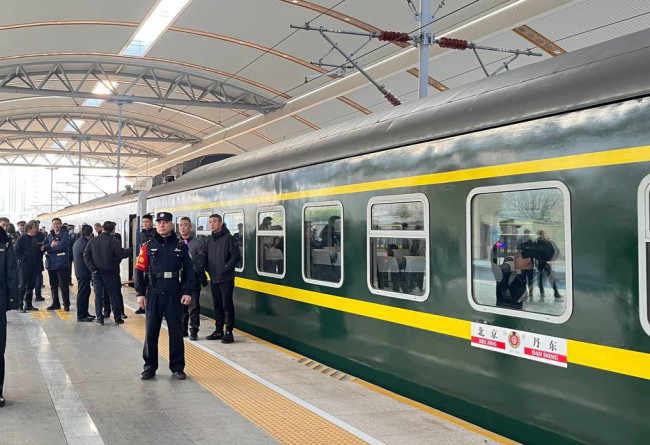 North Korea-China passenger train heading to Pyongyang, North Korea on the 12th. [Yonhap News]
Media outlets in Hong Kong and Taiwan have also focused on the possibility of changes in North Korea-China relations.
The South China Morning Post in Hong Kong suggested the possibility of expanding North Korea-China people-to-people exchanges with the resumption of train services, while Taiwan's Central News Agency analyzed that economic cooperation and diplomatic contacts could become more active again.
However, it appears that further time will be needed for full-scale people-to-people exchanges.
It is known that it is currently difficult for individuals to freely apply for North Korean visas, and it is predicted that train usage will be limited to North Korean residents or Chinese citizens with business visas for the time being.
A representative from China State Railway Group explained to Yonhap News that "only those with North Korean visas can use the train," adding, "Most of the passengers who have purchased tickets are North Koreans."
Nevertheless, expectations for the resumption of North Korean tourism are growing within the Chinese travel industry.
North Korea-specialized travel agencies in China have recently started taking reservations for North Korean tourism packages.
A representative from a Chinese travel agency that handles North Korean tourism packages told Yonhap News, "Reservations are currently available for North Korean tourism packages with a duration of 7-8 days departing in June," adding, "The cost is around 7,000 yuan per person (approximately 1.5 million Korean won), and some travelers have already paid deposits and made reservations."
In Beijing's diplomatic circles, there are observations that if North Korea-China people-to-people exchanges gradually expand, not only economic cooperation but also high-level exchanges could become more active again.
Hwang Tae-yeon, Deputy Research Fellow at the North Korean Research Division of the Korea Institute for National Unification, predicted, "Amid the close ties between Russia and North Korea, this can be seen as a result of the convergence of mutual interests, where China is concerned about its weakening influence over North Korea, and North Korea desires the restoration of economic cooperation with China. North Korea-China economic exchanges will gradually expand, and cooperation will continue at a manageable level."

 Iranian Foreign Ministry: "Continuing Message Exchanges with the U.S. and Activities of Mediating Countries"
Esmaeil Baghaei, Spokesperson for the Iranian Ministry of Foreign Affairs [Xinhua, Yonhap News file photo]Esmaeil Baghaei, spokesperson for the Iranian Ministry of Foreign Affairs, stated on the 26th
Iranian Foreign Ministry: "Continuing Message Exchanges with the U.S. and Activities of Mediating Countries"
Esmaeil Baghaei, Spokesperson for the Iranian Ministry of Foreign Affairs [Xinhua, Yonhap News file photo]Esmaeil Baghaei, spokesperson for the Iranian Ministry of Foreign Affairs, stated on the 26th
 President Yoon: "Do You Think You Are Safe from the Special Counsel?"... Final Statement Video Released
President Yoon Suk Yeol rebuking the special prosecutor on the 24th. [Court video / @birds_justice X account subtitle GIF] A video of President Yoon Suk Yeol's closing statement at his trial rega
President Yoon: "Do You Think You Are Safe from the Special Counsel?"... Final Statement Video Released
President Yoon Suk Yeol rebuking the special prosecutor on the 24th. [Court video / @birds_justice X account subtitle GIF] A video of President Yoon Suk Yeol's closing statement at his trial rega
 President Yoon, regarding the first-instance ruling on the Public Official Election Act: “An excessive political verdict that distorts the facts… We will appeal immediately.”
The first-instance sentencing hearing for President Yoon Suk Yeol regarding violations of the Public Official Election Act is being broadcast live at Seoul Station on the 27th. [Photo=Yonhap News]Pres
President Yoon, regarding the first-instance ruling on the Public Official Election Act: “An excessive political verdict that distorts the facts… We will appeal immediately.”
The first-instance sentencing hearing for President Yoon Suk Yeol regarding violations of the Public Official Election Act is being broadcast live at Seoul Station on the 27th. [Photo=Yonhap News]Pres
 WSJ: "SK Hynix ADR Premium Is a Sign of AI Trading Overheat"
Advertisement for SK Hynix ADR listing in New York's Times Square [Reuters=Yonhap News file photo]The Wall Street Journal (WSJ) has pointed out that the price of SK Hynix’s American Depositary Recei
WSJ: "SK Hynix ADR Premium Is a Sign of AI Trading Overheat"
Advertisement for SK Hynix ADR listing in New York's Times Square [Reuters=Yonhap News file photo]The Wall Street Journal (WSJ) has pointed out that the price of SK Hynix’s American Depositary Recei
 'Godfather of Japanese Mystery Novels' Keigo Higashino Passes Away After Battle with Cancer at 68
Famous Japanese mystery novelist Keigo Higashino [AFP=Yonhap News]It has been belatedly reported that Keigo Higashino, the "godfather of Japanese mystery novels" and author of bestsellers such as "The
'Godfather of Japanese Mystery Novels' Keigo Higashino Passes Away After Battle with Cancer at 68
Famous Japanese mystery novelist Keigo Higashino [AFP=Yonhap News]It has been belatedly reported that Keigo Higashino, the "godfather of Japanese mystery novels" and author of bestsellers such as "The
 [Park Pil-kyu Security Column] To the Ignorant Trying to Clothe a Beast in Sheep's Clothing
Rep. Kim Byung-joo of the Democratic Party of Korea [Photo=Yonhap News]“The Air Force Academy doesn't teach you how to fly a plane!” “The Army, Navy, and Air Force academies are exactly the
[Park Pil-kyu Security Column] To the Ignorant Trying to Clothe a Beast in Sheep's Clothing
Rep. Kim Byung-joo of the Democratic Party of Korea [Photo=Yonhap News]“The Air Force Academy doesn't teach you how to fly a plane!” “The Army, Navy, and Air Force academies are exactly the
 [Issue Diagnosis] Two Effects of the Election Petition Review
 [Photo] Evidence of Election Fraud Flooding U.S. Media… Trump Had 2.7 Million Votes Stolen
 [Video] U.S. Semiquincentennial Air Show... 'Art in the Sky' streaks across New York
 [Editorial Cartoon] A Draconian Law That Undermines Freedom of Expression

 List
List









