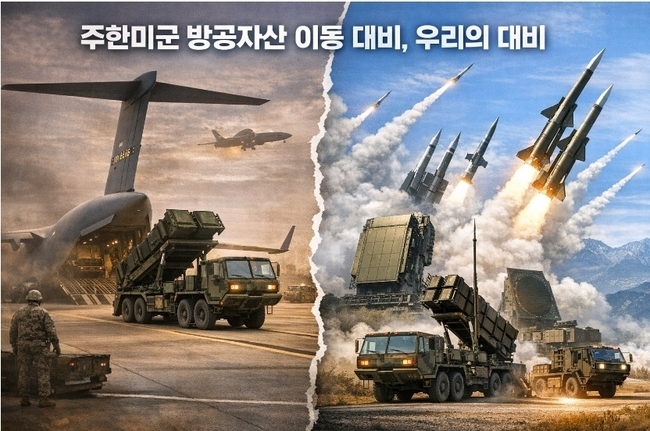
There are indications that some of the US Forces Korea's air defense assets have been moved to actual battlefields. Although the government has expressed opposition, it has acknowledged the reality that South Korea has difficulty controlling the US's global force operations. The assets subject to relocation are likely THAAD or Patriots, but the scale and schedule have not been disclosed.
While opinions are divided between those concerned about a security vacuum and those who dismiss it as excessive worry, focusing the debate solely on whether the equipment has moved misses the point. The important change now is that the deterrence posture of the ROK-US alliance is shifting from static deterrence to dynamic deterrence. Security debates should be brief, and military preparedness should be deep and quiet.
For a long time, US Forces Korea symbolized deterrence, being permanently stationed on the Korean Peninsula. It was an era where deterrence was formed simply by the physical presence of troops and equipment. However, the US's strategy has already moved away from a focus on static deployment towards emphasizing the mobility and flexibility of its forces. The US has designated China and Russia as competitors and adopted a strategy of rapidly redeploying forces to areas of need, assuming an environment where simultaneous crises occur in the Middle East, Europe, and the Indo-Pacific. This change is directly impacting the Korean Peninsula.
Recent domestic and international media have reported on indications that the entire THAAD battery at the Seongju base is being removed from the base. However, the government's assurance that there is no problem cannot assuage public anxiety. While Patriot systems can be replaced by the Cheongung-II, THAAD is currently the core of high-altitude defense that cannot be replaced. If THAAD, which is responsible for intercepting targets at altitudes of 40-150 km, is moved, a physical gap will immediately emerge in the upper-tier defense network. Our Long-range Surface-to-Air Missile (L-SAM) is scheduled for operational deployment next year, so it cannot immediately replace THAAD.
To claim that deterrence will not be affected without THAAD, while ignoring this reality, is not to reassure the public but to deceive them about the security situation. The government must strengthen communication with the US and transparently disclose whether THAAD is being moved, its return date, and measures to compensate for any gaps.
The standard for deterrence must now shift from what is deployed where, to how it is connected through networks. System-based deterrence, combining satellite surveillance, early warning, long-range strike, and data linkage between allies, is the new standard. Therefore, the key question is not whether equipment has moved, but what system is filling that void.
∆ The greatest asset of an alliance is a spirit of mutual benefit, more than equipment and technology.
Today's alliances must be structures of mutual benefit that help each other. If we are to receive support from an alliance in times of crisis, we must also be able to fight and support them when they wish. Alliances operate not by the number of troops and equipment, but by the sum of mutually trusted and connected capabilities.
∆ This opportunity must be seized as a chance for a groundbreaking advancement in South Korea's security.
Future alliances will operate not in an era of static forces, but as integrated deterrence systems combining dynamic forces and technological networks. Instead of focusing on preventing the movement of forces, the goal should be to maintain deterrence even after the move by integrating information, technology, and operational systems. Measures to secure practical deterrence are needed, such as real-time sharing of early warning information, linking missile defense data, and strengthening joint command and control systems.
In an era when US forces can move, South Korea must consider what kind of nation it will become in terms of capabilities and roles. We cannot remain a country completely dependent on alliances. We must leap forward to become a partner nation that jointly designs the deterrence capabilities of the alliance. The choices South Korea must make now are to review the vulnerabilities of its current security, strengthen its autonomous capabilities based on the alliance, and use ROK-US combined exercises as sophisticated tools for peace, building autonomous national defense through intensive practical training.
∆ The relocation of US Forces Korea's air defense assets must be taken as an opportunity to strengthen our own air defense capabilities.
North Korea is advancing its various missile systems and is even pursuing the development of hypersonic weapons. In this environment, South Korea's air defense network must become a core system supporting national survival, not a supplementary component of the alliance. Therefore, what our military must do is to complete our independent air defense network by deploying L-SAM operationally at an early stage.
The key to this is the combination of L-SAM and Cheongung-II. L-SAM intercepts enemy medium- and long-range ballistic missiles just before their re-entry into the atmosphere, and Cheongung-II re-intercepts high-speed targets that have re-entered below that altitude. If these layered air defense systems are linked, South Korea will possess a practical defense network capable of withstanding any saturation attack.
In an era where US Forces can relocate, the early completion of a layered air defense network has become the mission of the South Korean military. This is the minimum condition for sustaining national survival and a self-help measure for war prevention. We anticipate significant effort and a spiritual transformation from the military and the security apparatus.
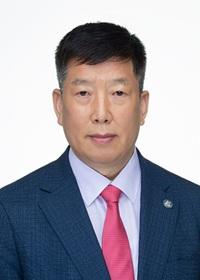
◆ Park Pil-kyu
Editorial Board Member, The Hankyoreh
40th graduating class, Korea Military Academy

 Iranian Foreign Ministry: "Continuing Message Exchanges with the U.S. and Activities of Mediating Countries"
Esmaeil Baghaei, Spokesperson for the Iranian Ministry of Foreign Affairs [Xinhua, Yonhap News file photo]Esmaeil Baghaei, spokesperson for the Iranian Ministry of Foreign Affairs, stated on the 26th
Iranian Foreign Ministry: "Continuing Message Exchanges with the U.S. and Activities of Mediating Countries"
Esmaeil Baghaei, Spokesperson for the Iranian Ministry of Foreign Affairs [Xinhua, Yonhap News file photo]Esmaeil Baghaei, spokesperson for the Iranian Ministry of Foreign Affairs, stated on the 26th
 President Yoon: "Do You Think You Are Safe from the Special Counsel?"... Final Statement Video Released
President Yoon Suk Yeol rebuking the special prosecutor on the 24th. [Court video / @birds_justice X account subtitle GIF] A video of President Yoon Suk Yeol's closing statement at his trial rega
President Yoon: "Do You Think You Are Safe from the Special Counsel?"... Final Statement Video Released
President Yoon Suk Yeol rebuking the special prosecutor on the 24th. [Court video / @birds_justice X account subtitle GIF] A video of President Yoon Suk Yeol's closing statement at his trial rega
 President Yoon, regarding the first-instance ruling on the Public Official Election Act: “An excessive political verdict that distorts the facts… We will appeal immediately.”
The first-instance sentencing hearing for President Yoon Suk Yeol regarding violations of the Public Official Election Act is being broadcast live at Seoul Station on the 27th. [Photo=Yonhap News]Pres
President Yoon, regarding the first-instance ruling on the Public Official Election Act: “An excessive political verdict that distorts the facts… We will appeal immediately.”
The first-instance sentencing hearing for President Yoon Suk Yeol regarding violations of the Public Official Election Act is being broadcast live at Seoul Station on the 27th. [Photo=Yonhap News]Pres
 WSJ: "SK Hynix ADR Premium Is a Sign of AI Trading Overheat"
Advertisement for SK Hynix ADR listing in New York's Times Square [Reuters=Yonhap News file photo]The Wall Street Journal (WSJ) has pointed out that the price of SK Hynix’s American Depositary Recei
WSJ: "SK Hynix ADR Premium Is a Sign of AI Trading Overheat"
Advertisement for SK Hynix ADR listing in New York's Times Square [Reuters=Yonhap News file photo]The Wall Street Journal (WSJ) has pointed out that the price of SK Hynix’s American Depositary Recei
 'Godfather of Japanese Mystery Novels' Keigo Higashino Passes Away After Battle with Cancer at 68
Famous Japanese mystery novelist Keigo Higashino [AFP=Yonhap News]It has been belatedly reported that Keigo Higashino, the "godfather of Japanese mystery novels" and author of bestsellers such as "The
'Godfather of Japanese Mystery Novels' Keigo Higashino Passes Away After Battle with Cancer at 68
Famous Japanese mystery novelist Keigo Higashino [AFP=Yonhap News]It has been belatedly reported that Keigo Higashino, the "godfather of Japanese mystery novels" and author of bestsellers such as "The
 [Park Pil-kyu Security Column] To the Ignorant Trying to Clothe a Beast in Sheep's Clothing
Rep. Kim Byung-joo of the Democratic Party of Korea [Photo=Yonhap News]“The Air Force Academy doesn't teach you how to fly a plane!” “The Army, Navy, and Air Force academies are exactly the
[Park Pil-kyu Security Column] To the Ignorant Trying to Clothe a Beast in Sheep's Clothing
Rep. Kim Byung-joo of the Democratic Party of Korea [Photo=Yonhap News]“The Air Force Academy doesn't teach you how to fly a plane!” “The Army, Navy, and Air Force academies are exactly the
 [Issue Diagnosis] Two Effects of the Election Petition Review
 [Photo] Evidence of Election Fraud Flooding U.S. Media… Trump Had 2.7 Million Votes Stolen
 [Video] U.S. Semiquincentennial Air Show... 'Art in the Sky' streaks across New York
 [Editorial Cartoon] A Draconian Law That Undermines Freedom of Expression

 List
List










