 The Office of the United States Trade Representative (USTR) in Washington D.C. It oversees Section 301 trade investigations. [Photo: Library of Congress]
As the United States initiates trade investigations citing the issue of "structural overcapacity," some domestic media outlets are heightening tensions by mentioning the possibility of invoking "Super 301."
Analyses also suggest that South Korea's trade surplus with the U.S. could become a target of the investigation.
However, examining the structure of U.S. trade law and recent trade policy trends reveals that these interpretations omit several crucial facts.
The Issue: The Term "Invoking Super 301"
Recent reports have used the phrase "invoking Super 301" when discussing potential U.S. trade pressure.
This phrase evokes memories of trade policies used by the U.S. in the 1980s and 1990s to pressure major trading partners like Japan.
Consequently, the interpretation that South Korea's trade surplus with the U.S. could also become a target of strong trade pressure has spread.
Verification ①: U.S. Trade Law Does Not Have "Super 301"
First, it is necessary to examine the structure of U.S. trade law.
The provision that actually exists in U.S. trade law is "Section 301" of the Trade Act of 1974.
This provision allows the U.S. government to conduct investigations and take retaliatory measures if it determines that a foreign government's policies or practices harm U.S. companies.
In contrast, "Super 301," mentioned in the media, is not a separate legal provision.
Super 301 was a policy program introduced during the 1988 Omnibus Trade and Competitiveness Act. It was an operational mechanism designed to automatically initiate 301 investigations by designating specific countries as "Priority Foreign Countries."
In other words, Super 301 was not an independent legal clause but rather a policy program or guideline that encouraged Congress to utilize Section 301 more actively.
Verification ②: Super 301 is Not a Standing Mechanism Currently
Another important fact is that Super 301 was not a permanent system.
This program was designed to operate for a limited period, with the initial mandatory application period from 1989 to 1990.
Although Congress has extended it on a limited basis a few times since then, it is not a system that is currently operated on a standing basis in U.S. trade policy.
Therefore, referring to the recent U.S. trade investigation as "invoking Super 301" is difficult to consider an accurate description in a legal sense.
The trade tools currently utilized by the U.S. include Section 301 investigations, Section 232 (national security tariffs), and anti-dumping and countervailing duties.
Verification ③: Background of the "Structural Overcapacity" Debate
Another concept that has emerged in this trade debate is "structural overcapacity."
U.S. trade authorities define structural overcapacity when production capacity is excessively expanded due to government subsidies or industrial policies.
The logic is that if such production capacity is exported to the global market, distorting prices and harming U.S. industries, it can be interpreted as an unfair trade practice subject to a Section 301 investigation.
Verification ④: China's Supply Chain Structure is the Core Background
The emphasis on "structural overcapacity" in recent U.S. trade policy is rooted in the China-centric supply chain structure.
The Chinese government has expanded its production capacity through substantial subsidies and financial support in various industries, including electric vehicles, batteries, solar power, and steel.
In this process, Chinese companies have secured production capacity exceeding domestic demand, and the surplus production has entered the overseas market, triggering global price competition, according to the U.S. and European Union.
Therefore, the recent trade debate is less about simple trade imbalances and more about industrial competition surrounding China's industrial policies and global supply chain structures.
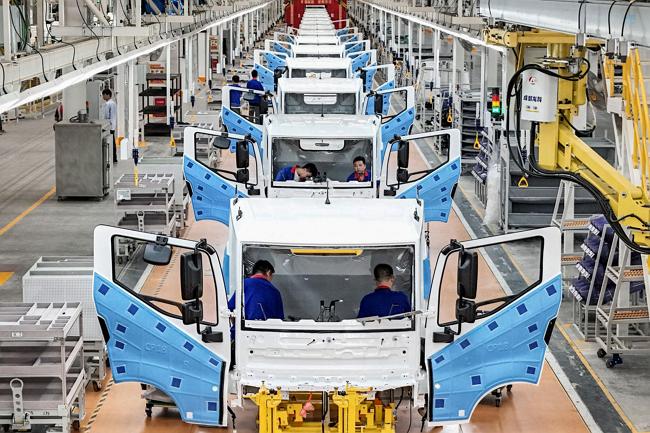 A BYD factory in China. The U.S. and Europe claim that Chinese government subsidies and production expansion are causing global oversupply. [Photo: BYD Website]
Correction of Interpretation: South Korea's Trade Surplus is Not the Core Issue
From this perspective, the core of the current debate is closer to China's industrial policies and supply chain structure rather than South Korea's trade surplus with the U.S.
In recent years, the U.S. and the EU have argued that China's large-scale subsidy policies in various industries, such as electric vehicles, batteries, and solar power, are creating global oversupply.
The concept of "structural overcapacity" has also emerged as a trade framework to address these industrial policies.
Supplement to Interpretation: Potential Impact on South Korea Also Exists
However, this does not mean that South Korea can be definitively excluded from trade pressure.
Section 301 investigations can be expanded to target specific industries or policies, and there is a possibility that changes in U.S. trade policy could affect the global supply chain as a whole.
In particular, as South Korea is one of the countries with a large trade surplus with the U.S., the possibility of changes in U.S. trade policy affecting Korean industries in the long term cannot be ruled out.
However, given that the main issues raised by U.S. trade authorities so far have focused on China's industrial subsidy policies and its overcapacity structure, interpreting this debate simply as a "South Korean trade surplus problem" is considered an excessive overreach, according to some points of view.
Ultimately, the essence of this Section 301 debate is not South Korea's trade surplus, but China's industrial policies and supply chain structure.
There are also concerns that focusing on phrases like "invoking Super 301," as some domestic reports do, could actually obscure the core issue of China's industrial policies in this trade debate.

 Iranian Foreign Ministry: "Continuing Message Exchanges with the U.S. and Activities of Mediating Countries"
Esmaeil Baghaei, Spokesperson for the Iranian Ministry of Foreign Affairs [Xinhua, Yonhap News file photo]Esmaeil Baghaei, spokesperson for the Iranian Ministry of Foreign Affairs, stated on the 26th
Iranian Foreign Ministry: "Continuing Message Exchanges with the U.S. and Activities of Mediating Countries"
Esmaeil Baghaei, Spokesperson for the Iranian Ministry of Foreign Affairs [Xinhua, Yonhap News file photo]Esmaeil Baghaei, spokesperson for the Iranian Ministry of Foreign Affairs, stated on the 26th
 President Yoon: "Do You Think You Are Safe from the Special Counsel?"... Final Statement Video Released
President Yoon Suk Yeol rebuking the special prosecutor on the 24th. [Court video / @birds_justice X account subtitle GIF] A video of President Yoon Suk Yeol's closing statement at his trial rega
President Yoon: "Do You Think You Are Safe from the Special Counsel?"... Final Statement Video Released
President Yoon Suk Yeol rebuking the special prosecutor on the 24th. [Court video / @birds_justice X account subtitle GIF] A video of President Yoon Suk Yeol's closing statement at his trial rega
 President Yoon, regarding the first-instance ruling on the Public Official Election Act: “An excessive political verdict that distorts the facts… We will appeal immediately.”
The first-instance sentencing hearing for President Yoon Suk Yeol regarding violations of the Public Official Election Act is being broadcast live at Seoul Station on the 27th. [Photo=Yonhap News]Pres
President Yoon, regarding the first-instance ruling on the Public Official Election Act: “An excessive political verdict that distorts the facts… We will appeal immediately.”
The first-instance sentencing hearing for President Yoon Suk Yeol regarding violations of the Public Official Election Act is being broadcast live at Seoul Station on the 27th. [Photo=Yonhap News]Pres
 WSJ: "SK Hynix ADR Premium Is a Sign of AI Trading Overheat"
Advertisement for SK Hynix ADR listing in New York's Times Square [Reuters=Yonhap News file photo]The Wall Street Journal (WSJ) has pointed out that the price of SK Hynix’s American Depositary Recei
WSJ: "SK Hynix ADR Premium Is a Sign of AI Trading Overheat"
Advertisement for SK Hynix ADR listing in New York's Times Square [Reuters=Yonhap News file photo]The Wall Street Journal (WSJ) has pointed out that the price of SK Hynix’s American Depositary Recei
 'Godfather of Japanese Mystery Novels' Keigo Higashino Passes Away After Battle with Cancer at 68
Famous Japanese mystery novelist Keigo Higashino [AFP=Yonhap News]It has been belatedly reported that Keigo Higashino, the "godfather of Japanese mystery novels" and author of bestsellers such as "The
'Godfather of Japanese Mystery Novels' Keigo Higashino Passes Away After Battle with Cancer at 68
Famous Japanese mystery novelist Keigo Higashino [AFP=Yonhap News]It has been belatedly reported that Keigo Higashino, the "godfather of Japanese mystery novels" and author of bestsellers such as "The
 [Park Pil-kyu Security Column] To the Ignorant Trying to Clothe a Beast in Sheep's Clothing
Rep. Kim Byung-joo of the Democratic Party of Korea [Photo=Yonhap News]“The Air Force Academy doesn't teach you how to fly a plane!” “The Army, Navy, and Air Force academies are exactly the
[Park Pil-kyu Security Column] To the Ignorant Trying to Clothe a Beast in Sheep's Clothing
Rep. Kim Byung-joo of the Democratic Party of Korea [Photo=Yonhap News]“The Air Force Academy doesn't teach you how to fly a plane!” “The Army, Navy, and Air Force academies are exactly the
 [Issue Diagnosis] Two Effects of the Election Petition Review
 [Photo] Evidence of Election Fraud Flooding U.S. Media… Trump Had 2.7 Million Votes Stolen
 [Video] U.S. Semiquincentennial Air Show... 'Art in the Sky' streaks across New York
 [Editorial Cartoon] A Draconian Law That Undermines Freedom of Expression

 List
List









