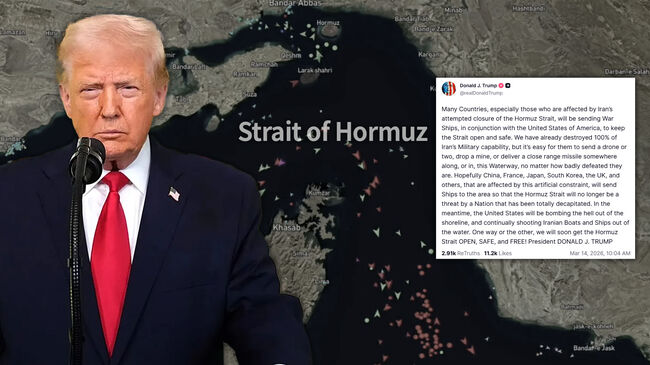
U.S. President Donald Trump urged five countries, including South Korea, to send warships to the Strait of Hormuz on the 14th (local time). He made this request after declaring that Iran's military capabilities had been destroyed 100%.
In a post on Truth Social that day, President Trump said, "Many countries affected by Iran's attempt to blockade the Strait of Hormuz, especially those affected, will send warships in cooperation with the United States to maintain the openness and safety of the strait."
He stated, "We have already destroyed 100% of Iran's military capabilities, but no matter how badly Iran is defeated, it is still easy for them to send one or two drones, drop mines, or fire short-range missiles somewhere in this strait."
He added, "Hopefully, China, France, Japan, South Korea, the United Kingdom, and other countries affected by this artificial constraint (blockade of the Strait of Hormuz) will also send naval vessels (warships) here so that the Strait of Hormuz is no longer threatened by a country whose leadership has been completely eliminated."
President Trump added, "Meanwhile, the United States will concentrate bombing on the coastline and continue to sink Iranian vessels. By any means necessary, we will soon make the Strait of Hormuz open, safe, and free!"
Earlier, on the 12th, Treasury Secretary Scott Bessent said in an interview with Sky News, "I believe the U.S. Navy will begin escorting ships with an international coalition as soon as it becomes militarily feasible."
Naval operations to escort vessels of their own nationality have typically been conducted by multiple countries, and South Korea has also carried out escort and counter-piracy operations for its flagged vessels worldwide.
Although President Trump's request for warships is a non-binding request with the phrase "hopefully," the general view is that there is sufficient justification.
However, it is noteworthy that the "international coalition" mentioned by Secretary Bessent does not consist of multinational forces formed by U.S. allies, but includes China, which is classified as a country posing a security threat, and France and the United Kingdom, which are lukewarm towards the U.S. military's operations in Iran.
This is interpreted as a strategy to make the Strait of Hormuz an international high seas, not Iran's territorial waters. This is because it amounts to declaring that Iran has already been neutralized and its governmental functions are not operating.
Immediately before President Trump's announcement, Indian authorities announced that two Indian LPG carriers, the Shivalik and the Nanda Devi, carrying a total of 92,712 tons of LPG, had successfully passed through the Strait of Hormuz early on the 14th (Saturday).
According to Anadolu Agency, Iran's permission for Indian vessels to pass came just one day after Indian Prime Minister Narendra Modi spoke with Iranian President Masoud Pezeshkian on Thursday.
Prior to that, China had also moved its oil tankers through the Strait of Hormuz with Iran's permission.
Currently, the Strait of Hormuz largely falls within the territorial waters and exclusive economic zones (EEZs) of Iran and Oman. Iran has often used this strait as a strategic card to threaten international oil prices by blockading it.
President Trump now appears to be entering the stage of declaring victory in military operations in Iran by effectively converting this area from Iranian territorial waters to high seas.
In a week, the USS Tripoli, Marine Expeditionary Unit, and landing force that departed from Japan are scheduled to arrive in the region.
President Trump's request poses a challenge to the Northeast Asian security order.
If China responds to the U.S. request, it would mean China abandoning Iran, and if it refuses the U.S. request, it would pour cold water on the U.S.-China summit scheduled for April.
South Korea is also placed at a crossroads, having to choose between a pro-China stance and a pro-U.S. stance. With most other Middle Eastern oil-producing countries having deteriorated relations with Iran, the South Korean government is forced to consider the aspect of the ROK-U.S. alliance while simultaneously fearing it might offend China.
Furthermore, with Japan expected to actively dispatch warships, China and South Korea's deliberations are likely to deepen.
U.S. NNP=Chief Reporter Sung Ku Hong / Special Correspondent for this newspaper NNP info@newsandpost.com

 Iranian Foreign Ministry: "Continuing Message Exchanges with the U.S. and Activities of Mediating Countries"
Esmaeil Baghaei, Spokesperson for the Iranian Ministry of Foreign Affairs [Xinhua, Yonhap News file photo]Esmaeil Baghaei, spokesperson for the Iranian Ministry of Foreign Affairs, stated on the 26th
Iranian Foreign Ministry: "Continuing Message Exchanges with the U.S. and Activities of Mediating Countries"
Esmaeil Baghaei, Spokesperson for the Iranian Ministry of Foreign Affairs [Xinhua, Yonhap News file photo]Esmaeil Baghaei, spokesperson for the Iranian Ministry of Foreign Affairs, stated on the 26th
 President Yoon: "Do You Think You Are Safe from the Special Counsel?"... Final Statement Video Released
President Yoon Suk Yeol rebuking the special prosecutor on the 24th. [Court video / @birds_justice X account subtitle GIF] A video of President Yoon Suk Yeol's closing statement at his trial rega
President Yoon: "Do You Think You Are Safe from the Special Counsel?"... Final Statement Video Released
President Yoon Suk Yeol rebuking the special prosecutor on the 24th. [Court video / @birds_justice X account subtitle GIF] A video of President Yoon Suk Yeol's closing statement at his trial rega
 President Yoon, regarding the first-instance ruling on the Public Official Election Act: “An excessive political verdict that distorts the facts… We will appeal immediately.”
The first-instance sentencing hearing for President Yoon Suk Yeol regarding violations of the Public Official Election Act is being broadcast live at Seoul Station on the 27th. [Photo=Yonhap News]Pres
President Yoon, regarding the first-instance ruling on the Public Official Election Act: “An excessive political verdict that distorts the facts… We will appeal immediately.”
The first-instance sentencing hearing for President Yoon Suk Yeol regarding violations of the Public Official Election Act is being broadcast live at Seoul Station on the 27th. [Photo=Yonhap News]Pres
 WSJ: "SK Hynix ADR Premium Is a Sign of AI Trading Overheat"
Advertisement for SK Hynix ADR listing in New York's Times Square [Reuters=Yonhap News file photo]The Wall Street Journal (WSJ) has pointed out that the price of SK Hynix’s American Depositary Recei
WSJ: "SK Hynix ADR Premium Is a Sign of AI Trading Overheat"
Advertisement for SK Hynix ADR listing in New York's Times Square [Reuters=Yonhap News file photo]The Wall Street Journal (WSJ) has pointed out that the price of SK Hynix’s American Depositary Recei
 'Godfather of Japanese Mystery Novels' Keigo Higashino Passes Away After Battle with Cancer at 68
Famous Japanese mystery novelist Keigo Higashino [AFP=Yonhap News]It has been belatedly reported that Keigo Higashino, the "godfather of Japanese mystery novels" and author of bestsellers such as "The
'Godfather of Japanese Mystery Novels' Keigo Higashino Passes Away After Battle with Cancer at 68
Famous Japanese mystery novelist Keigo Higashino [AFP=Yonhap News]It has been belatedly reported that Keigo Higashino, the "godfather of Japanese mystery novels" and author of bestsellers such as "The
 [Park Pil-kyu Security Column] To the Ignorant Trying to Clothe a Beast in Sheep's Clothing
Rep. Kim Byung-joo of the Democratic Party of Korea [Photo=Yonhap News]“The Air Force Academy doesn't teach you how to fly a plane!” “The Army, Navy, and Air Force academies are exactly the
[Park Pil-kyu Security Column] To the Ignorant Trying to Clothe a Beast in Sheep's Clothing
Rep. Kim Byung-joo of the Democratic Party of Korea [Photo=Yonhap News]“The Air Force Academy doesn't teach you how to fly a plane!” “The Army, Navy, and Air Force academies are exactly the
 [Issue Diagnosis] Two Effects of the Election Petition Review
 [Photo] Evidence of Election Fraud Flooding U.S. Media… Trump Had 2.7 Million Votes Stolen
 [Video] U.S. Semiquincentennial Air Show... 'Art in the Sky' streaks across New York
 [Editorial Cartoon] A Draconian Law That Undermines Freedom of Expression

 List
List