 Iranian merchant ship attacked in Strait of Hormuz [EPA Yonhap News]
The fact that U.S. President Donald Trump has effectively demanded that five countries, including South Korea, send warships to the Strait of Hormuz, which has emerged as the decisive battleground in the war with Iran, is interpreted as revealing his plan to involve other countries, centered on allies, in the war between the United States and Israel against Iran.
On the 14th (local time), President Trump posted on his social media, Truth Social, stating, "Many countries, especially those affected by Iran's attempt to block the Strait of Hormuz, will be sending warships in conjunction with the United States to keep the strait open and secure."
Although he began with a somewhat definitive expression, "will be sending," he added a premise of "Hopefully" when mentioning five countries, including South Korea, China, France, Japan, and the United Kingdom, which are "affected by this artificial restriction (blockade of the Strait of Hormuz)." In other words, as of now, it is read as a demand for the dispatch of warships.
President Trump stated that the reason for demanding warships from these countries was to make the Strait of Hormuz "open, secure, and free." This implies a request to join the U.S. military's operations, as they are major "stakeholders" whose oil supply could be disrupted by Iran's blockade of the Strait of Hormuz.
Although the size or specific role of the dispatched warships was not presented, it is expected that it could be a request to support the escort operation of ships in the Strait of Hormuz, which the U.S. military is expected to commence soon.
As President Trump wrote, "it is easy for them (Iran) to send one or two drones somewhere in this waterway (Strait of Hormuz), drop mines, or launch short-range missiles, no matter how badly defeated they are," meaning they want to share the role and risks in countering such Iranian attacks.
The escort operation in the Strait of Hormuz is known to have been planned and approached cautiously by the U.S. military, as it is exposed to targets of Iranian drone, mine, and missile attacks in the narrow waterway, posing a high risk of casualties to our side. Therefore, an intention to disperse the risk through joint operations by a multinational force, rather than unilateral operations by the U.S. military, is evident.
With the war with Iran exceeding two weeks, about half of the operational period (4-5 weeks) originally proposed by President Trump has passed. Iran seems to be holding out by taking the oil trapped in the Strait of Hormuz "hostage." For the U.S., which has predicted strong air strikes again next week, it is crucial to open the blockade of the Strait of Hormuz to deliver a decisive blow to Iran and conclude the war.
Among the five countries designated by President Trump, South Korea, Japan, the United Kingdom, and France are representative U.S. allies in Asia and Europe. President Trump has consistently expressed the perception that the U.S. has borne an unequal burden of collective defense on both continents and has demanded burden-sharing from its allies.
While Trump's previous demands were mainly financial, such as increased defense spending by allied countries, this time it is a demand for the deployment of actual military power, which is a different dimension. It can be said that he has presented a bill for the "security umbrella" that the U.S. has provided.
For these countries, which cannot ignore their alliance with the U.S., their deliberations are expected to deepen as they weigh the risks of direct involvement in the Middle East conflict.
If discussions on dispatching troops at the government level materialize according to President Trump's demand, South Korea's Cheonghae Unit, currently deployed in the Gulf of Aden, will be a point of focus. The Cheonghae Unit has a precedent of expanding its operational area to the Strait of Hormuz and conducting independent operations to escort South Korean vessels during the heightened tensions between the U.S. and Iran in 2020.
During the first term of the Trump administration, in early 2020, when tensions between the U.S. and Iran escalated after the U.S. eliminated Iran's top military figure, Qasem Soleimani, then-commander of the Revolutionary Guard, the government responded to the U.S. request to contribute to the stability of the Strait of Hormuz by expanding the operational scope of the Cheonghae Unit in the Gulf of Aden.
Although it was a request from an ally, the decision was made considering South Korea's economic and security needs, as the stability of the Strait of Hormuz, through which more than two-thirds of South Korea's imported crude oil passes, is directly linked to South Korea's economy and security.
However, at the time, the Moon Jae-in administration in South Korea opted for independent deployment instead of participating in the "International Maritime Security Construct (IMSC)" led by the U.S. for the collective defense of the Strait of Hormuz.
This was interpreted as a choice reflecting its intention to manage its relationship with its ally, the United States, while simultaneously avoiding being considered an "enemy" by Iran.
This time as well, the government is expected to face similar considerations as six years ago. Given that a war has actually broken out, these considerations may be deeper and more complex than they were six years ago.
As in six years ago, even if warships are dispatched according to the U.S.'s request, there is speculation that they may consider ways to temporarily expand the operational area of the Cheonghae Unit while maximally avoiding appearing to directly participate in the U.S. war against Iran.
In China's case, it is a strategic competitor that is almost equivalent to a potential adversary of the U.S., and it is also a friend of Iran and has criticized the attacks on Iran, making it unlikely to respond to President Trump's demands. Nevertheless, the fact that President Trump mentioned China can be interpreted as pointing out China's significant dependence on Iranian crude oil imports and as sending a pressuring message ahead of the U.S.-China summit.
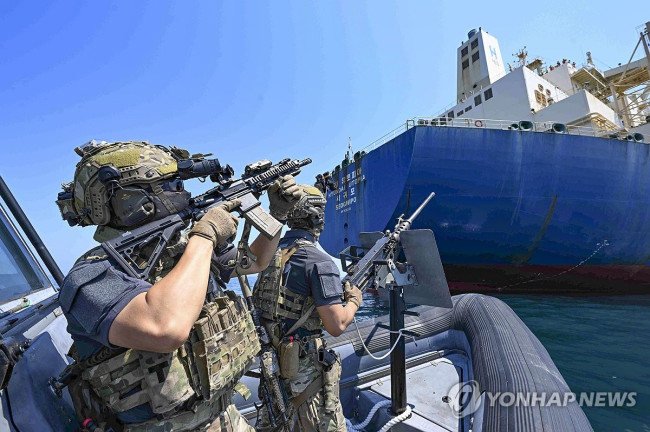 On August 1, 2025, members of the inspection and search team, composed of naval special warfare (UDT/SEAL) personnel, are boarding a high-speed boat and approaching a vessel assumed to be a hijacked merchant ship during the 'Anti-piracy Joint Exercise by Civilian, Government, and Military Personnel of the 46th Cheonghae Unit' held in the waters near Geoje, Gyeongnam Province. 2025.8.1 [Provided by the Navy]

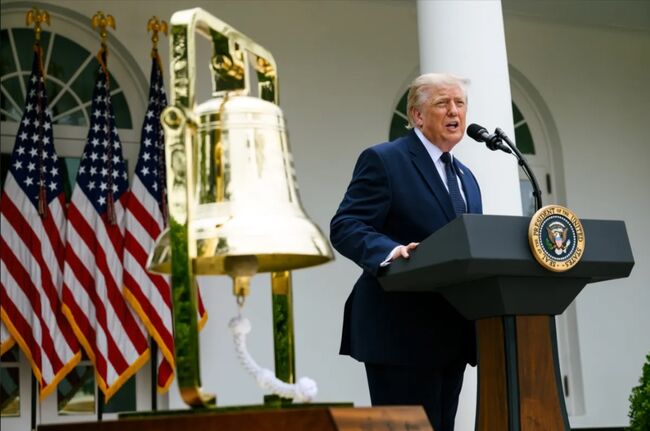 Trump pressures for rate cut again ahead of FOMC... "Should be the lowest in the world"
U.S. President Donald Trump. [Photo = The White House] U.S. President Donald Trump once again pressured the Federal Reserve, the U.S. central bank, to lower interest rates on the 27th (local time
Trump pressures for rate cut again ahead of FOMC... "Should be the lowest in the world"
U.S. President Donald Trump. [Photo = The White House] U.S. President Donald Trump once again pressured the Federal Reserve, the U.S. central bank, to lower interest rates on the 27th (local time
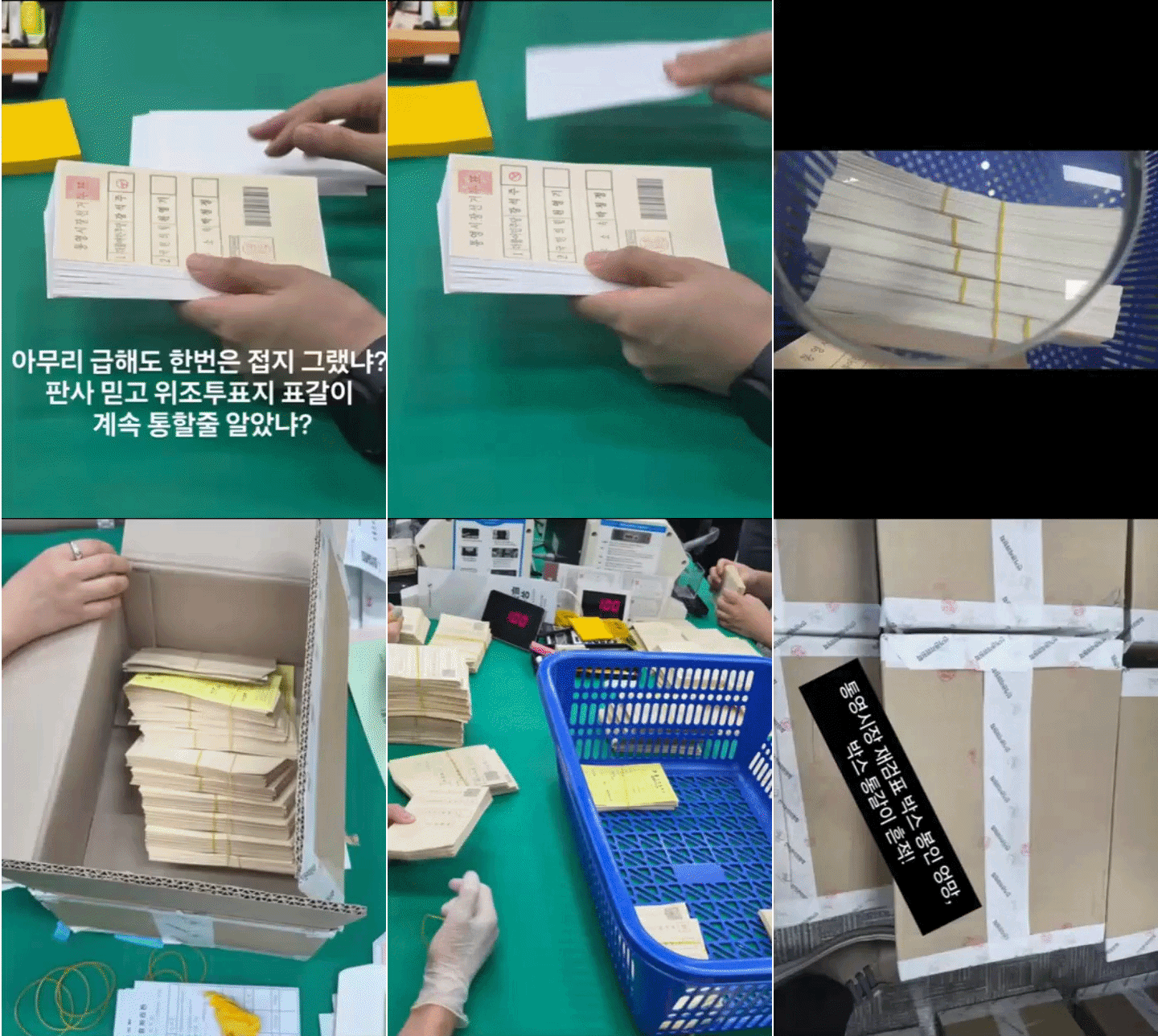 “Ignoring crisp ballots and damaged seals”… Tongyeong mayoral recount concludes with ‘no change in outcome,’ leaving suspicions and public outrage behind
Suspected counterfeit ballots discovered in Tongyeong [GIF from social media of Representative Hwang Kyo-ahn / Attorney Park Joo-hyun]During a recount of the Tongyeong mayoral election in South Gyeong
“Ignoring crisp ballots and damaged seals”… Tongyeong mayoral recount concludes with ‘no change in outcome,’ leaving suspicions and public outrage behind
Suspected counterfeit ballots discovered in Tongyeong [GIF from social media of Representative Hwang Kyo-ahn / Attorney Park Joo-hyun]During a recount of the Tongyeong mayoral election in South Gyeong
 President Yoon, regarding the first-instance ruling on the Public Official Election Act: “An excessive political verdict that distorts the facts… We will appeal immediately.”
The first-instance sentencing hearing for President Yoon Suk Yeol regarding violations of the Public Official Election Act is being broadcast live at Seoul Station on the 27th. [Photo=Yonhap News]Pres
President Yoon, regarding the first-instance ruling on the Public Official Election Act: “An excessive political verdict that distorts the facts… We will appeal immediately.”
The first-instance sentencing hearing for President Yoon Suk Yeol regarding violations of the Public Official Election Act is being broadcast live at Seoul Station on the 27th. [Photo=Yonhap News]Pres
 WSJ: "SK Hynix ADR Premium Is a Sign of AI Trading Overheat"
Advertisement for SK Hynix ADR listing in New York's Times Square [Reuters=Yonhap News file photo]The Wall Street Journal (WSJ) has pointed out that the price of SK Hynix’s American Depositary Recei
WSJ: "SK Hynix ADR Premium Is a Sign of AI Trading Overheat"
Advertisement for SK Hynix ADR listing in New York's Times Square [Reuters=Yonhap News file photo]The Wall Street Journal (WSJ) has pointed out that the price of SK Hynix’s American Depositary Recei
 'Godfather of Japanese Mystery Novels' Keigo Higashino Passes Away After Battle with Cancer at 68
Famous Japanese mystery novelist Keigo Higashino [AFP=Yonhap News]It has been belatedly reported that Keigo Higashino, the "godfather of Japanese mystery novels" and author of bestsellers such as "The
'Godfather of Japanese Mystery Novels' Keigo Higashino Passes Away After Battle with Cancer at 68
Famous Japanese mystery novelist Keigo Higashino [AFP=Yonhap News]It has been belatedly reported that Keigo Higashino, the "godfather of Japanese mystery novels" and author of bestsellers such as "The
 [Park Pil-kyu Security Column] To the Ignorant Trying to Clothe a Beast in Sheep's Clothing
Rep. Kim Byung-joo of the Democratic Party of Korea [Photo=Yonhap News]“The Air Force Academy doesn't teach you how to fly a plane!” “The Army, Navy, and Air Force academies are exactly the
[Park Pil-kyu Security Column] To the Ignorant Trying to Clothe a Beast in Sheep's Clothing
Rep. Kim Byung-joo of the Democratic Party of Korea [Photo=Yonhap News]“The Air Force Academy doesn't teach you how to fly a plane!” “The Army, Navy, and Air Force academies are exactly the
 [Issue Diagnosis] Two Effects of the Election Petition Review
 [Photo] Evidence of Election Fraud Flooding U.S. Media… Trump Had 2.7 Million Votes Stolen
 [Video] U.S. Semiquincentennial Air Show... 'Art in the Sky' streaks across New York
 [Editorial Cartoon] A Draconian Law That Undermines Freedom of Expression

 List
List









