 [Fox News Video GIF]
A Congressional Research Service (CRS) report has been released on how Congress might influence the U.S.-South Korea alliance as it reaches an "inflection point" with the "modernization" efforts by President Donald Trump and the Lee Jae-myung administration, and as it enters a new phase.
The report, titled "U.S.-South Korea Alliance: Background and Issues for Congress," authored by analyst Daniel J. Longo and dated March 5, provides various background materials to help members of Congress respond to the Trump administration's actions related to the alliance.
In a political context, an inflection point signifies a "critical turning point" where the trajectory of a nation or society fundamentally changes. It signifies not just a shift in circumstances, but a point where the existing order collapses and a new order is formed.
The report outlines Congress's role, focusing on "strategic flexibility" and "extended nuclear deterrence on the Korean Peninsula."
Specific issues mentioned include: △ Burden-sharing for the cost of stationing U.S. troops in South Korea △ Wartime operational control transfer issues △ The role of U.S. forces in South Korea regarding China: "Strategic Flexibility" △ The future of the U.S.-South Korea-Japan trilateral cooperation system △ The alliance's response to North Korea's nuclear threat: whether to adjust for improved inter-Korean relations △ U.S.-South Korea cooperation in shipbuilding △ South Korea's adoption of nuclear submarine technology and approval for uranium enrichment and reprocessing.
The report also draws attention with its numerous sections that compare the stances of former President Yoon Suk-yeol and current President Lee Jae-myung.
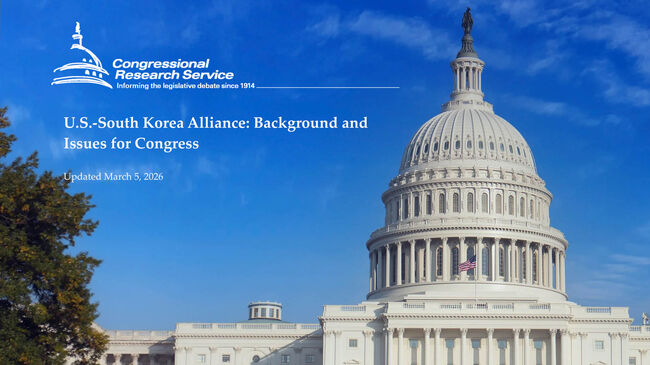
▶ View the full report here >>
The following is an excerpt from the report:
Some analyses suggest that the U.S.-South Korea alliance may have reached a turning point as both the Donald Trump administration and the Lee Jae-myung administration further pursue the "modernization" of the alliance.
President Lee Jae-myung has expressed South Korea's intent to acquire nuclear-powered submarines, and President Trump has indicated his support for this. While South Korea could utilize such submarines to counter North Korea and potentially China, there is debate among South Korean policymakers and experts about the prudence of deploying South Korean assets against China.
As the U.S.-South Korea alliance potentially enters a new phase, Congress may face several key issues related to its legislative, oversight, and appropriations roles, which could affect how the United States and South Korea navigate decisions such as the following.
Discussions on these issues arise at a time when both President Trump, should he be inaugurated in 2025, and President Lee Jae-myung of South Korea have expressed interest in the alliance's evolution. President Trump's 2025 National Security Strategy (NSS) appears to reposition South Korea as a potential linchpin not only in the region surrounding the Korean Peninsula but also in the United States' broader regional security priorities.
As part of its goal to have South Korea play a more leading role in the alliance, the Trump administration has expressed support for South Korea's acquisition of nuclear-powered submarines. Depending on the specifics of U.S.-South Korea cooperation on submarine development, a new bilateral nuclear cooperation agreement may be required under the Atomic Energy Act of 1954, as amended (AEA; P.L. 83-703; 42 U.S.C. §§2111 et seq).
The Trump administration has indicated an increased focus on broader Indo-Pacific threats, such as those posed by China, which could lead to a realignment of U.S. forces in South Korea. The Lee Jae-myung administration has pledged increased defense spending, additional U.S. weapons purchases, and continued military modernization. Both sides have also agreed to accelerate the reorganization of the alliance's command and control structure and strengthen trilateral cooperation with Japan.
South Korea's two major political parties support the U.S.-South Korea alliance, but they have historically shown distinct approaches to North Korea, China, and Japan. Generally, Democratic politicians, leaning center-left, have tended to express a stronger inclination toward expanding South Korea's strategic autonomy, adopting a more conciliatory approach toward North Korea, and showing distrust toward Japan, compared to conservative parties. In contrast, People Power Party politicians, leaning center-right, have tended to emphasize the importance of maintaining the U.S.-South Korea alliance, have been more skeptical about improving relations with North Korea, have shown less reluctance to establish formal cooperative relations with Japan, and have recently become more active in criticizing China's behavior.
More recently, the Democratic Party, leaning center-left, has shown a more cautious support for improving relations with North Korea, has expressed a commitment to strengthening South Korea's security through the U.S.-South Korea alliance, and has become more active in improving strategic relations with Japan. This trend is particularly noticeable among younger progressives.
The size of the U.S. military presence in South Korea has been a persistent point of contention amidst evolving political, security, and other dynamics, and has become particularly salient during President Trump's tenure.
At a summit with President Lee Jae-myung in Washington on August 25, 2025, President Trump raised the idea of the United States owning land for U.S. military bases in South Korea. While this has raised legal questions among some experts, it may signal the Trump administration's intention to maintain a U.S. military presence in South Korea.
Some experts argue that the U.S. military presence in South Korea is an essential part of the U.S. mutual defense commitment, and that a reduction in U.S. forces on the peninsula could raise questions about the credibility of that commitment among the South and North Korean populations... Other analysts contend that South Korea is now capable of defending itself, and that a continued U.S. presence could be provocative to nuclear-armed North Korea. North Korea could perceive a large U.S. military presence as a threat.
Today, as assessments of the threats posed by China and North Korea evolve, the debate over the size of the U.S. military presence on the Korean Peninsula remains a critical issue, given South Korea's military buildup and President Trump's public expressions of dissatisfaction with the alliance's asymmetrical nature.
"Strategic flexibility" is once again gaining prominence as the Donald Trump administration, in its second term, signals a move to modernize the alliance to more actively counter not only North Korea but also Chinese threats. By 2025, joint statements between the U.S. and South Korea, particularly at the Trump-Lee summit in November, have committed to "strengthening U.S. conventional deterrence against all regional threats to the U.S.-ROK alliance, including North Korea." At least one U.S. senator has stated his support for the strategic flexibility of U.S. forces, provided that (1) the alliance can continue to deter North Korea and (2) Congress maintains its oversight role in discussions of strategic flexibility.
General Xavier Brunson, commander of U.S. Forces Korea, has reportedly stated that the U.S. military in South Korea is "part of a broader Indo-Pacific strategy, not just focused on deterring North Korea." In 2022, former U.S. Forces Korea commander General Robert Abrams reportedly said that the United States would keep "all options open, including the potential mobilization of all military assets, including those in South Korea" in the event of a conflict surrounding Taiwan.
The Trump administration, in its second term, has shown a move to reorient U.S. forces in South Korea to counter China as an overseas "threat actor" and to prepare for contingencies in Taiwan. For example, the U.S. Air Force has permanently stationed MQ-9 Reaper drones at Kunsan Air Base on South Korea's west coast since September 2025. These drones are known to support intelligence, surveillance, and reconnaissance operations, with an operational range that includes not only the Demilitarized Zone (DMZ) but also the East China Sea and Taiwan.
Even if U.S. forces in South Korea adopt a posture geared toward cross-strait relations, it remains unclear what role South Korean forces would play in a conflict over Taiwan... South Korean officials have consistently argued that in any conflict scenario, South Korean forces must prioritize the threat from North Korea...
In the event of a Taiwan contingency, some analysts anticipate that U.S. policymakers would expect South Korea to continue deterring North Korea and provide indirect military support to Taiwan, such as logistical support for U.S. forces and reconnaissance of Chinese military assets. Then-President Yoon Suk-yeol emphasized in 2022 that "the highest priority of the U.S.-ROK alliance is based on a strong defense posture on the Korean Peninsula, so we must first address the North Korean threat." Current President Lee Jae-myung, during his campaign, was asked if South Korea would support Taiwan if China attacked it. President Lee responded, "I will consider that question when aliens try to invade Earth." Furthermore, if South Korea pursues the development of nuclear-powered submarines, some U.S. officials have stated that the United States would expect South Korea to utilize those submarines to support joint efforts in the region to counter China.
President Yoon stated ahead of his summit with President Biden in April 2023 that the situation in Taiwan is a "global issue" and that China was escalating tensions across the strait by "attempting to change the status quo by force."
Despite South Korea becoming more vocal in criticizing China's behavior, some South Korean policymakers, particularly within the progressive camp, tend to express more discomfort with high levels of bilateral tension with the United States than their American counterparts. Under the current Lee Jae-myung administration, joint statements between the U.S. and South Korea have mentioned "the importance of maintaining peace and stability in the Taiwan Strait." Simultaneously, President Lee stated after a summit with Chinese President Xi Jinping in November 2025 that the two countries are "walking on a path of mutual prosperity as strategic cooperative partners."
Whether South Korea will permit U.S. forces stationed on its territory to conduct offensive operations against China in the event of a Taiwan contingency is a highly sensitive and uncertain issue... South Korea could object to the stationing of U.S. forces on the peninsula for a variety of reasons, including a desire not to provoke China, a preference to focus all U.S. forces stationed in South Korea on the North Korean threat, or an unwillingness by South Korean leadership to engage in operations related to a U.S.-China dispute.
Congress could review whether the Department of Defense is adequately considering these political risks in its strategic and operational planning.
In November 2025, Presidents Trump and Lee announced that South Korea "shared its plan to provide comprehensive support totaling $33 billion to U.S. Forces Korea in accordance with South Korean legal requirements." It is unclear how this plan relates to the 12th Special Measures Agreement (SMA), but National Security Advisor Satellite reportedly mentioned that the $33 billion figure could include indirect costs such as tax and fee exemptions for U.S. forces, which have not typically been included in SMAs.
The two countries are pursuing changes to operational control (OPCON)... If hostilities on the Korean Peninsula escalate beyond a certain threshold, the United States and South Korea can activate the Combined Forces Command (CFC) and adopt a "wartime operational control" system to command troops. Under the current system, U.S. and South Korean forces would fall under the command of a CFC led by a U.S. four-star general with a South Korean deputy commander. Neither country is willing to relinquish command of its own military.
The progressive administration of President Lee Jae-myung has reportedly proposed achieving the transfer of operational control by 2030. In November 2025, the United States and South Korea agreed to "develop a capability development roadmap to rapidly meet the conditions necessary for the transfer of wartime operational control" and to conduct the second phase of a three-phase assessment of South Korea's military capabilities in 2026.
Questions are also being raised about the future role of the United Nations Command (UNC) in the process of transferring wartime operational control (OPCON) to South Korean forces... The UNC has argued that it must ensure smooth coordination between the three commands, particularly the South Korea-led Combined Forces Command (CFC) and the UNC, which is based in South Korea and Japan.
A primary reason for South Korea's concern about extended deterrence stems from the ambiguity inherent in U.S. official statements. That is, the United States has not explicitly stated in public that it would respond with nuclear weapons to a North Korean (officially, the Democratic People's Republic of Korea, or DPRK) nuclear attack on South Korea, as opposed to conventional weapons.
Conservative South Korean politicians tend to favor South Korean nuclear armament more than progressive politicians, largely as leverage against North Korea. President Lee Jae-myung has stated his opposition to both the redeployment of U.S. tactical nuclear weapons and South Korea's development of its own nuclear weapons, as these could provoke strong international backlash. At a press conference on December 3, 2025, President Lee stated, "Denuclearization of the Korean Peninsula is a fundamental principle agreed upon by both Koreas, and we have no intention of deviating from this principle."
With the clear intention of reassuring South Koreans skeptical of U.S. extended deterrence and deterring any South Korean nuclear ambitions, both governments issued the "Washington Declaration" during then-President Yoon Suk-yeol's state visit to the White House in 2023... The Washington Declaration states that South Korea "has full confidence in U.S. extended deterrence and recognizes the importance, necessity, and benefits of continued reliance on U.S. nuclear deterrence."... They also established the Nuclear Consultative Group (NCG), which held its first meeting in June 2023.
U.S.-South Korea-Japan trilateral cooperation reached an unprecedented level at the August 2023 Camp David summit, spearheaded by Presidents Biden, Yoon Suk-yeol, and then-Japanese Prime Minister Kishida.
Potential areas for U.S.-South Korea cooperation in the shipbuilding sector include:
- Sharing best practices in shipbuilding;
- Investment by South Korean shipbuilders in U.S. shipyards;
- Performing maintenance, repair, and overhaul (MRO) work on U.S. Navy vessels at South Korean shipyards; and
- Building new vessels for the U.S. Navy at South Korean shipyards.
The United States and South Korea are cooperating in the first three areas mentioned above... The fourth area, building new vessels for the U.S. Navy at South Korean shipyards, has not yet occurred.
Two major issues for Congress to address are whether cooperation can or should be enhanced in one or more of the first three areas, and whether to initiate cooperation in the fourth area.
President Trump has expressed his willingness to meet with Chairman Kim at an "appropriate time." Some observers say they are concerned that South Korea might be excluded from such talks. South Korean President Lee Jae-myung stated, "We will keep communication channels open with North Korea and pursue peace on the Korean Peninsula through dialogue and cooperation."
If Congress seeks to support a more unilateral approach toward North Korea, it could request a report from the administration on how it plans to engage with the Kim Jong Un regime outside the framework of the U.S.-South Korea alliance and what implications such engagement might have for regional security dynamics.
U.S. NNP=Sung Ku Hong, Chief Reporter / Special Contribution NNP info@newsandpost.com

 Iranian Foreign Ministry: "Continuing Message Exchanges with the U.S. and Activities of Mediating Countries"
Esmaeil Baghaei, Spokesperson for the Iranian Ministry of Foreign Affairs [Xinhua, Yonhap News file photo]Esmaeil Baghaei, spokesperson for the Iranian Ministry of Foreign Affairs, stated on the 26th
Iranian Foreign Ministry: "Continuing Message Exchanges with the U.S. and Activities of Mediating Countries"
Esmaeil Baghaei, Spokesperson for the Iranian Ministry of Foreign Affairs [Xinhua, Yonhap News file photo]Esmaeil Baghaei, spokesperson for the Iranian Ministry of Foreign Affairs, stated on the 26th
 President Yoon: "Do You Think You Are Safe from the Special Counsel?"... Final Statement Video Released
President Yoon Suk Yeol rebuking the special prosecutor on the 24th. [Court video / @birds_justice X account subtitle GIF] A video of President Yoon Suk Yeol's closing statement at his trial rega
President Yoon: "Do You Think You Are Safe from the Special Counsel?"... Final Statement Video Released
President Yoon Suk Yeol rebuking the special prosecutor on the 24th. [Court video / @birds_justice X account subtitle GIF] A video of President Yoon Suk Yeol's closing statement at his trial rega
 President Yoon, regarding the first-instance ruling on the Public Official Election Act: “An excessive political verdict that distorts the facts… We will appeal immediately.”
The first-instance sentencing hearing for President Yoon Suk Yeol regarding violations of the Public Official Election Act is being broadcast live at Seoul Station on the 27th. [Photo=Yonhap News]Pres
President Yoon, regarding the first-instance ruling on the Public Official Election Act: “An excessive political verdict that distorts the facts… We will appeal immediately.”
The first-instance sentencing hearing for President Yoon Suk Yeol regarding violations of the Public Official Election Act is being broadcast live at Seoul Station on the 27th. [Photo=Yonhap News]Pres
 WSJ: "SK Hynix ADR Premium Is a Sign of AI Trading Overheat"
Advertisement for SK Hynix ADR listing in New York's Times Square [Reuters=Yonhap News file photo]The Wall Street Journal (WSJ) has pointed out that the price of SK Hynix’s American Depositary Recei
WSJ: "SK Hynix ADR Premium Is a Sign of AI Trading Overheat"
Advertisement for SK Hynix ADR listing in New York's Times Square [Reuters=Yonhap News file photo]The Wall Street Journal (WSJ) has pointed out that the price of SK Hynix’s American Depositary Recei
 'Godfather of Japanese Mystery Novels' Keigo Higashino Passes Away After Battle with Cancer at 68
Famous Japanese mystery novelist Keigo Higashino [AFP=Yonhap News]It has been belatedly reported that Keigo Higashino, the "godfather of Japanese mystery novels" and author of bestsellers such as "The
'Godfather of Japanese Mystery Novels' Keigo Higashino Passes Away After Battle with Cancer at 68
Famous Japanese mystery novelist Keigo Higashino [AFP=Yonhap News]It has been belatedly reported that Keigo Higashino, the "godfather of Japanese mystery novels" and author of bestsellers such as "The
 [Park Pil-kyu Security Column] To the Ignorant Trying to Clothe a Beast in Sheep's Clothing
Rep. Kim Byung-joo of the Democratic Party of Korea [Photo=Yonhap News]“The Air Force Academy doesn't teach you how to fly a plane!” “The Army, Navy, and Air Force academies are exactly the
[Park Pil-kyu Security Column] To the Ignorant Trying to Clothe a Beast in Sheep's Clothing
Rep. Kim Byung-joo of the Democratic Party of Korea [Photo=Yonhap News]“The Air Force Academy doesn't teach you how to fly a plane!” “The Army, Navy, and Air Force academies are exactly the
 [Issue Diagnosis] Two Effects of the Election Petition Review
 [Photo] Evidence of Election Fraud Flooding U.S. Media… Trump Had 2.7 Million Votes Stolen
 [Video] U.S. Semiquincentennial Air Show... 'Art in the Sky' streaks across New York
 [Editorial Cartoon] A Draconian Law That Undermines Freedom of Expression

 List
List










