U.S. Central Command announced on the 17th (local time) via social media that it had struck an Iranian missile base in the Strait of Hormuz. [Photo=U.S. Central Command]
The U.S. military has struck a missile base on the Iranian coast near the Strait of Hormuz with a bunker buster, also known as a "bunker buster." Amid escalating military tensions surrounding the Strait of Hormuz, a key chokepoint for global oil transport, analyses suggest this attack could go beyond a simple airstrike and lead to the next phase of the war.
U.S. Central Command (CENTCOM) announced on the social media platform X on the 17th (local time), "A few hours ago, U.S. forces employed multiple 5,000-pound penetrating bunker buster munitions against hardened missile sites on the Iranian coast near the Strait of Hormuz."
CENTCOM further explained, "Iran's anti-ship cruise missiles deployed at these sites posed a threat to international shipping traversing the strait."
Penetrating bunker busters are weapons designed to penetrate soil, rock, and concrete structures before exploding internally, and are used to destroy underground facilities or hardened military bases. This attack appears to have directly targeted the missile bases and underground facilities Iran has been building in coastal areas.
Military experts are focusing on the fact that this airstrike is not a mere warning shot but rather an operation aimed at crippling Iran's ability to blockade the strait. Iran has maintained a strategy of threatening maritime traffic routes by establishing anti-ship missile bases along the coasts of the Persian Gulf and the Strait of Hormuz.
The Strait of Hormuz is a critical maritime transport route through which approximately 20% of the world's crude oil passes. Military conflicts in this area could have significant repercussions for the global energy market.
The timing of this attack is particularly noteworthy.
Recently, U.S. President Donald Trump has requested major maritime nations, including South Korea, Japan, the United Kingdom, and France, to dispatch warships to protect the shipping lanes in the Strait of Hormuz. However, the response from allied nations has generally been cautious or passive.
Against this backdrop, the U.S. military's direct strike on Iranian missile bases near the strait is being interpreted not merely as a military action, but as the beginning of an "Iran blockade operation" that preemptively eliminates Iran's ability to blockade the strait and intensifies pressure on the country.
South Korea, the U.S., and Japan had previously analyzed that the next phase of this conflict would likely involve maritime pressure and blockade strategies centered on the Strait of Hormuz. This U.S. bunker buster airstrike is seen as the first instance where this "second act of war" has materialized into actual military operations.
Military experts anticipate that future U.S. strategy may involve the phased elimination of Iranian coastal assets around the strait. In such a scenario, additional targets could include anti-ship missile bases, radar facilities, and mobile launchers, forming part of the coastal defense network.
Furthermore, the possibility of the U.S. Navy and allied navies expanding escort operations for merchant vessels and maritime surveillance in the Persian Gulf and the Arabian Sea, thereby strengthening maritime control, is also being raised.
Ultimately, this airstrike is being evaluated not just as an attack on missile bases, but as an event demonstrating that the focus of the war is shifting from military confrontation to a blockade strategy aimed at pressuring Iran.

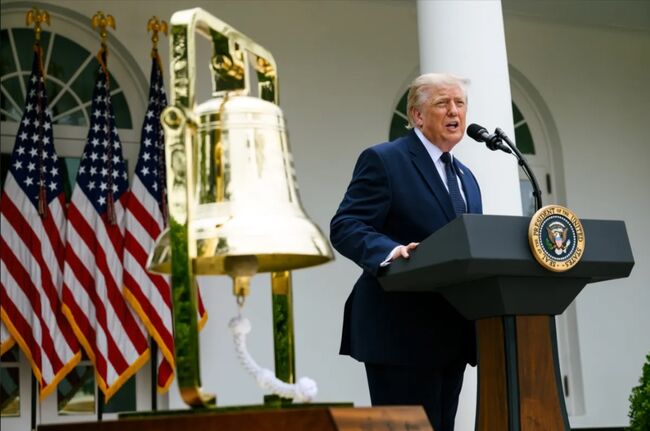 Trump pressures for rate cut again ahead of FOMC... "Should be the lowest in the world"
U.S. President Donald Trump. [Photo = The White House] U.S. President Donald Trump once again pressured the Federal Reserve, the U.S. central bank, to lower interest rates on the 27th (local time
Trump pressures for rate cut again ahead of FOMC... "Should be the lowest in the world"
U.S. President Donald Trump. [Photo = The White House] U.S. President Donald Trump once again pressured the Federal Reserve, the U.S. central bank, to lower interest rates on the 27th (local time
 “Ignoring crisp ballots and damaged seals”… Tongyeong mayoral recount concludes with ‘no change in outcome,’ leaving suspicions and public outrage behind
Suspected counterfeit ballots discovered in Tongyeong [GIF from social media of Representative Hwang Kyo-ahn / Attorney Park Joo-hyun]During a recount of the Tongyeong mayoral election in South Gyeong
“Ignoring crisp ballots and damaged seals”… Tongyeong mayoral recount concludes with ‘no change in outcome,’ leaving suspicions and public outrage behind
Suspected counterfeit ballots discovered in Tongyeong [GIF from social media of Representative Hwang Kyo-ahn / Attorney Park Joo-hyun]During a recount of the Tongyeong mayoral election in South Gyeong
 President Yoon, regarding the first-instance ruling on the Public Official Election Act: “An excessive political verdict that distorts the facts… We will appeal immediately.”
The first-instance sentencing hearing for President Yoon Suk Yeol regarding violations of the Public Official Election Act is being broadcast live at Seoul Station on the 27th. [Photo=Yonhap News]Pres
President Yoon, regarding the first-instance ruling on the Public Official Election Act: “An excessive political verdict that distorts the facts… We will appeal immediately.”
The first-instance sentencing hearing for President Yoon Suk Yeol regarding violations of the Public Official Election Act is being broadcast live at Seoul Station on the 27th. [Photo=Yonhap News]Pres
 WSJ: "SK Hynix ADR Premium Is a Sign of AI Trading Overheat"
Advertisement for SK Hynix ADR listing in New York's Times Square [Reuters=Yonhap News file photo]The Wall Street Journal (WSJ) has pointed out that the price of SK Hynix’s American Depositary Recei
WSJ: "SK Hynix ADR Premium Is a Sign of AI Trading Overheat"
Advertisement for SK Hynix ADR listing in New York's Times Square [Reuters=Yonhap News file photo]The Wall Street Journal (WSJ) has pointed out that the price of SK Hynix’s American Depositary Recei
 'Godfather of Japanese Mystery Novels' Keigo Higashino Passes Away After Battle with Cancer at 68
Famous Japanese mystery novelist Keigo Higashino [AFP=Yonhap News]It has been belatedly reported that Keigo Higashino, the "godfather of Japanese mystery novels" and author of bestsellers such as "The
'Godfather of Japanese Mystery Novels' Keigo Higashino Passes Away After Battle with Cancer at 68
Famous Japanese mystery novelist Keigo Higashino [AFP=Yonhap News]It has been belatedly reported that Keigo Higashino, the "godfather of Japanese mystery novels" and author of bestsellers such as "The
 [Park Pil-kyu Security Column] To the Ignorant Trying to Clothe a Beast in Sheep's Clothing
Rep. Kim Byung-joo of the Democratic Party of Korea [Photo=Yonhap News]“The Air Force Academy doesn't teach you how to fly a plane!” “The Army, Navy, and Air Force academies are exactly the
[Park Pil-kyu Security Column] To the Ignorant Trying to Clothe a Beast in Sheep's Clothing
Rep. Kim Byung-joo of the Democratic Party of Korea [Photo=Yonhap News]“The Air Force Academy doesn't teach you how to fly a plane!” “The Army, Navy, and Air Force academies are exactly the
 [Issue Diagnosis] Two Effects of the Election Petition Review
 [Photo] Evidence of Election Fraud Flooding U.S. Media… Trump Had 2.7 Million Votes Stolen
 [Video] U.S. Semiquincentennial Air Show... 'Art in the Sky' streaks across New York
 [Editorial Cartoon] A Draconian Law That Undermines Freedom of Expression

 List
List