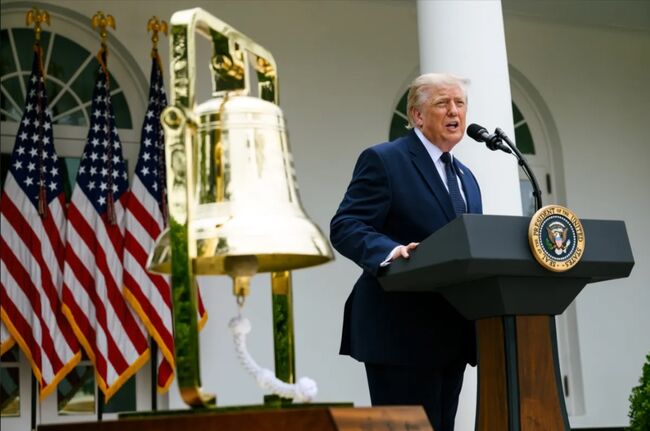
U.S. President Donald Trump [EPA Yonhap News]
The New York Times (NYT) reported on the 17th (local time) that U.S. President Donald Trump appears to be considering options to seize or destroy Iran's nuclear weapons materials.
If an operation were successful, it could serve as a justification for President Trump's declaration of victory. However, it is being evaluated as the most dangerous of modern military operations for the U.S. military.
According to the NYT, President Trump has been making statements in recent days that suggest he is weighing options for directly handling highly enriched uranium, which Iran could process into nuclear material feedstock.
President Trump has repeatedly asserted the justification for the ongoing military attack.
In this context, the logic presented by President Trump was that Iran was on the verge of acquiring nuclear weapons and had a high probability of using them against Israel and the United States in the future.
When meeting with reporters on the 16th, President Trump stated, "If Iran has nuclear weapons, they will use them within an hour, within a day, so a bad situation will occur."
According to the International Atomic Energy Agency (IAEA) and reports from prominent media outlets, Iran is estimated to possess 440 kg of enriched uranium with 60% purity.
This is a level that could reach the 90% purity required to build a nuclear bomb within weeks, and it is also observed that the current amount could be used to manufacture 9 to 10 nuclear warheads.
The whereabouts of this weapons-grade highly enriched uranium possessed by Iran are uncertain.
Various theories abound, ranging from speculation that it is among the debris of Iran's Isfahan nuclear facility, which the U.S. bombed last June, to claims that Iran secretly removed it before the bombing.
U.S. Secretary of State Marco Rubio recently stated in Congress that an operation to seize highly enriched uranium would require direct intervention by special forces.
President Trump, meeting with reporters, opened the possibility of deploying special forces, stating, "I am not afraid of ground operations at all."
Regardless of where the nuclear material is located, the mission to seize or destroy it is generally considered to be of unprecedented difficulty in modern warfare.
The NYT pointed out that it would be far more complex and dangerous than the operation to kill Osama bin Laden in 2011 or the operation to capture Venezuelan President Nicolas Maduro in January.
This is because it is difficult to pinpoint the exact location of the hidden uranium, and if the storage containers are damaged, highly toxic radioactive gas could leak.
There are also concerns that a chain reaction could occur if the containers are closely packed.
The possibility that Iran may have prepared tactics for hiding and deceiving regarding nuclear materials is also being raised.
It is speculated that hundreds of decoy containers could be placed within facilities to disrupt U.S. special forces operations.
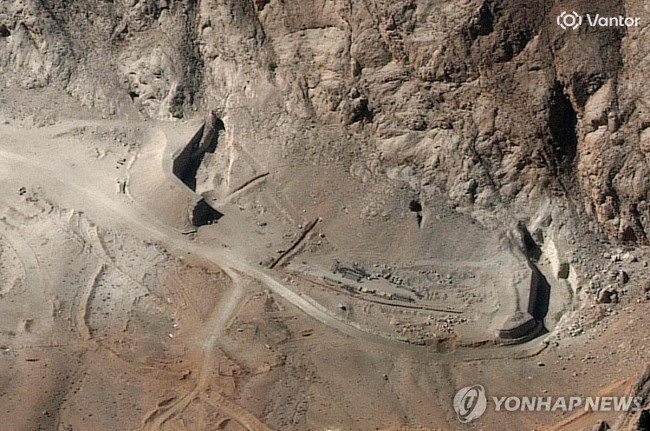 Entrance to a tunnel at Iran's central Isfahan missile base destroyed by U.S. and Israeli attacks. March 8, 2026. [AFP Yonhap News]
There are also many observations that the whereabouts of Iran's weapons-grade enriched uranium are directly linked to President Trump's justification for victory.
The current war, which began on the 28th of last month with surprise air strikes by the U.S. and Israel, is dragging on contrary to the initial expectations of both countries.
Experts point out that if President Trump were to conclude the war under the current circumstances due to costs and deteriorating public opinion, repercussions could follow.
The worst-case scenario is Iran actually embarking on the development of nuclear weapons.
Matthew Bunn, a nuclear expert at Harvard University, expressed concern, stating, "If the U.S. stops its attacks right now, the Iranian regime, harboring resentment from this war, will unprecedentedly pursue the manufacture of nuclear weapons."
There are conflicting assessments regarding how quickly Iran can convert its 60% enriched uranium into weapons.
President Trump claims that before bombing Iran's nuclear facilities last June, Iran could have produced nuclear weapons within a month.
Experts analyze that while Iran could have raised the purity of that enriched uranium to bomb-grade within a month, it would have taken more than several months, possibly up to a year, to build even a crude nuclear weapon.
Joe Kent, Director of the U.S. National Counterterrorism Center (NCTC), also resigned that day, arguing that Iran did not pose an imminent threat to the U.S.
Weapons-grade enriched uranium is drawing attention as a crucial leverage in a situation where conventional missile capabilities have been significantly weakened by the intense bombardment from the U.S. and Israel.
Given the extreme difficulty of a seizure operation, there are also predictions that diplomatic compromises, which were abandoned just before the war's outbreak, could re-emerge at some point.
Iranian Foreign Minister Abbas Araghchi proposed last month to dilute nuclear materials to a level suitable for power generation under IAEA inspection but to store them within Iran.
However, the U.S. rejected this, stating it could not tolerate Iran possessing nuclear materials, leading to the collapse of negotiations and ultimately the outbreak of war.
The NYT reported that while the U.S. approach to removing or diluting weapons-grade enriched uranium could become part of an agreement in future ceasefire negotiations, there are no signs that a solution will emerge through negotiations.

 Trump pressures for rate cut again ahead of FOMC... "Should be the lowest in the world"
U.S. President Donald Trump. [Photo = The White House] U.S. President Donald Trump once again pressured the Federal Reserve, the U.S. central bank, to lower interest rates on the 27th (local time
Trump pressures for rate cut again ahead of FOMC... "Should be the lowest in the world"
U.S. President Donald Trump. [Photo = The White House] U.S. President Donald Trump once again pressured the Federal Reserve, the U.S. central bank, to lower interest rates on the 27th (local time
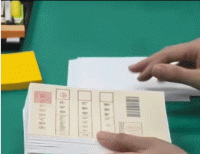
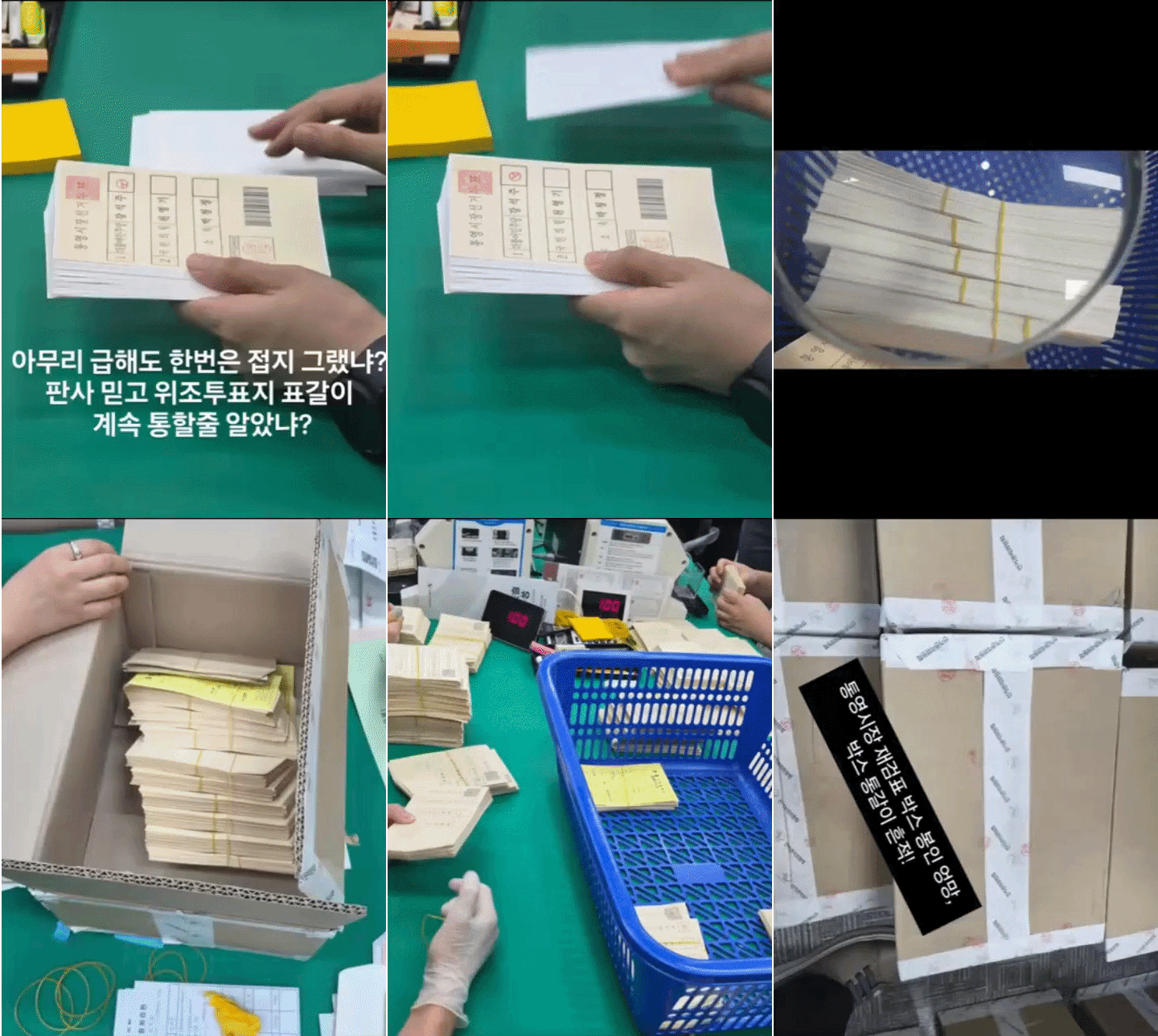 “Ignoring crisp ballots and damaged seals”… Tongyeong mayoral recount concludes with ‘no change in outcome,’ leaving suspicions and public outrage behind
Suspected counterfeit ballots discovered in Tongyeong [GIF from social media of Representative Hwang Kyo-ahn / Attorney Park Joo-hyun]During a recount of the Tongyeong mayoral election in South Gyeong
“Ignoring crisp ballots and damaged seals”… Tongyeong mayoral recount concludes with ‘no change in outcome,’ leaving suspicions and public outrage behind
Suspected counterfeit ballots discovered in Tongyeong [GIF from social media of Representative Hwang Kyo-ahn / Attorney Park Joo-hyun]During a recount of the Tongyeong mayoral election in South Gyeong
 President Yoon, regarding the first-instance ruling on the Public Official Election Act: “An excessive political verdict that distorts the facts… We will appeal immediately.”
The first-instance sentencing hearing for President Yoon Suk Yeol regarding violations of the Public Official Election Act is being broadcast live at Seoul Station on the 27th. [Photo=Yonhap News]Pres
President Yoon, regarding the first-instance ruling on the Public Official Election Act: “An excessive political verdict that distorts the facts… We will appeal immediately.”
The first-instance sentencing hearing for President Yoon Suk Yeol regarding violations of the Public Official Election Act is being broadcast live at Seoul Station on the 27th. [Photo=Yonhap News]Pres
 WSJ: "SK Hynix ADR Premium Is a Sign of AI Trading Overheat"
Advertisement for SK Hynix ADR listing in New York's Times Square [Reuters=Yonhap News file photo]The Wall Street Journal (WSJ) has pointed out that the price of SK Hynix’s American Depositary Recei
WSJ: "SK Hynix ADR Premium Is a Sign of AI Trading Overheat"
Advertisement for SK Hynix ADR listing in New York's Times Square [Reuters=Yonhap News file photo]The Wall Street Journal (WSJ) has pointed out that the price of SK Hynix’s American Depositary Recei
 'Godfather of Japanese Mystery Novels' Keigo Higashino Passes Away After Battle with Cancer at 68
Famous Japanese mystery novelist Keigo Higashino [AFP=Yonhap News]It has been belatedly reported that Keigo Higashino, the "godfather of Japanese mystery novels" and author of bestsellers such as "The
'Godfather of Japanese Mystery Novels' Keigo Higashino Passes Away After Battle with Cancer at 68
Famous Japanese mystery novelist Keigo Higashino [AFP=Yonhap News]It has been belatedly reported that Keigo Higashino, the "godfather of Japanese mystery novels" and author of bestsellers such as "The
 [Park Pil-kyu Security Column] To the Ignorant Trying to Clothe a Beast in Sheep's Clothing
Rep. Kim Byung-joo of the Democratic Party of Korea [Photo=Yonhap News]“The Air Force Academy doesn't teach you how to fly a plane!” “The Army, Navy, and Air Force academies are exactly the
[Park Pil-kyu Security Column] To the Ignorant Trying to Clothe a Beast in Sheep's Clothing
Rep. Kim Byung-joo of the Democratic Party of Korea [Photo=Yonhap News]“The Air Force Academy doesn't teach you how to fly a plane!” “The Army, Navy, and Air Force academies are exactly the
 [Issue Diagnosis] Two Effects of the Election Petition Review
 [Photo] Evidence of Election Fraud Flooding U.S. Media… Trump Had 2.7 Million Votes Stolen
 [Video] U.S. Semiquincentennial Air Show... 'Art in the Sky' streaks across New York
 [Editorial Cartoon] A Draconian Law That Undermines Freedom of Expression

 List
List