Apache Helicopter [EPA Yonhap News]
The United States has begun to intensify its military operations to normalize the flow of traffic in the Strait of Hormuz.
As the economic fallout of the war in Iran escalated, with international oil prices soaring due to the virtual blockage of crude oil transport through the Strait of Hormuz, the U.S. has launched operations to directly eliminate Iranian military assets threatening maritime routes, deploying Apache attack helicopters and other assets.
According to The Wall Street Journal (WSJ) on the 19th (local time), Chairman of the Joint Chiefs of Staff Dan Caine announced at a press conference that the U.S. had deployed low-flying A-10 attack aircraft and Apache attack helicopters over the Strait of Hormuz.
Caine stated, "The A-10 is conducting operations targeting high-speed attack boats in the Strait of Hormuz, and Apache helicopters have also joined the combat."
He also mentioned, without naming specific countries, that some allies are participating in operations using Apache helicopters.
The Strait of Hormuz is a vital maritime chokepoint through which 20% of the world's crude oil exports pass.
Following the outbreak of war due to airstrikes by the U.S. and Israel, Iran began to virtually blockade ship traffic by laying mines in the strait and deploying suicide speedboats and drones.
As oil tanker passage was blocked, international oil prices surged, and the stock market also fluctuated, beginning to impact the U.S. economy.
There were even predictions that interest rate cuts, which President Donald Trump had been pushing for by pressuring Federal Reserve Chairman Jerome Powell, might not happen.
As the situation escalated, the U.S. requested allies to dispatch warships to escort vessels passing through the Strait of Hormuz, but was refused. In an effort to redirect the strait's flow, the U.S. deployed Apache helicopters and other assets.
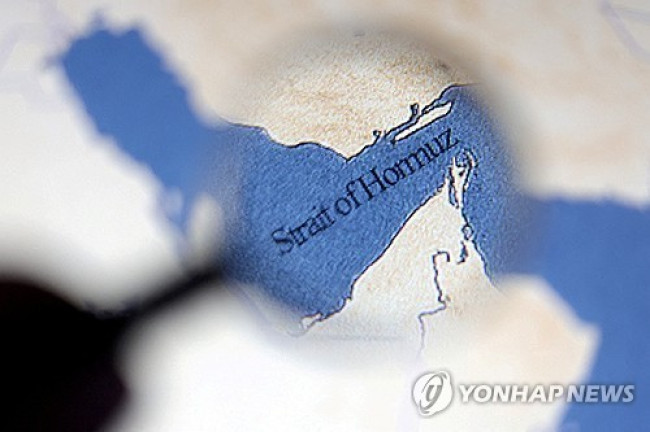 Map of the Strait of Hormuz [Reuters Yonhap News]
The underlying judgment appears to be that if the threats posed by Iranian mines and drones are mitigated to some extent from the air, warships could then be deployed to escort vessels through the Strait of Hormuz.
However, the WSJ predicted that it could take weeks for the U.S. to completely clear Iran's complex military assets from the area.
Farzin Nadimi, an Iran expert at the Washington Institute for Near East Policy, a U.S. think tank, assessed that despite U.S. airstrikes, Iran still possesses a vast amount of mines, cruise missiles, and hundreds of vessels.
"It will take weeks to reach a level where operations can be conducted safely in the strait, and even then, a significant amount of Iran's military assets will remain," he said.
Michael Connell, an Iran expert at the Center for Naval Analyses (CNA), also noted that the narrowest point of the Strait of Hormuz is only about 30 kilometers wide, stating that reducing the threat to a level where ships can resume passage is "possible but will take time, and it will likely be difficult to eliminate the threat 100%."
This implies that even if a stage is reached where threats are somewhat cleared and ship traffic can resume, the possibility of being attacked cannot be ruled out.
The WSJ also pointed out that normalizing the flow through the strait has become an urgent issue as Iran has begun to "weaponize" it by considering charging passage fees for vessels transiting the Strait of Hormuz and selectively allowing passage for ships from certain countries.
The analysis suggests that the U.S. cannot accept a situation where Iran leverages its control over the Strait of Hormuz to alleviate diplomatic isolation and establish trade relationships with countries needing oil and natural gas.
Danny Citrinowicz, a research fellow at the Atlantic Council, a U.S. think tank, commented, "Such attempts would practically create an interdependence, forcing countries that must secure energy from the Gulf region to accept Iran's demands directly or indirectly." He added that once such a power dynamic is established, it may be fundamentally difficult to change, even after the war ends.

 Bill Pulte to Restructure ‘Deep State’… Announces 4th Round of Layoffs at the Office of the Director of National Intelligence
Acting Director of National Intelligence Bill Pulte announced Sunday that he has carried out a fourth "deliberate and measured" reduction in personnel since taking office on June 19, as part of the Tr
Bill Pulte to Restructure ‘Deep State’… Announces 4th Round of Layoffs at the Office of the Director of National Intelligence
Acting Director of National Intelligence Bill Pulte announced Sunday that he has carried out a fourth "deliberate and measured" reduction in personnel since taking office on June 19, as part of the Tr
 First U.S. Ambassador of Trump's Second Term to Arrive This Week… Will It Provide Momentum to Resolve Pending Issues?
U.S. Ambassador to South Korea Michelle Steel speaks at the opening ceremony of the Korea-U.S. Shipbuilding Cooperation Center held at the Mayflower Hotel in Washington, D.C., on the 23rd (local time)
First U.S. Ambassador of Trump's Second Term to Arrive This Week… Will It Provide Momentum to Resolve Pending Issues?
U.S. Ambassador to South Korea Michelle Steel speaks at the opening ceremony of the Korea-U.S. Shipbuilding Cooperation Center held at the Mayflower Hotel in Washington, D.C., on the 23rd (local time)
 President Yoon, regarding the first-instance ruling on the Public Official Election Act: “An excessive political verdict that distorts the facts… We will appeal immediately.”
The first-instance sentencing hearing for President Yoon Suk Yeol regarding violations of the Public Official Election Act is being broadcast live at Seoul Station on the 27th. [Photo=Yonhap News]Pres
President Yoon, regarding the first-instance ruling on the Public Official Election Act: “An excessive political verdict that distorts the facts… We will appeal immediately.”
The first-instance sentencing hearing for President Yoon Suk Yeol regarding violations of the Public Official Election Act is being broadcast live at Seoul Station on the 27th. [Photo=Yonhap News]Pres
 91% of Net Influx of MZ Generation Goes to Seoul Metropolitan Area… Population Migration Also Shows 'K-shaped Polarization' by Industry
[Provided by Leaders Index]Over the past four years, the MZ generation population has become increasingly concentrated in the Seoul metropolitan area and the Chungcheong region. While cities cen
91% of Net Influx of MZ Generation Goes to Seoul Metropolitan Area… Population Migration Also Shows 'K-shaped Polarization' by Industry
[Provided by Leaders Index]Over the past four years, the MZ generation population has become increasingly concentrated in the Seoul metropolitan area and the Chungcheong region. While cities cen
 'Godfather of Japanese Mystery Novels' Keigo Higashino Passes Away After Battle with Cancer at 68
Famous Japanese mystery novelist Keigo Higashino [AFP=Yonhap News]It has been belatedly reported that Keigo Higashino, the "godfather of Japanese mystery novels" and author of bestsellers such as "The
'Godfather of Japanese Mystery Novels' Keigo Higashino Passes Away After Battle with Cancer at 68
Famous Japanese mystery novelist Keigo Higashino [AFP=Yonhap News]It has been belatedly reported that Keigo Higashino, the "godfather of Japanese mystery novels" and author of bestsellers such as "The
 [Park Pil-kyu Security Column] To the Ignorant Trying to Clothe a Beast in Sheep's Clothing
Rep. Kim Byung-joo of the Democratic Party of Korea [Photo=Yonhap News]“The Air Force Academy doesn't teach you how to fly a plane!” “The Army, Navy, and Air Force academies are exactly the
[Park Pil-kyu Security Column] To the Ignorant Trying to Clothe a Beast in Sheep's Clothing
Rep. Kim Byung-joo of the Democratic Party of Korea [Photo=Yonhap News]“The Air Force Academy doesn't teach you how to fly a plane!” “The Army, Navy, and Air Force academies are exactly the
 [Issue Diagnosis] Two Effects of the Election Petition Review
 [Photo] Evidence of Election Fraud Flooding U.S. Media… Trump Had 2.7 Million Votes Stolen
 [Video] U.S. Semiquincentennial Air Show... 'Art in the Sky' streaks across New York
 [Editorial Cartoon] A Draconian Law That Undermines Freedom of Expression

 List
List