지난 3월27일자로 발행된 ‘주간 한미일보’ 2호에 게재된 원고입니다. <편집자주>
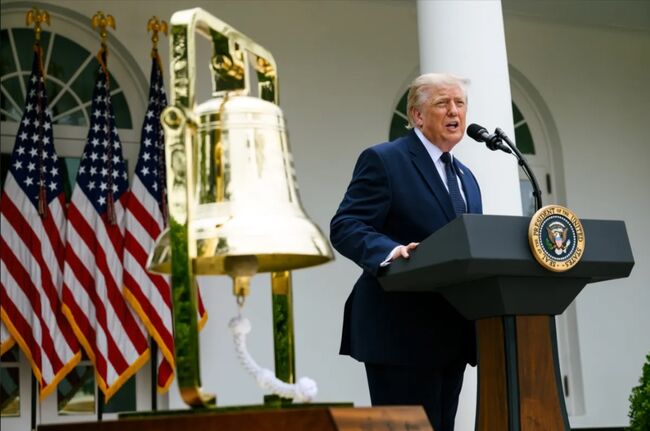
 U.S. President Donald Trump long ago realized that simply crying foul play in elections would change nothing, and that the system could only be fixed by reclaiming power through election victory. [Photo: White House]
The most noteworthy aspect of former U.S. President Donald Trump's fight against alleged election fraud is that he did not stop at mere defiance or an expression of anger.
All legal efforts to contest the 2020 presidential election failed. However, he did not stop there. In his speech at the Conservative Political Action Conference (CPAC), the largest political gathering of the conservative movement, just one month after his unceremonious departure from the White House in January 2021, he pledged to help Republicans regain control of the House and Senate in the 2022 midterm elections and hinted at a possible rerun in 2024.
'Trump-Style Direct Breakthrough' Evidenced by Investigations and Legislation
From the outset, his focus was not on pleading his case but on 'recapturing power.' He had long ago grasped the reality that simply claiming election irregularities would change nothing, and that the system could only be reformed by regaining power through an election victory.
It is also noteworthy that Trump's four years outside of power were less about founding a new party and more about a literal 'plowing of the fields' to overhaul the existing Republican Party.
According to major foreign media reports, he declared a sweeping purge of the party, targeting lawmakers, party officials, and activists who treated him as an outsider. By the time of the 2024 Republican National Convention, the Republican Party had effectively become 'Trump's Party.' He had previously exerted influence over primary rules and schedules, and in March 2024, he seized control of the Republican National Committee (RNC) leadership by positioning his close associates and daughter-in-law, Lara, to lead it.
This was not a product of spontaneous popularity but an organizational strategy to sequentially regain control of the party's structure, funding, rules, and personnel appointments with the goal of returning to power.
During his four years in the political wilderness, Trump branded mainstream Republicans who had mocked or distanced themselves from him as 'RINOs' (Republicans In Name Only), weakening those who were lukewarm or openly opposed to the allegations surrounding the 2020 election results.
As a result, the questions within the Republican Party also shifted. The party's atmosphere, which had treated election fraud claims as conspiracy theories, changed to 'Why are U.S. elections so flawed?' and 'Isn't citizenship verification or photo ID verification fundamental to elections?'
In other words, Trump succeeded not in making election fraud a 'perfectly proven incident,' but in transforming election security and voter eligibility issues into a core principle of the Republican Party and a slogan for mobilizing voters.
A key factor in this success was his ability to capture the sentiment of the declining working and middle-class white, blue-collar, and Rust Belt voters, which had been inversely proportional to globalization and the rise of China. Trump's 'America First' policy was interpreted as a will to reclaim American manufacturing and jobs by reversing the global supply chain and capital movement structures of the past 30 years.
This anti-globalization political stance was tied together by issues of borders, immigration, mail-in voting, voter registration, and election administration. For Trump's supporters, 'loose borders' and 'lax election administration' were two faces of the same ailment, and the decisive trigger point was the outcome of the 2020 presidential election.
Under the pandemic, the U.S. significantly expanded mail-in and early voting. Some states processed mail-in ballots that arrived several days, and in some cases, weeks, after election day. Combined with delays in vote counting on election night in 2020 and confusion at polling stations in major cities, Trump politicized this not as 'conclusive evidence' but as 'common-sense concern.'
This was the power of Trump's tenacity. He managed to transform doubts that were insufficient in legal terms into a demand in the language of popular politics: 'This system needs to be fixed.'
The Paradox of Turning Judicial Failure into Political Victory
Indications of foreign interference further strengthened this narrative. A report from the U.S. Director of National Intelligence (DNI) assessed that there were external influence operations aimed at undermining U.S. elections and political legitimacy during the 2020 election process.
While it did not directly disclose proof of vote manipulation, the fact that foreign actors targeted U.S. elections was confirmed. The seizure of a large number of counterfeit identification documents originating from mainland China and Hong Kong also played a role in this context.
While it cannot be definitively concluded that this directly led to illegal voting, it was sufficient to ignite public concern about the lax identification verification system and the potential for mail-in voting to be exploited.
With Trump's return to power, the distrust and convictions that had been building were translated into actual institutional reforms. The SAVE America Act is being pursued to require proof of citizenship and photo identification for new voter registrations.
It is also being used as a weapon for the midterm elections, portraying the Democratic Party as the 'party of open borders and lax election management.' The FBI's seizure of records related to the 2020 election in Fulton County, Georgia, in January is also part of this extension.
It remains uncertain whether this investigation will ultimately prove decisive fraud. However, the very act of elevating an issue that was once dismissed as a conspiracy theory to the level of a federal investigation and record retrieval is significant. The ability to re-raise issues in the language of investigation, administration, and legislation ultimately requires regaining power. This is the core lesson left by Trump.
Claims and efforts to prove election fraud are essential, but nothing will happen with them alone. To fix flawed systems, revise election administration rules, and mobilize government agencies, one must ultimately win elections and reclaim power. Trump went all-in on this point during his four years out of office.
Instead of forming a new party and shouting from the sidelines, he took over the existing large structure of the Republican Party, succeeded in returning to power, and then shifted the debate on election security to the arena of law and institutional reform. Trump's election fraud political science is more accurately viewed not as a 'history of judicial victory,' but as a 'history of politics that transformed allegations into momentum for institutional reform by returning to power.'

◆ Dr. Im Myeong-shin
Doctorate in Chinese Studies, Northeast Asian Researcher
Former Deputy Director of International Affairs, Sky Daily

 Trump pressures for rate cut again ahead of FOMC... "Should be the lowest in the world"
U.S. President Donald Trump. [Photo = The White House] U.S. President Donald Trump once again pressured the Federal Reserve, the U.S. central bank, to lower interest rates on the 27th (local time
Trump pressures for rate cut again ahead of FOMC... "Should be the lowest in the world"
U.S. President Donald Trump. [Photo = The White House] U.S. President Donald Trump once again pressured the Federal Reserve, the U.S. central bank, to lower interest rates on the 27th (local time
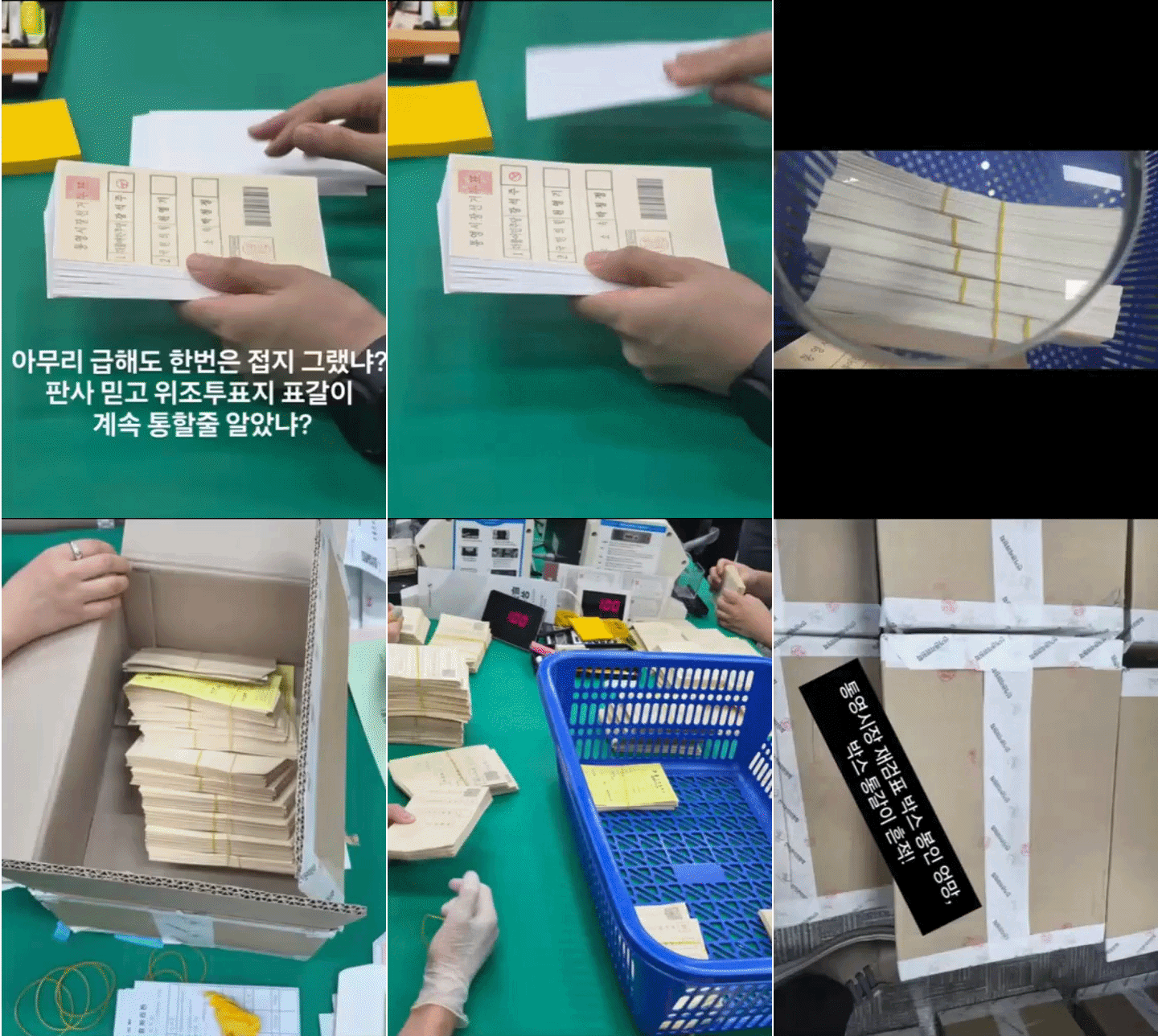 “Ignoring crisp ballots and damaged seals”… Tongyeong mayoral recount concludes with ‘no change in outcome,’ leaving suspicions and public outrage behind
Suspected counterfeit ballots discovered in Tongyeong [GIF from social media of Representative Hwang Kyo-ahn / Attorney Park Joo-hyun]During a recount of the Tongyeong mayoral election in South Gyeong
“Ignoring crisp ballots and damaged seals”… Tongyeong mayoral recount concludes with ‘no change in outcome,’ leaving suspicions and public outrage behind
Suspected counterfeit ballots discovered in Tongyeong [GIF from social media of Representative Hwang Kyo-ahn / Attorney Park Joo-hyun]During a recount of the Tongyeong mayoral election in South Gyeong
 President Yoon, regarding the first-instance ruling on the Public Official Election Act: “An excessive political verdict that distorts the facts… We will appeal immediately.”
The first-instance sentencing hearing for President Yoon Suk Yeol regarding violations of the Public Official Election Act is being broadcast live at Seoul Station on the 27th. [Photo=Yonhap News]Pres
President Yoon, regarding the first-instance ruling on the Public Official Election Act: “An excessive political verdict that distorts the facts… We will appeal immediately.”
The first-instance sentencing hearing for President Yoon Suk Yeol regarding violations of the Public Official Election Act is being broadcast live at Seoul Station on the 27th. [Photo=Yonhap News]Pres
 WSJ: "SK Hynix ADR Premium Is a Sign of AI Trading Overheat"
Advertisement for SK Hynix ADR listing in New York's Times Square [Reuters=Yonhap News file photo]The Wall Street Journal (WSJ) has pointed out that the price of SK Hynix’s American Depositary Recei
WSJ: "SK Hynix ADR Premium Is a Sign of AI Trading Overheat"
Advertisement for SK Hynix ADR listing in New York's Times Square [Reuters=Yonhap News file photo]The Wall Street Journal (WSJ) has pointed out that the price of SK Hynix’s American Depositary Recei
 'Godfather of Japanese Mystery Novels' Keigo Higashino Passes Away After Battle with Cancer at 68
Famous Japanese mystery novelist Keigo Higashino [AFP=Yonhap News]It has been belatedly reported that Keigo Higashino, the "godfather of Japanese mystery novels" and author of bestsellers such as "The
'Godfather of Japanese Mystery Novels' Keigo Higashino Passes Away After Battle with Cancer at 68
Famous Japanese mystery novelist Keigo Higashino [AFP=Yonhap News]It has been belatedly reported that Keigo Higashino, the "godfather of Japanese mystery novels" and author of bestsellers such as "The
 [Park Pil-kyu Security Column] To the Ignorant Trying to Clothe a Beast in Sheep's Clothing
Rep. Kim Byung-joo of the Democratic Party of Korea [Photo=Yonhap News]“The Air Force Academy doesn't teach you how to fly a plane!” “The Army, Navy, and Air Force academies are exactly the
[Park Pil-kyu Security Column] To the Ignorant Trying to Clothe a Beast in Sheep's Clothing
Rep. Kim Byung-joo of the Democratic Party of Korea [Photo=Yonhap News]“The Air Force Academy doesn't teach you how to fly a plane!” “The Army, Navy, and Air Force academies are exactly the
 [Issue Diagnosis] Two Effects of the Election Petition Review
 [Photo] Evidence of Election Fraud Flooding U.S. Media… Trump Had 2.7 Million Votes Stolen
 [Video] U.S. Semiquincentennial Air Show... 'Art in the Sky' streaks across New York
 [Editorial Cartoon] A Draconian Law That Undermines Freedom of Expression

 List
List