 Is there any country that surpasses China in the number and severity of "literary inquisitions" (文字獄), where writings and books were burned and literati were imprisoned, exiled, and executed on charges of slandering the state?
On the morning of April 2nd, the first trial of author Kim Gyu-na was held at the Bucheon Branch of the Incheon District Court. She had received a summary indictment for a fine of 1 million won for violating the May 18 Special Act due to her sentiments and expressions posted on social media immediately after Han Kang's Nobel Prize in Literature. Kim then filed for a formal trial to appeal this ruling.
Article 8 of the current Special Act criminalizes the dissemination of false information related to May 18, but it includes exceptions for arts, academia, research, theories, and reporting on current events or historical developments. The core of this legal battle lies precisely at this boundary: how far does the scope of punishment extend?
What is the Court Judging in Kim Gyu-na's Case?
Kim's expression can be interpreted not as an impulsive outburst of emotion, but as a "deliberate act of irreverence" (의도적 불경의 수사) against the reality where the overly sanctified perception of May 18 monopolizes literary and moral authority. She seems to have thrown a critical idea, which could never be conveyed through polite language, in a manner that deliberately broke the façade of decorum.
In short, the expression itself can be a message. Memories that have become sacred ground easily absorb polite dissent. Phrases like "regrettable," "needs re-examination," or "other interpretations are possible" are quickly dismissed as "polite noise." Only a strong protest statement can instantly reveal the defense mechanism of that sacred ground.
The controversial works of T. Hardy and D. H. Lawrence gained their historical literary status because their themes and styles that touched upon taboos were evaluated as forms of social criticism that pierced the hypocritical moralism of their time.
Lawrence's "Lady Chatterley's Lover" once faced obscenity charges and legal proceedings, but it left behind a symbolic debate about freedom of expression and literary value. It is also telling that Baek Nak-chong, a figure representing a trend in Korean intellectual circles and a leading figure of the pro-Democratic Party faction, wrote his Harvard Ph.D. dissertation (1972) on D. H. Lawrence.
One cannot help but question whether it is right to seal May 18 as a single sentence, a single diagram, and a single moral textbook. Should we not further examine why the fervor of the anti-dictatorship struggle escalated into such a tragic event?
As a complex event intertwined with the history of citizen resistance, armament and chaos, rumors and fear, and regime crisis, it should be the subject of research, discussion, refutation, and reinterpretation. The greater the event, the more diverse questions it withstands. Memories that do not, become dogma rather than truth.
Between Polite Noise and Rude Truth
Europe also has so-called "memory laws." In France, a law criminalizing speech and actions that deny or diminish anti-humanitarian crimes during World War II was introduced in 1990.
Robert Faurisson (1929-2018), a literature professor at the University of Lyon, resigned from his professorship in 1991 for denying the existence of gas chambers and claiming the Nazi genocide of Jews was a fabrication.
In 2018, Poland introduced a law to punish acts that publicly attribute responsibility for Nazi crimes to the Polish government and its citizens. However, after facing international criticism, the criminal penalty provisions were withdrawn in the same year.
Rwanda has also operated laws and systems surrounding the denial of genocide and "genocidal ideology." However, human rights organizations have warned of the risk that these laws could lead to the suppression of critical media and opposing opinions. Furthermore, compared to these cases, May 18 is a more multifaceted event that allows for greater divergence in interpretation.
Is there any country that surpasses China in the number and severity of "literary inquisitions" (文字獄), where writings and books were burned and literati were imprisoned, exiled, and executed on charges of slandering the state?
The essence remains the same even in modern times. One of the initial sparks of the Cultural Revolution, which would later be called the "Ten-Year Catastrophe," was the criticism surrounding the historical drama "Hai Rui Dismissed from Office" (海瑞罷官), which depicted an honest and upright official of the Ming dynasty. This was, in a way, a literary inquisition.
Liu Xiaobo (1955-2017), a key author of the "Charter 08" and a recipient of the 2010 Nobel Peace Prize, was ultimately sentenced to 11 years in prison for inciting state subversion and died in custody. According to PEN America, China set a world record in this regard by imprisoning 118 writers and public intellectuals in 2024.
Where Literature Dies, Only Propaganda Remains
When power decides to allow only specific narratives for certain memories, literature is the first to die, followed by history. What remains is propaganda and self-censorship.
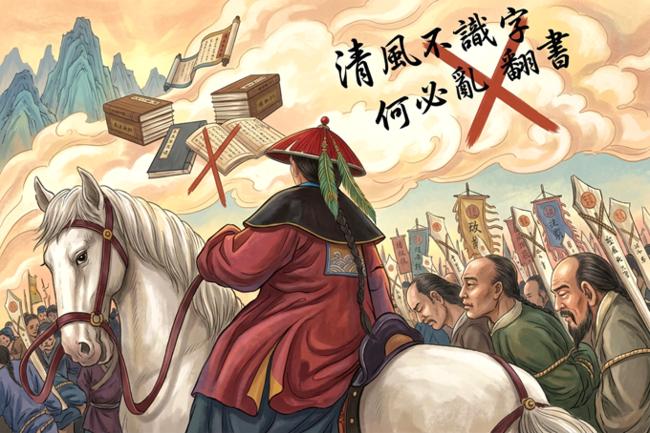 Is there any country that surpasses China in the number and severity of "literary inquisitions" (文字獄), where writings and books were burned and literati were imprisoned, exiled, and executed on charges of slandering the state?
The reality today in China, where palace intrigue or martial arts fantasy genres are prevalent and serious narratives are often overshadowed by genres like sci-fi, seems to be not unrelated to this context. It serves as a nearby cautionary tale for us.
Freedom does not exist solely to protect high-quality prose. Unless it is direct incitement to violence, all writing deserves the space to defend its "paradoxical intent."
If criticism is the "resilience of an open society," then punishment is the "threat of taboo." The dignity of a liberal democratic society lies in drawing even unwelcome words into the public sphere and overwhelming them with more accurate facts and better interpretations.
The dignity of May 18 should shine not through legal articles, but through judgments validated by fact-checking. While sanctified history may appear venerable for a time, it ultimately becomes the history of a power that fears freedom.

◆ Dr. Im Myung-shin
Doctor of Chinese Studies, Northeast Asian Researcher
Former Deputy Director of International Affairs, Sky Daily

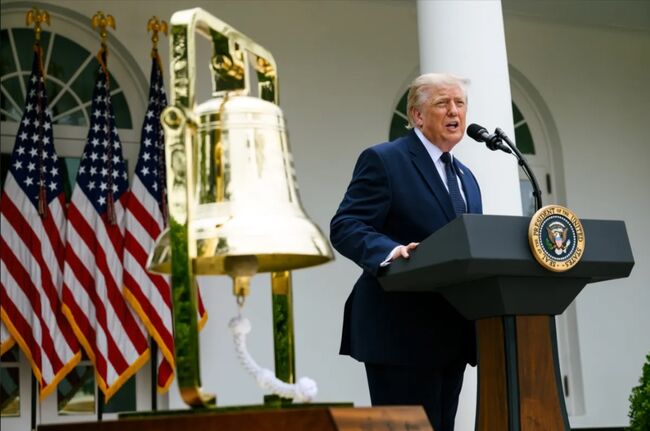 Trump pressures for rate cut again ahead of FOMC... "Should be the lowest in the world"
U.S. President Donald Trump. [Photo = The White House] U.S. President Donald Trump once again pressured the Federal Reserve, the U.S. central bank, to lower interest rates on the 27th (local time
Trump pressures for rate cut again ahead of FOMC... "Should be the lowest in the world"
U.S. President Donald Trump. [Photo = The White House] U.S. President Donald Trump once again pressured the Federal Reserve, the U.S. central bank, to lower interest rates on the 27th (local time
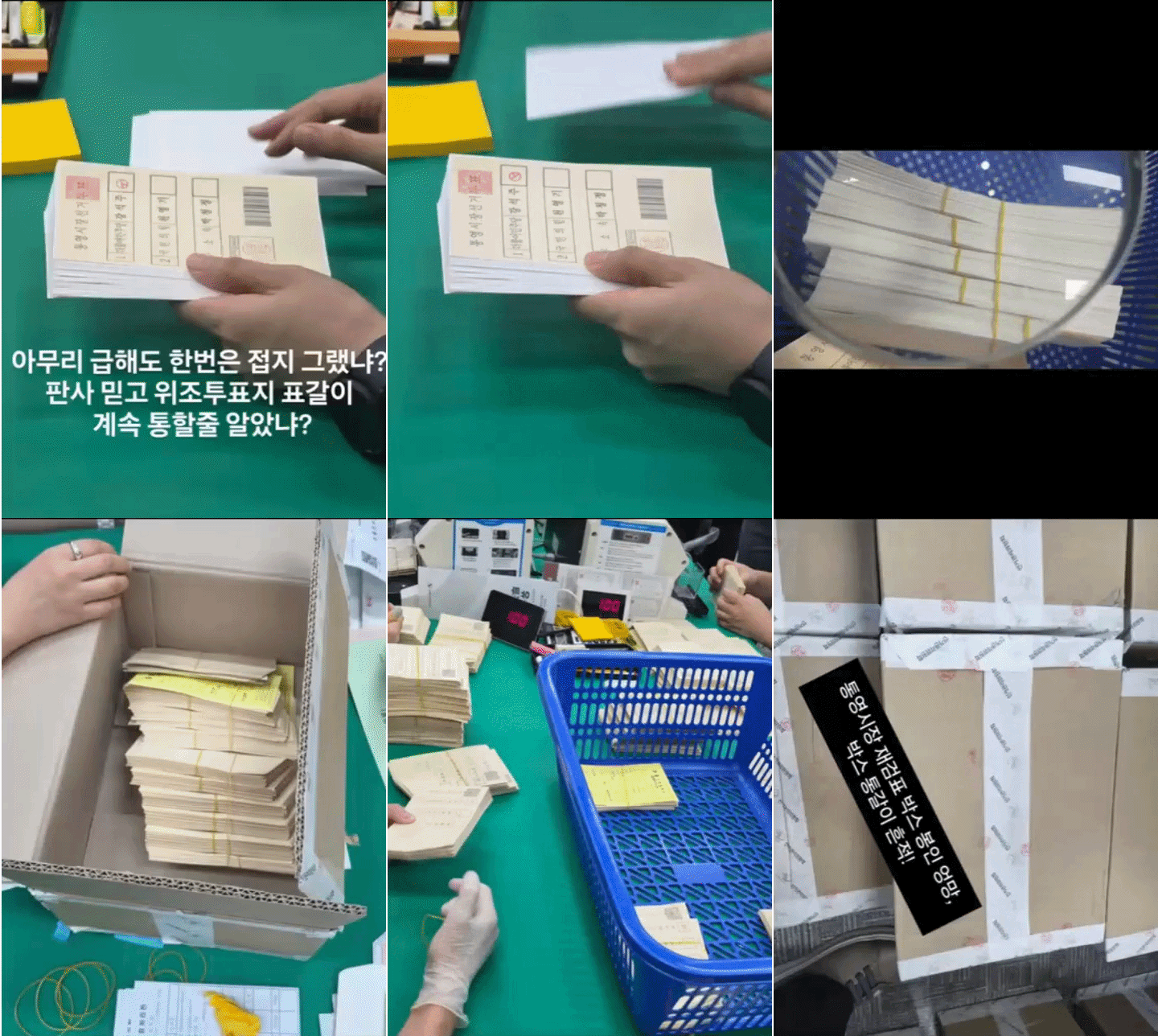 “Ignoring crisp ballots and damaged seals”… Tongyeong mayoral recount concludes with ‘no change in outcome,’ leaving suspicions and public outrage behind
Suspected counterfeit ballots discovered in Tongyeong [GIF from social media of Representative Hwang Kyo-ahn / Attorney Park Joo-hyun]During a recount of the Tongyeong mayoral election in South Gyeong
“Ignoring crisp ballots and damaged seals”… Tongyeong mayoral recount concludes with ‘no change in outcome,’ leaving suspicions and public outrage behind
Suspected counterfeit ballots discovered in Tongyeong [GIF from social media of Representative Hwang Kyo-ahn / Attorney Park Joo-hyun]During a recount of the Tongyeong mayoral election in South Gyeong
 President Yoon, regarding the first-instance ruling on the Public Official Election Act: “An excessive political verdict that distorts the facts… We will appeal immediately.”
The first-instance sentencing hearing for President Yoon Suk Yeol regarding violations of the Public Official Election Act is being broadcast live at Seoul Station on the 27th. [Photo=Yonhap News]Pres
President Yoon, regarding the first-instance ruling on the Public Official Election Act: “An excessive political verdict that distorts the facts… We will appeal immediately.”
The first-instance sentencing hearing for President Yoon Suk Yeol regarding violations of the Public Official Election Act is being broadcast live at Seoul Station on the 27th. [Photo=Yonhap News]Pres
 WSJ: "SK Hynix ADR Premium Is a Sign of AI Trading Overheat"
Advertisement for SK Hynix ADR listing in New York's Times Square [Reuters=Yonhap News file photo]The Wall Street Journal (WSJ) has pointed out that the price of SK Hynix’s American Depositary Recei
WSJ: "SK Hynix ADR Premium Is a Sign of AI Trading Overheat"
Advertisement for SK Hynix ADR listing in New York's Times Square [Reuters=Yonhap News file photo]The Wall Street Journal (WSJ) has pointed out that the price of SK Hynix’s American Depositary Recei
 'Godfather of Japanese Mystery Novels' Keigo Higashino Passes Away After Battle with Cancer at 68
Famous Japanese mystery novelist Keigo Higashino [AFP=Yonhap News]It has been belatedly reported that Keigo Higashino, the "godfather of Japanese mystery novels" and author of bestsellers such as "The
'Godfather of Japanese Mystery Novels' Keigo Higashino Passes Away After Battle with Cancer at 68
Famous Japanese mystery novelist Keigo Higashino [AFP=Yonhap News]It has been belatedly reported that Keigo Higashino, the "godfather of Japanese mystery novels" and author of bestsellers such as "The
 [Park Pil-kyu Security Column] To the Ignorant Trying to Clothe a Beast in Sheep's Clothing
Rep. Kim Byung-joo of the Democratic Party of Korea [Photo=Yonhap News]“The Air Force Academy doesn't teach you how to fly a plane!” “The Army, Navy, and Air Force academies are exactly the
[Park Pil-kyu Security Column] To the Ignorant Trying to Clothe a Beast in Sheep's Clothing
Rep. Kim Byung-joo of the Democratic Party of Korea [Photo=Yonhap News]“The Air Force Academy doesn't teach you how to fly a plane!” “The Army, Navy, and Air Force academies are exactly the
 [Issue Diagnosis] Two Effects of the Election Petition Review
 [Photo] Evidence of Election Fraud Flooding U.S. Media… Trump Had 2.7 Million Votes Stolen
 [Video] U.S. Semiquincentennial Air Show... 'Art in the Sky' streaks across New York
 [Editorial Cartoon] A Draconian Law That Undermines Freedom of Expression

 List
List










