 A gas station in Seoul. [Photo=Yonhap News]
In February 2026, producer prices showed an upward trend again, indicating a renewed inflation pressure. Particularly, the surge in prices of livestock products and financial/insurance services suggests a higher likelihood of cost increases at the production stage being passed on to consumer prices.
According to the producer price index released by the Bank of Korea, producer prices in February 2026 rose by 2.4% compared to the same month last year, an increase from the previous month's 1.9%. This signifies that producer prices, which had been on a gradual upward trend since the end of last year, have entered another phase of increase.
The core driver of this rise is agricultural, forestry, and fishery products, especially livestock.
Livestock prices surged by 15.5% year-on-year, acting as a major factor pushing up overall prices. This is analyzed not as a simple supply-demand imbalance, but as a structural outcome stemming from the combined impact of increased feed costs and a decrease in the number of livestock.
Amidst the growing burden of feed costs due to rising international grain prices and exchange rates, farms that experienced losses during the previous price decline have reduced their scale of operations, leading to a decrease in overall supply. Furthermore, the persistent risk of diseases such as African Swine Fever (ASF) and Avian Influenza (AI) appears to have exacerbated the upward price pressure.
Manufactured goods generally continued their gradual upward trend.
Primary metal products increased by 8.3% year-on-year, and computers, electronic and optical equipment also rose by 10.0%, reflecting the cost pressures across the manufacturing sector. This is a typical pattern influenced by global raw material prices and industrial cycles, with the potential for price increases at the production stage to gradually spread to downstream industries.
In the service sector, financial and insurance services stood out the most.
This sector surged by 20.0% year-on-year, driving overall service prices. This is interpreted as a direct reflection of increased financial costs and expanded risk premiums due to rising interest rates.
Transportation, accommodation, and food services also continued their upward trend, influenced by rising labor costs and raw material prices. Notably, the increase in livestock prices is acting as a stimulus for dining-out costs, spreading throughout service prices.
Conversely, electricity, gas, water, and waste management services decreased by 1.1% year-on-year, partially offsetting the overall price increase.
However, this is a result of policy-driven rate controls rather than market prices, and if these suppressed prices are reflected all at once in the future, they could become an additional factor for price increases.
In summary, the current rise in producer prices exhibits characteristics of 'multi-layered inflation,' where different causes are simultaneously at play across various sectors, rather than being a problem of specific items.
In the agricultural and livestock sector, cost increases have combined with supply reductions; in manufacturing, raw material prices and global economic trends have had an impact; and in the service sector, rising interest rates and labor costs are driving up prices.
This structure suggests that price stabilization in the short term will be challenging.
In particular, the rise in producer prices tends to be passed on to consumer prices with a time lag, leading to analyses that it is highly likely to translate into increased perceived inflation pressure going forward.
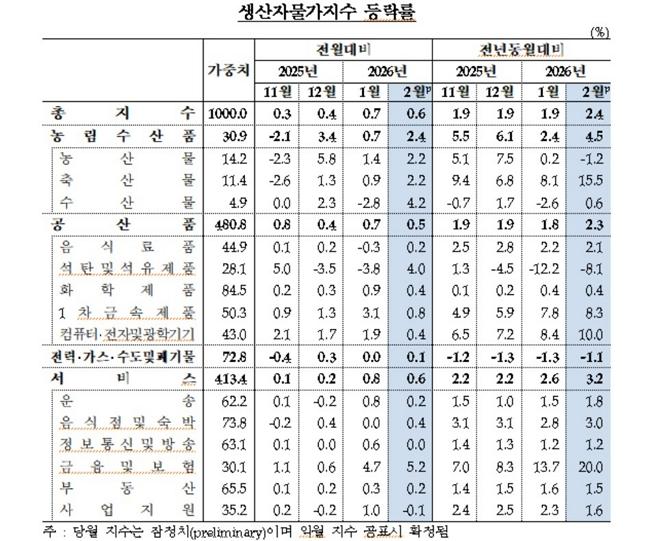 Trends in producer price index fluctuations. [Data=Bank of Korea]

 Iranian Foreign Ministry: "Continuing Message Exchanges with the U.S. and Activities of Mediating Countries"
Esmaeil Baghaei, Spokesperson for the Iranian Ministry of Foreign Affairs [Xinhua, Yonhap News file photo]Esmaeil Baghaei, spokesperson for the Iranian Ministry of Foreign Affairs, stated on the 26th
Iranian Foreign Ministry: "Continuing Message Exchanges with the U.S. and Activities of Mediating Countries"
Esmaeil Baghaei, Spokesperson for the Iranian Ministry of Foreign Affairs [Xinhua, Yonhap News file photo]Esmaeil Baghaei, spokesperson for the Iranian Ministry of Foreign Affairs, stated on the 26th
 President Yoon: "Do You Think You Are Safe from the Special Counsel?"... Final Statement Video Released
President Yoon Suk Yeol rebuking the special prosecutor on the 24th. [Court video / @birds_justice X account subtitle GIF] A video of President Yoon Suk Yeol's closing statement at his trial rega
President Yoon: "Do You Think You Are Safe from the Special Counsel?"... Final Statement Video Released
President Yoon Suk Yeol rebuking the special prosecutor on the 24th. [Court video / @birds_justice X account subtitle GIF] A video of President Yoon Suk Yeol's closing statement at his trial rega
 President Yoon, regarding the first-instance ruling on the Public Official Election Act: “An excessive political verdict that distorts the facts… We will appeal immediately.”
The first-instance sentencing hearing for President Yoon Suk Yeol regarding violations of the Public Official Election Act is being broadcast live at Seoul Station on the 27th. [Photo=Yonhap News]Pres
President Yoon, regarding the first-instance ruling on the Public Official Election Act: “An excessive political verdict that distorts the facts… We will appeal immediately.”
The first-instance sentencing hearing for President Yoon Suk Yeol regarding violations of the Public Official Election Act is being broadcast live at Seoul Station on the 27th. [Photo=Yonhap News]Pres
 WSJ: "SK Hynix ADR Premium Is a Sign of AI Trading Overheat"
Advertisement for SK Hynix ADR listing in New York's Times Square [Reuters=Yonhap News file photo]The Wall Street Journal (WSJ) has pointed out that the price of SK Hynix’s American Depositary Recei
WSJ: "SK Hynix ADR Premium Is a Sign of AI Trading Overheat"
Advertisement for SK Hynix ADR listing in New York's Times Square [Reuters=Yonhap News file photo]The Wall Street Journal (WSJ) has pointed out that the price of SK Hynix’s American Depositary Recei
 'Godfather of Japanese Mystery Novels' Keigo Higashino Passes Away After Battle with Cancer at 68
Famous Japanese mystery novelist Keigo Higashino [AFP=Yonhap News]It has been belatedly reported that Keigo Higashino, the "godfather of Japanese mystery novels" and author of bestsellers such as "The
'Godfather of Japanese Mystery Novels' Keigo Higashino Passes Away After Battle with Cancer at 68
Famous Japanese mystery novelist Keigo Higashino [AFP=Yonhap News]It has been belatedly reported that Keigo Higashino, the "godfather of Japanese mystery novels" and author of bestsellers such as "The
 [Park Pil-kyu Security Column] To the Ignorant Trying to Clothe a Beast in Sheep's Clothing
Rep. Kim Byung-joo of the Democratic Party of Korea [Photo=Yonhap News]“The Air Force Academy doesn't teach you how to fly a plane!” “The Army, Navy, and Air Force academies are exactly the
[Park Pil-kyu Security Column] To the Ignorant Trying to Clothe a Beast in Sheep's Clothing
Rep. Kim Byung-joo of the Democratic Party of Korea [Photo=Yonhap News]“The Air Force Academy doesn't teach you how to fly a plane!” “The Army, Navy, and Air Force academies are exactly the
 [Issue Diagnosis] Two Effects of the Election Petition Review
 [Photo] Evidence of Election Fraud Flooding U.S. Media… Trump Had 2.7 Million Votes Stolen
 [Video] U.S. Semiquincentennial Air Show... 'Art in the Sky' streaks across New York
 [Editorial Cartoon] A Draconian Law That Undermines Freedom of Expression

 List
List









