Flags flutter in the wind at the Constitutional Court in Jongno-gu, Seoul, on March 23, as the Constitutional Court, which introduced the "remedy for court rulings" system, is expected to release the preliminary review results of cases received so far as early as this week. [Yonhap News]
Following the implementation of the remedy for court rulings system, which allows constitutional complaints against court judgments, all 26 claims submitted in the first preliminary review by the designated panel were dismissed. None of the cases managed to pass the threshold for full review.
The Constitutional Court released the "Status of Decisions by Designated Panels Regarding Cases for Annulment of Rulings and Key Rulings" on March 24, detailing these outcomes. This marks the first decision related to the remedy for court rulings system based on the deliberations of the designated panel, composed of three justices.
The Constitutional Court decided to dismiss 26 out of a total of 153 cases of remedy for court rulings received from the system's implementation on March 12 up to the previous day. To date, no cases have passed the preliminary review and been referred to the full bench.
When a case is filed, the designated panel determines if it meets the legal requirements. If a claim is found to be unlawful, it is dismissed without a substantive review. So far, not a single case has cleared this "first hurdle."
In the initial review, the most common reason for dismissal was failure to meet the 'grounds for claim' requirement, with 17 cases; followed by 'exceeded claim period' with 5 cases, 'other unlawful reasons' with 3 cases, and 'lack of subsidiarity' with 2 cases. One case failed to meet both the subsidiarity and grounds for claim requirements.
Under the Constitutional Court Act, the 'grounds for claim' are met when a finalized ruling either: ▲ contradicts a Constitutional Court decision, ▲ was not made through the proper procedures stipulated by the Constitution or laws, or ▲ clearly violates the Constitution or laws, infringing upon fundamental rights.
Through these decisions by the designated panel, the Constitutional Court has set a standard: "Claimants seeking the annulment of finalized rulings must make a sincere and thorough argument and substantiation regarding whether they meet the grounds stipulated by the Constitutional Court Act."
Specifically, it was determined that a claim for infringement of fundamental rights cannot be considered to have met the grounds for claim if the claimant: ▲ makes vague and abstract arguments about possessing the grounds mentioned in each sub-clause, ▲ formally makes arguments related to these sub-clauses but the substance is to dispute the court's factual findings or evaluation of evidence, or the correctness of applying laws in a specific case, or ▲ is merely dissatisfied with the outcome of the ruling.
In the case of '2026heonma679', which was recently filed, the claimant argued that "the Supreme Court ruling infringed upon the right to liberty and equality by recognizing the evidentiary value of evidence collected during an illegal arrest of a suspect caught in the act and without procedural safeguards." However, the Constitutional Court dismissed the claim on the grounds that the grounds for claim were not met.
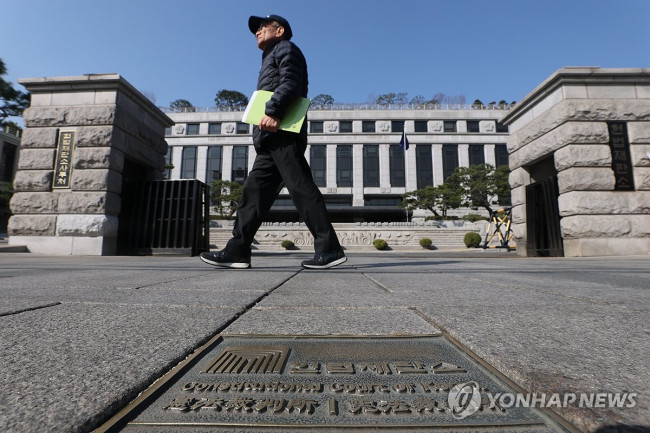 Constitutional Court ahead of the first preliminary review decision for remedy for court rulings [Yonhap News]
Furthermore, according to the Constitutional Court Act, a remedy for court rulings must be filed within 30 days of the ruling becoming final. Failure to adhere to this deadline results in dismissal due to 'exceeded claim period.' In this preliminary review, 5 cases were dismissed for exceeding the claim period.
In the case of '2026heonma652', the claimant had their ruling finalized on January 8 and filed the remedy for court rulings on March 12, well beyond the 30-day limit. The claimant argued that they could not file earlier because constitutional complaints against court rulings were not permitted before the implementation of the remedy for court rulings system. However, the Constitutional Court deemed this argument insufficient to justify the delay in filing.
If a constitutional complaint is filed without exhausting other legal remedies, it is dismissed for failing to meet the 'subsidiarity' requirement.
The lawsuit filed by the bereaved family of the late Kim Dal-soo, a fisherman who returned after being abducted to North Korea, regarding the dismissal of their state compensation claim for delayed criminal compensation, was dismissed for this lack of subsidiarity.
The claimant argued that an appeal was not applicable under the Small Claims Court Act, so they forfeited their right to appeal. However, the Constitutional Court ruled that "given the purpose of Article 3 of the Small Claims Court Act and the record, it cannot be considered an exception to the principle of subsidiarity where there was no expectation of fulfilling prior legal proceedings," implying that an appeal was still possible under the Small Claims Court Act.
The remedy for court rulings targets 'finalized rulings.' In the case of '2026heonma703', the remedy for court rulings claim was filed during the appellate stage, and it was dismissed because it "does not constitute a ruling subject to constitutional complaint review."
The 'first case', filed just 10 minutes after the remedy for court rulings system was implemented, is still under review by the designated panel. This case was filed by a Syrian national, Mohamed (42), seeking to annul a ruling on deportation.
However, it is suggested that this case may also be dismissed for exceeding the claim period, as the ruling's finalization date was already about two months prior to the filing.
Jang Young-ha, a district party committee chairman for the People Power Party in Seongnam's Sujeong-gu, who was convicted of spreading false information about President Lee Jae-myung, and YouTuber Gujeyeok (real name Lee Jun-hee), who was sentenced to prison for extorting tens of millions of won from YouTuber Ttzuya, have also filed for remedy for court rulings, and their preliminary review results are expected soon.
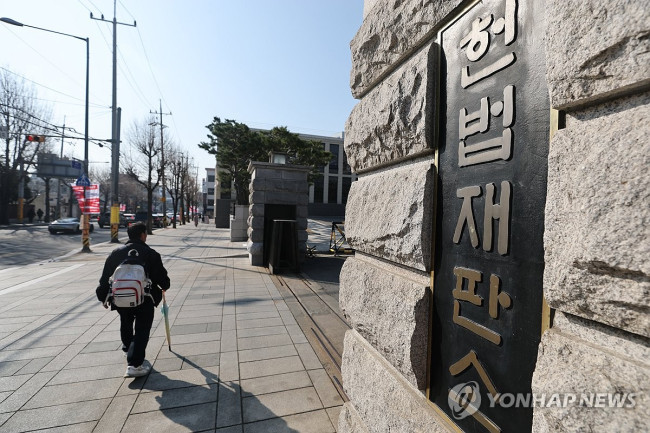 Constitutional Court ahead of the first preliminary review decision for remedy for court rulings [Yonhap News]
Both inside and outside the Constitutional Court, the importance of preliminary review has been emphasized to manage the caseload burden resulting from the introduction of the remedy for court rulings system.
The Constitutional Court had initially predicted that between 10,000 and 15,000 additional cases would be filed annually, representing 25-30% of appeals.
However, based on the filing trends during the first week of implementation, the annual estimate has been revised to 5,000-7,000 cases. A significant portion of these are expected to be dismissed at the preliminary review stage.
The legal community anticipates that the standards and proportion of cases filtered out during preliminary review over the next few months will influence the system's establishment.
The importance of preliminary review was also discussed at a seminar hosted by the law firm Barun on the afternoon of March 24, themed "Practical Guide to the Content and Procedures of the Remedy for Court Rulings System."
Attorney Park Sung-ho described preliminary review as the "real gateway for remedy for court rulings" and highlighted "cases clearly not falling under the grounds for claim" as the core element among dismissal reasons. He noted that "obviousness is difficult to determine solely through a formal procedural review and inevitably requires a substantial review of substantive requirements."
Attorney Jeon Ki-chul stated that "the obviousness of fundamental rights infringement will be established through case law," and presented three German review formulas: the principle that the Federal Constitutional Court intervenes when a court completely overlooks or fundamentally misunderstands the meaning and scope of fundamental rights (Heck formula); the principle that the intensity of review varies depending on which fundamental right is in question; and the principle that the Constitutional Court does not intervene in reviewing a court's evaluation of evidence unless arbitrariness is found.
Attorney Kim Jin-han, a former constitutional researcher, also emphasized the need for a meticulous preliminary review system design at an internal presentation on the remedy for court rulings and preliminary review systems held on March 20 by the Constitutional Practice Research Society (President Justice Jung Jung-mi), stating, "If we go down the wrong path now, it could lead the Constitutional Court to a precipice."

 Iranian Foreign Ministry: "Continuing Message Exchanges with the U.S. and Activities of Mediating Countries"
Esmaeil Baghaei, Spokesperson for the Iranian Ministry of Foreign Affairs [Xinhua, Yonhap News file photo]Esmaeil Baghaei, spokesperson for the Iranian Ministry of Foreign Affairs, stated on the 26th
Iranian Foreign Ministry: "Continuing Message Exchanges with the U.S. and Activities of Mediating Countries"
Esmaeil Baghaei, Spokesperson for the Iranian Ministry of Foreign Affairs [Xinhua, Yonhap News file photo]Esmaeil Baghaei, spokesperson for the Iranian Ministry of Foreign Affairs, stated on the 26th
 President Yoon: "Do You Think You Are Safe from the Special Counsel?"... Final Statement Video Released
President Yoon Suk Yeol rebuking the special prosecutor on the 24th. [Court video / @birds_justice X account subtitle GIF] A video of President Yoon Suk Yeol's closing statement at his trial rega
President Yoon: "Do You Think You Are Safe from the Special Counsel?"... Final Statement Video Released
President Yoon Suk Yeol rebuking the special prosecutor on the 24th. [Court video / @birds_justice X account subtitle GIF] A video of President Yoon Suk Yeol's closing statement at his trial rega
 President Yoon, regarding the first-instance ruling on the Public Official Election Act: “An excessive political verdict that distorts the facts… We will appeal immediately.”
The first-instance sentencing hearing for President Yoon Suk Yeol regarding violations of the Public Official Election Act is being broadcast live at Seoul Station on the 27th. [Photo=Yonhap News]Pres
President Yoon, regarding the first-instance ruling on the Public Official Election Act: “An excessive political verdict that distorts the facts… We will appeal immediately.”
The first-instance sentencing hearing for President Yoon Suk Yeol regarding violations of the Public Official Election Act is being broadcast live at Seoul Station on the 27th. [Photo=Yonhap News]Pres
 WSJ: "SK Hynix ADR Premium Is a Sign of AI Trading Overheat"
Advertisement for SK Hynix ADR listing in New York's Times Square [Reuters=Yonhap News file photo]The Wall Street Journal (WSJ) has pointed out that the price of SK Hynix’s American Depositary Recei
WSJ: "SK Hynix ADR Premium Is a Sign of AI Trading Overheat"
Advertisement for SK Hynix ADR listing in New York's Times Square [Reuters=Yonhap News file photo]The Wall Street Journal (WSJ) has pointed out that the price of SK Hynix’s American Depositary Recei
 'Godfather of Japanese Mystery Novels' Keigo Higashino Passes Away After Battle with Cancer at 68
Famous Japanese mystery novelist Keigo Higashino [AFP=Yonhap News]It has been belatedly reported that Keigo Higashino, the "godfather of Japanese mystery novels" and author of bestsellers such as "The
'Godfather of Japanese Mystery Novels' Keigo Higashino Passes Away After Battle with Cancer at 68
Famous Japanese mystery novelist Keigo Higashino [AFP=Yonhap News]It has been belatedly reported that Keigo Higashino, the "godfather of Japanese mystery novels" and author of bestsellers such as "The
 [Park Pil-kyu Security Column] To the Ignorant Trying to Clothe a Beast in Sheep's Clothing
Rep. Kim Byung-joo of the Democratic Party of Korea [Photo=Yonhap News]“The Air Force Academy doesn't teach you how to fly a plane!” “The Army, Navy, and Air Force academies are exactly the
[Park Pil-kyu Security Column] To the Ignorant Trying to Clothe a Beast in Sheep's Clothing
Rep. Kim Byung-joo of the Democratic Party of Korea [Photo=Yonhap News]“The Air Force Academy doesn't teach you how to fly a plane!” “The Army, Navy, and Air Force academies are exactly the
 [Issue Diagnosis] Two Effects of the Election Petition Review
 [Photo] Evidence of Election Fraud Flooding U.S. Media… Trump Had 2.7 Million Votes Stolen
 [Video] U.S. Semiquincentennial Air Show... 'Art in the Sky' streaks across New York
 [Editorial Cartoon] A Draconian Law That Undermines Freedom of Expression

 List
List