지난 3월20일자로 발행된 ‘주간 한미일보’ 창간호에 게재된 원고입니다. <편집자주>
 The center of political information consumption is no longer solely newspapers and broadcasting. Political content competes simultaneously on various platforms such as YouTube, SNS, and online communities, transforming the political public opinion environment. [Photo=Alex Ruhl/ALAMY STOCK]
— Why Political Discourse Has Changed
Politics is decided by elections. However, public opinion formed in the pre-election phase significantly influences the direction of political power.
As the structure of political information production and dissemination has changed, political discourse is also moving in a different direction than before.
This series analyzes the background and structure of how political information has begun to operate like a market.
If news delivered facts, content competes for attention. As political information moves towards content, political discourse has also entered a competitive structure.
① Why Political Information is Becoming Increasingly Extreme
The observation that political discourse has become much harsher than in the past is now a common sentiment in many countries around the world. The language used in political news is becoming more sensational, and political debates are spreading much faster. Analyses also suggest that political confrontation has intensified across the United States, Europe, and Asia.
However, these changes are difficult to attribute solely to increased conflict between political factions. More significant than the changes in the political environment is the transformation in the structure of political information production and consumption.
In the 20th-century political information landscape, news played a central role. Newspapers and broadcasters played a crucial role in shaping political discourse by covering and reporting on political information. The criteria for what constitutes political news and what statements escalate into social debate were also formed through the media.
In this structure, the flow of political information was relatively stable. News was delivered after undergoing a certain reporting process and editing procedure, and political discourse was formed within this structure.
However, the emergence of the internet and social media began to significantly alter the political information environment. In the online space, anyone can produce political information. Blogs, communities, and later YouTube and SNS, have drastically lowered the barriers to political information production.
Political information is no longer solely produced by the media but has shifted to a structure where it is created and disseminated by individuals and various networks. As a result, the volume of political information has rapidly increased.
In the past, news-centric environment, the amount of political news produced daily was limited to a certain level. However, in a content environment, political messages are produced virtually without limit. Numerous political messages emerge simultaneously, such as political YouTube channels, podcast broadcasts, and SNS political content.
The issue is not the volume of political information but the method of competition. In the news environment, the criteria for competition in political information were fact-checking and public relevance. However, in the content environment, the key criterion becomes how much attention it can attract.
In this competitive structure, strong messages spread faster. Messages that emphasize conflict or provoke emotions elicit more responses. This is also why political discourse tends to use extreme language.
The polarization of political discourse can be seen not as a result of political conflict but as a structural change occurring due to the altered methods of political information competition.
② Is the Era of News Over?
The media was at the center of the 20th-century political information environment. Newspapers and broadcasters played a significant role in shaping political discourse by covering political events and delivering them in the form of news.
In this structure, the media's influence stemmed not just from the volume of reporting but from its gatekeeping power. The media determined which events were important political news, which statements became social debates, and which issues were elevated to public agendas.
However, after the advent of the internet and platforms, the news consumption structure began to change rapidly.
A key change is the shift in news consumption pathways. In the United States, a significant number of citizens now access news through online platforms rather than traditional media. YouTube has also evolved beyond a simple video platform to function as a space for news consumption.
In the past, broadcast news or newspaper pages were the primary channels for news. However, a structure has now emerged where YouTube videos, SNS posts, and online community writings compete simultaneously.
News is no longer consumed in a single format.
Similar changes are occurring in Korea. Portal news services have had a significant impact on the news consumption structure. Portals like Naver and Daum have become major channels for news consumption by aggregating news from various media outlets in one place.
In this process, news consumption methods have also changed. In the past, political news was often encountered through newspaper layouts or broadcast news schedules. However, in the portal environment, it has become common for users to selectively consume only specific articles.
News is now consumed as article-unit content. The combination with YouTube and SNS has further complicated the political news landscape. Political interview videos, political commentary content, and political analysis broadcasts deliver political information while competing with news.
The phenomenon of political news being reconstructed into content format is also increasing. Scenes from broadcast interviews are re-edited into short video clips, and political news is often re-imagined as explanatory videos. The political information environment is shifting from a news-centric structure to a content competition structure.
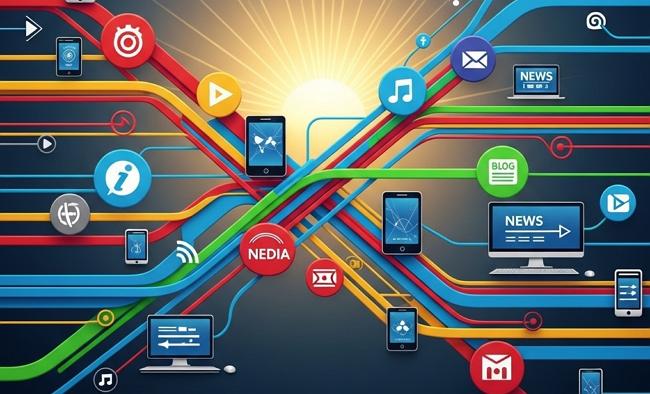 The political information environment, once centered on newspapers and broadcasting, has significantly changed with the advent of the internet and platforms. News is no longer the sole channel for political information. [Image=easy-peasy.ai]
③ Who Creates Political Content?
As the political information environment shifts to a content competition structure, the biggest change has been in the composition of political information producers. In the past, the media was at the core of political information production. Newspaper and broadcast journalists played a crucial role in shaping political discourse by covering and reporting political news.
However, with the dawn of the platform era, the structure of political information production has drastically changed. Journalists are no longer the only ones creating political content. YouTubers, podcast hosts, independent journalists, political analysts, and even ordinary citizens are participating in the production of political content.
Political information production has moved from a media-centric structure to a multi-producer structure.
In the United States, political podcasts and YouTube channels are having a significant impact on shaping political discourse. Some political content creators have garnered millions of listeners and viewers, wielding influence comparable to traditional media.
In the past, political interviews were often conducted on broadcast news programs. However, popular podcasts or YouTube channels are now becoming primary venues for political interviews.
Similar changes are observed in Korea. Political YouTube channels and political commentary broadcasts have already secured considerable influence, and online communities also play a significant role in shaping political discourse.
As the structure of political information production has become more layered, the way political discourse is formed is also changing. The political information environment is no longer a simple news delivery structure. It now operates as a political content market with diverse producers participating.
 In a platform environment, algorithms determine content exposure. The spread of political messages is also heavily influenced by platform data responses. [Photo=AI Image]
④ Where Does Political Content Explode?
At the center of political content dissemination today are platform algorithms. On platforms like YouTube, TikTok, and Instagram, hundreds of millions of pieces of content are uploaded daily. Algorithms largely determine which content is exposed to users.
Platforms analyze user behavior data. Based on data such as which videos users watch for a long time, which content they comment on, and which videos they share, the platform recommends content that is likely to attract user interest.
Especially on YouTube, watch time acts as a crucial metric. The longer users watch a piece of content, the more it is recommended to other users. In this structure, content that holds attention for a long time is important.
Political content tends to spread rapidly in this environment. Messages that provoke strong emotions, such as anger or conflict, easily elicit user responses. As comments and shares increase, algorithms expose this content to more users. In this process, political content spreads explosively.
In the past, the channels for spreading political messages were relatively simple. When a political statement was made, the media reported it, and it spread throughout society via broadcast and newspapers. However, the situation is different now. Political messages spread on platforms. Statements not reported by the media can reach millions of people on platforms. The speed of political content dissemination has also significantly increased.
In the past, the media was at the center of political discourse. Now, platform algorithms play a central role in the dissemination of political information. Political power is decided in elections. However, the political opinion formed in the pre-election phase is increasingly being shaped within an algorithmic environment.
Part 2 Preview
The competition for political content is not merely a competition for public opinion. Structures such as advertising revenue, sponsorships, and the platform economy operate in the political content market. In the next installment, we will explore how political content becomes profitable.

 Trump pressures for rate cut again ahead of FOMC... "Should be the lowest in the world"
U.S. President Donald Trump. [Photo = The White House] U.S. President Donald Trump once again pressured the Federal Reserve, the U.S. central bank, to lower interest rates on the 27th (local time
Trump pressures for rate cut again ahead of FOMC... "Should be the lowest in the world"
U.S. President Donald Trump. [Photo = The White House] U.S. President Donald Trump once again pressured the Federal Reserve, the U.S. central bank, to lower interest rates on the 27th (local time
 “Ignoring crisp ballots and damaged seals”… Tongyeong mayoral recount concludes with ‘no change in outcome,’ leaving suspicions and public outrage behind
Suspected counterfeit ballots discovered in Tongyeong [GIF from social media of Representative Hwang Kyo-ahn / Attorney Park Joo-hyun]During a recount of the Tongyeong mayoral election in South Gyeong
“Ignoring crisp ballots and damaged seals”… Tongyeong mayoral recount concludes with ‘no change in outcome,’ leaving suspicions and public outrage behind
Suspected counterfeit ballots discovered in Tongyeong [GIF from social media of Representative Hwang Kyo-ahn / Attorney Park Joo-hyun]During a recount of the Tongyeong mayoral election in South Gyeong
 President Yoon, regarding the first-instance ruling on the Public Official Election Act: “An excessive political verdict that distorts the facts… We will appeal immediately.”
The first-instance sentencing hearing for President Yoon Suk Yeol regarding violations of the Public Official Election Act is being broadcast live at Seoul Station on the 27th. [Photo=Yonhap News]Pres
President Yoon, regarding the first-instance ruling on the Public Official Election Act: “An excessive political verdict that distorts the facts… We will appeal immediately.”
The first-instance sentencing hearing for President Yoon Suk Yeol regarding violations of the Public Official Election Act is being broadcast live at Seoul Station on the 27th. [Photo=Yonhap News]Pres
 WSJ: "SK Hynix ADR Premium Is a Sign of AI Trading Overheat"
Advertisement for SK Hynix ADR listing in New York's Times Square [Reuters=Yonhap News file photo]The Wall Street Journal (WSJ) has pointed out that the price of SK Hynix’s American Depositary Recei
WSJ: "SK Hynix ADR Premium Is a Sign of AI Trading Overheat"
Advertisement for SK Hynix ADR listing in New York's Times Square [Reuters=Yonhap News file photo]The Wall Street Journal (WSJ) has pointed out that the price of SK Hynix’s American Depositary Recei
 'Godfather of Japanese Mystery Novels' Keigo Higashino Passes Away After Battle with Cancer at 68
Famous Japanese mystery novelist Keigo Higashino [AFP=Yonhap News]It has been belatedly reported that Keigo Higashino, the "godfather of Japanese mystery novels" and author of bestsellers such as "The
'Godfather of Japanese Mystery Novels' Keigo Higashino Passes Away After Battle with Cancer at 68
Famous Japanese mystery novelist Keigo Higashino [AFP=Yonhap News]It has been belatedly reported that Keigo Higashino, the "godfather of Japanese mystery novels" and author of bestsellers such as "The
 [Park Pil-kyu Security Column] To the Ignorant Trying to Clothe a Beast in Sheep's Clothing
Rep. Kim Byung-joo of the Democratic Party of Korea [Photo=Yonhap News]“The Air Force Academy doesn't teach you how to fly a plane!” “The Army, Navy, and Air Force academies are exactly the
[Park Pil-kyu Security Column] To the Ignorant Trying to Clothe a Beast in Sheep's Clothing
Rep. Kim Byung-joo of the Democratic Party of Korea [Photo=Yonhap News]“The Air Force Academy doesn't teach you how to fly a plane!” “The Army, Navy, and Air Force academies are exactly the
 [Issue Diagnosis] Two Effects of the Election Petition Review
 [Photo] Evidence of Election Fraud Flooding U.S. Media… Trump Had 2.7 Million Votes Stolen
 [Video] U.S. Semiquincentennial Air Show... 'Art in the Sky' streaks across New York
 [Editorial Cartoon] A Draconian Law That Undermines Freedom of Expression

 List
List