- Axios reports: "Massive bombing of nuclear facilities also an option as an alternative to high-risk ground troops."
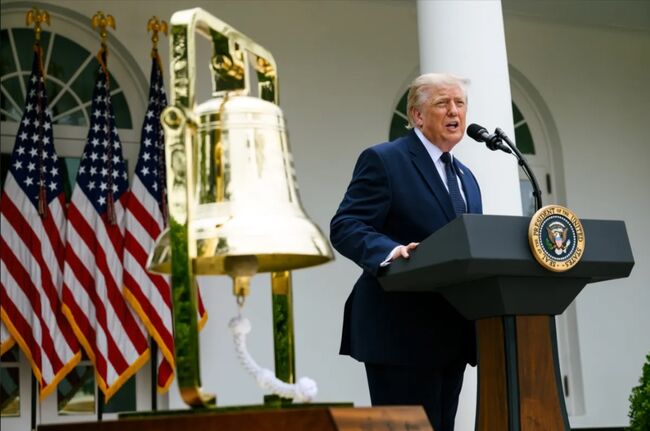
 President Trump and Secretary of Defense Hagerty [EPA Yonhap News]
While negotiations for an end to hostilities with Iran, mentioned by U.S. President Donald Trump, have not progressed, the U.S. Department of Defense (War Department) is preparing "final blow" options, according to U.S. media outlet Axios on the 26th (local time).
Axios reported, citing U.S. government officials and sources familiar with internal discussions, that President Trump currently has four "final blow" options to choose from.
The four options are: invasion or blockade of Kharg Island, Iran's largest oil export terminal; invasion of Larak Island, necessary for Iran to strengthen its control over the Strait of Hormuz; occupation of Abu Musa Island and two surrounding islands at the western entrance to the Strait of Hormuz; and interception or seizure of vessels exporting Iranian crude oil from the eastern part of the Strait of Hormuz.
In addition, U.S. forces have been preparing a plan for a ground operation to penetrate deep into Iran and secure highly enriched uranium (HEU) hidden within nuclear facilities, Axios reported.
Furthermore, Axios introduced a plan to prevent Iran from accessing HEU by launching large-scale airstrikes on facilities where Iran is believed to be storing HEU, rather than deploying ground troops which carry a high risk of U.S. casualties.
The outlet reported that President Trump has not yet decided whether to choose any of these scenarios. White House officials expressed caution, particularly regarding the ground troop deployment option, calling it "hypothetical."
However, sources told Axios that President Trump is prepared to escalate his offensive if talks with Iran do not yield results quickly.
President Trump had already warned on the 21st that if Iran did not lift its blockade of the Strait of Hormuz within 48 hours, he would attack Iran's energy infrastructure, including power plants.
On the 23rd, as the deadline approached, President Trump postponed the planned attack for five days, stating that whether to attack power plants and other facilities would be decided based on the outcome of negotiations with Iran during that period.
Currently, while the negotiations with Iran mentioned by President Trump are surrounded by controversy over their concrete reality, movements by the U.S. military to prepare for an escalation of its offensive have been successively reported through the media.
On the 26th, Russian media outlet RIA Novosti reported that a U.S. Air Force C-17A Globemaster III transport aircraft had entered UAE airspace and engaged in maneuver training that appeared to be in preparation for ground combat.
On the 24th, The New York Times (NYT) reported that approximately 2,000 troops from the U.S. Army's elite 82nd Airborne Division had been ordered to deploy to the Middle East, and separately, it was reported that approximately 5,000 personnel from two U.S. Marine expeditionary units were heading to the Middle East.
Regarding these U.S. military preparations for an escalation of its offensive, interpretations vary, with some suggesting it is a strategy of maximum pressure for negotiations, while others believe it is in preparation for a "final blow" against Iran immediately after negotiations, which are unlikely to reach an agreement, collapse.
What do you think of this article?

 Trump pressures for rate cut again ahead of FOMC... "Should be the lowest in the world"
U.S. President Donald Trump. [Photo = The White House] U.S. President Donald Trump once again pressured the Federal Reserve, the U.S. central bank, to lower interest rates on the 27th (local time
Trump pressures for rate cut again ahead of FOMC... "Should be the lowest in the world"
U.S. President Donald Trump. [Photo = The White House] U.S. President Donald Trump once again pressured the Federal Reserve, the U.S. central bank, to lower interest rates on the 27th (local time
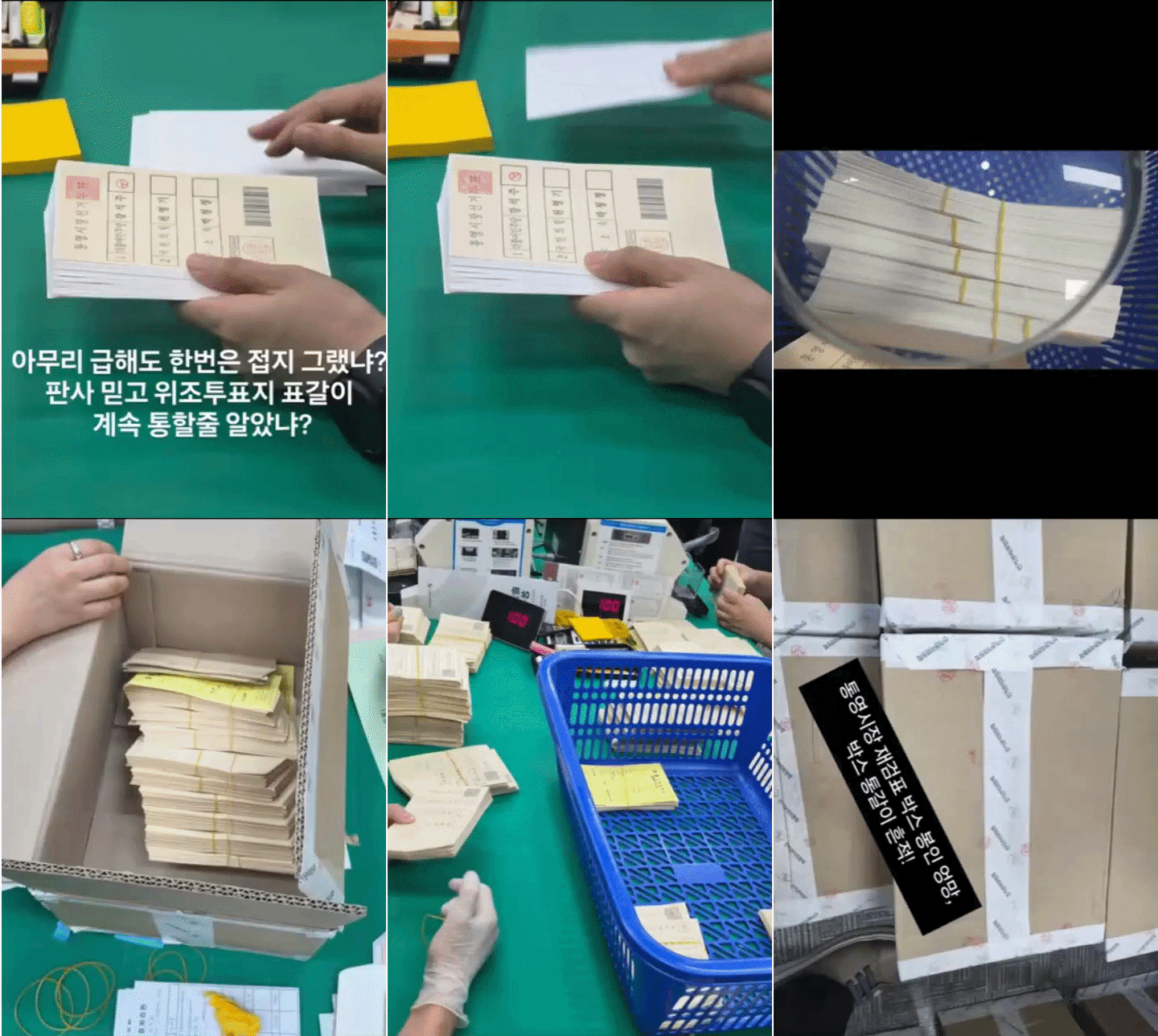 “Ignoring crisp ballots and damaged seals”… Tongyeong mayoral recount concludes with ‘no change in outcome,’ leaving suspicions and public outrage behind
Suspected counterfeit ballots discovered in Tongyeong [GIF from social media of Representative Hwang Kyo-ahn / Attorney Park Joo-hyun]During a recount of the Tongyeong mayoral election in South Gyeong
“Ignoring crisp ballots and damaged seals”… Tongyeong mayoral recount concludes with ‘no change in outcome,’ leaving suspicions and public outrage behind
Suspected counterfeit ballots discovered in Tongyeong [GIF from social media of Representative Hwang Kyo-ahn / Attorney Park Joo-hyun]During a recount of the Tongyeong mayoral election in South Gyeong
 President Yoon, regarding the first-instance ruling on the Public Official Election Act: “An excessive political verdict that distorts the facts… We will appeal immediately.”
The first-instance sentencing hearing for President Yoon Suk Yeol regarding violations of the Public Official Election Act is being broadcast live at Seoul Station on the 27th. [Photo=Yonhap News]Pres
President Yoon, regarding the first-instance ruling on the Public Official Election Act: “An excessive political verdict that distorts the facts… We will appeal immediately.”
The first-instance sentencing hearing for President Yoon Suk Yeol regarding violations of the Public Official Election Act is being broadcast live at Seoul Station on the 27th. [Photo=Yonhap News]Pres
 WSJ: "SK Hynix ADR Premium Is a Sign of AI Trading Overheat"
Advertisement for SK Hynix ADR listing in New York's Times Square [Reuters=Yonhap News file photo]The Wall Street Journal (WSJ) has pointed out that the price of SK Hynix’s American Depositary Recei
WSJ: "SK Hynix ADR Premium Is a Sign of AI Trading Overheat"
Advertisement for SK Hynix ADR listing in New York's Times Square [Reuters=Yonhap News file photo]The Wall Street Journal (WSJ) has pointed out that the price of SK Hynix’s American Depositary Recei
 'Godfather of Japanese Mystery Novels' Keigo Higashino Passes Away After Battle with Cancer at 68
Famous Japanese mystery novelist Keigo Higashino [AFP=Yonhap News]It has been belatedly reported that Keigo Higashino, the "godfather of Japanese mystery novels" and author of bestsellers such as "The
'Godfather of Japanese Mystery Novels' Keigo Higashino Passes Away After Battle with Cancer at 68
Famous Japanese mystery novelist Keigo Higashino [AFP=Yonhap News]It has been belatedly reported that Keigo Higashino, the "godfather of Japanese mystery novels" and author of bestsellers such as "The
 [Park Pil-kyu Security Column] To the Ignorant Trying to Clothe a Beast in Sheep's Clothing
Rep. Kim Byung-joo of the Democratic Party of Korea [Photo=Yonhap News]“The Air Force Academy doesn't teach you how to fly a plane!” “The Army, Navy, and Air Force academies are exactly the
[Park Pil-kyu Security Column] To the Ignorant Trying to Clothe a Beast in Sheep's Clothing
Rep. Kim Byung-joo of the Democratic Party of Korea [Photo=Yonhap News]“The Air Force Academy doesn't teach you how to fly a plane!” “The Army, Navy, and Air Force academies are exactly the
 [Issue Diagnosis] Two Effects of the Election Petition Review
 [Photo] Evidence of Election Fraud Flooding U.S. Media… Trump Had 2.7 Million Votes Stolen
 [Video] U.S. Semiquincentennial Air Show... 'Art in the Sky' streaks across New York
 [Editorial Cartoon] A Draconian Law That Undermines Freedom of Expression

 List
List