오는 4월 7일은 ‘신문의 날’이다. 신문은 이날 사설 등을 통해 새로운 각오를 다짐하고는 한다. 필자는 최근 벗의 초청으로 경남 산청군 생초면을 두루 둘러볼 기회를 가졌다. 보는 내내, 그곳에서 120여 년 전 벌어진 한 사건이 이 나라 사법과 언론의 처참한 현실을 고발하고 있다는 상념이 떠나질 않았다.
 Statue of Justice. [Getty Images=Google AI Synthesis]
In 1902 (the 6th year of the Korean Empire's Gwangmu era), a woman named Kim Jo-yi was murdered in the village of Aptong (now Seochomyeon Eoseori), Sancheong County, Gyeongsang Province. The perpetrator was her husband.
Her husband, Kwon Won-jung, was habitually neglecting his livelihood and was addicted to gambling. At the time of the incident, he was being pursued by loan sharks due to his gambling debts. As he had done several times before, Kwon Won-jung pestered Kim Jo-yi to get money from her parents. Kim Jo-yi refused, saying, "Even a flea has a face," and that she could no longer ask for help. When his words failed to persuade her, Kwon Won-jung finally resorted to fists and a club. The violence was excessive. Kim Jo-yi collapsed and died.
According to testimonies given during the subsequent autopsy, a flustered Kwon Won-jung and his mother dragged the body to the barn and staged it to look like a suicide by hanging it from a beam. They then claimed to have moved the body to the main room and laid it out. Kwon Won-jung immediately fled.
Upon receiving notice of the death, the magistrate of Sancheong County conducted a preliminary autopsy and issued a death certificate for suicide. After the preliminary autopsy results were released, a secondary autopsy was performed by the magistrate of the neighboring Danseong Prefecture to reconfirm the findings, which also concluded it was a suicide.
However, Kim Jo-yi's father insisted that his daughter had clearly died from her husband's assault and appealed to the Daegu Provincial Office, where the Gyeongsang Provincial Governor resided. He argued that Sancheong County and Danseong Prefecture, influenced by the influential Gwon clan, had declared it a suicide despite clear signs of trauma on the body.
The Daegu Provincial Office conducted a third autopsy following the family's objection. This time, the magistrate of Hapcheon County was dispatched to Sancheong County. Magistrate Lee Byeong-ui investigated the signs of assault on the body and the circumstances of the staged suicide, overturning the conclusion to homicide. He did not stop at merely observing the body; he keenly delved into the suspicious circumstances from the beginning and the inconsistencies in witness testimonies.
This time, the Gwon clan, which dominated the village, strongly protested. The testimonies of the villagers also began to change. Eventually, fourth and fifth autopsies were repeated, and due to the Gwon clan's systematic obstruction of testimony and bribery, the ruling was paradoxically reversed to "suicide" or "cause of death unknown."
Kim Jo-yi's father did not give up. Through the family's persistent appeals, the case was ultimately transferred to the Pyeongniwon, the supreme court of the Korean Empire. The Ministry of Justice ordered another thorough investigation, and this time, an official from the Ministry was dispatched as a special investigator.
The investigators conducted a detailed reinvestigation for the sixth time, and based on the Gwon family's private funds and the recantation of confessions from nearby residents, they reinterpreted the traces on the body. In 1904, the Supreme Court finally concluded that "Husband Kwon Won-jung beat his wife Kim Jo-yi to death and then staged it as a suicide." The principal offender, Kwon Won-jung, was sentenced to death (hanging), and accomplices who helped dispose of the body or gave false testimony were sentenced to exile and imprisonment.
The arduous legal process that unfolded over 120 years ago, during a time when Joseon was precariously collapsing, offers many insights for us today. At that time, the investigators and judges of Joseon, though their country was as precarious as a candle in the wind, strived to maintain a minimum level of integrity in the face of "facts" and "physical evidence."
Although the officials in Joseon were thoroughly corrupt, as seen above, the authority of the "legal codes (like the Gyeongguk Daejeon)" and "investigation manuals (like the Muwonrok, 無寃錄)" that supported the system were still alive and functioning until the very end. The very process of investigations and deliberations being reversed six times paradoxically eloquently testifies to the governing principle of "Ensure there is no injustice (無寃)" and the will of the legal system.
Then, what is the state of the current Republic of Korea? Unfortunately, lost in ideological criteria or political interests, a practice of "preordaining the conclusion and fitting the evidence accordingly" is rampant. What is even more tragic is that many within the judiciary and journalism are desensitized to such misconduct and even feel no shame.
Following the legal proceedings of the Kim Jo-yi murder case, we witness the sorrowful paradox that historical progress is never linear. The tenacious pursuit of substantive truth by the judicial officials of the Korean Empire seems to sternly condemn the reality of modern Korea's courts, equipped with a sophisticated judicial system, having devolved into instruments of political strife and ideology.
Justice does not come with technological advancement; it arises from the integrity of judges and the system who can say "what is wrong is wrong" even under pressure from power, a fact that is being thoroughly ignored in our society today.
The actions of the judiciary in sensitive political matters such as the rebellion trial of former President Yoon Suk-yeol or election fraud lawsuits demonstrate that the scales of justice are disgracefully skewed. Today's ideologically biased trials, rather than being a process of finding "truth," have devolved into a mere formality to socially bury a particular political faction or legitimize a usurper, a criticism for which they would have no defense.
The fact that Joseon went through six autopsies in the Kim Jo-yi case was not due to a perfect system, but because humility regarding the "possibility of misjudgment" was alive. This stands in stark contrast to the modern Korean judiciary, which is trapped in infallible dogma.
When judgments swayed by a particular ideology are cloaked in the name of "rule of law," the law transforms from a shield protecting justice into a terrifying weapon for defeating the opponent. Fair elections and former President Yoon Suk-yeol were thus destroyed. Isn't it paradoxical that a failing Joseon seems to be mocking the advanced legal system of modern Korea?
The legacy media of this country should be equally criticized. They are consistently exhibiting a cowardly stance, as seen in the history of medieval witch trials: "The court declared her a witch, so she must be a witch, and it wasn't me who made that judgment."
This is the true nature of the Korean judiciary's rulings in election fraud or the Yoon Suk-yeol trial, and the legacy media's reporting on them. Beyond the rightness or wrongness of the verdicts, the violence that occurs when institutional authority monopolizes truth and the irresponsibility of observers who ride on that authority is the reality of the dark clouds covering Korean society.
The greatest tragedy of medieval witch hunts lay in the circular logic of assuming "witch" and then fitting all evidence and circumstances to that assumption. If this country's judiciary rushes towards the conclusion of "rebellion" as dictated by a particular political faction, then the legal grounds presented during the trial are no different from cheap cosmetics applied to a wrinkled face by a prostitute, rather than tools for seeking truth.
The media is no different. They too merely echo, "The court ruled it was rebellion, so it is rebellion," or "The court ruled there was no election fraud, so there was no election fraud." The attitude of "The judiciary said so" is an act of abandoning the media's very reason for existence: the pursuit of substantive truth.
The crime of witch hunts disappeared in Western societies not because judges awakened. Historical progress began with the voices of reason (including the media) that asked the fundamental question, "Do witches truly exist?"
If the Korean media remains at the level of "The court said she was a witch, so she is a witch," it is equivalent to the media, which should be monitoring the judiciary to prevent it from becoming an accessory to violent politics, instead justifying a misguided judiciary. On "Newspaper Day," is it appropriate to merely promote bargain sales of cheap cosmetics?
Former Editorial Advisor, Munhwa Ilbo

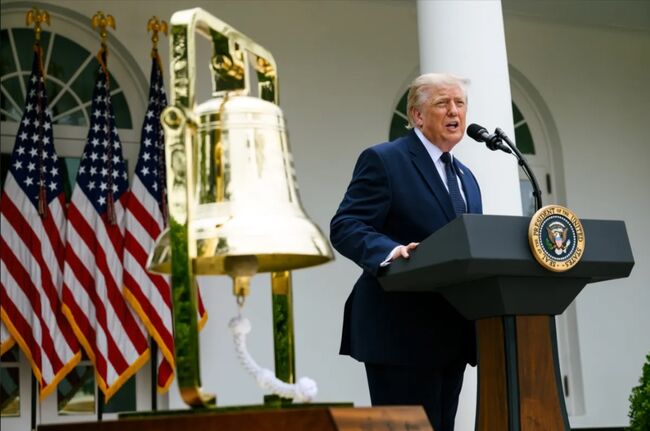 Trump pressures for rate cut again ahead of FOMC... "Should be the lowest in the world"
U.S. President Donald Trump. [Photo = The White House] U.S. President Donald Trump once again pressured the Federal Reserve, the U.S. central bank, to lower interest rates on the 27th (local time
Trump pressures for rate cut again ahead of FOMC... "Should be the lowest in the world"
U.S. President Donald Trump. [Photo = The White House] U.S. President Donald Trump once again pressured the Federal Reserve, the U.S. central bank, to lower interest rates on the 27th (local time
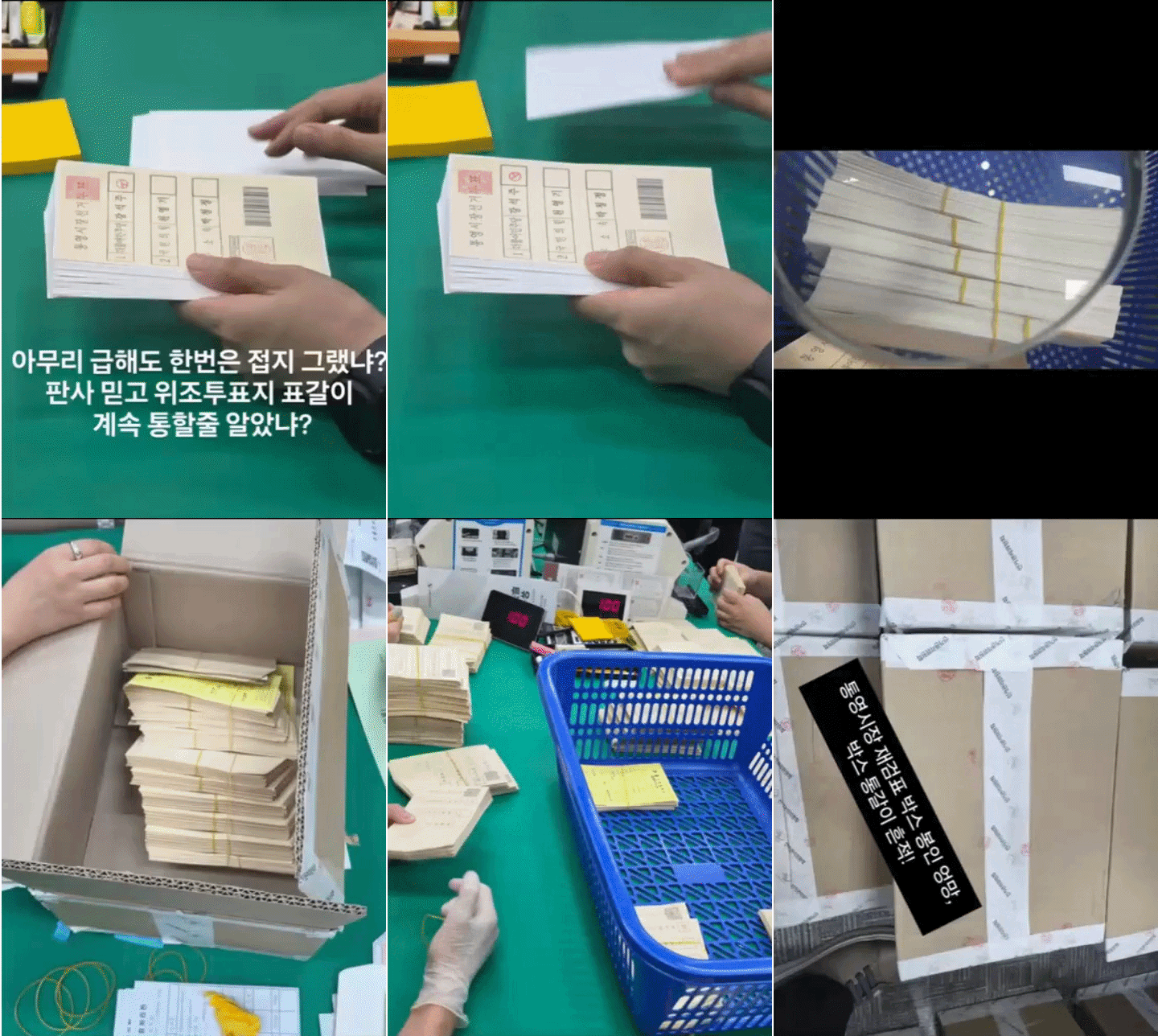 “Ignoring crisp ballots and damaged seals”… Tongyeong mayoral recount concludes with ‘no change in outcome,’ leaving suspicions and public outrage behind
Suspected counterfeit ballots discovered in Tongyeong [GIF from social media of Representative Hwang Kyo-ahn / Attorney Park Joo-hyun]During a recount of the Tongyeong mayoral election in South Gyeong
“Ignoring crisp ballots and damaged seals”… Tongyeong mayoral recount concludes with ‘no change in outcome,’ leaving suspicions and public outrage behind
Suspected counterfeit ballots discovered in Tongyeong [GIF from social media of Representative Hwang Kyo-ahn / Attorney Park Joo-hyun]During a recount of the Tongyeong mayoral election in South Gyeong
 President Yoon, regarding the first-instance ruling on the Public Official Election Act: “An excessive political verdict that distorts the facts… We will appeal immediately.”
The first-instance sentencing hearing for President Yoon Suk Yeol regarding violations of the Public Official Election Act is being broadcast live at Seoul Station on the 27th. [Photo=Yonhap News]Pres
President Yoon, regarding the first-instance ruling on the Public Official Election Act: “An excessive political verdict that distorts the facts… We will appeal immediately.”
The first-instance sentencing hearing for President Yoon Suk Yeol regarding violations of the Public Official Election Act is being broadcast live at Seoul Station on the 27th. [Photo=Yonhap News]Pres
 WSJ: "SK Hynix ADR Premium Is a Sign of AI Trading Overheat"
Advertisement for SK Hynix ADR listing in New York's Times Square [Reuters=Yonhap News file photo]The Wall Street Journal (WSJ) has pointed out that the price of SK Hynix’s American Depositary Recei
WSJ: "SK Hynix ADR Premium Is a Sign of AI Trading Overheat"
Advertisement for SK Hynix ADR listing in New York's Times Square [Reuters=Yonhap News file photo]The Wall Street Journal (WSJ) has pointed out that the price of SK Hynix’s American Depositary Recei
 'Godfather of Japanese Mystery Novels' Keigo Higashino Passes Away After Battle with Cancer at 68
Famous Japanese mystery novelist Keigo Higashino [AFP=Yonhap News]It has been belatedly reported that Keigo Higashino, the "godfather of Japanese mystery novels" and author of bestsellers such as "The
'Godfather of Japanese Mystery Novels' Keigo Higashino Passes Away After Battle with Cancer at 68
Famous Japanese mystery novelist Keigo Higashino [AFP=Yonhap News]It has been belatedly reported that Keigo Higashino, the "godfather of Japanese mystery novels" and author of bestsellers such as "The
 [Park Pil-kyu Security Column] To the Ignorant Trying to Clothe a Beast in Sheep's Clothing
Rep. Kim Byung-joo of the Democratic Party of Korea [Photo=Yonhap News]“The Air Force Academy doesn't teach you how to fly a plane!” “The Army, Navy, and Air Force academies are exactly the
[Park Pil-kyu Security Column] To the Ignorant Trying to Clothe a Beast in Sheep's Clothing
Rep. Kim Byung-joo of the Democratic Party of Korea [Photo=Yonhap News]“The Air Force Academy doesn't teach you how to fly a plane!” “The Army, Navy, and Air Force academies are exactly the
 [Issue Diagnosis] Two Effects of the Election Petition Review
 [Photo] Evidence of Election Fraud Flooding U.S. Media… Trump Had 2.7 Million Votes Stolen
 [Video] U.S. Semiquincentennial Air Show... 'Art in the Sky' streaks across New York
 [Editorial Cartoon] A Draconian Law That Undermines Freedom of Expression

 List
List