![[Graphic] Expected US Ground Operation Options Against Iran](/data/cheditor4/2603/GYH2026032900050004400_P2.jpg) [Graphic] Expected US Ground Operation Options Against Iran [Yonhap News]
[Graphic] Expected US Ground Operation Options Against Iran [Yonhap News]
As the United States reportedly positions around 7,000 ground troops near Iran, attention is focusing on potential targets should a ground offensive be launched.
Previously, media attention had centered on Kharg Island. Given that approximately 90% of Iran's oil exports pass through this island, it was expected that seizing control of it would strangle the Iranian economy and cripple its ability to wage war.
President Donald Trump has stated that he could "take out" Kharg Island whenever he chooses. However, if oil infrastructure were destroyed in the process, Iran's post-war reconstruction could be delayed by years, and it could have a severe negative impact on the global economy.
Furthermore, Kharg Island is located deep within the Persian Gulf. Even if U.S. airstrikes were to destroy major military facilities there, ground troops would be required for an actual occupation.
Because long-term operations are difficult for a 2,000-strong airborne force carrying only light equipment, the deployment of naval vessels carrying heavy equipment is essential; however, Iran has defensive lines positioned across the Strait of Hormuz to block such movements.
Consequently, CNN reported on the 29th (local time) that the seven islands in the strait—often referred to by Iran as "unsinkable aircraft carriers"—could be the primary targets.
When U.S. Navy vessels from the southern Iranian waters move into the Persian Gulf, the first islands they encounter are Hormuz, Larak, Qeshm, and Hengam, all located to the east of the strait. These four islands are within Iran’s Exclusive Economic Zone (EEZ) and are close to the mainland.
Passing these, one encounters Abu Musa, Greater Tunb, and Lesser Tunb to the west. These are territories whose sovereignty has been disputed between Iran and the United Arab Emirates (UAE), which lies across the sea.
In academic circles, the arc connecting these seven islands is sometimes called the "arch-shaped defensive line" that the Iranian military uses to guard Hormuz. It is considered a location that "provides Iran with a strategic advantage in controlling the security of the Strait of Hormuz."
In particular, it is said that large tankers and warships must pass through the three smaller islands to the west (Abu Musa, Greater Tunb, and Lesser Tunb) to navigate the narrow and shallow waters of the Strait of Hormuz.
Last year, Alireza Tangsiri, commander of the Islamic Revolutionary Guard Corps (IRGC) Navy, stated, "We must arm and operationalize this group of islands." Commander Tangsiri was recently killed in an Israeli airstrike.
Ultimately, if U.S. ground operations were to unfold, securing these strategically vital islands would be the key, though military experts point out that this would inevitably come with significant risks and losses.
Carl Schuster, former director of operations at the U.S. Pacific Command’s Joint Intelligence Center, told CNN that if it were up to him, he would deploy all 5,000 troops currently organized into two Marine Expeditionary Units to seize these islands.
The problem is that for such an amphibious Marine operation to succeed, the vessels carrying the troops must first pass through the eastern part of the strait. Cedric Leighton, a CNN military analyst, pointed out that the four islands in the east, particularly Larak Island, pose a significant threat.
He noted that with missiles or small attack craft launched from Larak Island, "(Iran) could block everything passing through the strait."
While CV-22 Osprey tiltrotor aircraft and helicopters stationed on naval vessels are capable of vertical takeoff and landing, their relatively slow movement speeds make them easy targets if Iran’s air defense systems are active.
Moreover, ground troops occupying the islands would be exposed to drones, missiles, and artillery fire from the Iranian mainland, significantly increasing the potential for further casualties. So far, 13 U.S. service members have died, and approximately 300 have been injured.
Schuster analyzed that capturing the three western islands, such as Abu Musa, would be more strategically advantageous for the U.S. than Kharg Island, and would also carry "less risk of damaging the future Iranian economy" that President Trump envisions.
However, even if the capture of these three islands is successful, problems remain. When the UAE gained independence from British colonial rule, the Iranian Pahlavi dynasty—backed by the U.S.—had seized them. Subsequently, the UAE raised the issue of Iran’s occupation of the islands and demanded resolution from the United Nations.
As an anti-American regime came to power in Iran following the Islamic Revolution, the U.S. has aligned itself with the UAE’s claims. CNN noted that if U.S. forces were to occupy these islands, they could fall into a diplomatic dilemma regarding whether to return them to post-war Iran or to the UAE.
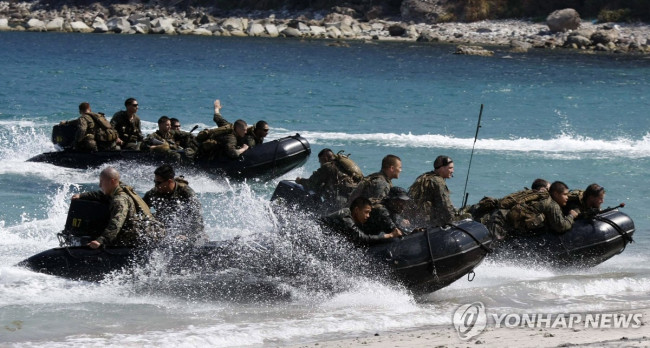 U.S. 31st Marine Expeditionary Unit training [EPA=Yonhap News]

 Trump pressures for rate cut again ahead of FOMC... "Should be the lowest in the world"
U.S. President Donald Trump. [Photo = The White House] U.S. President Donald Trump once again pressured the Federal Reserve, the U.S. central bank, to lower interest rates on the 27th (local time
Trump pressures for rate cut again ahead of FOMC... "Should be the lowest in the world"
U.S. President Donald Trump. [Photo = The White House] U.S. President Donald Trump once again pressured the Federal Reserve, the U.S. central bank, to lower interest rates on the 27th (local time
 “Ignoring crisp ballots and damaged seals”… Tongyeong mayoral recount concludes with ‘no change in outcome,’ leaving suspicions and public outrage behind
Suspected counterfeit ballots discovered in Tongyeong [GIF from social media of Representative Hwang Kyo-ahn / Attorney Park Joo-hyun]During a recount of the Tongyeong mayoral election in South Gyeong
“Ignoring crisp ballots and damaged seals”… Tongyeong mayoral recount concludes with ‘no change in outcome,’ leaving suspicions and public outrage behind
Suspected counterfeit ballots discovered in Tongyeong [GIF from social media of Representative Hwang Kyo-ahn / Attorney Park Joo-hyun]During a recount of the Tongyeong mayoral election in South Gyeong
 President Yoon, regarding the first-instance ruling on the Public Official Election Act: “An excessive political verdict that distorts the facts… We will appeal immediately.”
The first-instance sentencing hearing for President Yoon Suk Yeol regarding violations of the Public Official Election Act is being broadcast live at Seoul Station on the 27th. [Photo=Yonhap News]Pres
President Yoon, regarding the first-instance ruling on the Public Official Election Act: “An excessive political verdict that distorts the facts… We will appeal immediately.”
The first-instance sentencing hearing for President Yoon Suk Yeol regarding violations of the Public Official Election Act is being broadcast live at Seoul Station on the 27th. [Photo=Yonhap News]Pres
 WSJ: "SK Hynix ADR Premium Is a Sign of AI Trading Overheat"
Advertisement for SK Hynix ADR listing in New York's Times Square [Reuters=Yonhap News file photo]The Wall Street Journal (WSJ) has pointed out that the price of SK Hynix’s American Depositary Recei
WSJ: "SK Hynix ADR Premium Is a Sign of AI Trading Overheat"
Advertisement for SK Hynix ADR listing in New York's Times Square [Reuters=Yonhap News file photo]The Wall Street Journal (WSJ) has pointed out that the price of SK Hynix’s American Depositary Recei
 'Godfather of Japanese Mystery Novels' Keigo Higashino Passes Away After Battle with Cancer at 68
Famous Japanese mystery novelist Keigo Higashino [AFP=Yonhap News]It has been belatedly reported that Keigo Higashino, the "godfather of Japanese mystery novels" and author of bestsellers such as "The
'Godfather of Japanese Mystery Novels' Keigo Higashino Passes Away After Battle with Cancer at 68
Famous Japanese mystery novelist Keigo Higashino [AFP=Yonhap News]It has been belatedly reported that Keigo Higashino, the "godfather of Japanese mystery novels" and author of bestsellers such as "The
 [Park Pil-kyu Security Column] To the Ignorant Trying to Clothe a Beast in Sheep's Clothing
Rep. Kim Byung-joo of the Democratic Party of Korea [Photo=Yonhap News]“The Air Force Academy doesn't teach you how to fly a plane!” “The Army, Navy, and Air Force academies are exactly the
[Park Pil-kyu Security Column] To the Ignorant Trying to Clothe a Beast in Sheep's Clothing
Rep. Kim Byung-joo of the Democratic Party of Korea [Photo=Yonhap News]“The Air Force Academy doesn't teach you how to fly a plane!” “The Army, Navy, and Air Force academies are exactly the
 [Issue Diagnosis] Two Effects of the Election Petition Review
 [Photo] Evidence of Election Fraud Flooding U.S. Media… Trump Had 2.7 Million Votes Stolen
 [Video] U.S. Semiquincentennial Air Show... 'Art in the Sky' streaks across New York
 [Editorial Cartoon] A Draconian Law That Undermines Freedom of Expression

 List
List