4월1일자로 발행한 ‘주간 한미일보’ 3호에 게재된 원고입니다. <편집자주>
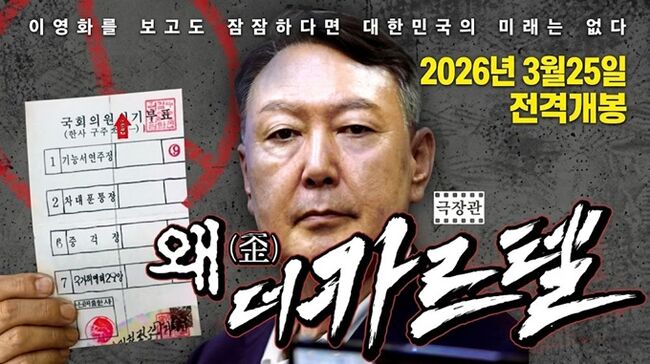
'The Cartel' was released on March 25th in 70 theaters nationwide. In fact, this film has been considered the originator of election fraud films even before its theatrical release.
The film was first created in September 2023. Many people, including President Yoon Suk-yeol, watched this film through social media. The theatrical version released this time adds events that occurred after the June 3rd presidential election in 2025.
The film explains how organized and systematic the election fraud was, focusing on the April 15th general election in 2020.
The Core of Election Fraud: 'Inflating Votes'
The most basic method of election fraud mentioned in the film is 'inflating votes.' In all elections, regulations stipulate that CCTV in polling stations must be covered, making it impossible to conduct post-verification of inflated voter numbers or other suspicious illegal activities at polling stations nationwide.
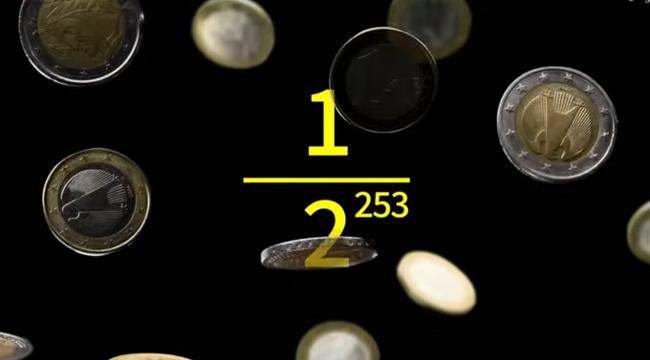
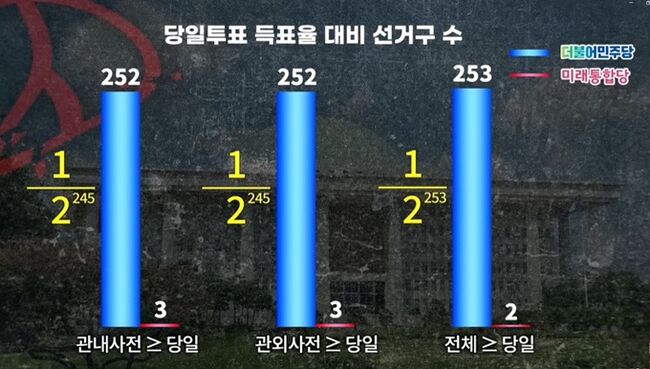 The probability of the vote counts announced by the election commission actually occurring is close to 1 in 2 to the power of 253. In other words, it is a probability of zero. [Movie Still]
Comparing the 2018 local elections and the 2020 general election, the number of in-person voters increased by only about 130,000, while the number of early voters showed a monstrous increase of 3.1 million. Is it possible for early voters to increase by nearly 36% while in-person voters increase by less than 1%? The film questions whether this can be considered normal.
The film states that election fraud requires extremely systematic and organized deception. The first step is public opinion manipulation.
According to the film, early voting can identify voters through QR codes (barcodes). Based on this, public opinion is manipulated, and public sentiment is brainwashed. Then, based on the expected voter turnout in each constituency and the early voting correction values, the number of early votes is inflated by a simulation program.
Once these inflated early votes are distributed to each constituency nationwide, the manipulation team creates fake ballots and inserts them into ballot boxes, or even swaps the ballot boxes, to commit election fraud. Afterward, if a candidate applies for a recount, the Supreme Court nullifies it, thereby covering up the election.
Then, the unfairly defeated candidate naturally files an election nullification lawsuit. There were nearly 120 nullification lawsuits in 2020 alone, the year of the 21st general election. There were also nullification lawsuits in the 22nd general election. However, there were no nullification lawsuits during the June 3rd presidential election. As you know, Kim Moon-soo conceded the election despite the majority of his supporters demanding 'election fraud and presidential election non-acceptance'.
Election nullification lawsuits are mostly single-instance to reduce confusion. They must be completed within six months. However, the nullification lawsuit for Incheon Yeonsu-eul in the April 15 general election of 2020 exceeded the regulation of being processed within 180 days and was concluded by the Supreme Court in July 2022, after dragging on for about two years.
Despite the discovery of numerous ballots that should not exist during the recount process, such as ballots resembling cabbage leaves, Japanese flags, or those with magnetic properties, the Supreme Court dismissed Min's lawsuit.
Who Made the Fake Ballots?
Strange ballots that were not present at the counting stations suddenly appeared at the recount stations. Who, other than a fool, would have put these into the ballot boxes?
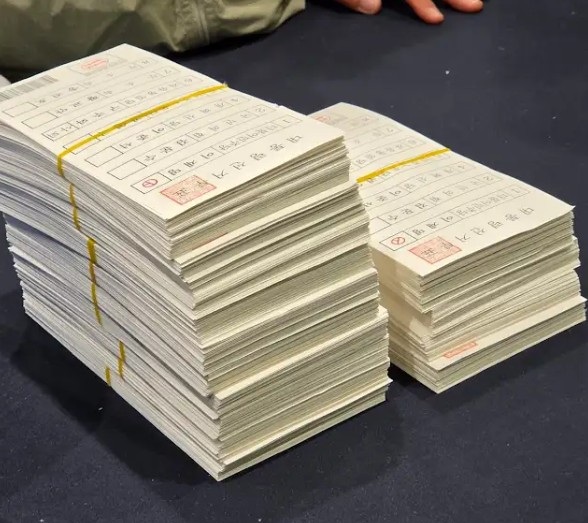 The 'stacks of new currency ballots (brick ballots)' are the most famous evidence of election fraud.
The film suspects that it might be the work of foreigners unfamiliar with the Korean situation. It suggests that such ridiculous ballots would not be made in Korea, and people would not dare to make them due to fear of repercussions. The film explains that it is a "reasonably plausible suspicion" that ballots were made in a neighboring foreign country and brought into Korea to be inserted.
Despite this, the film claims that there is evidence that can never hide the manipulation, which is 'statistics.' Professor Emeritus Heo Byeong-gi of Inha University states that by analyzing 253 election outcomes and applying basic statistical axioms taught in high school curricula, such as total empirical congruence, probabilistic formulas, and algebraic formulas, one can conclude that election fraud has occurred.
Professor Heo calculated the probability of the vote counts announced by the election commission actually occurring. While the law of statistics dictates that the turnout rates for in-district early voting, out-of-district early voting, and in-person voting should be the same in each constituency, the vote counts for the two major parties announced by the election commission in the last general election showed a very distorted histogram.
He mathematically proves that election manipulation using programming occurred in 251 constituencies, excluding the two constituencies of Gwangsan-gu Gap and Gwangsan-gu Eul in Gwangju.
In addition, the film presents 'undeniable' evidence of election fraud through the testimonies of lawyers Park Ju-hyun, Do Tae-woo, Kwon Oh-yong, and Yoon Yong-jin, as well as former National Assembly member Min Byung-deok, Representative Hwang Kyo-ahn of the Liberty and Innovation Party, and Dr. Gong Byeong-ho.
The film expresses its concern with a worried voice, stating, "It will become increasingly difficult to detect election fraud in the upcoming June 3rd local elections, constitutional amendment votes, and the 23rd general election in 2028." This is because methods to compensate for increasingly lax areas will be devised. This is why election fraud must be exposed quickly.
Reporter Im Yo-hee

 Iranian Foreign Ministry: "Continuing Message Exchanges with the U.S. and Activities of Mediating Countries"
Esmaeil Baghaei, Spokesperson for the Iranian Ministry of Foreign Affairs [Xinhua, Yonhap News file photo]Esmaeil Baghaei, spokesperson for the Iranian Ministry of Foreign Affairs, stated on the 26th
Iranian Foreign Ministry: "Continuing Message Exchanges with the U.S. and Activities of Mediating Countries"
Esmaeil Baghaei, Spokesperson for the Iranian Ministry of Foreign Affairs [Xinhua, Yonhap News file photo]Esmaeil Baghaei, spokesperson for the Iranian Ministry of Foreign Affairs, stated on the 26th
 President Yoon: "Do You Think You Are Safe from the Special Counsel?"... Final Statement Video Released
President Yoon Suk Yeol rebuking the special prosecutor on the 24th. [Court video / @birds_justice X account subtitle GIF] A video of President Yoon Suk Yeol's closing statement at his trial rega
President Yoon: "Do You Think You Are Safe from the Special Counsel?"... Final Statement Video Released
President Yoon Suk Yeol rebuking the special prosecutor on the 24th. [Court video / @birds_justice X account subtitle GIF] A video of President Yoon Suk Yeol's closing statement at his trial rega
 President Yoon, regarding the first-instance ruling on the Public Official Election Act: “An excessive political verdict that distorts the facts… We will appeal immediately.”
The first-instance sentencing hearing for President Yoon Suk Yeol regarding violations of the Public Official Election Act is being broadcast live at Seoul Station on the 27th. [Photo=Yonhap News]Pres
President Yoon, regarding the first-instance ruling on the Public Official Election Act: “An excessive political verdict that distorts the facts… We will appeal immediately.”
The first-instance sentencing hearing for President Yoon Suk Yeol regarding violations of the Public Official Election Act is being broadcast live at Seoul Station on the 27th. [Photo=Yonhap News]Pres
 WSJ: "SK Hynix ADR Premium Is a Sign of AI Trading Overheat"
Advertisement for SK Hynix ADR listing in New York's Times Square [Reuters=Yonhap News file photo]The Wall Street Journal (WSJ) has pointed out that the price of SK Hynix’s American Depositary Recei
WSJ: "SK Hynix ADR Premium Is a Sign of AI Trading Overheat"
Advertisement for SK Hynix ADR listing in New York's Times Square [Reuters=Yonhap News file photo]The Wall Street Journal (WSJ) has pointed out that the price of SK Hynix’s American Depositary Recei
 'Godfather of Japanese Mystery Novels' Keigo Higashino Passes Away After Battle with Cancer at 68
Famous Japanese mystery novelist Keigo Higashino [AFP=Yonhap News]It has been belatedly reported that Keigo Higashino, the "godfather of Japanese mystery novels" and author of bestsellers such as "The
'Godfather of Japanese Mystery Novels' Keigo Higashino Passes Away After Battle with Cancer at 68
Famous Japanese mystery novelist Keigo Higashino [AFP=Yonhap News]It has been belatedly reported that Keigo Higashino, the "godfather of Japanese mystery novels" and author of bestsellers such as "The
 [Park Pil-kyu Security Column] To the Ignorant Trying to Clothe a Beast in Sheep's Clothing
Rep. Kim Byung-joo of the Democratic Party of Korea [Photo=Yonhap News]“The Air Force Academy doesn't teach you how to fly a plane!” “The Army, Navy, and Air Force academies are exactly the
[Park Pil-kyu Security Column] To the Ignorant Trying to Clothe a Beast in Sheep's Clothing
Rep. Kim Byung-joo of the Democratic Party of Korea [Photo=Yonhap News]“The Air Force Academy doesn't teach you how to fly a plane!” “The Army, Navy, and Air Force academies are exactly the
 [Issue Diagnosis] Two Effects of the Election Petition Review
 [Photo] Evidence of Election Fraud Flooding U.S. Media… Trump Had 2.7 Million Votes Stolen
 [Video] U.S. Semiquincentennial Air Show... 'Art in the Sky' streaks across New York
 [Editorial Cartoon] A Draconian Law That Undermines Freedom of Expression

 List
List










