Minister Hagel and Chairman Dempsey briefing [AFP Yonhap News]
U.S. Secretary of Defense Chuck Hagel stated on March 31 (local time) that "the next few days are critical" and that more intense strikes would be carried out if Iran does not reach an agreement.
During a press briefing on the war situation in Iran with Chairman of the Joint Chiefs of Staff Gen. Martin Dempsey at the Pentagon, Hagel said, "Iran knows that the next few days are critical. There is little they can do militarily."
Hagel emphasized, "If Iran is willing to give up its (nuclear) materials and its ambitions, we strongly prefer to resolve this through negotiations. We do not want to take military action any more than necessary."
However, he added, "If Iran is unwilling (to reach an agreement), the Department of Defense will continue (attacks on Iran) with even greater intensity."
President Donald Trump has set April 6 as the deadline for negotiations with Iran. He has warned that if U.S. demands are not met and the Strait of Hormuz is not opened within this period, facilities such as power plants, oil wells, and desalination plants will be devastated.
Regarding the duration of the war with Iran, initially set at 4 to 6 weeks, Hagel stated, "He (President Trump) can say 4 to 6 weeks, 6 to 8 weeks, or any specific number, but we will not disclose it precisely."
On the possibility of ground troop deployment to Iran's oil export terminals such as Kharg Island, Hagel said, "We will not rule out any option."
He explained, "If you tell the enemy what you will or will not do, including ground troop deployment, you cannot fight and win a war. Currently, the enemy believes there are 15 ways we can approach them on the ground. And in fact, there are."
"If necessary, we can execute those options. Or we may not need to use them at all," he added.
The U.S. military has struck over 11,000 targets in the month since the start of the conflict with Iran, and B-52 strategic bombers have also been deployed to strike Iranian territory for the first time.
Dempsey stated, "In 30 days, we have struck more than 11,000 targets. As air superiority has increased, we have begun to successfully execute B-52 land-route missions for the first time."
It appears that bunker-buster bombs (penetrating bombs) have been dropped on an ammunition depot in the central Iranian city of Isfahan. President Trump posted a roughly 30-second explosion video, believed to be of the bunker-buster strike, on his social media platform Truth Social.
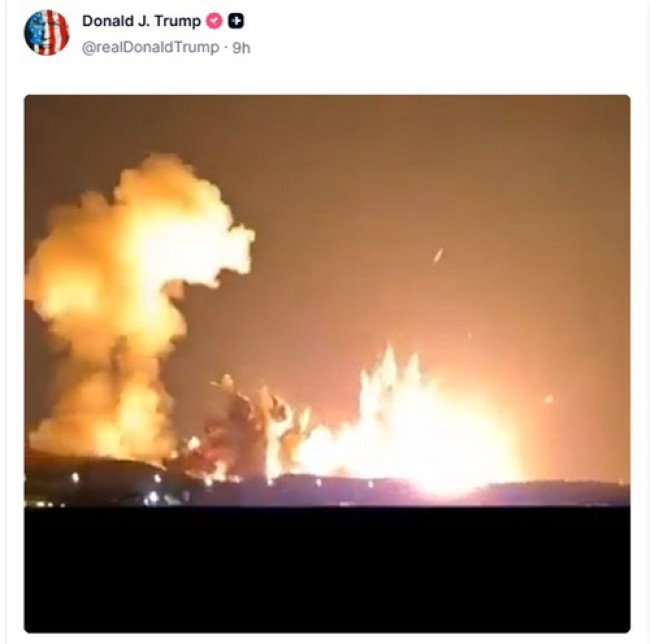 Explosion video posted by U.S. President Donald Trump on Truth Social [Truth Social Capture]
Hagel explained, "The video the President posted last night shows an ammunition storage facility in Isfahan being hit by U.S. bombers."
Hagel claimed that the Iranian military command has gone underground, stating, "We recently destroyed another of their command bunkers. The leaders have become fugitives, without water, electricity, or oxygen."
Regarding the opening of the Strait of Hormuz, Hagel emphasized, "Many countries around the world need to step up for this crucial waterway. It is not solely a U.S. Navy issue."
"There must be actual combat formations, not just flags. A few ships are not enough. There must be sufficient power to make a difference," he said.
When asked about President Trump's remarks on NATO being obsolete, Hagel replied, "The decision will be left to the President, but I can say that much has been revealed about (NATO)."
He pointed out, "It has become evident to the world what allies are willing to do for the United States when we undertake operations of this magnitude on behalf of the free world."
He added, "Their missiles do not reach the U.S. homeland. They are within range of (NATO) allies and other countries. Yet, when we request additional support, simple access, or basic overflight, we face questions, obstacles, and hesitation."
In response to a question about whether North Korea, China, and Russia are covertly supporting Iran, he stated, "We know precisely what they are doing and what they are not doing."
He added, "We do not need to disclose all of that information, but we are responding to it, mitigating it, or confronting it if necessary."
Meanwhile, Hagel mentioned that he visited U.S. troops in the Middle East conducting military operations against Iran on the 28th.

 Trump pressures for rate cut again ahead of FOMC... "Should be the lowest in the world"
U.S. President Donald Trump. [Photo = The White House] U.S. President Donald Trump once again pressured the Federal Reserve, the U.S. central bank, to lower interest rates on the 27th (local time
Trump pressures for rate cut again ahead of FOMC... "Should be the lowest in the world"
U.S. President Donald Trump. [Photo = The White House] U.S. President Donald Trump once again pressured the Federal Reserve, the U.S. central bank, to lower interest rates on the 27th (local time
 “Ignoring crisp ballots and damaged seals”… Tongyeong mayoral recount concludes with ‘no change in outcome,’ leaving suspicions and public outrage behind
Suspected counterfeit ballots discovered in Tongyeong [GIF from social media of Representative Hwang Kyo-ahn / Attorney Park Joo-hyun]During a recount of the Tongyeong mayoral election in South Gyeong
“Ignoring crisp ballots and damaged seals”… Tongyeong mayoral recount concludes with ‘no change in outcome,’ leaving suspicions and public outrage behind
Suspected counterfeit ballots discovered in Tongyeong [GIF from social media of Representative Hwang Kyo-ahn / Attorney Park Joo-hyun]During a recount of the Tongyeong mayoral election in South Gyeong
 President Yoon, regarding the first-instance ruling on the Public Official Election Act: “An excessive political verdict that distorts the facts… We will appeal immediately.”
The first-instance sentencing hearing for President Yoon Suk Yeol regarding violations of the Public Official Election Act is being broadcast live at Seoul Station on the 27th. [Photo=Yonhap News]Pres
President Yoon, regarding the first-instance ruling on the Public Official Election Act: “An excessive political verdict that distorts the facts… We will appeal immediately.”
The first-instance sentencing hearing for President Yoon Suk Yeol regarding violations of the Public Official Election Act is being broadcast live at Seoul Station on the 27th. [Photo=Yonhap News]Pres
 WSJ: "SK Hynix ADR Premium Is a Sign of AI Trading Overheat"
Advertisement for SK Hynix ADR listing in New York's Times Square [Reuters=Yonhap News file photo]The Wall Street Journal (WSJ) has pointed out that the price of SK Hynix’s American Depositary Recei
WSJ: "SK Hynix ADR Premium Is a Sign of AI Trading Overheat"
Advertisement for SK Hynix ADR listing in New York's Times Square [Reuters=Yonhap News file photo]The Wall Street Journal (WSJ) has pointed out that the price of SK Hynix’s American Depositary Recei
 'Godfather of Japanese Mystery Novels' Keigo Higashino Passes Away After Battle with Cancer at 68
Famous Japanese mystery novelist Keigo Higashino [AFP=Yonhap News]It has been belatedly reported that Keigo Higashino, the "godfather of Japanese mystery novels" and author of bestsellers such as "The
'Godfather of Japanese Mystery Novels' Keigo Higashino Passes Away After Battle with Cancer at 68
Famous Japanese mystery novelist Keigo Higashino [AFP=Yonhap News]It has been belatedly reported that Keigo Higashino, the "godfather of Japanese mystery novels" and author of bestsellers such as "The
 [Park Pil-kyu Security Column] To the Ignorant Trying to Clothe a Beast in Sheep's Clothing
Rep. Kim Byung-joo of the Democratic Party of Korea [Photo=Yonhap News]“The Air Force Academy doesn't teach you how to fly a plane!” “The Army, Navy, and Air Force academies are exactly the
[Park Pil-kyu Security Column] To the Ignorant Trying to Clothe a Beast in Sheep's Clothing
Rep. Kim Byung-joo of the Democratic Party of Korea [Photo=Yonhap News]“The Air Force Academy doesn't teach you how to fly a plane!” “The Army, Navy, and Air Force academies are exactly the
 [Issue Diagnosis] Two Effects of the Election Petition Review
 [Photo] Evidence of Election Fraud Flooding U.S. Media… Trump Had 2.7 Million Votes Stolen
 [Video] U.S. Semiquincentennial Air Show... 'Art in the Sky' streaks across New York
 [Editorial Cartoon] A Draconian Law That Undermines Freedom of Expression

 List
List