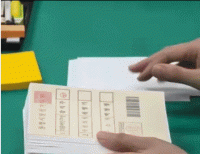
President Trump [UPI Yonhap News]
U.S. President Donald Trump expressed dissatisfaction on Sunday (local time) with South Korea for not immediately responding to a request for troop deployment, stating that European and Asian countries should manage the Strait of Hormuz, which is effectively blockaded by Iran.
Given that President Trump has even mentioned considering withdrawal from the North Atlantic Treaty Organization (NATO) while citing a lack of assistance when needed, concerns are rising that his dissatisfaction over the delayed approval of the troop deployment request could manifest as some form of 'action' against the ROK-U.S. alliance.
However, it has been noted that the White House uploaded a video of the speech event to its YouTube account and then deleted it.
According to the video previously released by the White House, President Trump, while hosting an Easter luncheon at the White House, stated, "Let the European countries do it. Let South Korea do it," implying that the blockade of the Strait of Hormuz was not America's problem.
President Trump added, "(South Korea) has not been helpful to us," noting, "Even though we have 45,000 soldiers in a dangerous area, right next to nuclear power."
The term 'nuclear power' appears to refer to North Korea. This argument suggests that South Korea has not cooperated with requests, such as dispatching warships to the Strait of Hormuz, despite the U.S. stationing its forces in South Korea near North Korea, which possesses nuclear weapons, for the security of the South.
The number of U.S. forces in South Korea is around 28,500, but President Trump cited an inflated figure on this occasion as well. This is interpreted as his characteristic speaking style of exaggerating U.S. contributions while highlighting the other party's non-cooperation.
President Trump continued, "Let Japan do it. They get 90% of the oil from the (Hormuz) Strait. Let China do it. Let them do it."
Amidst the escalating energy crisis caused by the blockade of the Strait of Hormuz, President Trump is daily seeking an exit strategy by framing it as a problem for countries highly dependent on the strait.
However, his mention of South Korea is noteworthy. President Trump had previously expressed anger on the 17th, stating, "We don't need NATO's help. Nor do Japan and South Korea," after requesting naval deployments to the Strait of Hormuz from NATO members and China, Japan, and South Korea, but receiving no positive response. However, this is essentially the first time he has specifically singled out South Korea and expressed his dissatisfaction by saying, "South Korea has not been helpful."
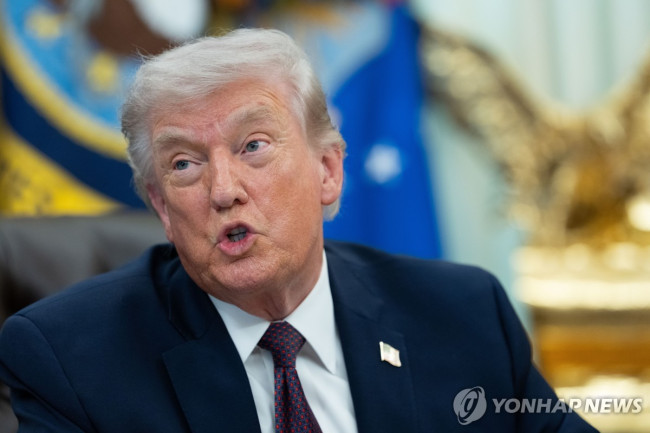 President Trump [UPI Yonhap News]
Until now, President Trump's expressions of dissatisfaction have been primarily focused on NATO. In an interview published by the British media outlet The Telegraph on the 31st of last month, he made strong remarks such as, "I am strongly considering withdrawing from NATO."
It appears to be President Trump's perception that the U.S. contributes significantly to the security of its allies at great cost, yet receives no assistance when it needs it, and therefore, appropriate measures are necessary.
His mention of the U.S. Forces Korea, effectively referring to North Korea, is also notable. It seems intended to emphasize that the U.S. Forces Korea are helping South Korea while taking on the 'North Korean nuclear risk'.
Accordingly, concerns are emerging that President Trump may take coercive measures against South Korea and Japan, among others, on trade and security issues, in parallel with pressure on NATO.
While engaging in a war with Iran, the Trump administration has initiated investigations against major trading partners, including South Korea, China, Japan, and the European Union (EU), based on Section 301 of the Trade Act, citing issues such as 'overproduction and overcapacity' and 'import of goods produced by forced labor.' The plan is to fill the gap left by reciprocal tariffs resulting from Supreme Court rulings based on the investigation results.
Considering that the Easter luncheon was initially a private event, it is possible that President Trump spoke more candidly. Since the White House posted and then deleted the video, and President Trump mentioned several countries in addition to South Korea, it remains to be seen whether his dissatisfaction with South Korea will lead to actual measures.
On the 14th of last month, President Trump requested naval deployments to the Strait of Hormuz, mentioning South Korea, Japan, France, the United Kingdom, and China. This drew criticism for initiating military operations against Iran without consultation and putting allies in a difficult situation, and South Korea and Japan maintained a cautious stance.

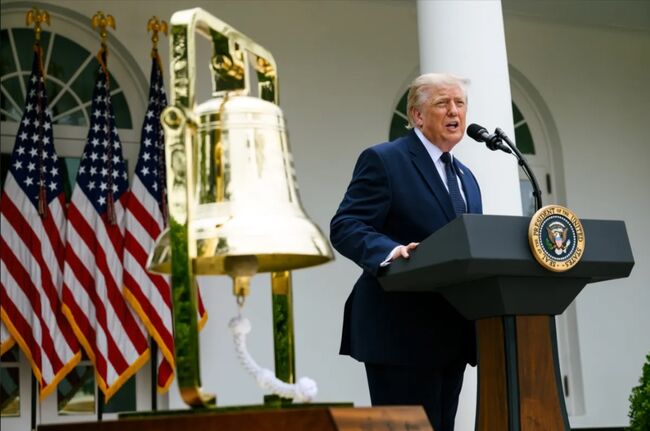 Trump pressures for rate cut again ahead of FOMC... "Should be the lowest in the world"
U.S. President Donald Trump. [Photo = The White House] U.S. President Donald Trump once again pressured the Federal Reserve, the U.S. central bank, to lower interest rates on the 27th (local time
Trump pressures for rate cut again ahead of FOMC... "Should be the lowest in the world"
U.S. President Donald Trump. [Photo = The White House] U.S. President Donald Trump once again pressured the Federal Reserve, the U.S. central bank, to lower interest rates on the 27th (local time
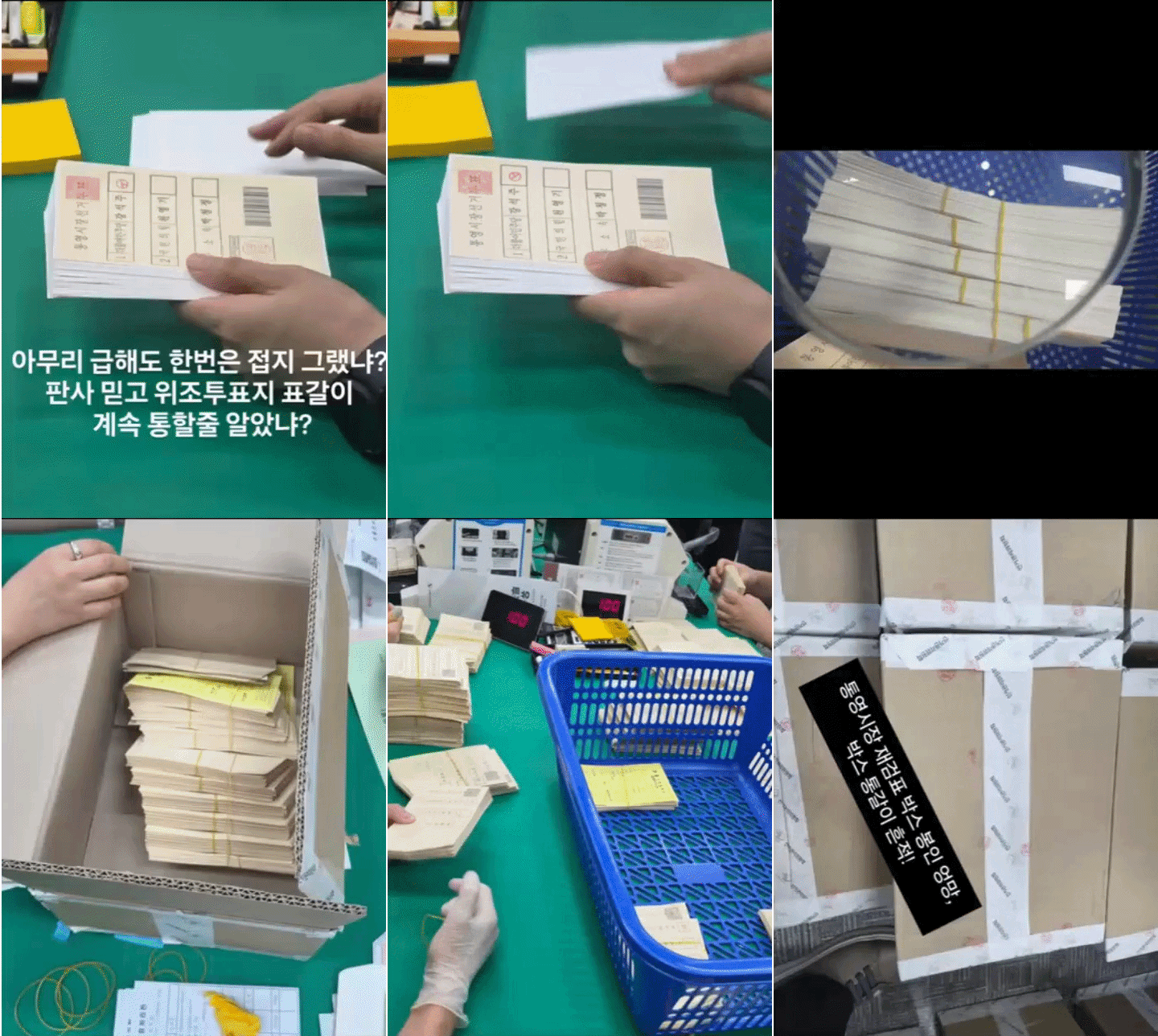 “Ignoring crisp ballots and damaged seals”… Tongyeong mayoral recount concludes with ‘no change in outcome,’ leaving suspicions and public outrage behind
Suspected counterfeit ballots discovered in Tongyeong [GIF from social media of Representative Hwang Kyo-ahn / Attorney Park Joo-hyun]During a recount of the Tongyeong mayoral election in South Gyeong
“Ignoring crisp ballots and damaged seals”… Tongyeong mayoral recount concludes with ‘no change in outcome,’ leaving suspicions and public outrage behind
Suspected counterfeit ballots discovered in Tongyeong [GIF from social media of Representative Hwang Kyo-ahn / Attorney Park Joo-hyun]During a recount of the Tongyeong mayoral election in South Gyeong
 President Yoon, regarding the first-instance ruling on the Public Official Election Act: “An excessive political verdict that distorts the facts… We will appeal immediately.”
The first-instance sentencing hearing for President Yoon Suk Yeol regarding violations of the Public Official Election Act is being broadcast live at Seoul Station on the 27th. [Photo=Yonhap News]Pres
President Yoon, regarding the first-instance ruling on the Public Official Election Act: “An excessive political verdict that distorts the facts… We will appeal immediately.”
The first-instance sentencing hearing for President Yoon Suk Yeol regarding violations of the Public Official Election Act is being broadcast live at Seoul Station on the 27th. [Photo=Yonhap News]Pres
 WSJ: "SK Hynix ADR Premium Is a Sign of AI Trading Overheat"
Advertisement for SK Hynix ADR listing in New York's Times Square [Reuters=Yonhap News file photo]The Wall Street Journal (WSJ) has pointed out that the price of SK Hynix’s American Depositary Recei
WSJ: "SK Hynix ADR Premium Is a Sign of AI Trading Overheat"
Advertisement for SK Hynix ADR listing in New York's Times Square [Reuters=Yonhap News file photo]The Wall Street Journal (WSJ) has pointed out that the price of SK Hynix’s American Depositary Recei
 'Godfather of Japanese Mystery Novels' Keigo Higashino Passes Away After Battle with Cancer at 68
Famous Japanese mystery novelist Keigo Higashino [AFP=Yonhap News]It has been belatedly reported that Keigo Higashino, the "godfather of Japanese mystery novels" and author of bestsellers such as "The
'Godfather of Japanese Mystery Novels' Keigo Higashino Passes Away After Battle with Cancer at 68
Famous Japanese mystery novelist Keigo Higashino [AFP=Yonhap News]It has been belatedly reported that Keigo Higashino, the "godfather of Japanese mystery novels" and author of bestsellers such as "The
 [Park Pil-kyu Security Column] To the Ignorant Trying to Clothe a Beast in Sheep's Clothing
Rep. Kim Byung-joo of the Democratic Party of Korea [Photo=Yonhap News]“The Air Force Academy doesn't teach you how to fly a plane!” “The Army, Navy, and Air Force academies are exactly the
[Park Pil-kyu Security Column] To the Ignorant Trying to Clothe a Beast in Sheep's Clothing
Rep. Kim Byung-joo of the Democratic Party of Korea [Photo=Yonhap News]“The Air Force Academy doesn't teach you how to fly a plane!” “The Army, Navy, and Air Force academies are exactly the
 [Issue Diagnosis] Two Effects of the Election Petition Review
 [Photo] Evidence of Election Fraud Flooding U.S. Media… Trump Had 2.7 Million Votes Stolen
 [Video] U.S. Semiquincentennial Air Show... 'Art in the Sky' streaks across New York
 [Editorial Cartoon] A Draconian Law That Undermines Freedom of Expression

 List
List