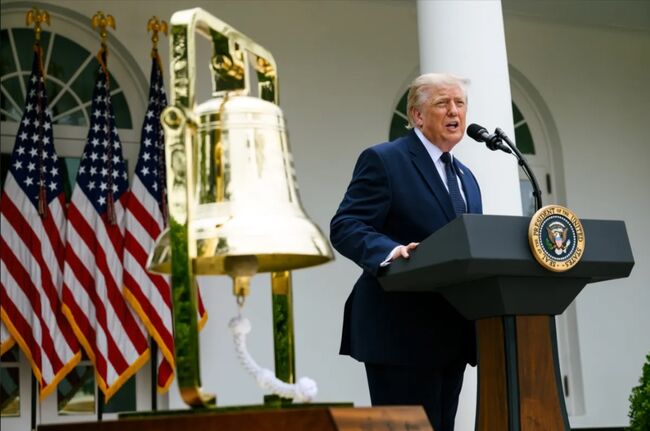
President Donald Trump's televised address to the nation on the 1st (local time) focused on alleviating public concerns over rising oil prices and a prolonged war, emphasizing that the military operation against Iran is nearing successful completion.
He stated that while Iran would be strongly targeted for two to three weeks, negotiations would also proceed concurrently. There were expectations that President Trump's plan to end the conflict would be detailed in his address to the nation, but no new announcements were made.
His assertion that countries heavily reliant on the Strait of Hormuz should take responsibility for its management was also reiterated. Contrary to concerns, the speech did not include strong criticism of allies such as NATO.
From the outset of his approximately 18-minute address from the White House, President Trump sought to justify the military operation against Iran, highlighting its successful execution and emphasizing that it was nearing its end.
He stated, "We have achieved swift, decisive, and overwhelming victories on the battlefield," and added, "I am pleased to announce that key strategic objectives are nearing completion."
President Trump also said, "We will finish the job, and we will finish it very quickly."
This was a reiteration that the war with Iran would end quickly, considering the unfavorable public opinion in the United States and the worsening sentiment due to rising oil prices.
In this context, President Trump drew attention by listing wars in which the U.S. had previously participated, mentioning their durations down to the day.
President Trump said, "It is very important to have a balanced perspective on these wars," and added, "America's participation in World War I was 1 year, 7 months, and 5 days."
He then stated the duration of World War II (3 years, 8 months, 25 days), the Korean War (3 years, 1 month, 2 days), the Vietnam War (19 years, 5 months, 29 days), and the Iraq War (8 years, 8 months, 28 days), before emphasizing, "We are conducting a very strong and excellent military operation for 32 days against one of the most powerful countries, and that country's strength has diminished and it is basically no longer a threat."
This is interpreted as an attempt to quell concerns about a prolonged war by highlighting that the conflict with Iran has been significantly shorter than previous wars.
President Trump directly addressed Americans' concerns about recent oil price hikes, characterizing them as 'short-term increases' and blaming Iran's attacks on oil tankers.
He also attempted to alleviate anxieties about rising oil prices by stating that the U.S. produces more oil and gas than Saudi Arabia and Russia combined.
He predicted that once the conflict ends, the Strait of Hormuz would naturally reopen, leading to a sharp drop in oil prices and a surge in stock prices. He also claimed that despite some stock market decline, the response had been better than expected, and the economic damage was not significant.
President Trump reiterated his argument that countries heavily reliant on the Strait of Hormuz should manage it, as the U.S. imports very little oil from the region.
He also stated, "Buy oil from the United States or 'show courage now and go to the Strait of Hormuz to manage it.'"
 President Trump entering to deliver his address to the nation [AFP Yonhap News]
While there were expectations that President Trump would provide concrete details of his plan to end the conflict in his first prime-time address to the nation since the start of the Iran war, the content was largely consistent with what he had previously stated in public Q&As and social media posts.
President Trump mentioned the next two to three weeks, stating that Iran would be struck extremely hard and sent back to the Stone Age, and added, "Discussions are also ongoing." The previous day, President Trump had indicated a period of two to three weeks, stating his intention to withdraw from the war regardless of an agreement and that strong strikes would occur.
While the mention of strong strikes in this speech might be seen as an attempt to gain leverage in negotiations, the limited mention of negotiations itself suggests that expectations for a diplomatic resolution might not be very high.
Concerns had been raised that the address might include sharp criticism of allies, including NATO, but references to allies were relatively few.
In a British media interview released on the 31st, President Trump stated that he was strongly considering withdrawing from NATO, and in a Reuters interview released that morning, he also indicated his intention to express dissatisfaction with NATO through his speech, raising concerns.
However, President Trump did not mention NATO or criticize specific countries in his address.
While there were some remarks expressing dissatisfaction with the lack of response to the request for troop deployment in the Strait of Hormuz, the tone was less severe than usual.
It is possible that instead of openly confronting allies by alienating them with an unpopular war in Iran, the focus was on emphasizing the justification and achievements of the Iran operation to alleviate public concerns.
However, President Trump did acknowledge the allies in the Middle East, saying, "I want to thank our allies in the Middle East, Israel, Saudi Arabia, Qatar, the United Arab Emirates (UAE), Kuwait, and Bahrain," naming countries that cooperated in the Iran operation or were affected by it.
This was President Trump's first prime-time address to the nation since the start of the Iran war. U.S. presidents typically deliver addresses during prime time, at 9 PM, to ensure a larger audience can watch the live broadcast for significant announcements or when national unity is required.

 Trump pressures for rate cut again ahead of FOMC... "Should be the lowest in the world"
U.S. President Donald Trump. [Photo = The White House] U.S. President Donald Trump once again pressured the Federal Reserve, the U.S. central bank, to lower interest rates on the 27th (local time
Trump pressures for rate cut again ahead of FOMC... "Should be the lowest in the world"
U.S. President Donald Trump. [Photo = The White House] U.S. President Donald Trump once again pressured the Federal Reserve, the U.S. central bank, to lower interest rates on the 27th (local time
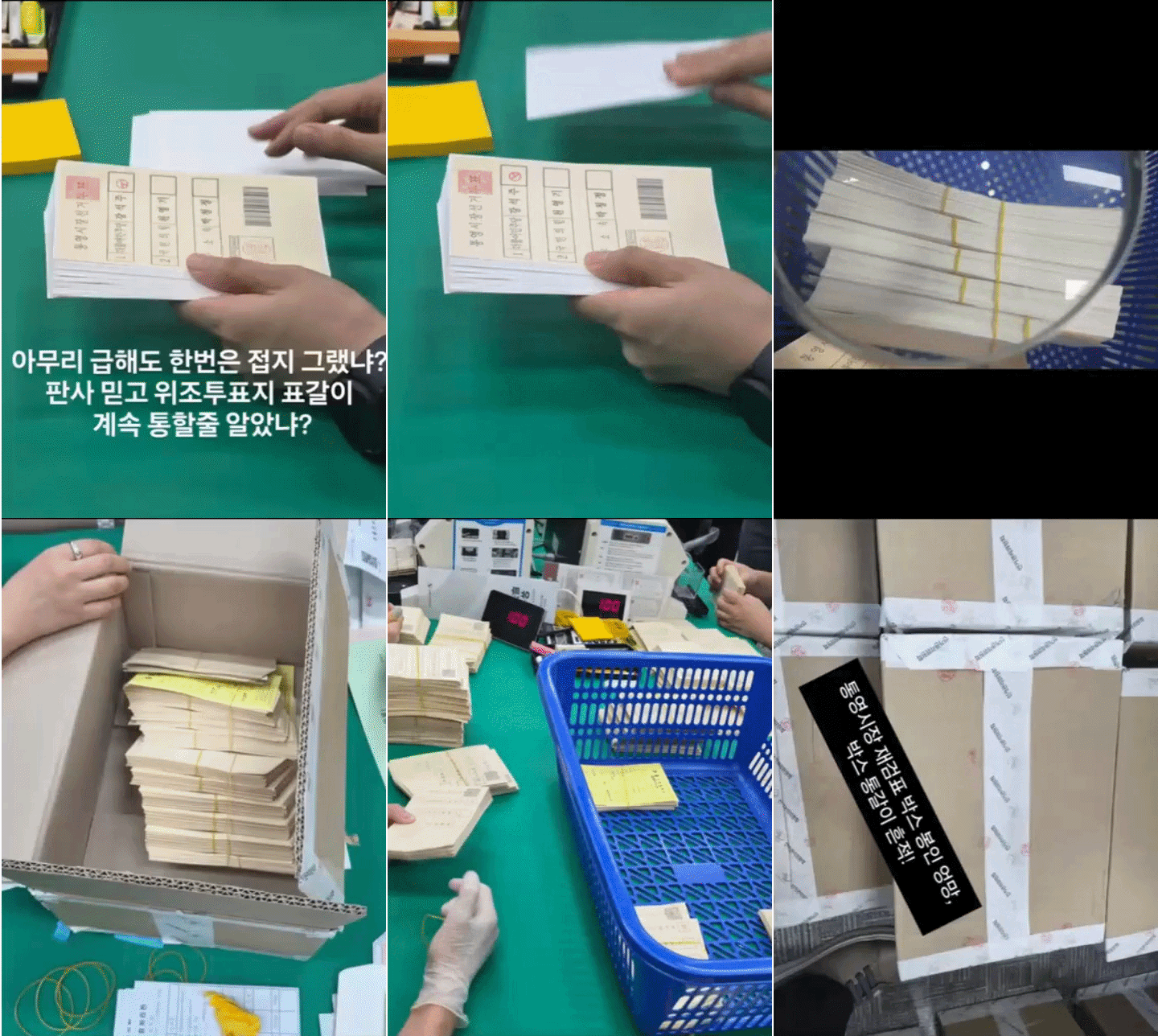 “Ignoring crisp ballots and damaged seals”… Tongyeong mayoral recount concludes with ‘no change in outcome,’ leaving suspicions and public outrage behind
Suspected counterfeit ballots discovered in Tongyeong [GIF from social media of Representative Hwang Kyo-ahn / Attorney Park Joo-hyun]During a recount of the Tongyeong mayoral election in South Gyeong
“Ignoring crisp ballots and damaged seals”… Tongyeong mayoral recount concludes with ‘no change in outcome,’ leaving suspicions and public outrage behind
Suspected counterfeit ballots discovered in Tongyeong [GIF from social media of Representative Hwang Kyo-ahn / Attorney Park Joo-hyun]During a recount of the Tongyeong mayoral election in South Gyeong
 President Yoon, regarding the first-instance ruling on the Public Official Election Act: “An excessive political verdict that distorts the facts… We will appeal immediately.”
The first-instance sentencing hearing for President Yoon Suk Yeol regarding violations of the Public Official Election Act is being broadcast live at Seoul Station on the 27th. [Photo=Yonhap News]Pres
President Yoon, regarding the first-instance ruling on the Public Official Election Act: “An excessive political verdict that distorts the facts… We will appeal immediately.”
The first-instance sentencing hearing for President Yoon Suk Yeol regarding violations of the Public Official Election Act is being broadcast live at Seoul Station on the 27th. [Photo=Yonhap News]Pres
 WSJ: "SK Hynix ADR Premium Is a Sign of AI Trading Overheat"
Advertisement for SK Hynix ADR listing in New York's Times Square [Reuters=Yonhap News file photo]The Wall Street Journal (WSJ) has pointed out that the price of SK Hynix’s American Depositary Recei
WSJ: "SK Hynix ADR Premium Is a Sign of AI Trading Overheat"
Advertisement for SK Hynix ADR listing in New York's Times Square [Reuters=Yonhap News file photo]The Wall Street Journal (WSJ) has pointed out that the price of SK Hynix’s American Depositary Recei
 'Godfather of Japanese Mystery Novels' Keigo Higashino Passes Away After Battle with Cancer at 68
Famous Japanese mystery novelist Keigo Higashino [AFP=Yonhap News]It has been belatedly reported that Keigo Higashino, the "godfather of Japanese mystery novels" and author of bestsellers such as "The
'Godfather of Japanese Mystery Novels' Keigo Higashino Passes Away After Battle with Cancer at 68
Famous Japanese mystery novelist Keigo Higashino [AFP=Yonhap News]It has been belatedly reported that Keigo Higashino, the "godfather of Japanese mystery novels" and author of bestsellers such as "The
 [Park Pil-kyu Security Column] To the Ignorant Trying to Clothe a Beast in Sheep's Clothing
Rep. Kim Byung-joo of the Democratic Party of Korea [Photo=Yonhap News]“The Air Force Academy doesn't teach you how to fly a plane!” “The Army, Navy, and Air Force academies are exactly the
[Park Pil-kyu Security Column] To the Ignorant Trying to Clothe a Beast in Sheep's Clothing
Rep. Kim Byung-joo of the Democratic Party of Korea [Photo=Yonhap News]“The Air Force Academy doesn't teach you how to fly a plane!” “The Army, Navy, and Air Force academies are exactly the
 [Issue Diagnosis] Two Effects of the Election Petition Review
 [Photo] Evidence of Election Fraud Flooding U.S. Media… Trump Had 2.7 Million Votes Stolen
 [Video] U.S. Semiquincentennial Air Show... 'Art in the Sky' streaks across New York
 [Editorial Cartoon] A Draconian Law That Undermines Freedom of Expression

 List
List