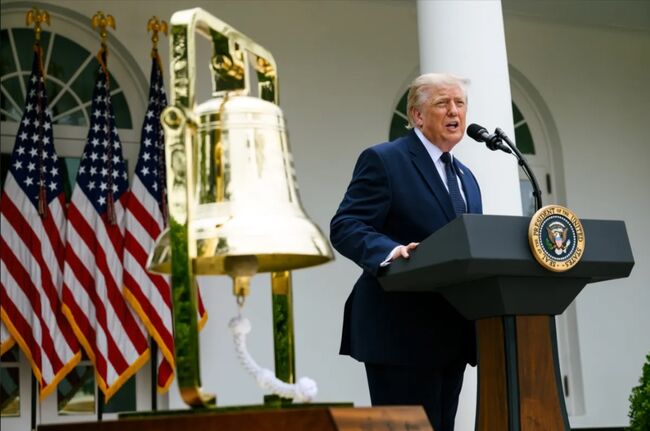
 President Trump [AFP Yonhap News]
On November 11 (local time), the same day the United States and Iran began negotiations in Pakistan, U.S. President Donald Trump claimed that the U.S. was beginning efforts to clear the Strait of Hormuz for the sake of South Korea, Japan, China, and the rest of the world.
While it remains unclear what "clearing efforts" President Trump is referring to, U.S. media reported that multiple U.S. warships had transited the Strait of Hormuz without coordination with Iran. If confirmed, this would be seen as an increase in pressure against Iran through a show of force just before the Pakistan talks between U.S. and Iranian delegations, drawing significant attention.
In a post on the social media platform Truth Social on the same day, President Trump criticized critical media coverage of the Iran conflict before stating, "We are now starting to clear the Strait of Hormuz for countries all over the world, including China, Japan, South Korea, France, Germany, and many others."
He added, "Amazingly, they do not have the courage or the will to do it themselves. But, very interestingly, many countries are coming to the United States to fill up their empty oil tankers," he added.
President Trump emphasized that Iran was losing miserably, stating, "All that is left for them is the threat that ships could hit mines, but all 28 of their mine-laying ships have sunk to the bottom of the sea."
President Trump did not specifically mention what the "clearing efforts" in the Strait of Hormuz entailed.
The U.S. online news outlet Axios reported, citing U.S. officials, that several U.S. Navy warships had passed through the Strait of Hormuz that day. The U.S. newspaper The Wall Street Journal reported that it was two U.S. Navy guided-missile destroyers and that there were no particular issues.
Axios further reported that the operation was conducted without coordination with Iran and that it was the first time U.S. warships had transited the Strait of Hormuz since the outbreak of the Iran conflict.
The official described it as "an operation focused on freedom of navigation on the high seas." It can be viewed as a form of show of force by the U.S. against Iran's blockade of the strait and collection of transit fees, coinciding with the start of negotiations between the U.S. and Iran in Pakistan.
However, the Iranian Foreign Ministry stated on the same day that U.S. destroyers attempted to approach from the east of the Strait of Hormuz but turned back after warnings from the Iranian military.
President Trump's remarks about the U.S. clearing the Strait of Hormuz for countries worldwide appear to stem from the perception that the U.S. is ensuring the openness of the Strait, which Asian countries like South Korea, China, and Japan, as well as European nations, should be doing.
This can be seen as an expression of dissatisfaction that while Iran has effectively blockaded the Strait of Hormuz due to U.S. military operations, the U.S. is shifting responsibility to countries like South Korea, implying they are not taking more active steps to ensure the strait's openness.
President Trump has repeatedly expressed his dissatisfaction with allies who have not immediately responded to demands for troop deployment in the Strait of Hormuz, arguing that countries with high dependency on the strait should resolve the blockage, as the U.S. has low dependency.
In a separate Truth Social post that day, President Trump stated, "Completely empty oil tankers, some of the largest in the world, are now coming to the United States to fill up with the best oil and gas. We are waiting for you."
This can be interpreted as an indirect demand for countries struggling with the global energy crisis caused by the Strait of Hormuz blockage to purchase U.S. oil.
President Trump posted a series of messages on Truth Social around the time negotiations began between U.S. and Iranian delegations in Pakistan before heading to a golf course.

 Trump pressures for rate cut again ahead of FOMC... "Should be the lowest in the world"
U.S. President Donald Trump. [Photo = The White House] U.S. President Donald Trump once again pressured the Federal Reserve, the U.S. central bank, to lower interest rates on the 27th (local time
Trump pressures for rate cut again ahead of FOMC... "Should be the lowest in the world"
U.S. President Donald Trump. [Photo = The White House] U.S. President Donald Trump once again pressured the Federal Reserve, the U.S. central bank, to lower interest rates on the 27th (local time
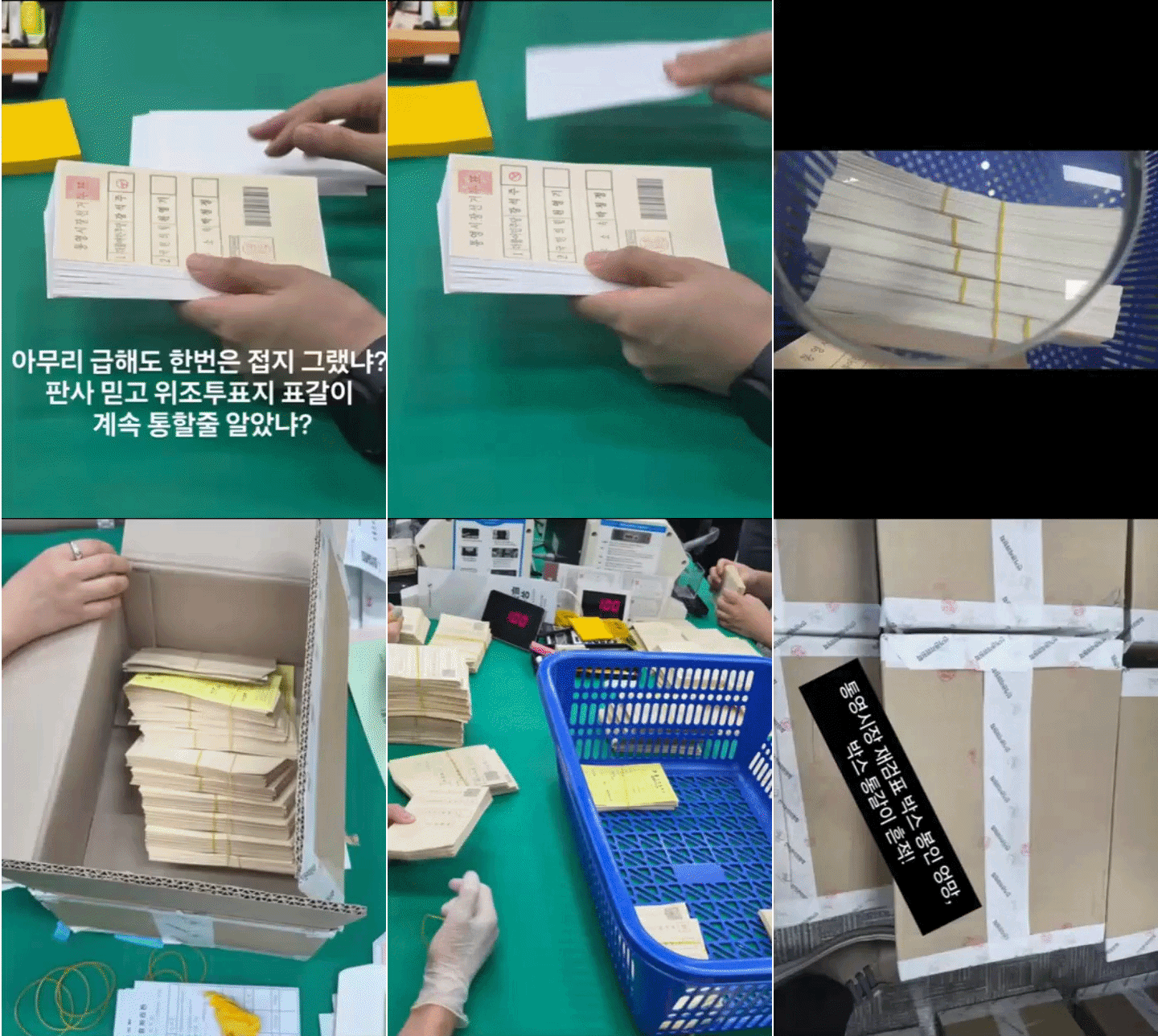 “Ignoring crisp ballots and damaged seals”… Tongyeong mayoral recount concludes with ‘no change in outcome,’ leaving suspicions and public outrage behind
Suspected counterfeit ballots discovered in Tongyeong [GIF from social media of Representative Hwang Kyo-ahn / Attorney Park Joo-hyun]During a recount of the Tongyeong mayoral election in South Gyeong
“Ignoring crisp ballots and damaged seals”… Tongyeong mayoral recount concludes with ‘no change in outcome,’ leaving suspicions and public outrage behind
Suspected counterfeit ballots discovered in Tongyeong [GIF from social media of Representative Hwang Kyo-ahn / Attorney Park Joo-hyun]During a recount of the Tongyeong mayoral election in South Gyeong
 President Yoon, regarding the first-instance ruling on the Public Official Election Act: “An excessive political verdict that distorts the facts… We will appeal immediately.”
The first-instance sentencing hearing for President Yoon Suk Yeol regarding violations of the Public Official Election Act is being broadcast live at Seoul Station on the 27th. [Photo=Yonhap News]Pres
President Yoon, regarding the first-instance ruling on the Public Official Election Act: “An excessive political verdict that distorts the facts… We will appeal immediately.”
The first-instance sentencing hearing for President Yoon Suk Yeol regarding violations of the Public Official Election Act is being broadcast live at Seoul Station on the 27th. [Photo=Yonhap News]Pres
 WSJ: "SK Hynix ADR Premium Is a Sign of AI Trading Overheat"
Advertisement for SK Hynix ADR listing in New York's Times Square [Reuters=Yonhap News file photo]The Wall Street Journal (WSJ) has pointed out that the price of SK Hynix’s American Depositary Recei
WSJ: "SK Hynix ADR Premium Is a Sign of AI Trading Overheat"
Advertisement for SK Hynix ADR listing in New York's Times Square [Reuters=Yonhap News file photo]The Wall Street Journal (WSJ) has pointed out that the price of SK Hynix’s American Depositary Recei
 'Godfather of Japanese Mystery Novels' Keigo Higashino Passes Away After Battle with Cancer at 68
Famous Japanese mystery novelist Keigo Higashino [AFP=Yonhap News]It has been belatedly reported that Keigo Higashino, the "godfather of Japanese mystery novels" and author of bestsellers such as "The
'Godfather of Japanese Mystery Novels' Keigo Higashino Passes Away After Battle with Cancer at 68
Famous Japanese mystery novelist Keigo Higashino [AFP=Yonhap News]It has been belatedly reported that Keigo Higashino, the "godfather of Japanese mystery novels" and author of bestsellers such as "The
 [Park Pil-kyu Security Column] To the Ignorant Trying to Clothe a Beast in Sheep's Clothing
Rep. Kim Byung-joo of the Democratic Party of Korea [Photo=Yonhap News]“The Air Force Academy doesn't teach you how to fly a plane!” “The Army, Navy, and Air Force academies are exactly the
[Park Pil-kyu Security Column] To the Ignorant Trying to Clothe a Beast in Sheep's Clothing
Rep. Kim Byung-joo of the Democratic Party of Korea [Photo=Yonhap News]“The Air Force Academy doesn't teach you how to fly a plane!” “The Army, Navy, and Air Force academies are exactly the
 [Issue Diagnosis] Two Effects of the Election Petition Review
 [Photo] Evidence of Election Fraud Flooding U.S. Media… Trump Had 2.7 Million Votes Stolen
 [Video] U.S. Semiquincentennial Air Show... 'Art in the Sky' streaks across New York
 [Editorial Cartoon] A Draconian Law That Undermines Freedom of Expression

 List
List









