 Hyangwonjeong Pavilion. [Photo=Cultural Heritage Administration, Royal Palaces and Tombs Center]
Beyond Geunjeongjeon Hall and Gyeonghoeru Pavilion, which represent Gyeongbokgung Palace, and venturing further into the rear garden, one encounters a secluded space where the final embers of Joseon once burned. This area includes Geoncheonggung Palace, imbued with King Gojong's will for independence; Jipokjae, a study reflecting dreams of modernization; and Hyangwonjeong, a pavilion blooming like a lotus between them.
These three spaces, which have silently endured through the maelstrom of history, are located in the deepest part of Gyeongbokgung Palace. They offer a glimpse into the urgent times of King Gojong, who sought to preserve the nation amidst the rivalry of powerful nations in the late Joseon period.
'Geoncheonggung Palace': A Palace within a Palace
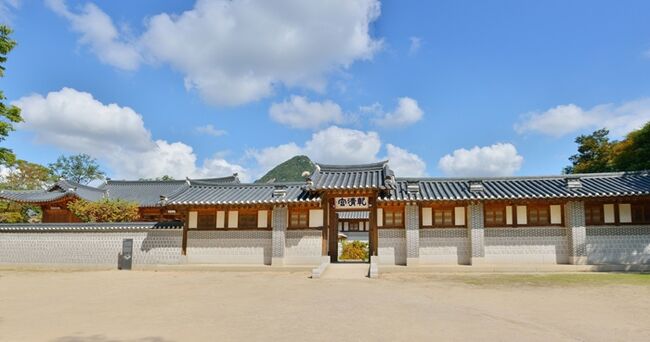 Geoncheonggung Palace. [Photo=Cultural Heritage Administration, Royal Palaces and Tombs Center]
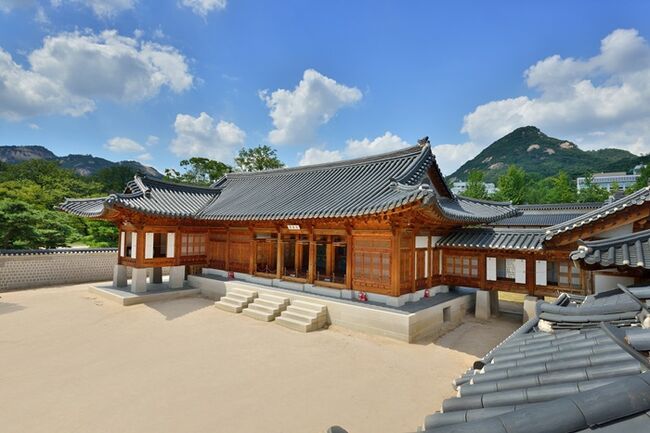 Jangandang, the main hall of Geoncheonggung Palace. [Photo=Cultural Heritage Administration, Royal Palaces and Tombs Center]
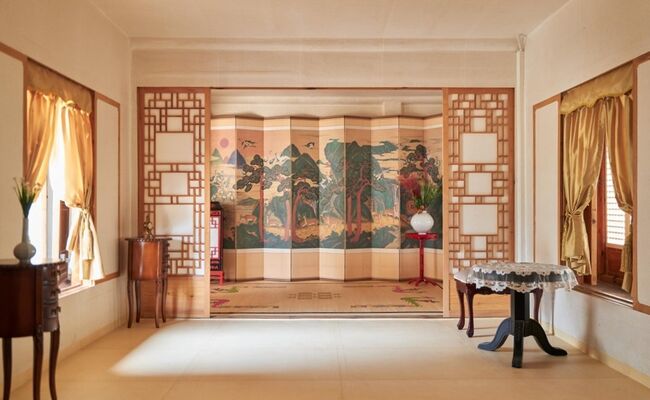 Gyonnyeonghap, the queen's quarters in Geoncheonggung Palace. [Photo=Cultural Heritage Administration, Royal Palaces and Tombs Center]
In 1873, after the reconstruction of Gyeongbokgung Palace was largely completed, King Gojong declared his personal rule, breaking free from the regency of his father, Heungseon Daewongun. Geoncheonggung Palace, situated at the northernmost edge of the palace grounds, became a symbol of Gojong's independence.
Comprising Jangandang, the main hall, and Gyonnyeonghap, the queen's quarters, Geoncheonggung Palace presented a modest exterior without ornate decoration. However, it was here that Gojong met with his ministers to discuss state affairs and received foreign envoys, aiming to strengthen Joseon's standing.
Tragically, in 1895, the "Eulmi Incident" occurred within Gyonnyeonghap, where Empress Myeongseong was assassinated by Japanese swords. From then on, Geoncheonggung Palace became a place holding the deepest sorrow of the Joseon Dynasty.
The First Light Illuminating the Darkness of Modernity
Geoncheonggung Palace also served as a laboratory for King Gojong as Joseon actively embraced modern civilization. In 1887, at the request of the Joseon royal family, the American Edison Electric Light Company installed a generator, illuminating Korea's very first electric light here.
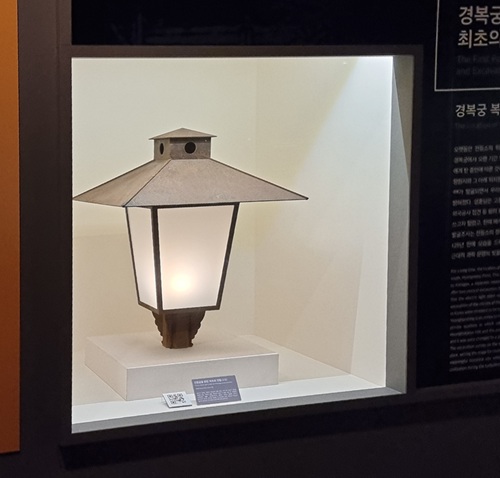 The first electric light installed in front of Geoncheonggung Palace. A model is displayed at the Korea Electric Museum. [Photo=Reporter Lim Yo-hee]
This event occurred just eight years after the invention of the carbon filament bulb by the great inventor Thomas Edison. It was a groundbreaking development, arriving approximately two years earlier than in China's Forbidden City or Japan's imperial palaces.
How did King Gojong learn about electric lights? The secret lies with the Korean diplomatic mission, Bobingsa, sent to the United States in 1883. After touring agricultural facilities and machinery in the U.S., the Bobingsa delegation also visited Britain, France, and Italy.
Upon their return, they reported on the steam engines and electrical facilities they had witnessed. Following royal orders, they placed an order with the Edison Electric Light Company for power generation equipment and lighting fixtures.
The power station, equivalent to a thermal power plant today, generated electricity using steam produced by burning coal. Edison was reportedly very intrigued by the order from a small country like Joseon and immediately began constructing the power facility.
Edison meticulously handled the construction, aiming to export similar power stations to neighboring countries like China and Japan.
Electric lights were installed in the northern wing of Jangandang, followed by Gyonnyeonghap, the queen's residence, and the main hall. In addition to indoor lighting, streetlights were erected in front of Geoncheonggung Palace and outside its walls. Electric lights also illuminated Hyangwonjeong Pavilion within the pond. On the day the lights were turned on, it is said that everyone within the palace grounds gathered in front of Hyangwonjeong Pavilion to witness the spectacle.
'Hyangwonjeong Pavilion': The Further the Scent, the Clearer it Becomes
South of Geoncheonggung Palace, on an artificial island in the Hyangwonji Pond, stands Hyangwonjeong Pavilion. The name means "pavilion of distant fragrance," and this private resting space for the royal family is connected to the north by Chwihyanggyo Bridge.
The bridge, meaning "bridge where one is intoxicated by fragrance," was destroyed during the Korean War. In a peculiar turn of events during its restoration in 1953, a bridge was mistakenly built to the south.
However, through historical research, the bridge was newly constructed in its original location (to the north) in 2021, following the path King Gojong and Empress Myeongseong would have taken from Geoncheonggung Palace to Hyangwonjeong.
'Jipokjae': Housing 40,000 Volumes of Books
To the northwest of Geoncheonggung Palace lies the Jipokjae complex, a royal library in the style of Qing Dynasty architecture. Meaning "collecting jade-like precious books," this was King Gojong's personal study and a reception area for foreign envoys.
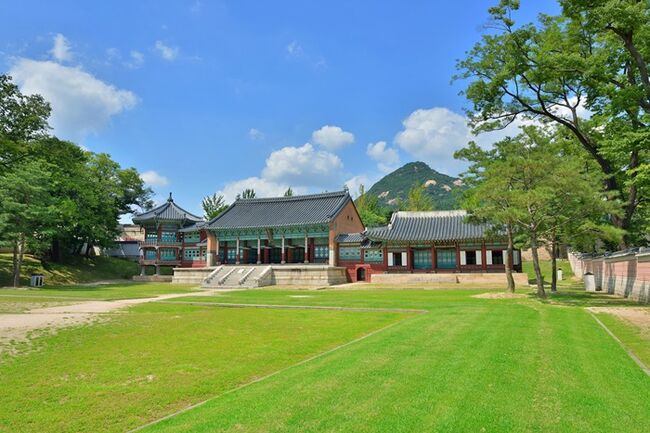 Jipokjae. [Photo=Cultural Heritage Administration, Royal Palaces and Tombs Center]
Connected to Palgujeong to the west and Hyeopgildang to the east, Jipokjae housed approximately 40,000 books, representing the highest level of scholarship at the time. Here, King Gojong studied Western progressive thought, seeking a path toward independence and modernization.
Located deep within Gyeongbokgung Palace, Geoncheonggung, Hyangwonjeong, and Jipokjae are sites layered with history: the determination of a son seeking to break from his father's shadow, a king's anguish trying to protect his nation against a strong tide of foreign powers, and the tragic fate of a man who lost his wife at the twilight of an era.
While fragrance grows clearer with distance, history's meaning deepens with understanding. The Geoncheonggung Palace area is a place where one can briefly contemplate the loneliness of King Gojong, who endured the turbulent waves of history with his whole being during a time when Joseon's fate hung by a thread.
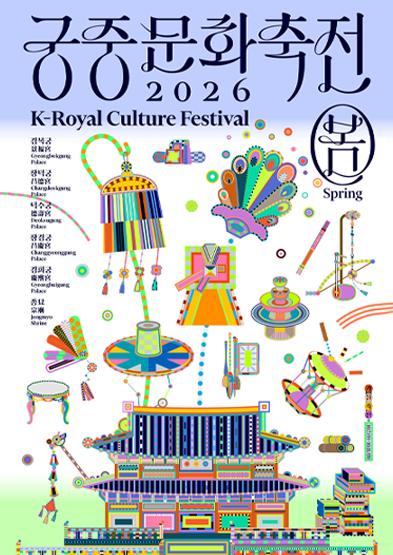
Meanwhile, the '2026 Spring Palace Culture Festival' will be held from April 25th to May 3rd, organized by the Cultural Heritage Administration's Royal Palaces and Tombs Center and the Cultural Heritage Promotion Agency, at Gyeongbokgung, Changdeokgung, Deoksugung, Changgyeonggung, Gyeonghuigung Palaces, and Jongmyo Shrine. During this period, various experience programs will be offered against the backdrop of the palaces, including a △K-Heritage Market △Palace Playroom △Awakening the Morning Palace △Children's Palace Culture Festival: Palace Job Chronicle.
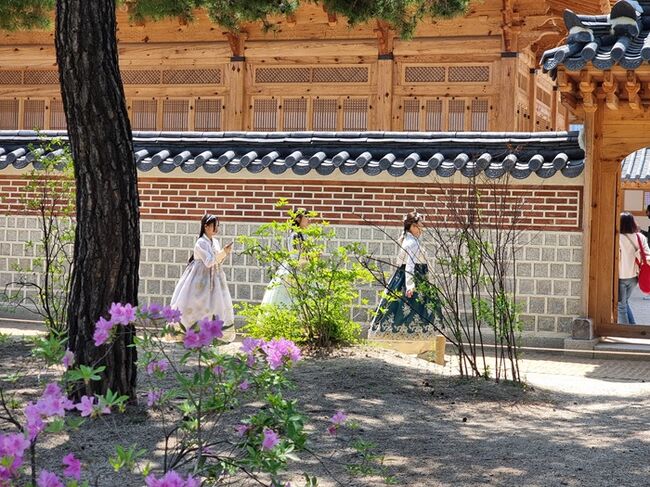 Visitors strolling through the palace grounds in Hanbok. [Photo=Reporter Lim Yo-hee]
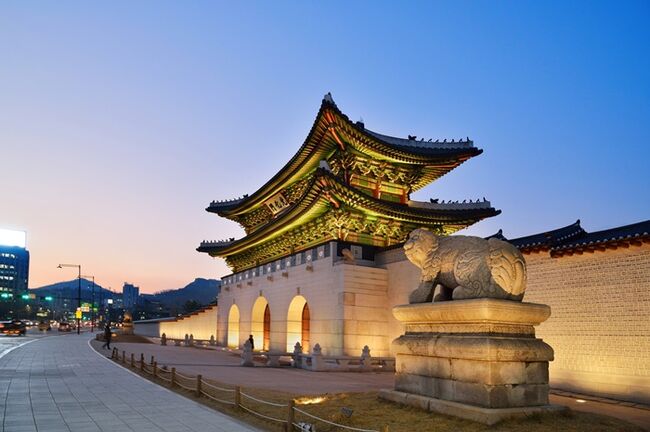 Gwanghwamun Gate, the main gate of Gyeongbokgung Palace. [Photo=Cultural Heritage Administration, Royal Palaces and Tombs Center]
Reporter Lim Yo-hee

 Iranian Foreign Ministry: "Continuing Message Exchanges with the U.S. and Activities of Mediating Countries"
Esmaeil Baghaei, Spokesperson for the Iranian Ministry of Foreign Affairs [Xinhua, Yonhap News file photo]Esmaeil Baghaei, spokesperson for the Iranian Ministry of Foreign Affairs, stated on the 26th
Iranian Foreign Ministry: "Continuing Message Exchanges with the U.S. and Activities of Mediating Countries"
Esmaeil Baghaei, Spokesperson for the Iranian Ministry of Foreign Affairs [Xinhua, Yonhap News file photo]Esmaeil Baghaei, spokesperson for the Iranian Ministry of Foreign Affairs, stated on the 26th
 President Yoon: "Do You Think You Are Safe from the Special Counsel?"... Final Statement Video Released
President Yoon Suk Yeol rebuking the special prosecutor on the 24th. [Court video / @birds_justice X account subtitle GIF] A video of President Yoon Suk Yeol's closing statement at his trial rega
President Yoon: "Do You Think You Are Safe from the Special Counsel?"... Final Statement Video Released
President Yoon Suk Yeol rebuking the special prosecutor on the 24th. [Court video / @birds_justice X account subtitle GIF] A video of President Yoon Suk Yeol's closing statement at his trial rega
 President Yoon, regarding the first-instance ruling on the Public Official Election Act: “An excessive political verdict that distorts the facts… We will appeal immediately.”
The first-instance sentencing hearing for President Yoon Suk Yeol regarding violations of the Public Official Election Act is being broadcast live at Seoul Station on the 27th. [Photo=Yonhap News]Pres
President Yoon, regarding the first-instance ruling on the Public Official Election Act: “An excessive political verdict that distorts the facts… We will appeal immediately.”
The first-instance sentencing hearing for President Yoon Suk Yeol regarding violations of the Public Official Election Act is being broadcast live at Seoul Station on the 27th. [Photo=Yonhap News]Pres
 WSJ: "SK Hynix ADR Premium Is a Sign of AI Trading Overheat"
Advertisement for SK Hynix ADR listing in New York's Times Square [Reuters=Yonhap News file photo]The Wall Street Journal (WSJ) has pointed out that the price of SK Hynix’s American Depositary Recei
WSJ: "SK Hynix ADR Premium Is a Sign of AI Trading Overheat"
Advertisement for SK Hynix ADR listing in New York's Times Square [Reuters=Yonhap News file photo]The Wall Street Journal (WSJ) has pointed out that the price of SK Hynix’s American Depositary Recei
 'Godfather of Japanese Mystery Novels' Keigo Higashino Passes Away After Battle with Cancer at 68
Famous Japanese mystery novelist Keigo Higashino [AFP=Yonhap News]It has been belatedly reported that Keigo Higashino, the "godfather of Japanese mystery novels" and author of bestsellers such as "The
'Godfather of Japanese Mystery Novels' Keigo Higashino Passes Away After Battle with Cancer at 68
Famous Japanese mystery novelist Keigo Higashino [AFP=Yonhap News]It has been belatedly reported that Keigo Higashino, the "godfather of Japanese mystery novels" and author of bestsellers such as "The
 [Park Pil-kyu Security Column] To the Ignorant Trying to Clothe a Beast in Sheep's Clothing
Rep. Kim Byung-joo of the Democratic Party of Korea [Photo=Yonhap News]“The Air Force Academy doesn't teach you how to fly a plane!” “The Army, Navy, and Air Force academies are exactly the
[Park Pil-kyu Security Column] To the Ignorant Trying to Clothe a Beast in Sheep's Clothing
Rep. Kim Byung-joo of the Democratic Party of Korea [Photo=Yonhap News]“The Air Force Academy doesn't teach you how to fly a plane!” “The Army, Navy, and Air Force academies are exactly the
 [Issue Diagnosis] Two Effects of the Election Petition Review
 [Photo] Evidence of Election Fraud Flooding U.S. Media… Trump Had 2.7 Million Votes Stolen
 [Video] U.S. Semiquincentennial Air Show... 'Art in the Sky' streaks across New York
 [Editorial Cartoon] A Draconian Law That Undermines Freedom of Expression

 List
List









