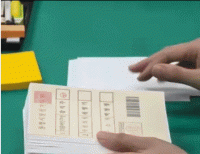
Wafiq Safa, a senior official in Hezbollah's political council, speaks in Beirut on April 13. [Photo=AP]
Iran's proxy forces are not a pathetic "alliance of the weak." They are an armed network nurtured for decades by the Islamic Revolutionary Guard Corps (IRGC), a political-military complex that has absorbed diverse local grievances to weave them into an anti-American, anti-Israel front.
Therefore, the first habit to discard when interpreting the Middle East is the simplistic schema of "America/Israel = Evil" and "Anti-American/Anti-Israel = Good." A clear common thread connects Hezbollah, Hamas, the Houthis, and pro-Iranian militias in Iraq.
That thread is their consistent use of the language of "resistance" to justify all their actions and claim righteousness, enjoying moral impunity under that guise. While they may wear the cloak of the weak, their actual operational method resembles a power machine that combines propaganda, welfare, sectarianism, armament, hostage-taking, and elections.
Diverse Grievances, One Method
Hezbollah was an organization cultivated by the IRGC during the Lebanese Civil War, immediately following Israel's invasion of Lebanon in 1982 under the pretext of suppressing the Palestine Liberation Organization. It was never just a simple militia. Hezbollah operates as a "state within a state" by integrating Lebanese political parties, welfare organizations, intelligence networks, and its own military force.
It grew in strength through multiple wars with Israel, and even after the elimination of Nasrallah and the ceasefire in 2024, Lebanon continues to grapple with the issue of Hezbollah's disarmament. Hezbollah has significantly held the Lebanese state itself hostage to pursue its animosity towards Israel.
Hamas, too, cannot be neatly categorized as mere "resistance of the weak." It emerged in 1987 during the First Intifada as an offshoot of the Muslim Brotherhood and has claimed to be the representative of the Palestinian cause since its takeover of the Gaza Strip in 2007.
However, in reality, it has entrenched local political divisions, blurred the lines between civilian space and armed struggle, and narrowed the possibilities for long-term compromise. Framing Hamas solely as a symbol of the weak's resistance erases its fundamentalist Islamic character, its alignment with Iran, and the damage it has inflicted on its own society. The responsibility of Hamas, which has weaponized the suffering of Palestinian civilians while ostensibly speaking for them, is continuously pushed aside.
The Houthis are even more complex. While not initially an organization created by Iran, as the civil war deepened, Iran proactively provided weapons, training, and technical support, ultimately cultivating them into a proxy asset that destabilizes the Red Sea.
This is the organization that has attacked merchant vessels over 100 times since the war triggered by Hamas's October 7th attack in 2023, sinking two and seizing one, and killing at least four sailors. Behind their rhetoric of "solidarity with Gaza" lies the clear shadow of Iran.
Pro-Iranian militias in Iraq are more intricate. While it would be an overstatement to label the entire "Popular Mobilization Forces" as an Iranian subcontractor, it is clear that key factions like Kata'ib Hezbollah have maintained close ties with the IRGC. Even after gaining the glory of the anti-ISIS war, state salaries, and a legal veneer, they are criticized for operating outside the regular military command structure and eroding Iraq from within. This duality, where they wield weapons with state salaries while aligning their strategy with Iran, has become entrenched. The pro-Iranian militias are at the core of a structure where the outward form of the Iraqi state remains, but its substantive sovereignty is being eroded from within.
Biased Moralism
In essence, these Iranian proxy forces are not NGOs. They are armed political actors who wield propaganda, welfare, sectarianism, elections, hostage-taking, missiles, and drones in concert. They are not groups that can be explained away by the single notion of "standing up to the strong."
Amidst this, Trump attempted a completely new approach in the Middle East. While the mainstream in the US and Europe focused on separate containment and management of issues in Lebanon, Gaza, Yemen, and Iraq, the assassination of Soleimani and the Abraham Accords during Trump's first term were concrete actions stemming from a holistic view of the Iranian regime, its proxy forces, and the reshaping of Arab-Israel relations. Instead of management, the direction shifted towards pressure for dismantlement, and towards structural reorganization rather than temporary fixes.
The normalization talks between Saudi Arabia and Israel had also made significant progress as an extension of the Abraham Accords. This is why there have been suspicions and interpretations that the October 7th attack was a military action intended to disrupt that momentum. Misreading the current Middle East landscape as a simple "Israel vs. Resistance Forces" dichotomy means missing the entire picture.
We must recognize Hezbollah, the Houthis, and the pro-Iranian militias in Iraq as Iran's distributed pressure mechanisms, linking Lebanon, the Red Sea, Iraq, and the Strait of Hormuz. This is not an issue to be viewed solely through sentimental language like "solidarity with Palestine." It must be observed as a geopolitical issue that destabilizes maritime trade routes, insurance premiums, energy flows, and US military deployments. Viewing them separately makes them isolated incidents, but linking them under one axis reveals the historical context and alternative strategies.
Trump's Reshuffling
Ultimately, the larger axis of the current Middle East situation is Trump's reshaping of the regional order and, within that context, China's containment. By 2025, China was importing over 80% of Iran's seaborne crude oil, accounting for approximately 13.4% of China's total seaborne crude oil imports.
Dismantling Iran's proxy forces and neutralizing its maritime leverage is not only about removing Iran's tools of destruction against Israel and the US but also about targeting the cheap oil and the benefits of Middle East instability that China has enjoyed by circumventing sanctions.
Trump's recent mention of a 50% tariff on arms suppliers to Iran, ostensibly targeting China and Russia, is also seen as a signal that he will not stand idly by in the relevant frontlines within the Middle East. This means the Middle East front is beyond a regional conflict and is intertwined with the energy and maritime routes of the US-China confrontation.
Restoration of Civilization
The message delivered by Vice President Vance and Secretary of State Rubio at the Munich Security Conference falls within the same vein. Vance criticized Europe in the 2025 conference, stating that the greater threat to Europe, more so than Russia or China, is the retreat of its inherent internal values, the suppression of freedom of expression, and uncontrollable immigration. In the 2026 conference, Rubio appealed, urging the US and Europe to be "inheritors of the same great and noble civilization."
The core issue is singular: Western European elites, ashamed of their civilization's foundations and identity, are failing to grasp the nature of proxy wars waged by Islamism, nor the reasons why the Middle East is directly connected to European order. Their non-Christian, anti-Christian secularism has blurred their perception, not just in cultural debates but also in their ability to read security realities. The distorted view of the Middle East has, in turn, exacerbated Europe's own crises.

◆ Dr. Im Myung-shin
Ph.D. in Chinese Studies, Northeast Asian Researcher
Former Deputy Director, International Desk, The Sky Daily

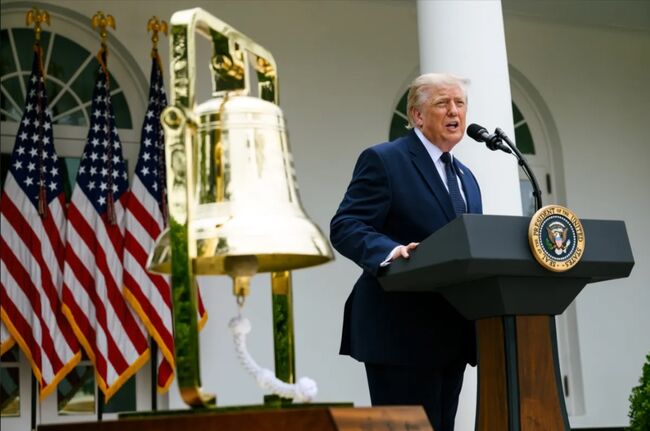 Trump pressures for rate cut again ahead of FOMC... "Should be the lowest in the world"
U.S. President Donald Trump. [Photo = The White House] U.S. President Donald Trump once again pressured the Federal Reserve, the U.S. central bank, to lower interest rates on the 27th (local time
Trump pressures for rate cut again ahead of FOMC... "Should be the lowest in the world"
U.S. President Donald Trump. [Photo = The White House] U.S. President Donald Trump once again pressured the Federal Reserve, the U.S. central bank, to lower interest rates on the 27th (local time
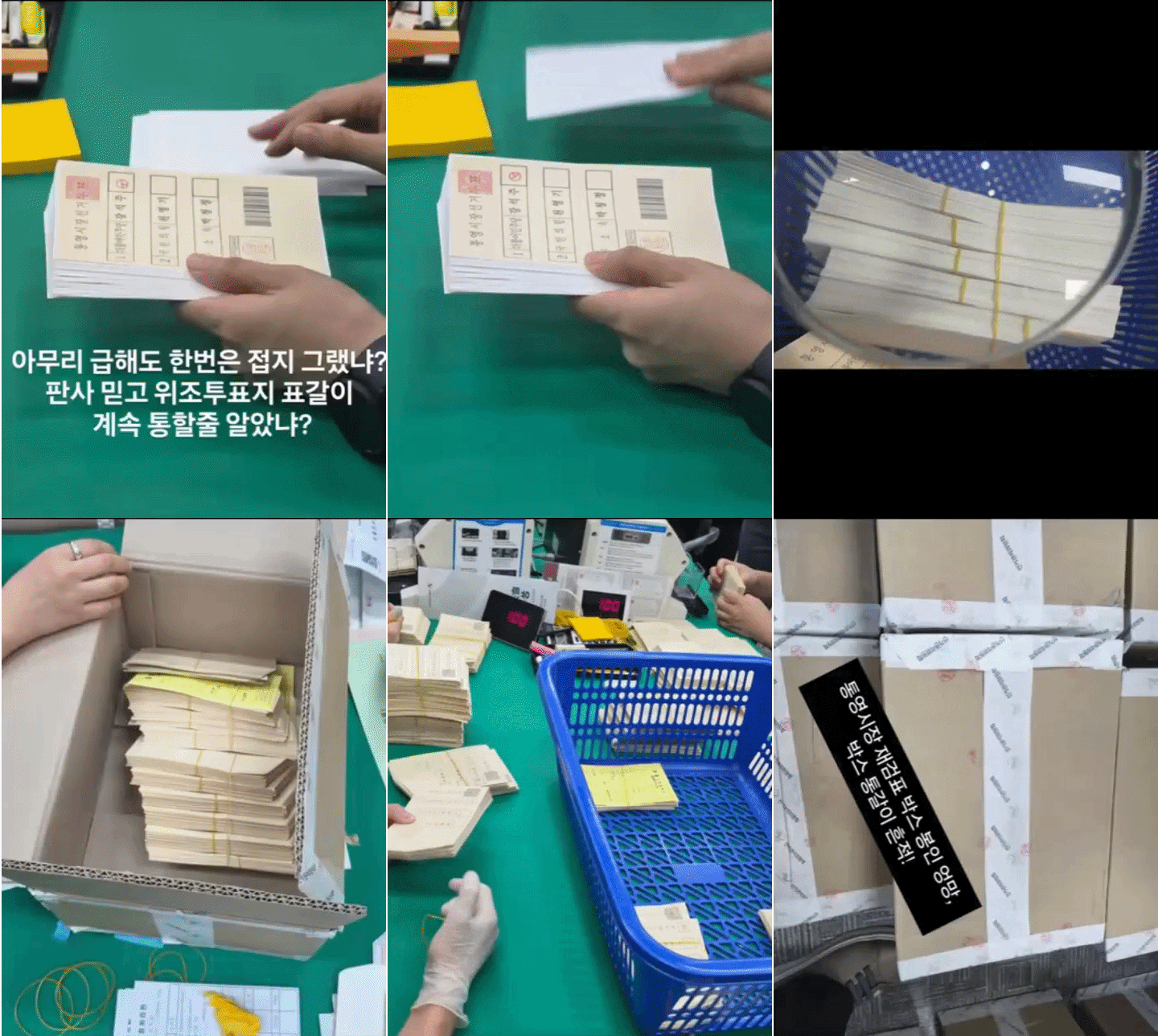 “Ignoring crisp ballots and damaged seals”… Tongyeong mayoral recount concludes with ‘no change in outcome,’ leaving suspicions and public outrage behind
Suspected counterfeit ballots discovered in Tongyeong [GIF from social media of Representative Hwang Kyo-ahn / Attorney Park Joo-hyun]During a recount of the Tongyeong mayoral election in South Gyeong
“Ignoring crisp ballots and damaged seals”… Tongyeong mayoral recount concludes with ‘no change in outcome,’ leaving suspicions and public outrage behind
Suspected counterfeit ballots discovered in Tongyeong [GIF from social media of Representative Hwang Kyo-ahn / Attorney Park Joo-hyun]During a recount of the Tongyeong mayoral election in South Gyeong
 President Yoon, regarding the first-instance ruling on the Public Official Election Act: “An excessive political verdict that distorts the facts… We will appeal immediately.”
The first-instance sentencing hearing for President Yoon Suk Yeol regarding violations of the Public Official Election Act is being broadcast live at Seoul Station on the 27th. [Photo=Yonhap News]Pres
President Yoon, regarding the first-instance ruling on the Public Official Election Act: “An excessive political verdict that distorts the facts… We will appeal immediately.”
The first-instance sentencing hearing for President Yoon Suk Yeol regarding violations of the Public Official Election Act is being broadcast live at Seoul Station on the 27th. [Photo=Yonhap News]Pres
 WSJ: "SK Hynix ADR Premium Is a Sign of AI Trading Overheat"
Advertisement for SK Hynix ADR listing in New York's Times Square [Reuters=Yonhap News file photo]The Wall Street Journal (WSJ) has pointed out that the price of SK Hynix’s American Depositary Recei
WSJ: "SK Hynix ADR Premium Is a Sign of AI Trading Overheat"
Advertisement for SK Hynix ADR listing in New York's Times Square [Reuters=Yonhap News file photo]The Wall Street Journal (WSJ) has pointed out that the price of SK Hynix’s American Depositary Recei
 'Godfather of Japanese Mystery Novels' Keigo Higashino Passes Away After Battle with Cancer at 68
Famous Japanese mystery novelist Keigo Higashino [AFP=Yonhap News]It has been belatedly reported that Keigo Higashino, the "godfather of Japanese mystery novels" and author of bestsellers such as "The
'Godfather of Japanese Mystery Novels' Keigo Higashino Passes Away After Battle with Cancer at 68
Famous Japanese mystery novelist Keigo Higashino [AFP=Yonhap News]It has been belatedly reported that Keigo Higashino, the "godfather of Japanese mystery novels" and author of bestsellers such as "The
 [Park Pil-kyu Security Column] To the Ignorant Trying to Clothe a Beast in Sheep's Clothing
Rep. Kim Byung-joo of the Democratic Party of Korea [Photo=Yonhap News]“The Air Force Academy doesn't teach you how to fly a plane!” “The Army, Navy, and Air Force academies are exactly the
[Park Pil-kyu Security Column] To the Ignorant Trying to Clothe a Beast in Sheep's Clothing
Rep. Kim Byung-joo of the Democratic Party of Korea [Photo=Yonhap News]“The Air Force Academy doesn't teach you how to fly a plane!” “The Army, Navy, and Air Force academies are exactly the
 [Issue Diagnosis] Two Effects of the Election Petition Review
 [Photo] Evidence of Election Fraud Flooding U.S. Media… Trump Had 2.7 Million Votes Stolen
 [Video] U.S. Semiquincentennial Air Show... 'Art in the Sky' streaks across New York
 [Editorial Cartoon] A Draconian Law That Undermines Freedom of Expression

 List
List