 The first president, Rhee Syngman, declaring the establishment of the Republic of Korea in front of the Central Government Building on August 15, 1948.
President Lee Jae-myung argues that Syngman Rhee, obsessed with the desire for perpetual rule, trampled on democracy and the rule of law, and engineered fraudulent elections. He also claims that "just one year after the April 19 Revolution, a military coup occurred, and it was on the soil of the April 19 democratic ideals that the Republic of Korea achieved remarkable leaps and prosperity, becoming one of the world's top 10 economic powers and a leading cultural powerhouse."
This reflects Lee Jae-myung's historical perception, which is suspected of being linked to the Gyeonggi Eastern Alliance, a stronghold of Juche ideology. It aligns with the propaganda and incitement tactics of pro-North Korean leftists targeting an ignorant public.
The assertion that Rhee Syngman, who was confirmed as elected unopposed after the opposition Democratic Party's presidential candidate, Cho Byung-ok, was hospitalized and died in a Washington D.C. military hospital during his campaign, orchestrated fraudulent elections for his perpetual rule, lacks credibility.
The foundation of the Republic of Korea's current prosperity is not the incompetent and corrupt Democratic Party government led by Prime Minister Chang Myon, which came to power as a result of the April 19th Revolution, but rather Park Chung-hee's May 16th Revolution, which emerged a year later to overcome the national chaos caused by the "protest republic" the Democratic Party had created.
The May 16th Revolution was technically a coup, but its outcome was a successful revolution surpassing the French or Russian Revolutions. Lee Jae-myung and the Democratic Party have been at the center of allegations of fraudulent elections for the past two decades. Now is not the time to discuss the March 15th fraudulent election 66 years ago, which was the cause of the April 19th Revolution, but rather the time to raise issues regarding the April 15th fraudulent election in the 2020 general election and subsequent allegations of fraudulent elections, and to conduct investigations and trials.
The March 15th fraudulent election is unrelated to the presidential election in which Rhee Syngman was elected. With Cho Byung-ok deceased, Rhee Syngman's election was already confirmed, so there was no reason for him to engage in fraudulent elections. Furthermore, even if the Democratic Party's vice-presidential candidate, Chang Myon, had been elected, it would not have resulted in a change of government.
In the vice-presidential election, which was conducted separately from the American running mate system, Yi Ki-poong of the Liberal Party, who was trailing behind Chang Myon, orchestrated fraudulent elections. While the March 15th fraudulent election was a one-time act of fraud by Yi Ki-poong personally, the current allegations of fraudulent elections are far more malicious and anti-national than the March 15th incident, as they involve suspected intervention by the Democratic Party, pro-North Korean leftists, North Korea, and China, and have continued for the past two decades.
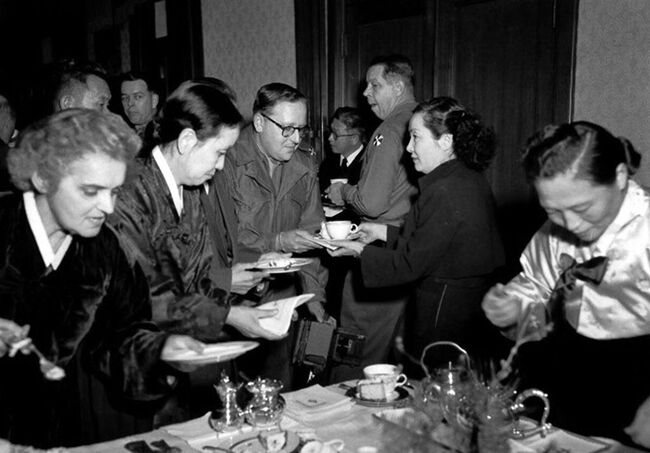 Francesca Rhee attending a luncheon in honor of General Benouville in 1953.
On the occasion of the 66th anniversary of the April 19th Revolution, the People Power Party should have launched a large-scale campaign to investigate allegations of fraudulent elections, but Jang Dong-hyuk and the People Power Party are indifferent to the struggle of many citizens to uncover the truth about these allegations.
There is no record or testimony indicating that Rhee Syngman was aware of the fraudulent elections. Rhee Syngman resigned his position as president, taking responsibility for his command. Rhee Syngman did not view the April 19th Uprising, which arose in protest of the fraudulent elections, negatively; he stated that a people who stand idly by in the face of injustice are no different from dead people.
Rhee Syngman's resignation due to fraudulent elections unrelated to him should be evaluated as a positive action, not a subject of criticism.
The reason why pro-North Korean anti-state forces constantly criticize Rhee Syngman is because of his role in preventing the communization of the Republic of Korea and establishing a liberal democratic nation through the "founding war." This involved his persistent efforts to control the North Korean communist group, the South Korean Labor Party, and the pro-North Korean leftists who were brainwashed and followed them, during the process of the Korean War caused by the North Korean invasion and the persistent machinations of the North Korean communist group after liberation in 1945, while simultaneously engaging in a life-or-death diplomatic struggle with the US government, which had different interests.
To pro-North Korean leftists, Rhee Syngman is an eyesore. To understand the "founding war" of the diplomatic maestro and fighter Rhee Syngman, one must have a proper understanding of the history of the establishment of the Republic of Korea government and the Korean War, as well as the international dynamics surrounding Korea before and after liberation and the domestic political situation in the United States.
The establishment and success of the Republic of Korea as a liberal democracy were not accidental. They are due to the establishment of a liberal democratic system and efforts in industrialization and modernization through the fierce struggle of Rhee Syngman and Park Chung-hee against communists. If Rhee Syngman had compromised with a moderate approach, as the People Power Party does, the Republic of Korea, which has developed based on liberal democracy and a market economy, would not exist.
Following the Russian Revolution of 1917, the ghost of Marxist-Leninist communist revolution swept across the world and landed on the Korean Peninsula. Even after the liberation in 1945, during the Japanese colonial era, most people were excited about communism. Rhee Syngman struggled to establish a liberal democratic system in Korea by defeating communism. Without the foresight of Rhee Syngman, the Republic of Korea would have already been communized, and we would now be living under Kim Jong-un's rule, as communism was favored by the public at that time.
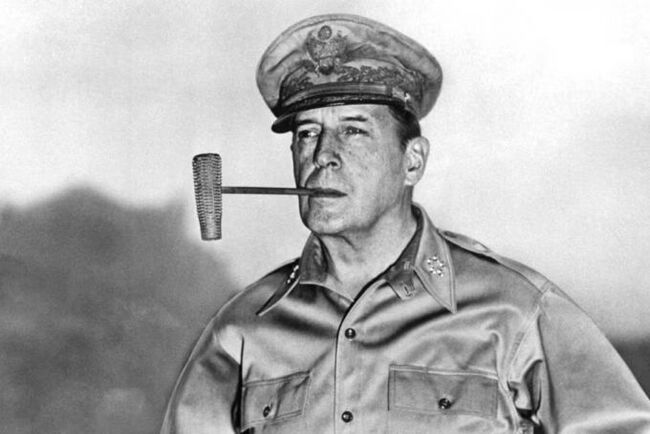 MacArthur, a hero of World War II, also admired Rhee Syngman.
In 1923, when the world was swept by a communist fervor, Rhee Syngman wrote the thesis "Is Communism Right or Wrong?" in the United States, expounding on the dangers of communist ideology. At that time, there was no scholar or politician, not only in the Republic of Korea but also in the United States or Europe, who surpassed Rhee Syngman's foresight. This is why MacArthur, an proud elite and a war hero of World War II, respected Rhee Syngman.
Rhee Syngman's achievements are immense, even if only for preventing the communization of the Republic of Korea. Despite U.S. support, communist regimes were established in China and Vietnam, and laments arose in the U.S. asking why there was no figure like Rhee Syngman in China and Vietnam.
Based on the liberal democratic Republic of Korea established by Rhee Syngman, Park Chung-hee, with the support of the people united by the desire to live well, came to power. During his 19 years in office, he achieved the Miracle on the Han River, transforming the Republic of Korea from the world's poorest country into a modernized and industrialized nation, and surpassing North Korea, which had superior national strength after liberation, by leveraging the industrial facilities left by Japan.
Democratization is not possible without economic development, and there is no precedent for it. The democratization of the Republic of Korea was brought about by Rhee Syngman and Park Chung-hee.
After Japan's surrender in 1945, liberation occurred, and in 1948, the government of the Republic of Korea was established, with Rhee Syngman inaugurated as the first president. On June 25, 1950, North Korean forces, with the support of the Soviet Union and China, launched an invasion. The ROK forces were pushed back to the Nakdong River front, and then UN forces, led by the United States, intervened, leading to the recapture of Seoul on September 28th through General MacArthur's Incheon Landing.
The United States, after driving North Korean forces north of the 38th parallel, did not advance further, fearing Soviet and Chinese intervention and preferring to maintain the status quo rather than escalate the conflict.
However, Rhee Syngman advocated for a northward unification, crossing the 38th parallel with ROK forces alone, and the U.S. reluctantly joined the northward advance. ROK and UN forces recaptured Pyongyang on October 19th and advanced to the Yalu and Tumen Rivers bordering China by the end of October. However, due to the immediate intervention of hundreds of thousands of Chinese troops employing human wave tactics, the ROK and UN forces began to retreat. Truman, fearing escalation into World War III, rejected Rhee Syngman and MacArthur's plan to bomb Manchuria.
The external reason for the Soviet Union's absence from the UN Security Council meeting convened to pass a resolution for UN forces to intervene immediately after the North Korean invasion was that the government of Mao Zedong's Communist China, which had been driven to Taiwan after being defeated by Chiang Kai-shek's Nationalist government, should become a permanent member of the Security Council. The Soviet Union had continuously boycotted the Security Council, citing Taiwan's participation.
However, according to declassified Stalin letters, the reason the Soviet Union did not exercise its veto power over UN forces' participation in the Korean War was to check Mao Zedong. By inducing China's participation in the Korean War, the Soviet Union aimed to simultaneously weaken both the United States and China through a war in Korea, keep Mao Zedong under Soviet influence, and prevent the United States from deploying additional forces to Europe – achieving two goals with one action.
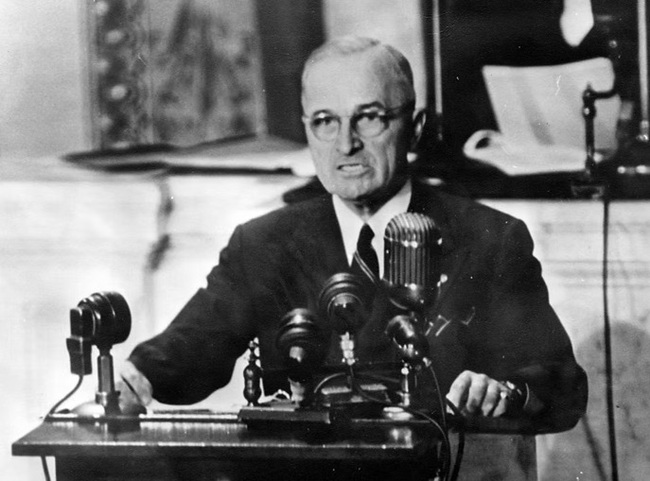 U.S. President Truman was criticized for forcing a truce, ignoring the opinions of Rhee Syngman, MacArthur, and other U.S. military commanders.
Truman, aiming to concentrate on the European front with the Soviet Union, decided to limit the Korean War. He rejected MacArthur's plan to bomb the Yalu River Bridge and Manchuria, blockade Chinese coastlines, and engage in full-scale war with China, including the participation of 600,000 Taiwanese troops under Chiang Kai-shek, who had been defeated in the Chinese Civil War and driven to Taiwan, and operations involving Chinese mainland guerrillas. He went as far as to dismiss MacArthur.
After MacArthur's dismissal, Rhee Syngman sent a letter to MacArthur.
"I am convinced that there is no ultimate solution to the Korean problem other than your plan. As time goes by, your name will shine even brighter as a preeminent leader and statesman of this era in world history." (Translated by Ban Gwang-sik, Douglas MacArthur, 'MacArthur Memoirs 2')
Rhee Syngman and MacArthur viewed the intervention of Chinese forces in the Korean War as a golden opportunity to overthrow the Chinese Communist Party through full-scale war and establish a liberal democratic government in China. They believed that if this opportunity was missed, the growing power of the Soviet Union and China would eventually make it difficult for the United States and free nations to prevent the expansion of communism.
Although the Soviet Union succeeded in developing nuclear weapons in 1949, they were in the early stages of development and could not produce sufficient nuclear weapons for practical use. With the United States dominating air superiority, it was argued that if the Siberian Railway, the sole supply route to the Far East, was destroyed by air raids, Soviet participation in the Korean War would be impossible. China, lacking industrialization after the Chinese Civil War, could not continue the Korean War without Soviet military support.
Therefore, the strategy proposed by MacArthur was that by cutting off the Soviet supply route and conducting air raids on Chinese mainland supply bases and routes, and by blockading the Chinese coast with the overwhelming naval power of the United States, China's overseas supply would also be cut off. Mao Zedong would not be able to hold out for long, and with the landing of Chiang Kai-shek's 600,000 troops in Korea and mainland China, the Mao Zedong communist regime could be overthrown with only naval and air power, without additional U.S. ground troop deployment.
MacArthur argued that if the United States retreated without annihilating the North Korean and Chinese communist forces through the Korean War, the next target would be Europe, and the global communization by the Soviet Union and China would be unstoppable. This strategy perfectly aligned with Rhee Syngman's strategy.
However, Truman, ignorant of international affairs and riding the post-World War II anti-war sentiment, rejected the proposals of Rhee Syngman and MacArthur. Considering the current international situation of a new Cold War between the free world led by the United States and China, Russia, and North Korea, the foresight of Rhee Syngman and MacArthur, who looked 70 years ahead, is astonishing.
After the ROK and UN forces advanced to the Yalu River, they retreated south following the intervention of Chinese forces, and the Korean War entered a stalemate around the 38th parallel. Amidst the anti-war sentiment in the United States due to the protracted war, the U.S. sought an armistice agreement. However, Rhee Syngman advocated for a northward unification and, to disrupt the armistice negotiations between the U.S., China, and North Korea, released anti-communist prisoners of war and refused to sign the armistice agreement, arguing that if an armistice was reached, North Korea and China would strengthen their forces and invade the South again.
Facing Rhee Syngman's staunch opposition to the armistice, the United States formulated Plan Everready, contemplating responses including the removal of Rhee Syngman. However, finding no suitable solution, they promised to negotiate a Mutual Defense Treaty with South Korea to appease Rhee Syngman.
"The U.S. government promised President Rhee Syngman that negotiations for a Mutual Defense Treaty would begin immediately upon the signing of the armistice agreement and its recognition by the South Korean government. Following the release of anti-communist prisoners, the Eisenhower administration, through a series of meetings, discussed U.S. response measures, including the removal of Rhee Syngman and the withdrawal of U.S. troops. However, as in previous cases, they faced a policy limitation of desiring a swift end to the war but being unable to abandon the communization of Korea." (Hong Yong-pyo, 'The Threat of Northward Unification and America's Operation to Remove Rhee Syngman,' Shin Dong-a, August 14, 2006)
On July 27, 1953, the Korean War Armistice Agreement was signed between the UN Commander-in-Chief and the North Korean and Chinese forces, with South Korea not participating. At Rhee Syngman's repeated request, concerned about a renewed invasion by North Korea, the Mutual Defense Treaty between South Korea and the United States was signed on October 1, 1953. The following year, on July 28th, Rhee Syngman delivered a joint address to both houses of the U.S. Congress during a state visit to the United States.
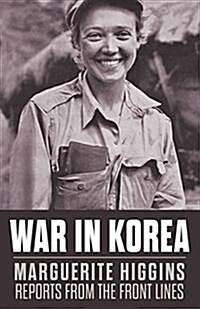 Marguerite Higgins' book "War in Korea"
Rhee Syngman argued that North Korea was disregarding the armistice agreement, building airfields near the demarcation line, and expanding its military. He urged the United States to abrogate the armistice agreement and assist the Korean government and Chiang Kai-shek's government in Taiwan to drive out the communists in mainland China, who were supported by the Soviet Union. Otherwise, he warned, free democratic nations would continue to suffer threats of invasion from Soviet and Chinese communists, and the Soviet Union, having completed its nuclear weapons development, would eventually invade the U.S. mainland.
Rhee Syngman's address to the U.S. Congress was ignored, buried under the anti-war sentiment in the United States, stemming from its fatigue from participating in World War II and the Korean War. However, history has proven Rhee Syngman's foresight to be correct. Marguerite Higgins, a war correspondent for the New York Herald Tribune who wrote Korean War articles and the book 'War in Korea,' becoming the first female Pulitzer Prize winner, criticized in 'War in Korea' (translated by Lee Hyun-pyo) that the Truman and Eisenhower administrations, including the White House and the State Department, ignored the opinions of Rhee Syngman, MacArthur, and other U.S. military commanders and forced through the armistice.
"Rhee Syngman was often referred to as a reactionary. George M. McCune, in his book 'Korea Today,' described how many Americans opposed Rhee Syngman's reactionary methods and favored Koreans who showed a more conciliatory attitude toward the Soviets in the period immediately after Korea's liberation from Japanese invasion in 1945-46. However, considering the subsequent events, it is difficult to criticize Rhee Syngman for his anti-Soviet stance.
I stayed in Korea for six months during the early stages of the Korean War and have since visited Korea seven times. Furthermore, I have visited Asian countries such as Hong Kong, Indochina, Thailand, Myanmar, India, and Pakistan. Each time I traveled, the people of those countries asked me almost the same question, referencing China's intervention in Korea: Why couldn't the United States stop China? In the minds of Asians, the fact that the United States, with the world's strongest defense and economic power, was driven out by Asians was ingrained."
After his dismissal, MacArthur, in his congressional address and nationwide speeches, argued that the passive response to the Korean War by Truman and U.S. State Department officials, prioritizing Europe, would only give the Soviet and Chinese communists time to strengthen and challenge the United States. The following is an excerpt from the explanatory statement made by Congressman Don regarding the resolution to award MacArthur a Congressional Gold Medal after his dismissal.
"If General MacArthur's recommendations had been accepted in the early stages of the Korean War, the world would not be in the crisis it is in today. If General MacArthur had been allowed to conduct the war in Korea as he had planned, the enemy would have already been annihilated, and the balance of power in the world would have tilted far more favorably towards the free world.
The attack by the North Korean puppet forces and the subsequent intervention of China were a golden opportunity to correct the mistakes made by the United States at Yalta and Potsdam. At that time, the Soviet Union had not fully recovered from the wounds of World War II, and it was not yet in a stage to produce nuclear weapons in large quantities. General MacArthur pointed out with regret and sadness that a good opportunity had been missed.
We may one day have to fight China. By then, China will possess nuclear weapons, with the vast Eurasian continent as its backdrop. This grave problem could have been cleanly resolved in 1951 if the policymakers in Washington had possessed the foresight to give General MacArthur in Asia the signal to advance." (Translated by Ban Gwang-sik, Douglas MacArthur, 'MacArthur Memoirs 2')
The mistakes made by the United States at Yalta and Potsdam, as mentioned by Congressman Don, refer to President Roosevelt, who was even criticized as pro-Soviet and communist. Not only did he provide unlimited military supplies and economic aid to Stalin's Soviet Union during World War II, but after the war, he allowed Soviet troops to enter Eastern Europe, which had been occupied by Hitler's Germany, and North Korea after the withdrawal of Japanese forces. This facilitated the international spread of Soviet communism and helped complete the Cold War system where the Soviet Union opposed the United States.
During World War II, Roosevelt provided massive, unconditional military supplies to Stalin's communist regime, but conversely, he demanded strict quid pro quo for aid to Britain. This is why Roosevelt is criticized as a communist.
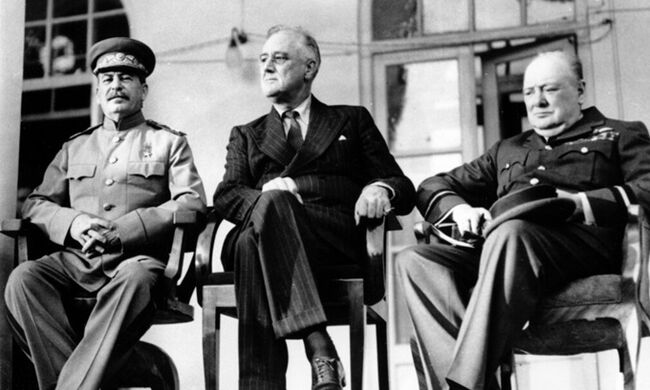 Leaders of various countries meeting in Tehran, the capital of Iran, in November 1943, during World War II. From left: Joseph Stalin, General Secretary of the Soviet Communist Party; Franklin Roosevelt, President of the United States; Winston Churchill (right), Prime Minister of the United Kingdom.
As stated in Congressman Don's resolution and Higgins' book, not only Roosevelt but also the American political circles at the time and the general public were filled with illusions about communism. Against these individuals, the staunch anti-communists Rhee Syngman and MacArthur waged a difficult struggle.
Twenty years after the success of the Russian communist revolution in 1917, the Great Depression in the United States in 1929 led to widespread skepticism about market economies and liberal democratic systems. Roosevelt, who won the presidential election in 1932, used the Great Depression as a pretext to introduce policies such as the New Deal, the Social Security Act, and labor laws, and to implement coercive and undemocratic policies, including the internment of hundreds of thousands of Japanese Americans. As a result, the Supreme Court repeatedly ruled these socialist policies of Roosevelt and the Democratic Party unconstitutional.
When the Supreme Court intervened, Roosevelt attempted to double the number of Supreme Court justices and appoint judges favorable to him, but this failed due to concerns that it would undermine the separation of powers, with even Democratic congressmen opposing it. Roosevelt even broke the precedent established since President Washington's tenure, running for a third and fourth term. He died of illness just one month after being elected for a fourth term. Following Roosevelt's death, the U.S. Congress passed the 22nd Amendment, which prohibits a president from serving more than two terms.
Roosevelt and the left wing of the United States, including the Democratic Party, characterized the Great Depression as a failure of market economies and liberal democracy, and harbored illusions about Soviet communism, which was seen as free from the impact of the Great Depression. This was because the United States and the Western world were unaware of the reality of Soviet communism due to Stalin's manipulation and propaganda through media control.
After Lenin's death in 1924, Stalin, after a power struggle to eliminate rivals such as Trotsky, succeeded in modernizing the Soviet Union through the introduction of collective farms and industrialization. However, to achieve economic development goals, millions of peasants died of starvation while exporting agricultural products from collective farms to accelerate industrialization, and millions of lives were lost through ruthless purges.
The Great Depression in the United States was not caused by the failure of liberal democracy and market economies but by the excessive austerity policies of the Federal Reserve Board members at the time. Milton Friedman criticized the Fed, composed of economic experts trapped in narrow economic theories, for causing the Great Depression.
The Fed turned a situation that could have ended as a short economic downturn into a Great Depression. The Great Depression was not a market failure but a result of the Fed's excessive monetary tightening. The Fed's prolonged monetary tightening, driven by an obsession with the simplistic theory that inflation could be controlled through setting money supply targets and high interest rates, was the cause of the Great Depression.
One hundred years after the Great Depression of 1929, the current Fed, led by Chairman Powell, is stubbornly maintaining excessively high interest rates after the COVID-19 pandemic, despite repeated demands from U.S. President Trump to lower benchmark interest rates. The biggest factor strangling corporate activity and the economy is various government regulations, and the most powerful regulation is high interest rates. Deregulation and the abolition of regulations are the first steps to reviving businesses and the economy. The Fed's prolonged tightening policy, driven by concerns about the rise in asset values such as stocks and real estate, and excessive bank lending, fuels a collapse in asset values like stocks, economic downturns, and bankruptcies of banks and businesses, thereby triggering an economic depression.
The person who put a brake on the pro-socialist atmosphere in the United States that lasted for 20 years after the Great Depression was Senator Joseph McCarthy of the Republican Party. In February 1950, McCarthy announced that there were 205 Soviet spies operating covertly within the U.S. State Department. For several years, through the House Un-American Activities Committee, a witch hunt ensued to root out communists in all sectors of the U.S. government, economy, arts, media, and Hollywood directors, writers, and actors.
As the fact that Alger Hiss, who influenced Roosevelt's foreign policy by attending the Yalta Conference as Roosevelt's advisor, was a Soviet secret communist and spy was revealed, and as other Soviet spies and communists operating within the United States were exposed, awareness of communists within the U.S. grew.
In June 1950, when the McCarthyism frenzy was at its peak, the Korean War broke out. The Democratic Party, cornered and suspected of being communist, and Truman, who became president after Roosevelt's death, decided to send U.S. troops to Korea. Truman made the decision to deploy troops under the pressure of the McCarthyism frenzy, but while mindful of the Soviet Union and China after the deployment, he consistently opposed operational plans to check China and achieve Korean unification, as advocated by Rhee Syngman and MacArthur.
Unlike MacArthur, who enjoyed national popularity as a war hero with titles such as top graduate of the Army War College, youngest division commander, youngest Army Chief of Staff, and hero of the Pacific War, Truman, who had a high school education and was an inconspicuous senator, was nominated for vice president as a result of internal Democratic factional struggles and became president by chance after Roosevelt's death. After retirement, Truman returned to Kansas City, Missouri, and in 1963, told Kim Jong-pil, who visited him, that he was sorry for not being able to help Rhee Syngman and MacArthur achieve Korean unification.
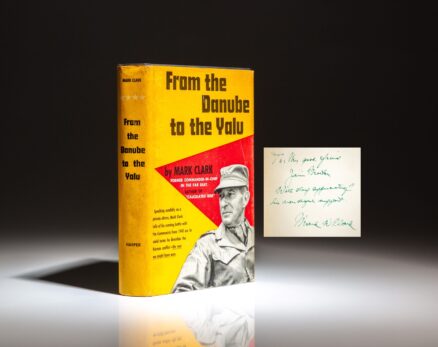 Memoir "From the Danube to the Yalu" by General Mark Clark, Commander of the UN Forces.
On July 27, 1953, General Mark Clark, Commander of the UN Forces and signatory to the Armistice Agreement, criticized the U.S. government's armistice in his memoir "From the Danube to the Yalu."
"The most important decision for the United States and the free world should have been made when the Chinese forces entered the battle in November 1950. It is incomprehensible that we did not warn them to withdraw immediately, or face attacks on their key facilities, despite the risk of escalating into a world war. If we had possessed firm resolve, we could have punished the Chinese forces and achieved victory, and I was personally disappointed that the government did not make such a decision.
My heart was heavy as the armistice agreement was concluded and signed. While I was grateful that the killing would cease for the time being, I had a serious premonition that our people might have to pay a more costly price in blood in the future than if we had decided to completely defeat the communist invaders on the Korean Peninsula."
General James Van Fleet, Commander of the U.S. Eighth Army, requested a northward advance to annihilate the retreating enemy after repelling two spring offensives by North Korean and Chinese forces following his appointment in April 1951. However, this was thwarted by Truman's opposition.
TIME magazine featured Van Fleet on its cover on May 14, 1951. After his retirement, Van Fleet published articles in the weekly pictorial LIFE on May 11th and 18th, 1953, titled 'The Truth about Korea: From a Man Now Free to Speak,' in which he revealed what he could not say during his tenure.
"The six weeks after I took command of the Eighth Army in Korea in the spring of 1951 were the greatest period in U.S. Army history, and the morale of our troops was at its highest during the Korean War. At that time, our advance was stalemated by high-ranking policy makers in our government who ordered us not to advance further, and the long and tedious armistice negotiations began.
Looking back at our government's policy after May 1951, I cannot help but feel a sense of sorrow that we made a terrible mistake on the Korean Peninsula. Why did we opt for an armistice that would not bring true peace to the Korean Peninsula, when we were overwhelmingly superior to the Chinese forces? Why were we so desperately insistent on achieving peace through an armistice when we could have completely annihilated the enemy?
We can achieve military victory over the aggressors. In the long run, this is the only way to save our grandchildren from war and its resultant defeats. Victory comes at a cost. War always entails sacrifice, and it is better to end it quickly than to drag it out. If we retreat in Asia, yielding to the communists, we will ultimately be defeated, losing everything. What exactly are we afraid of?" (Translated by Lee Hyun-pyo, Margerite Higgins, 'War in Korea')
This is Van Fleet's assessment of Rhee Syngman: "The Korean people, having not received sufficient education due to Japanese occupation and having lived lives of extreme poverty, experienced democracy for the first time under the Rhee Syngman government. However, they faced communist propaganda that incited hatred of the United States and urged the killing of the rich and landowners to share the spoils. President Rhee Syngman helped the people understand the nature of the communist threat and instilled courage and perseverance. Through this, he transformed the Korean people, who had lacked sufficient educational opportunities, and a Korean society lacking discipline, into the world's strongest nation capable of resisting communist aggression."
The reason Rhee Syngman's government was able to prevent North Korea's invasion on June 25th was partly due to U.S. support, but as seen in the cases of China and Vietnam, U.S. support is a necessary condition, not a sufficient one. In China and Vietnam, the majority of the people turned their backs on the corrupt and incompetent regimes of Chiang Kai-shek and Ngo Dinh Diem, but the people of the Republic of Korea trusted and followed the Rhee Syngman government. This is why U.S. presidents and high-ranking officials, after their defeats in China and Vietnam, invariably spoke of why there was no figure like Rhee Syngman in China and Vietnam.
Rhee Syngman's efforts to establish the government of the Republic of Korea and his 12-year tenure should be remembered for his contribution to defending the Republic of Korea, which adhered to liberal democracy and a market economy, against the communist ambition for world revolution during the intense U.S.-Soviet Cold War confrontation that began immediately after the end of World War II. Assessments of Rhee Syngman as pro-Japanese or a dictator are evaluations that can only be made by North Korean communists and the pro-North Korean leftists they have brainwashed.
Kim Il-young's evaluation of Rhee Syngman's constitutional amendment for direct presidential elections through the Busan Political Incident and martial law: "If we consider the northward unification theory as Rhee Syngman's means of checking the U.S.'s East Asian policy, which is centered on Japan, and its Korean Peninsula policy aimed at re-division, then the theory of direct presidential election amendment holds significance beyond simply extending his term in office. The opposition forces between the U.S. and Rhee Syngman exhibited an ambiguous stance.
While they pursued a cabinet system amendment to seize power from Rhee Syngman under U.S. protection, they simultaneously showed a contradictory attitude by supporting Rhee Syngman's northward unification theory against the U.S.'s wishes. Their primary concern was the cabinet system amendment for the sake of gaining power, and they did not ponder at all how to connect this domestic politics with war policy.
They appear to have lacked the foresight to organically link domestic politics and war policy. In this regard, Rhee Syngman can be considered the only politician who understood politics as an extension of war policy." (Park Ji-hyang, 'Reconsideration of Post-Liberation History 2')
On the foundation of Rhee Syngman's liberal democratic Republic of Korea, the Park Chung-hee regime emerged, leading to a miraculous modernization and industrialization of the Republic of Korea that surprised the world. Deng Xiaoping, who emerged after the downfall of Chinese communism in all aspects—political, economic, cultural, and social—due to Mao Zedong's Great Leap Forward and Cultural Revolution, which caused tens of millions of deaths, benchmarked Park Chung-hee. Deng Xiaoping is remembered for his contributions to China's industrialization and modernization and is the primary contributor to China's current prosperity. This is why Rhee Syngman and Park Chung-hee are evaluated not only in the Republic of Korea but also globally.
◆ Hwang Doo-hyong
Former Washington Correspondent for Yonhap News Agency
Former Deputy Director of the Editorial Department, Yonhap News Agency

 Iranian Foreign Ministry: "Continuing Message Exchanges with the U.S. and Activities of Mediating Countries"
Esmaeil Baghaei, Spokesperson for the Iranian Ministry of Foreign Affairs [Xinhua, Yonhap News file photo]Esmaeil Baghaei, spokesperson for the Iranian Ministry of Foreign Affairs, stated on the 26th
Iranian Foreign Ministry: "Continuing Message Exchanges with the U.S. and Activities of Mediating Countries"
Esmaeil Baghaei, Spokesperson for the Iranian Ministry of Foreign Affairs [Xinhua, Yonhap News file photo]Esmaeil Baghaei, spokesperson for the Iranian Ministry of Foreign Affairs, stated on the 26th
 President Yoon: "Do You Think You Are Safe from the Special Counsel?"... Final Statement Video Released
President Yoon Suk Yeol rebuking the special prosecutor on the 24th. [Court video / @birds_justice X account subtitle GIF] A video of President Yoon Suk Yeol's closing statement at his trial rega
President Yoon: "Do You Think You Are Safe from the Special Counsel?"... Final Statement Video Released
President Yoon Suk Yeol rebuking the special prosecutor on the 24th. [Court video / @birds_justice X account subtitle GIF] A video of President Yoon Suk Yeol's closing statement at his trial rega
 President Yoon, regarding the first-instance ruling on the Public Official Election Act: “An excessive political verdict that distorts the facts… We will appeal immediately.”
The first-instance sentencing hearing for President Yoon Suk Yeol regarding violations of the Public Official Election Act is being broadcast live at Seoul Station on the 27th. [Photo=Yonhap News]Pres
President Yoon, regarding the first-instance ruling on the Public Official Election Act: “An excessive political verdict that distorts the facts… We will appeal immediately.”
The first-instance sentencing hearing for President Yoon Suk Yeol regarding violations of the Public Official Election Act is being broadcast live at Seoul Station on the 27th. [Photo=Yonhap News]Pres
 WSJ: "SK Hynix ADR Premium Is a Sign of AI Trading Overheat"
Advertisement for SK Hynix ADR listing in New York's Times Square [Reuters=Yonhap News file photo]The Wall Street Journal (WSJ) has pointed out that the price of SK Hynix’s American Depositary Recei
WSJ: "SK Hynix ADR Premium Is a Sign of AI Trading Overheat"
Advertisement for SK Hynix ADR listing in New York's Times Square [Reuters=Yonhap News file photo]The Wall Street Journal (WSJ) has pointed out that the price of SK Hynix’s American Depositary Recei
 'Godfather of Japanese Mystery Novels' Keigo Higashino Passes Away After Battle with Cancer at 68
Famous Japanese mystery novelist Keigo Higashino [AFP=Yonhap News]It has been belatedly reported that Keigo Higashino, the "godfather of Japanese mystery novels" and author of bestsellers such as "The
'Godfather of Japanese Mystery Novels' Keigo Higashino Passes Away After Battle with Cancer at 68
Famous Japanese mystery novelist Keigo Higashino [AFP=Yonhap News]It has been belatedly reported that Keigo Higashino, the "godfather of Japanese mystery novels" and author of bestsellers such as "The
 [Park Pil-kyu Security Column] To the Ignorant Trying to Clothe a Beast in Sheep's Clothing
Rep. Kim Byung-joo of the Democratic Party of Korea [Photo=Yonhap News]“The Air Force Academy doesn't teach you how to fly a plane!” “The Army, Navy, and Air Force academies are exactly the
[Park Pil-kyu Security Column] To the Ignorant Trying to Clothe a Beast in Sheep's Clothing
Rep. Kim Byung-joo of the Democratic Party of Korea [Photo=Yonhap News]“The Air Force Academy doesn't teach you how to fly a plane!” “The Army, Navy, and Air Force academies are exactly the
 [Issue Diagnosis] Two Effects of the Election Petition Review
 [Photo] Evidence of Election Fraud Flooding U.S. Media… Trump Had 2.7 Million Votes Stolen
 [Video] U.S. Semiquincentennial Air Show... 'Art in the Sky' streaks across New York
 [Editorial Cartoon] A Draconian Law That Undermines Freedom of Expression

 List
List










