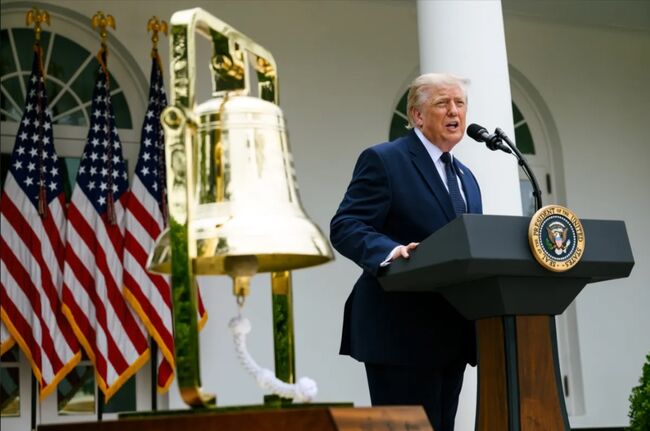
President Trump [AFP Yonhap News]
U.S. President Donald Trump stated on the 20th (local time) that the ceasefire deadline with Iran is by the evening of the 22nd (morning of the 23rd in Korean time) according to Eastern Standard Time, and the possibility of an extension is very slim.
Negotiations are set to begin on the 21st, and he said the U.S. naval blockade of Iran would not be lifted until an agreement is signed. He has also caused confusion by repeatedly changing his statements regarding whether Vice President JD Vance would depart for Pakistan.
In a phone interview with Bloomberg News that day, President Trump said that the end of the two-week ceasefire with Iran would be "Wednesday evening Washington time."
While the U.S. and Iran agreed to a ceasefire on the 7th, the two-week ceasefire deadline was initially considered to be the 21st, a Tuesday. This is interpreted as effectively extending the ceasefire period by one day by flexibly interpreting the starting point.
President Trump added that negotiations would begin on the 21st, stating that Vice President JD Vance would depart for Pakistan that day for negotiations with Iran.
Regarding the possibility of extending the ceasefire, President Trump said it was "very slim" and that the U.S. naval blockade of Iran would continue until an agreement is reached.
President Trump said, "They want me to open it. Iran desperately wants me to open (the strait). I will not open it until there is a signed agreement."
When asked if fighting would immediately resume if no agreement is reached, he replied, "If there is no agreement, I certainly expect so."
"I will not rush into a bad deal," he said, adding that there is sufficient time. He mentioned he would like to attend the talks directly but stated it might not be necessary.
Ultimately, President Trump's message appears to be an attempt to raise expectations for a negotiated settlement, while interpreting the ceasefire period as flexibly as possible.
However, President Trump also intensified pressure on Iran by reiterating that the naval blockade would continue and that attacks would resume if no agreement is reached.
In a previous interview with the New York Post, President Trump said that Vice President Vance was on his way to Pakistan and would arrive soon. Later, Reuters reported, citing sources familiar with the matter, that Vice President Vance was still in the U.S. and had not yet departed for Pakistan.
Meanwhile, Fox News host Maria Bartiromo posted on X that morning, "President Trump said, 'An agreement will be reached tonight.'"
According to President Trump's interview with Bloomberg News, negotiations are scheduled to start on the 21st, making an "agreement tonight" impossible.
Amidst the confusion caused by President Trump's fluctuating remarks, there are also observations that he may be deliberately making confusing statements as the prospects for negotiations remain uncertain.
The previous day, President Trump had presented "negotiations in Islamabad on the 20th" as a fait accompli, while Iran has not clarified its stance on participating in the negotiations.
Amid reports that participation is being positively considered, there are also suspicions within Iran that President Trump is feigning a negotiating posture without genuine intent, as a way to build a justification for resuming attacks.
President Trump also asserted on his social media platform Truth Social that day, while criticizing media reports about the Iran war, "The outcome in Iran will be surprising, much like the outcome in Venezuela, which the media does not report well."
President Trump emphasized, "If Iran's new leadership (regime change!) is wise, Iran can have a great and prosperous future."
This claim is based on the argument that Venezuela has become prosperous since Venezuelan President Nicolás Maduro was extradited by U.S. forces in early January, leading to the gradual opening of oil export channels and improvement in foreign relations under close cooperation with the Trump administration.
Although not explicitly stated, this is also interpreted as implying that if an agreement is reached with the United States, economic support for Iran's reconstruction and prosperity will be provided in the post-war period.
President Trump attached the condition "if the new leadership is wise." Given that the Iranian military has resumed the blockade of the Strait of Hormuz, this can also be seen as a call for internal consensus among those leading the negotiations, such as Iranian Parliament Speaker Mohammad Bagher Ghalibaf.
Meanwhile, U.S. Central Command announced that since the naval blockade began on the 13th targeting vessels entering and exiting Iranian ports and coastal areas, 27 ships have turned back or returned to Iranian ports.

 Trump pressures for rate cut again ahead of FOMC... "Should be the lowest in the world"
U.S. President Donald Trump. [Photo = The White House] U.S. President Donald Trump once again pressured the Federal Reserve, the U.S. central bank, to lower interest rates on the 27th (local time
Trump pressures for rate cut again ahead of FOMC... "Should be the lowest in the world"
U.S. President Donald Trump. [Photo = The White House] U.S. President Donald Trump once again pressured the Federal Reserve, the U.S. central bank, to lower interest rates on the 27th (local time
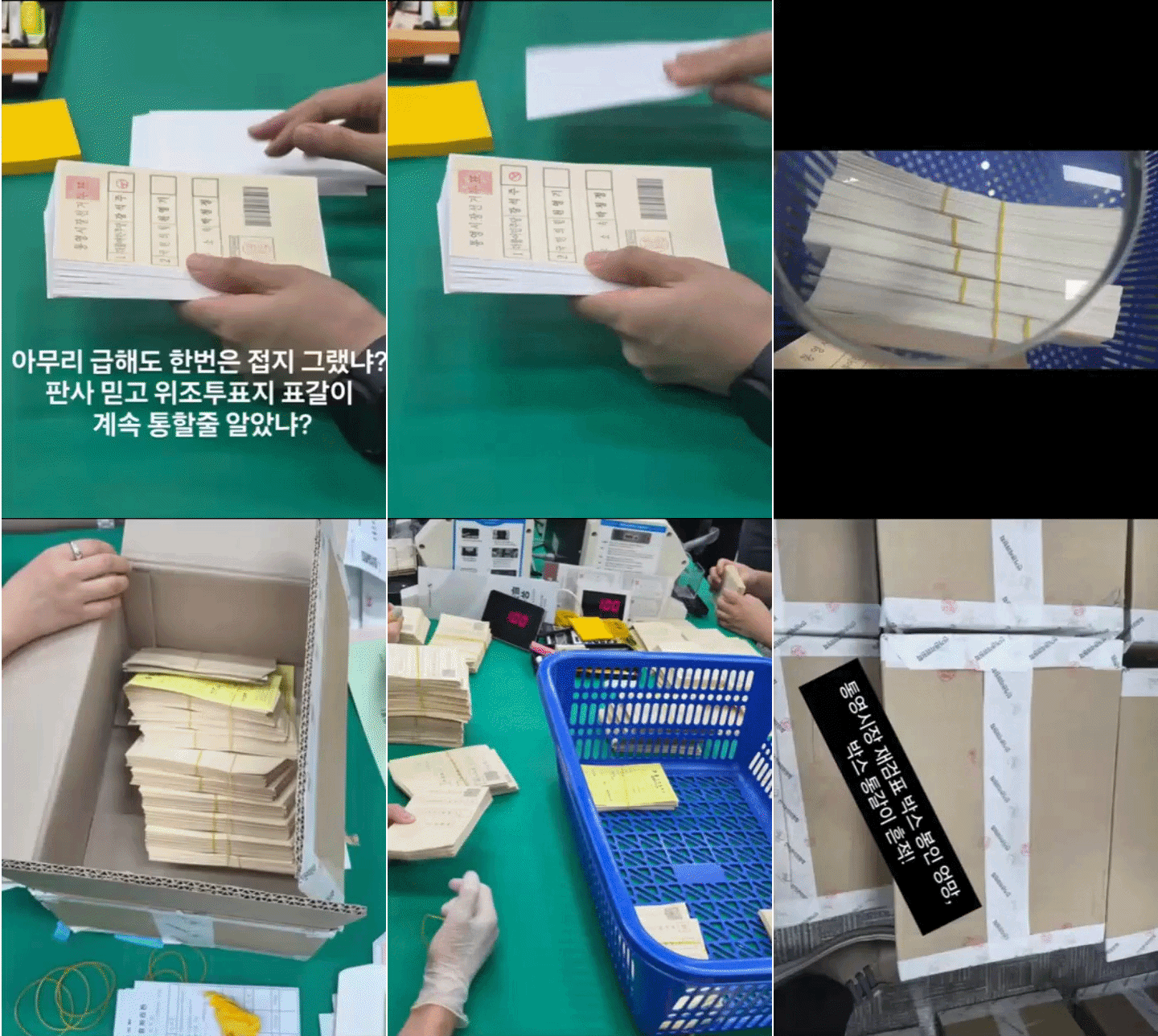 “Ignoring crisp ballots and damaged seals”… Tongyeong mayoral recount concludes with ‘no change in outcome,’ leaving suspicions and public outrage behind
Suspected counterfeit ballots discovered in Tongyeong [GIF from social media of Representative Hwang Kyo-ahn / Attorney Park Joo-hyun]During a recount of the Tongyeong mayoral election in South Gyeong
“Ignoring crisp ballots and damaged seals”… Tongyeong mayoral recount concludes with ‘no change in outcome,’ leaving suspicions and public outrage behind
Suspected counterfeit ballots discovered in Tongyeong [GIF from social media of Representative Hwang Kyo-ahn / Attorney Park Joo-hyun]During a recount of the Tongyeong mayoral election in South Gyeong
 President Yoon, regarding the first-instance ruling on the Public Official Election Act: “An excessive political verdict that distorts the facts… We will appeal immediately.”
The first-instance sentencing hearing for President Yoon Suk Yeol regarding violations of the Public Official Election Act is being broadcast live at Seoul Station on the 27th. [Photo=Yonhap News]Pres
President Yoon, regarding the first-instance ruling on the Public Official Election Act: “An excessive political verdict that distorts the facts… We will appeal immediately.”
The first-instance sentencing hearing for President Yoon Suk Yeol regarding violations of the Public Official Election Act is being broadcast live at Seoul Station on the 27th. [Photo=Yonhap News]Pres
 WSJ: "SK Hynix ADR Premium Is a Sign of AI Trading Overheat"
Advertisement for SK Hynix ADR listing in New York's Times Square [Reuters=Yonhap News file photo]The Wall Street Journal (WSJ) has pointed out that the price of SK Hynix’s American Depositary Recei
WSJ: "SK Hynix ADR Premium Is a Sign of AI Trading Overheat"
Advertisement for SK Hynix ADR listing in New York's Times Square [Reuters=Yonhap News file photo]The Wall Street Journal (WSJ) has pointed out that the price of SK Hynix’s American Depositary Recei
 'Godfather of Japanese Mystery Novels' Keigo Higashino Passes Away After Battle with Cancer at 68
Famous Japanese mystery novelist Keigo Higashino [AFP=Yonhap News]It has been belatedly reported that Keigo Higashino, the "godfather of Japanese mystery novels" and author of bestsellers such as "The
'Godfather of Japanese Mystery Novels' Keigo Higashino Passes Away After Battle with Cancer at 68
Famous Japanese mystery novelist Keigo Higashino [AFP=Yonhap News]It has been belatedly reported that Keigo Higashino, the "godfather of Japanese mystery novels" and author of bestsellers such as "The
 [Park Pil-kyu Security Column] To the Ignorant Trying to Clothe a Beast in Sheep's Clothing
Rep. Kim Byung-joo of the Democratic Party of Korea [Photo=Yonhap News]“The Air Force Academy doesn't teach you how to fly a plane!” “The Army, Navy, and Air Force academies are exactly the
[Park Pil-kyu Security Column] To the Ignorant Trying to Clothe a Beast in Sheep's Clothing
Rep. Kim Byung-joo of the Democratic Party of Korea [Photo=Yonhap News]“The Air Force Academy doesn't teach you how to fly a plane!” “The Army, Navy, and Air Force academies are exactly the
 [Issue Diagnosis] Two Effects of the Election Petition Review
 [Photo] Evidence of Election Fraud Flooding U.S. Media… Trump Had 2.7 Million Votes Stolen
 [Video] U.S. Semiquincentennial Air Show... 'Art in the Sky' streaks across New York
 [Editorial Cartoon] A Draconian Law That Undermines Freedom of Expression

 List
List