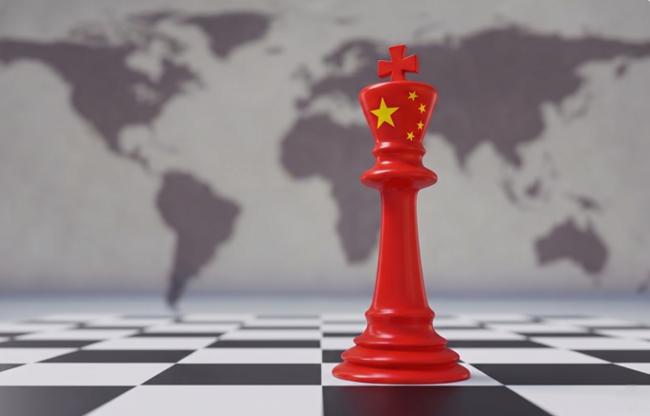
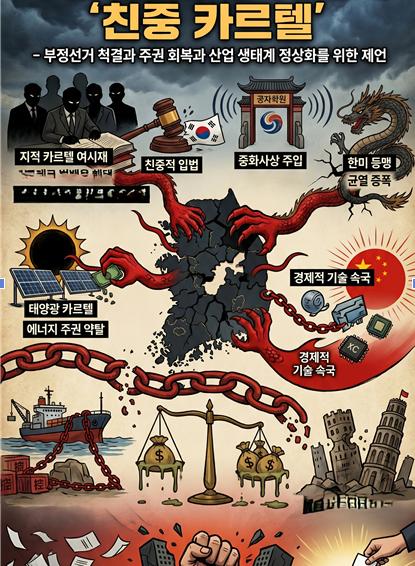
An exposé of pro-China cartels that are destroying South Korea's national system and threatening its sovereignty and security. The pro-China intellectual cartel, 'Yeosijae,' which claims to be a non-partisan think tank, has produced discourse that shifts South Korea's strategic axis towards China and legitimizes a China-centric order.
The pro-China cultural cartel, consisting of 23 Confucius Institutes, operates as a Communist Party propaganda organization with bases within universities, injecting Sinocentric ideology through cognitive manipulation, denying historical legitimacy, and undermining the order of liberal democratic values.
The pro-China political cartel, the 'Korea-China Parliamentary League,' is a massive organization with 102 members from both ruling and opposition parties. It has pushed for preferential treatment for Chinese citizens and legislation detrimental to national security, induced policies that create cracks in ROK-US-Japan security cooperation, and maintained a submissive stance that prioritizes Beijing's sentiments over national interests.
The solar power cartel, involving over 2,200 companies and institutions nationwide, has squandered national finances through practices such as △unjust loans, △subsidy fraud, and △issuing fraudulent tax invoices. They are 'plunderers of energy sovereignty' who have mortgaged South Korea's energy ecosystem to Chinese technology and 'economic traitors' who have leaked national wealth.
The pro-China cartels are a 'corrupt community of interest' where Chinese influence has infiltrated the core of South Korea's security, politics, economy, and culture, prioritizing China's strategic interests over national interests. This goes beyond mere diplomatic bias; it is a 'structural subservience to China' that compromises the entire national operating system.
Ultimately, the pro-China cartels aim to usurp sovereignty by exploiting the opacity of server security and the controversies surrounding the introduction of Chinese-made election equipment and parts, thereby constant threatening the election system, which is central to national sovereignty.
1. Pro-China Cartels Prioritizing China's Strategic Interests Over National Interests
The pro-China cartels are not merely a diplomatic bias but a 'treasonous network that infringes upon sovereignty.' These pro-China politicians use the sacred power of legislation to codify China's interests and have engaged in self-harming security actions by framing ROK-US-Japan security cooperation as 'diplomatic friction,' thereby dismantling South Korea's right to survival.
The economic sector is even more dire. By condoning capital infiltration through the yuan, they have effectively handed over core technologies such as semiconductors and batteries, which are national strategic assets, to China. This has reduced the domestic industrial ecosystem to a subcontractor base for Chinese capital and represents a clear act of economic sovereignty usurpation, weakening South Korea's economic self-reliance and turning it into a 'technological vassal state.'
These groups, using Confucius Institutes and the media as bases, inject Sinocentric historical narratives to shake the very foundations of South Korea's cultural identity and are implanting pro-China sentiment through organized online public opinion manipulation. Diplomatically, they are abandoning the 'value alliance' of the free world and, under the guise of 'neutrality,' are plotting to subordinate South Korea to China's influence. They intentionally amplify divisions in the ROK-US alliance and repeatedly engage in acts that disgrace national dignity by reducing South Korea to a strategic appendage of China.
2. The Structural and Functional Three-Axis Model: The Core Mechanism of Pro-China Cartels
Pro-China cartels project global influence through a 'structural three-axis' comprising the planning forces, domestic collaborators, and approximately 80 pro-China regimes entangled in the Belt and Road debt trap. The supporting 'functional three-axis' of economy, information, and elites are the key weapons used to neutralize South Korea.
The economic domain goes beyond simple trade, forming a 'long-term subjugation structure' through investment, loans, and infrastructure projects. By making specific strategic industries and regional economies dependent on Chinese capital, this has laid the groundwork for a powerful economic hostage situation that can paralyze the nation's policy decision-making power in times of crisis. The information domain, through content distribution and data access, attempts to seize cognitive space, serving as a cultural foundation that weakens societal judgment and policy autonomy.
'Yeosijae,' a key pro-China elite group, was dissolved in 2022. However, academics, industrialists, media personnel, and former high-ranking generals who participated as advisors and researchers for Yeosijae, under the guise of 'peace process' or 'disarmament,' weakened frontline defense systems and advocated against THAAD deployment. This logic implanted strategic ambiguity favorable to China in defense strategy, rather than strengthening ROK-US-Japan security cohesion. These individuals have persisted with policies favorable to China, drawing public criticism.
Analyzing the Chinese Communist Party's united front tactics in law, politics, and public opinion warfare will reveal the extent of the damage caused by pro-China cartels through pro-China legislation, how national wealth has flowed to China through pro-China politicians, and the specific processes and reasons behind how public opinion manipulation and election fraud have devastated the nation.
3. The Disastrous End of an 'Interest Community' Bound by Money, Not Values
The pro-China cartels are a 'money alliance' bound by strict economic compensation, not universal values. This has a fatal limitation, as it is bound to collapse the moment China's capital supply dries up. In particular, human rights abuses such as forced labor in Xinjiang symbolize their moral bankruptcy, and strong international sanctions are boomerang-ing back as 'diplomatic isolation' for pro-China forces and regimes.
Indeed, countries closely aligned with China are ostracized by the free world as 'states unable to share values.' In the Islamic world, fundamentalists, enraged by China's human rights abuses and exploitative economic structure, have even attacked Chinese individuals.
The pro-China cartels have led to systemic collapse. Sri Lanka fell into a debt trap and had its 'Hambantota Port' operating rights seized for 99 years. Malaysia and Ecuador have also lost economic control due to corruption scandals and the pledging of national infrastructure as collateral. In contrast, Australia and Canada are recovering their sovereignty by enacting 'foreign interference prevention acts' to block Chinese political intervention. The 'bloody traitorous walls' of pro-China regimes, erected at the cost of human rights for the benefit of a select few, are inevitably destined to crumble under the wrath of the people.
4. Eradicating Pro-China Cartels for the Restoration of South Korea's Sovereignty
The only path to restoring South Korea's sovereignty and regaining its security integrity is the dismantling of the pro-China cartels that have encroached upon the nation's operating system and vitality. We must now confront and reject the Chinese digital information and parasitic entities in core industries that have deeply infiltrated the veins of our society.
To shatter the poisoned chalice and reclaim the heart of South Korea, we must widely publicize the harm and hypocrisy of those who have blinded the public with the sweet talk of 'economic cooperation.' We need human innovation and a political overhaul to completely remove from politics the 'digital straws of politicians' who leak state secrets and the 'economic traitors' who plunder national wealth.
To understand the reality of pro-China cartels and eradicate them, securing the integrity of the election system is urgent. Eliminating the chain of election fraud influenced by the pro-China cartels is the very beginning of sovereignty restoration. This is not merely a political slogan but our mission of the era and the final struggle for survival.
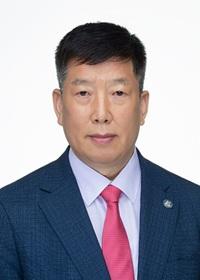
◆ Park Pil-gyu, Committee Member
Editorial Board Member, The Korea-US Daily
Korea Military Academy, Class of '88 (40th graduating class)

 Iranian Foreign Ministry: "Continuing Message Exchanges with the U.S. and Activities of Mediating Countries"
Esmaeil Baghaei, Spokesperson for the Iranian Ministry of Foreign Affairs [Xinhua, Yonhap News file photo]Esmaeil Baghaei, spokesperson for the Iranian Ministry of Foreign Affairs, stated on the 26th
Iranian Foreign Ministry: "Continuing Message Exchanges with the U.S. and Activities of Mediating Countries"
Esmaeil Baghaei, Spokesperson for the Iranian Ministry of Foreign Affairs [Xinhua, Yonhap News file photo]Esmaeil Baghaei, spokesperson for the Iranian Ministry of Foreign Affairs, stated on the 26th
 President Yoon: "Do You Think You Are Safe from the Special Counsel?"... Final Statement Video Released
President Yoon Suk Yeol rebuking the special prosecutor on the 24th. [Court video / @birds_justice X account subtitle GIF] A video of President Yoon Suk Yeol's closing statement at his trial rega
President Yoon: "Do You Think You Are Safe from the Special Counsel?"... Final Statement Video Released
President Yoon Suk Yeol rebuking the special prosecutor on the 24th. [Court video / @birds_justice X account subtitle GIF] A video of President Yoon Suk Yeol's closing statement at his trial rega
 President Yoon, regarding the first-instance ruling on the Public Official Election Act: “An excessive political verdict that distorts the facts… We will appeal immediately.”
The first-instance sentencing hearing for President Yoon Suk Yeol regarding violations of the Public Official Election Act is being broadcast live at Seoul Station on the 27th. [Photo=Yonhap News]Pres
President Yoon, regarding the first-instance ruling on the Public Official Election Act: “An excessive political verdict that distorts the facts… We will appeal immediately.”
The first-instance sentencing hearing for President Yoon Suk Yeol regarding violations of the Public Official Election Act is being broadcast live at Seoul Station on the 27th. [Photo=Yonhap News]Pres
 WSJ: "SK Hynix ADR Premium Is a Sign of AI Trading Overheat"
Advertisement for SK Hynix ADR listing in New York's Times Square [Reuters=Yonhap News file photo]The Wall Street Journal (WSJ) has pointed out that the price of SK Hynix’s American Depositary Recei
WSJ: "SK Hynix ADR Premium Is a Sign of AI Trading Overheat"
Advertisement for SK Hynix ADR listing in New York's Times Square [Reuters=Yonhap News file photo]The Wall Street Journal (WSJ) has pointed out that the price of SK Hynix’s American Depositary Recei
 'Godfather of Japanese Mystery Novels' Keigo Higashino Passes Away After Battle with Cancer at 68
Famous Japanese mystery novelist Keigo Higashino [AFP=Yonhap News]It has been belatedly reported that Keigo Higashino, the "godfather of Japanese mystery novels" and author of bestsellers such as "The
'Godfather of Japanese Mystery Novels' Keigo Higashino Passes Away After Battle with Cancer at 68
Famous Japanese mystery novelist Keigo Higashino [AFP=Yonhap News]It has been belatedly reported that Keigo Higashino, the "godfather of Japanese mystery novels" and author of bestsellers such as "The
 [Park Pil-kyu Security Column] To the Ignorant Trying to Clothe a Beast in Sheep's Clothing
Rep. Kim Byung-joo of the Democratic Party of Korea [Photo=Yonhap News]“The Air Force Academy doesn't teach you how to fly a plane!” “The Army, Navy, and Air Force academies are exactly the
[Park Pil-kyu Security Column] To the Ignorant Trying to Clothe a Beast in Sheep's Clothing
Rep. Kim Byung-joo of the Democratic Party of Korea [Photo=Yonhap News]“The Air Force Academy doesn't teach you how to fly a plane!” “The Army, Navy, and Air Force academies are exactly the
 [Issue Diagnosis] Two Effects of the Election Petition Review
 [Photo] Evidence of Election Fraud Flooding U.S. Media… Trump Had 2.7 Million Votes Stolen
 [Video] U.S. Semiquincentennial Air Show... 'Art in the Sky' streaks across New York
 [Editorial Cartoon] A Draconian Law That Undermines Freedom of Expression

 List
List









