 A Statue of Peace installed in the Mitte district of Berlin, Germany. It was forcibly removed on October 17, 2025, due to a municipal administrative order and court ruling. Mr. Kim Byung-heon, who was arrested on March 20 for charges including defamation of the deceased for his campaign to remove the statue, stated, "Statues of Peace, reflecting the sculptor's misguided perceptions and anti-Japanese animosity, have been installed 156 times domestically and over 30 times internationally. Hundreds of statues of varying shapes and sizes are also installed in elementary, middle, and high schools nationwide, including Muhak Girls' High School and Seocho High School." He emphasized, "These statues installed on school grounds are anti-educational structures that hinder the proper emotional development of students." [Photo=Yonhap News]
The Act on the Recovery of Illicitly Acquired Property of Pro-Japanese Collaborators has passed the National Assembly plenary session. In the subtext of modern Korean history lies a massive interest group, an "anti-Japanese cartel," that has solidified its vested interests by harnessing anti-Japanese sentiment as its driving force.
This group continuously regenerates conflict, not as a means of healing past historical pain, but as a way to extract political benefits. We aim to dissect the parasitic structure of the "anti-Japanese cartel," which can only survive by agitating historical wounds, and to propose a path for Korea to overcome Japan (克日) and move forward.
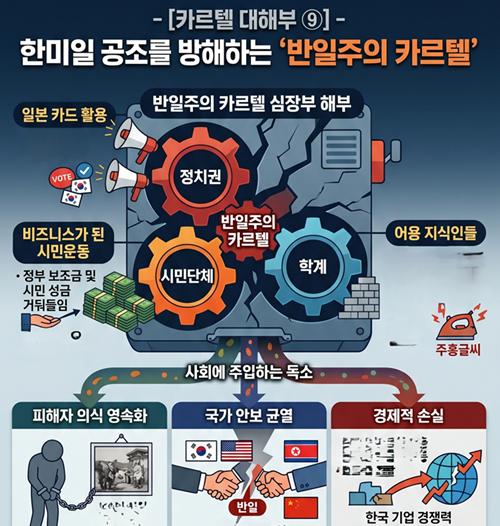
1. The Reality and Structure of the 'Anti-Japanese Cartel'
The 'anti-Japanese cartel' is a machine of ideology, vested interests, and idealism, driven by the interlocking gears of politics, civic groups, and academia. The purpose of this machine is not true patriotism, but the acquisition of power, leadership within its faction, and capital.
First, Anti-Japanese Sentiment as a Political Tool
During election seasons or times of political crisis when approval ratings plummet, specific factions unfailingly resort to the 'anti-Japanese' card. This is because inciting animosity towards Japan is cheaper and more advantageous in elections than presenting complex policy alternatives or national visions, as it effectively mobilizes the public.
For them, anti-Japanese sentiment serves as a powerful shield to continuously discredit and bury opposing forces by labeling them as 'native Japanese collaborators' or 'pro-Japanese traitors,' while simultaneously covering up their own failures.
Second, Civic Movements as a Business
Numerous organizations established under the guise of aiding victims of sexual slavery or forced labor annually collect substantial government subsidies and public donations. However, their activities often show a pattern where funds are concentrated on expanding the organization's reach, political rallies, and maintaining internal networks within the cartel, rather than on the welfare of the victims or their actual restoration of honor.
As revealed in the case of the Justice for Peace and Human Rights Foundation (Jeong-ui Gi-eok Yeon-dae), the voices of the elderly victims have been reduced to a means of maintaining the organization's authority, and the reconciliation and forgiveness they genuinely seek have been thoroughly ignored for the benefit of the anti-Japanese cartel.
Third, Intellectuals Building Academic Fortresses
Confined within the narrow framework of nationalism, these individuals deny international legal common sense and objective historical records. They disregard the legal weight of the 1965 Basic Treaty between Korea and Japan and subsequent changes in international dynamics, instead emphasizing delusional victimhood attributed to the Japanese military during the colonial era to solely produce narratives that stir public emotion.
Hidden behind the guise of academic freedom, they cast the scarlet letter of 'pro-Japanese colonial historian' upon scholars who present differing interpretations, engaging in intellectual terrorism.
2. The 'Anti-Japanese Cartel' Eroding the Nation's Future
The most fatal poison injected by the anti-Japanese cartel into our society is the 'perpetuation of a victim mentality.' Despite South Korea's emergence as one of the world's top 10 economies and a cultural powerhouse, they attempt to keep it trapped in the sense of defeat from its colonial past a century ago. This instills baseless hatred and inferiority complexes in the younger generation, acting as psychological shackles as they venture into the global arena.
The 'Anti-Japanese Cartel' Shaking the Foundations of National Security
In the Northeast Asian geopolitical landscape, where the North Korean nuclear threat is constant, security cooperation among South Korea, the United States, and Japan is not an option but a matter of survival. The 'anti-Japanese cartel,' however, drags past historical conflicts into the security domain, advocating for the termination of agreements like the General Security of Military Information (GSOMIA) and creating cracks in national defense. This ultimately provides strategic advantages to forces threatening the values of liberal democracy, such as North Korea and China, and is akin to self-harm (treasonous) acts.
The 'Anti-Japanese Cartel' Inflicting Enormous Economic Losses
At a time of rapid global supply chain shifts, technological cooperation and capital exchange with Japan are crucial factors in enhancing the competitiveness of Korean companies. However, the emotional boycotts and diplomatic friction led by the cartel expose Korean businesses to unnecessary risks and cause the international community to perceive Korea as an 'unpredictable nation,' thereby eroding national credibility.
3. Dismantling the 'Anti-Japanese Cartel' with Reason, Ending the Politics of Emotion
It is time for South Korea to break free from the net woven by the 'anti-Japanese cartel.' True victory over Japan (극일) is not about throwing stones at Japan, but about possessing overwhelming strength that makes Japan unable to look down on us and instead look up to us.
Strengthening Transparency in Historical Interpretation
We must end an era where specific groups monopolize historical records and manipulate them to their liking. By utilizing digital technology, we should make modern and contemporary historical records accessible to all citizens and establish a system for cross-verification of multinational materials from UNESCO, Korea, Japan, the UK, and China. When truth is transparently revealed, barbarism that incites based on personal whims will naturally weaken.
Legal Auditing of Civic Organizations' Financial Transparency
Organizations dealing with national pain, such as the issue of comfort women, must disclose every single won of their financial flow to the public. When a structure that diverts funds meant for victims to unintended destinations is fundamentally blocked, the ecosystem of business based on anti-Japanese sentiment and historical distortion will collapse.
Building a Future-Oriented Korea-Japan Cooperation Model
Instead of engaging in wasteful debates shackled by past grievances, we should create a structure for mutual gain in future industries such as aerospace, energy, and artificial intelligence. The more intricately economic and technological interests are intertwined, the less effective politically motivated anti-Japanese incitement will be.
4. Healing Historical Wounds with 'Coexistence' Instead of Regressive 'Bamboo Spears'
The 'anti-Japanese cartel' is a significant obstacle hindering South Korea's growth. We must prevent them from holding historical grievances hostage to threaten our future. Forgetting the past and being buried in the past, thereby losing the present and future, are entirely different matters. We must adopt the stance of a saint, forgiving and accepting.
True patriotism is not about dredging up past wounds and screaming. It is about rising above those wounds to build a strong nation that no one can challenge. We must end the 'era of bamboo spears' born from the excessive politicization of emotions. Our youth must open an era of 'coexistence,' where they confidently compete with Japan and the entire world, and where mutual victory is achieved.
Facing the reality of the 'anti-Japanese cartel' and severing their profit chain is the first step for South Korea to achieve true self-reliance and leap forward as a global pivotal state. We must now choose confidence over hatred, and the future over the past. This is the historical mission entrusted to us living in this era.

◆ Committee Member Park Pil-gyu
Editorial Committee Member, The Hankyoreh-Japan Tribune
40th graduating class, Korea Military Academy

 Iranian Foreign Ministry: "Continuing Message Exchanges with the U.S. and Activities of Mediating Countries"
Esmaeil Baghaei, Spokesperson for the Iranian Ministry of Foreign Affairs [Xinhua, Yonhap News file photo]Esmaeil Baghaei, spokesperson for the Iranian Ministry of Foreign Affairs, stated on the 26th
Iranian Foreign Ministry: "Continuing Message Exchanges with the U.S. and Activities of Mediating Countries"
Esmaeil Baghaei, Spokesperson for the Iranian Ministry of Foreign Affairs [Xinhua, Yonhap News file photo]Esmaeil Baghaei, spokesperson for the Iranian Ministry of Foreign Affairs, stated on the 26th
 President Yoon: "Do You Think You Are Safe from the Special Counsel?"... Final Statement Video Released
President Yoon Suk Yeol rebuking the special prosecutor on the 24th. [Court video / @birds_justice X account subtitle GIF] A video of President Yoon Suk Yeol's closing statement at his trial rega
President Yoon: "Do You Think You Are Safe from the Special Counsel?"... Final Statement Video Released
President Yoon Suk Yeol rebuking the special prosecutor on the 24th. [Court video / @birds_justice X account subtitle GIF] A video of President Yoon Suk Yeol's closing statement at his trial rega
 President Yoon, regarding the first-instance ruling on the Public Official Election Act: “An excessive political verdict that distorts the facts… We will appeal immediately.”
The first-instance sentencing hearing for President Yoon Suk Yeol regarding violations of the Public Official Election Act is being broadcast live at Seoul Station on the 27th. [Photo=Yonhap News]Pres
President Yoon, regarding the first-instance ruling on the Public Official Election Act: “An excessive political verdict that distorts the facts… We will appeal immediately.”
The first-instance sentencing hearing for President Yoon Suk Yeol regarding violations of the Public Official Election Act is being broadcast live at Seoul Station on the 27th. [Photo=Yonhap News]Pres
 WSJ: "SK Hynix ADR Premium Is a Sign of AI Trading Overheat"
Advertisement for SK Hynix ADR listing in New York's Times Square [Reuters=Yonhap News file photo]The Wall Street Journal (WSJ) has pointed out that the price of SK Hynix’s American Depositary Recei
WSJ: "SK Hynix ADR Premium Is a Sign of AI Trading Overheat"
Advertisement for SK Hynix ADR listing in New York's Times Square [Reuters=Yonhap News file photo]The Wall Street Journal (WSJ) has pointed out that the price of SK Hynix’s American Depositary Recei
 'Godfather of Japanese Mystery Novels' Keigo Higashino Passes Away After Battle with Cancer at 68
Famous Japanese mystery novelist Keigo Higashino [AFP=Yonhap News]It has been belatedly reported that Keigo Higashino, the "godfather of Japanese mystery novels" and author of bestsellers such as "The
'Godfather of Japanese Mystery Novels' Keigo Higashino Passes Away After Battle with Cancer at 68
Famous Japanese mystery novelist Keigo Higashino [AFP=Yonhap News]It has been belatedly reported that Keigo Higashino, the "godfather of Japanese mystery novels" and author of bestsellers such as "The
 [Park Pil-kyu Security Column] To the Ignorant Trying to Clothe a Beast in Sheep's Clothing
Rep. Kim Byung-joo of the Democratic Party of Korea [Photo=Yonhap News]“The Air Force Academy doesn't teach you how to fly a plane!” “The Army, Navy, and Air Force academies are exactly the
[Park Pil-kyu Security Column] To the Ignorant Trying to Clothe a Beast in Sheep's Clothing
Rep. Kim Byung-joo of the Democratic Party of Korea [Photo=Yonhap News]“The Air Force Academy doesn't teach you how to fly a plane!” “The Army, Navy, and Air Force academies are exactly the
 [Issue Diagnosis] Two Effects of the Election Petition Review
 [Photo] Evidence of Election Fraud Flooding U.S. Media… Trump Had 2.7 Million Votes Stolen
 [Video] U.S. Semiquincentennial Air Show... 'Art in the Sky' streaks across New York
 [Editorial Cartoon] A Draconian Law That Undermines Freedom of Expression

 List
List










