- Recent call between US and South Korean Defense Ministers revealed Trump administration's demands in SNS posts
- At the ROK-US Summit, concrete demands such as "increasing defense spending to 5% of GDP" may be specified.
 Deputy Under Secretary of Defense for Policy Elbridge Colby. Yonhap News.
Elbridge Colby, the U.S. Deputy Under Secretary of Defense for Policy, who has emerged as a key figure in pushing for changes in global alliances under the Donald Trump administration, is drawing attention for recently expressing expectations for South Korea to play a greater role in North Korea defense and defense spending.
In a post on X (formerly Twitter) on the 31st of last month (Korean time), assessing the phone call between the defense ministers of South Korea and the U.S., Colby wrote, "South Korea is willing to take a more leading role in strong defense against North Korea and continues to be a role model in defense spending."
Colby added, "We and South Korea are closely aligned in the need to modernize our alliance (ROK-U.S. alliance) in response to the regional security environment," adding, "We will continue to work closely with South Korea to build a strategically sustainable alliance that is prepared to defend against common threats."
This post, released ahead of the ROK-U.S. summit, is interpreted as an explicit expression of the Trump administration's expectations for South Korea's role in the ROK-U.S. alliance.
First, the 'leading role of South Korea in North Korea defense' can be seen as reflecting the stance or expectation that 'the U.S. needs to invest more military capabilities in the Indo-Pacific region for deterrence against China, so South Korea should take on more responsibility for defense against North Korea using conventional forces, and increase defense spending for this purpose.'
U.S. media reported that the Trump administration, in its "Interim National Defense Strategy Guidance" drafted in March, prioritized preparing for a Chinese invasion of Taiwan and defending the U.S. homeland, and was considering a plan to delegate responses to other threats such as North Korea and Iran mostly to allies.
Notably, since his days outside of government, Colby has argued that while the U.S. should continue to provide extended deterrence (nuclear umbrella) to protect South Korea from North Korean nuclear weapons, South Korea should take a more leading role in defending against North Korea's conventional threats. This confirms that his stance has not changed even after becoming deputy under secretary.
Furthermore, the mention of 'defense spending' could be linked to President Trump's demand for North Atlantic Treaty Organization (NATO) member states to increase their defense spending to 5% of their gross domestic product (GDP), which was recently agreed upon.
This can be interpreted as an intention to apply the standard of '5% of GDP defense spending,' similar to NATO, to Asian allies, with an expectation that South Korea, with the summit imminent, will proactively respond.
In addition, the remarks on cooperation for "alliance modernization," "defending against common threats," and building a "strategically sustainable alliance" reveal the perception that the ROK-U.S. alliance should also play a role in deterring threats from China, the U.S.'s primary strategic competitor, not just North Korea.
Given Colby's previous stance, there are also growing expectations that he will pursue so-called 'strategic flexibility,' which involves expanding the role and operational scope of U.S. Forces Korea to prepare for a Chinese invasion of Taiwan.
Colby, who served as Deputy Assistant Secretary of Defense for Strategy and Force Development during the first Trump administration, has been re-appointed in the second Trump administration and is leading the formulation of "America First" defense policies.
In particular, he is leading the development of the U.S.'s new National Defense Strategy (NDS), which is scheduled to be released around late summer this year.
Yonhap News
What do you think of this article?

 Trump pressures for rate cut again ahead of FOMC... "Should be the lowest in the world"
U.S. President Donald Trump. [Photo = The White House] U.S. President Donald Trump once again pressured the Federal Reserve, the U.S. central bank, to lower interest rates on the 27th (local time
Trump pressures for rate cut again ahead of FOMC... "Should be the lowest in the world"
U.S. President Donald Trump. [Photo = The White House] U.S. President Donald Trump once again pressured the Federal Reserve, the U.S. central bank, to lower interest rates on the 27th (local time
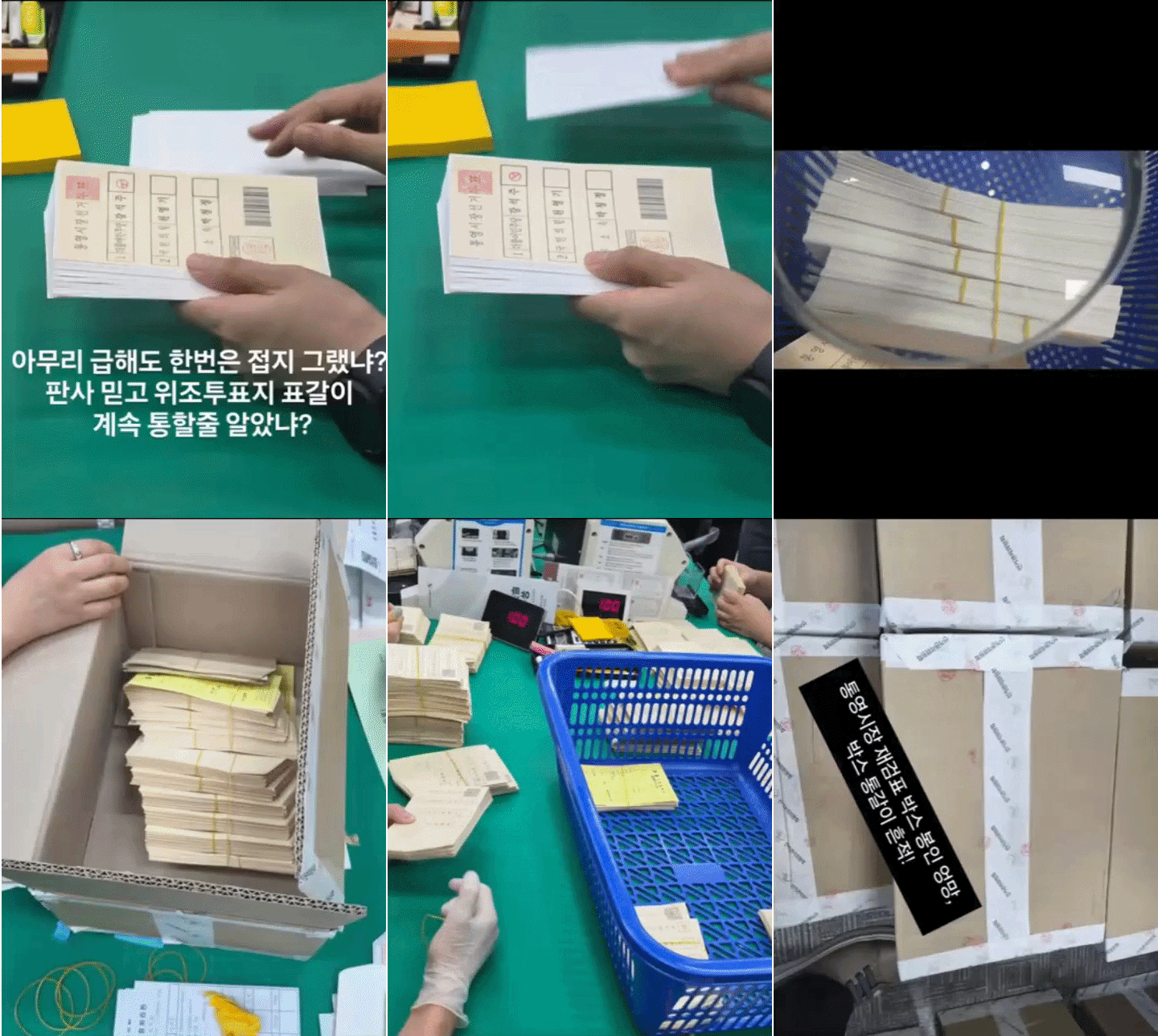 “Ignoring crisp ballots and damaged seals”… Tongyeong mayoral recount concludes with ‘no change in outcome,’ leaving suspicions and public outrage behind
Suspected counterfeit ballots discovered in Tongyeong [GIF from social media of Representative Hwang Kyo-ahn / Attorney Park Joo-hyun]During a recount of the Tongyeong mayoral election in South Gyeong
“Ignoring crisp ballots and damaged seals”… Tongyeong mayoral recount concludes with ‘no change in outcome,’ leaving suspicions and public outrage behind
Suspected counterfeit ballots discovered in Tongyeong [GIF from social media of Representative Hwang Kyo-ahn / Attorney Park Joo-hyun]During a recount of the Tongyeong mayoral election in South Gyeong
 President Yoon, regarding the first-instance ruling on the Public Official Election Act: “An excessive political verdict that distorts the facts… We will appeal immediately.”
The first-instance sentencing hearing for President Yoon Suk Yeol regarding violations of the Public Official Election Act is being broadcast live at Seoul Station on the 27th. [Photo=Yonhap News]Pres
President Yoon, regarding the first-instance ruling on the Public Official Election Act: “An excessive political verdict that distorts the facts… We will appeal immediately.”
The first-instance sentencing hearing for President Yoon Suk Yeol regarding violations of the Public Official Election Act is being broadcast live at Seoul Station on the 27th. [Photo=Yonhap News]Pres
 WSJ: "SK Hynix ADR Premium Is a Sign of AI Trading Overheat"
Advertisement for SK Hynix ADR listing in New York's Times Square [Reuters=Yonhap News file photo]The Wall Street Journal (WSJ) has pointed out that the price of SK Hynix’s American Depositary Recei
WSJ: "SK Hynix ADR Premium Is a Sign of AI Trading Overheat"
Advertisement for SK Hynix ADR listing in New York's Times Square [Reuters=Yonhap News file photo]The Wall Street Journal (WSJ) has pointed out that the price of SK Hynix’s American Depositary Recei
 'Godfather of Japanese Mystery Novels' Keigo Higashino Passes Away After Battle with Cancer at 68
Famous Japanese mystery novelist Keigo Higashino [AFP=Yonhap News]It has been belatedly reported that Keigo Higashino, the "godfather of Japanese mystery novels" and author of bestsellers such as "The
'Godfather of Japanese Mystery Novels' Keigo Higashino Passes Away After Battle with Cancer at 68
Famous Japanese mystery novelist Keigo Higashino [AFP=Yonhap News]It has been belatedly reported that Keigo Higashino, the "godfather of Japanese mystery novels" and author of bestsellers such as "The
 [Park Pil-kyu Security Column] To the Ignorant Trying to Clothe a Beast in Sheep's Clothing
Rep. Kim Byung-joo of the Democratic Party of Korea [Photo=Yonhap News]“The Air Force Academy doesn't teach you how to fly a plane!” “The Army, Navy, and Air Force academies are exactly the
[Park Pil-kyu Security Column] To the Ignorant Trying to Clothe a Beast in Sheep's Clothing
Rep. Kim Byung-joo of the Democratic Party of Korea [Photo=Yonhap News]“The Air Force Academy doesn't teach you how to fly a plane!” “The Army, Navy, and Air Force academies are exactly the
 [Issue Diagnosis] Two Effects of the Election Petition Review
 [Photo] Evidence of Election Fraud Flooding U.S. Media… Trump Had 2.7 Million Votes Stolen
 [Video] U.S. Semiquincentennial Air Show... 'Art in the Sky' streaks across New York
 [Editorial Cartoon] A Draconian Law That Undermines Freedom of Expression

 List
List