U.S. Secretary of the Navy Richard Spencer stated on the 24th (local time) that the United States is implementing an "ironclad blockade" against Iran, which is strengthening "by the hour," with the U.S. Navy turning away vessels and intensifying the blockade globally as part of a broader military and economic campaign.
Spencer announced at a press conference earlier that day that the blockade, a key element of "Operation Epic Fury," is designed to cut off Iran's maritime transport and compel Tehran to abandon its nuclear ambitions.
"As part of these efforts, we are enforcing an increasingly ironclad blockade," Spencer said. "From the Gulf of Oman to the high seas, our Navy is enforcing this blockade without hesitation or apology."
He stated that all vessels meeting U.S. criteria, including ships going to or from Iranian vessels or ports, have been turned back, and that as of Friday morning, 34 vessels not bound for Iran have been allowed passage.
"Our blockade is expanding and spreading globally," Spencer said, citing the recent seizure of two Iranian "clandestine fleet" vessels in the Indo-Pacific this week that had sailed before the blockade went into effect.
Spencer also added that a second U.S. aircraft carrier will join operations in the coming days to further reinforce enforcement.
"No vessel will be able to navigate to anywhere in the world through the Strait of Hormuz without the permission of the U.S. Navy," he said. "The blockade is tightening by the hour. We have control. Nothing in, nothing out."
Spencer said the operation reflects a more focused and rapid approach compared to past U.S. conflicts.
"Operation Epic Fury has achieved decisive military results in a matter of weeks," he said, comparing it to the wars in Korea, Vietnam, Iraq, and Afghanistan. "Clear mission objectives have been achieved, and ultimately, Iran will not possess a nuclear weapon."
He described the operation as entering a "new phase" combining sustained military pressure with diplomatic openings for Tehran.
"Iran has a critical choice to make. They have the opportunity to strike a good deal, a wise deal," Spencer said.
He emphasized that President Donald Trump is not rushing negotiations.
"As President Trump has said once again yesterday, we have plenty of time, there is no need to rush into negotiations," Spencer said. "Iran knows that the opportunity is still there for them to make a wise choice."
Spencer also strongly criticized Iran's military, particularly the Islamic Revolutionary Guard Corps (IRGC), portraying them as weakened and resorting to unconventional tactics.
"The IRGC has been reduced to a pirate group with a flag," he said, accusing the Iranian military of attacking merchant ships and laying mines.
He referred to recent incidents where Iranian small boats approached and fired upon warships, stating that such actions demonstrate a lack of conventional naval power by the Iranian navy.
"They are acting like pirates, like terrorists," he said.
Spencer stated that President Trump has empowered U.S. forces to respond aggressively to threats in the region.
"If Iran mines the waters or threatens U.S. merchant ships or U.S. military forces, we will fire and destroy them without hesitation," he said.
He explained that the blockade measures are part of a broader strategy to pressure Iran's economy, warning that Tehran's financial stability is at risk.
"They will have no choice but to watch their regime's fragile economic condition collapse under sustained American pressure," Spencer said.
Spencer also pointed out Iran's decades-long hostile stance toward the United States.
"Iran has been at war with the United States for 47 years, killing our citizens, our military, and our allies," he said.
He praised President Trump's leadership, describing the president's approach as firm and consistent.
"President Trump's will is unwavering, and his mission is very clear," Spencer said.
Spencer also urged U.S. allies, particularly those reliant on maritime transport through the Strait of Hormuz, to take on a greater role.
"This fight cannot be an American-only fight," he said. "Europe and Asia have benefited for decades under our protection, but the era of free-riding is over."
He added that allies have a direct stake in keeping the maritime shipping lanes open.
"We do not depend on Europe, but Europe needs the Strait of Hormuz far more than we do," he said.
Spencer stated that the U.S. is prepared to sustain the operation indefinitely if necessary.
"We must blockade for as long as necessary," he said. "The bottom line is, and will remain, that Iran will never have a nuclear bomb."
He concluded his remarks by emphasizing that the U.S. military is ready for further action.
"The Department of Defense is prepared for what is to come," Spencer said. "We are ready for all contingencies."
U.S. NNP=Sung Ku Hong, Chief Correspondent / Special Correspondent for this publication NNP info@newsandpost.com

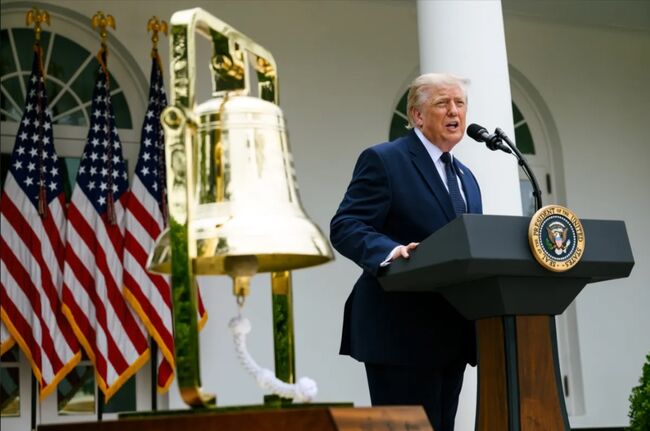 Trump pressures for rate cut again ahead of FOMC... "Should be the lowest in the world"
U.S. President Donald Trump. [Photo = The White House] U.S. President Donald Trump once again pressured the Federal Reserve, the U.S. central bank, to lower interest rates on the 27th (local time
Trump pressures for rate cut again ahead of FOMC... "Should be the lowest in the world"
U.S. President Donald Trump. [Photo = The White House] U.S. President Donald Trump once again pressured the Federal Reserve, the U.S. central bank, to lower interest rates on the 27th (local time
 “Ignoring crisp ballots and damaged seals”… Tongyeong mayoral recount concludes with ‘no change in outcome,’ leaving suspicions and public outrage behind
Suspected counterfeit ballots discovered in Tongyeong [GIF from social media of Representative Hwang Kyo-ahn / Attorney Park Joo-hyun]During a recount of the Tongyeong mayoral election in South Gyeong
“Ignoring crisp ballots and damaged seals”… Tongyeong mayoral recount concludes with ‘no change in outcome,’ leaving suspicions and public outrage behind
Suspected counterfeit ballots discovered in Tongyeong [GIF from social media of Representative Hwang Kyo-ahn / Attorney Park Joo-hyun]During a recount of the Tongyeong mayoral election in South Gyeong
 President Yoon, regarding the first-instance ruling on the Public Official Election Act: “An excessive political verdict that distorts the facts… We will appeal immediately.”
The first-instance sentencing hearing for President Yoon Suk Yeol regarding violations of the Public Official Election Act is being broadcast live at Seoul Station on the 27th. [Photo=Yonhap News]Pres
President Yoon, regarding the first-instance ruling on the Public Official Election Act: “An excessive political verdict that distorts the facts… We will appeal immediately.”
The first-instance sentencing hearing for President Yoon Suk Yeol regarding violations of the Public Official Election Act is being broadcast live at Seoul Station on the 27th. [Photo=Yonhap News]Pres
 WSJ: "SK Hynix ADR Premium Is a Sign of AI Trading Overheat"
Advertisement for SK Hynix ADR listing in New York's Times Square [Reuters=Yonhap News file photo]The Wall Street Journal (WSJ) has pointed out that the price of SK Hynix’s American Depositary Recei
WSJ: "SK Hynix ADR Premium Is a Sign of AI Trading Overheat"
Advertisement for SK Hynix ADR listing in New York's Times Square [Reuters=Yonhap News file photo]The Wall Street Journal (WSJ) has pointed out that the price of SK Hynix’s American Depositary Recei
 'Godfather of Japanese Mystery Novels' Keigo Higashino Passes Away After Battle with Cancer at 68
Famous Japanese mystery novelist Keigo Higashino [AFP=Yonhap News]It has been belatedly reported that Keigo Higashino, the "godfather of Japanese mystery novels" and author of bestsellers such as "The
'Godfather of Japanese Mystery Novels' Keigo Higashino Passes Away After Battle with Cancer at 68
Famous Japanese mystery novelist Keigo Higashino [AFP=Yonhap News]It has been belatedly reported that Keigo Higashino, the "godfather of Japanese mystery novels" and author of bestsellers such as "The
 [Park Pil-kyu Security Column] To the Ignorant Trying to Clothe a Beast in Sheep's Clothing
Rep. Kim Byung-joo of the Democratic Party of Korea [Photo=Yonhap News]“The Air Force Academy doesn't teach you how to fly a plane!” “The Army, Navy, and Air Force academies are exactly the
[Park Pil-kyu Security Column] To the Ignorant Trying to Clothe a Beast in Sheep's Clothing
Rep. Kim Byung-joo of the Democratic Party of Korea [Photo=Yonhap News]“The Air Force Academy doesn't teach you how to fly a plane!” “The Army, Navy, and Air Force academies are exactly the
 [Issue Diagnosis] Two Effects of the Election Petition Review
 [Photo] Evidence of Election Fraud Flooding U.S. Media… Trump Had 2.7 Million Votes Stolen
 [Video] U.S. Semiquincentennial Air Show... 'Art in the Sky' streaks across New York
 [Editorial Cartoon] A Draconian Law That Undermines Freedom of Expression

 List
List