Mechanism of Type I Collagen Production by Astrocytes and Neuronal Death in Ischemic Stroke [Provided by IBS]
A domestic research team has identified the cause of neuronal damage that leads to stroke sequelae and proposed a treatment.
They revealed that the protective barrier formed by the excessive production of hydrogen peroxide in the brain, due to blocked cerebral blood vessels, paradoxically leads to neuronal death. Furthermore, they demonstrated that a drug candidate compound based on this discovery could restore paralyzed stroke-affected monkeys in primate experiments, thereby increasing its clinical potential.
The Institute for Basic Science (IBS) announced on the 28th that the research team led by Dr. Chang-joon Lee of the Center for Neural Circuits and Behaviors, in collaboration with Eulji University, confirmed that excessive hydrogen peroxide production in the brain causes astrocytes to produce collagen, leading to neuronal death. They also showed that inhibiting this process can prevent brain damage caused by cerebral infarction.
Astrocytes are the most abundant cells in the brain and play a protective role.
Specifically, it has been known that astrocytes form an astroglial barrier around the damaged area after a stroke to prevent the spread of the condition.
However, contrary to conventional wisdom, the research team has revealed that this protective barrier actually contributes to neuronal death.
They confirmed that after a stroke, a surge in hydrogen peroxide stimulates astrocytes, which then produce type I collagen to form an astroglial barrier that engulfs and kills neurons.
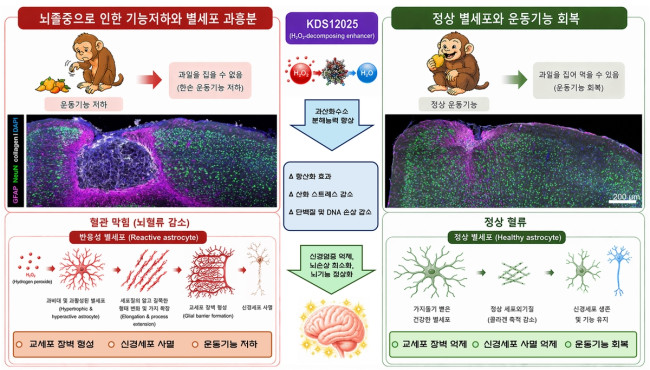 Stroke-induced functional decline and recovery after administration of KDS12025 [Provided by IBS]
Subsequently, the research team administered their novel drug candidate compound, 'KDS12025,' which can inhibit collagen production and remove hydrogen peroxide, to rats and primates. They confirmed that motor function could be restored to normal levels within a week.
Notably, they observed the recovery of neural function even when the drug was administered two days after the stroke occurred, suggesting the possibility of extending the stroke treatment golden hour, which is typically considered to be 3-4 hours.
In experiments where KDS12025 was administered to a primate model of stroke, a significant reduction in lesion size was observed after three days, and paralyzed hands recovered within a week.
In an experiment involving picking up and eating fruit, stroke model monkeys were unable to move their hands due to motor impairment, while KDS12025-treated monkeys succeeded in all ten attempts.
"We have elucidated the mechanism of collagen synthesis by astrocytes induced by reactive oxygen species at the molecular and cellular level," said Dr. Bo-young Lee, an IBS research fellow. "This provides a crucial clue for understanding the various causes of neuronal death and will serve as a cornerstone for treating not only stroke but also neurodegenerative diseases such as dementia and Parkinson's."
The research team emphasized that while existing stroke drug candidates have focused on removing blood clots, their novel compound offers a new approach by treating neurons to reduce sequelae.
Professor Seung-joon Yoo of Eulji University expressed his hope that "proving therapeutic efficacy in primate models, not just cells and small animals, will significantly shorten the clinical trial period and offer new hope to patients."
"By establishing a one-stop research system that integrates basic research, drug development, and preclinical stages, which were previously conducted sporadically, we have succeeded not only in identifying the fundamental cause of stroke but also in proposing a specific treatment," said Dr. Chang-joon Lee, the center director. "We will continue to dedicate ourselves to basic science research that directly benefits humanity and society."
The research findings were published in the international academic journal 'Cell Metabolism' on the same day.

 Iranian Foreign Ministry: "Continuing Message Exchanges with the U.S. and Activities of Mediating Countries"
Esmaeil Baghaei, Spokesperson for the Iranian Ministry of Foreign Affairs [Xinhua, Yonhap News file photo]Esmaeil Baghaei, spokesperson for the Iranian Ministry of Foreign Affairs, stated on the 26th
Iranian Foreign Ministry: "Continuing Message Exchanges with the U.S. and Activities of Mediating Countries"
Esmaeil Baghaei, Spokesperson for the Iranian Ministry of Foreign Affairs [Xinhua, Yonhap News file photo]Esmaeil Baghaei, spokesperson for the Iranian Ministry of Foreign Affairs, stated on the 26th
 President Yoon: "Do You Think You Are Safe from the Special Counsel?"... Final Statement Video Released
President Yoon Suk Yeol rebuking the special prosecutor on the 24th. [Court video / @birds_justice X account subtitle GIF] A video of President Yoon Suk Yeol's closing statement at his trial rega
President Yoon: "Do You Think You Are Safe from the Special Counsel?"... Final Statement Video Released
President Yoon Suk Yeol rebuking the special prosecutor on the 24th. [Court video / @birds_justice X account subtitle GIF] A video of President Yoon Suk Yeol's closing statement at his trial rega
 President Yoon, regarding the first-instance ruling on the Public Official Election Act: “An excessive political verdict that distorts the facts… We will appeal immediately.”
The first-instance sentencing hearing for President Yoon Suk Yeol regarding violations of the Public Official Election Act is being broadcast live at Seoul Station on the 27th. [Photo=Yonhap News]Pres
President Yoon, regarding the first-instance ruling on the Public Official Election Act: “An excessive political verdict that distorts the facts… We will appeal immediately.”
The first-instance sentencing hearing for President Yoon Suk Yeol regarding violations of the Public Official Election Act is being broadcast live at Seoul Station on the 27th. [Photo=Yonhap News]Pres
 WSJ: "SK Hynix ADR Premium Is a Sign of AI Trading Overheat"
Advertisement for SK Hynix ADR listing in New York's Times Square [Reuters=Yonhap News file photo]The Wall Street Journal (WSJ) has pointed out that the price of SK Hynix’s American Depositary Recei
WSJ: "SK Hynix ADR Premium Is a Sign of AI Trading Overheat"
Advertisement for SK Hynix ADR listing in New York's Times Square [Reuters=Yonhap News file photo]The Wall Street Journal (WSJ) has pointed out that the price of SK Hynix’s American Depositary Recei
 'Godfather of Japanese Mystery Novels' Keigo Higashino Passes Away After Battle with Cancer at 68
Famous Japanese mystery novelist Keigo Higashino [AFP=Yonhap News]It has been belatedly reported that Keigo Higashino, the "godfather of Japanese mystery novels" and author of bestsellers such as "The
'Godfather of Japanese Mystery Novels' Keigo Higashino Passes Away After Battle with Cancer at 68
Famous Japanese mystery novelist Keigo Higashino [AFP=Yonhap News]It has been belatedly reported that Keigo Higashino, the "godfather of Japanese mystery novels" and author of bestsellers such as "The
 [Park Pil-kyu Security Column] To the Ignorant Trying to Clothe a Beast in Sheep's Clothing
Rep. Kim Byung-joo of the Democratic Party of Korea [Photo=Yonhap News]“The Air Force Academy doesn't teach you how to fly a plane!” “The Army, Navy, and Air Force academies are exactly the
[Park Pil-kyu Security Column] To the Ignorant Trying to Clothe a Beast in Sheep's Clothing
Rep. Kim Byung-joo of the Democratic Party of Korea [Photo=Yonhap News]“The Air Force Academy doesn't teach you how to fly a plane!” “The Army, Navy, and Air Force academies are exactly the
 [Issue Diagnosis] Two Effects of the Election Petition Review
 [Photo] Evidence of Election Fraud Flooding U.S. Media… Trump Had 2.7 Million Votes Stolen
 [Video] U.S. Semiquincentennial Air Show... 'Art in the Sky' streaks across New York
 [Editorial Cartoon] A Draconian Law That Undermines Freedom of Expression

 List
List