Gen. Paul LaCamera, commander of the Combined Forces Command and U.S. Forces Korea, has revealed a "kill web" concept where South Korea, Japan, and the Philippines would closely share information on a cyber network and conduct joint military operations in case of contingencies, according to a report by The Japan Times on the 29th.
In an interview with The Japan Times, Commander LaCamera stated that building a kill web, which closely links the military capabilities of South Korea, Japan, and the Philippines in multiple ways, is necessary to more effectively respond to the growing security threats from North Korea, China, and Russia.
 Gen. Paul LaCamera, commander of the Combined Forces Command, speaks with reporters during a combined ROK-U.S. bridging exercise at the Imjin River in Yeoncheon, Gyeonggi Province, on the 14th. The exercise, part of the ROK-U.S. combined exercise 'Freedom Shield' (FS), involved the U.S. 2nd Infantry Division/ROK-U.S. Combined Division, the Republic of Korea Army's Capital Mechanized Infantry Division, and the 7th Engineer Brigade. [Yonhap News]
He explained that the goal is to integrate the military linkage of South Korea, the U.S., and Japan into a single network system, extending beyond traditional military operational domains such as land, sea, and air to include space, cyber, and electromagnetic domains.
For example, he envisioned a structure where U.S. satellite-based sensors detect signs of attack from North Korea, China, or Russia, and then a ground radar base in one of the three countries — South Korea, Japan, or the Philippines — tracks the movement, with another country taking a retaliatory action.
He further elaborated that a network enabling all sensors, including satellites, drones, and troops, to transmit real-time data to attack assets such as aircraft, ships, and missile systems is essential for the kill web concept.
Commander LaCamera pointed out that in modern warfare, victory or defeat is often determined in cyber and electromagnetic spaces before conventional combat even begins, and he emphasized deterrence of regional military provocations and coordinated responses.
The Japan Times commented that Commander LaCamera's concept suggests a significant shift in the U.S. Department of Defense's perspective on the East Asian region.
Specifically, regarding the Korean Peninsula, it analyzed that the U.S. no longer views it as an independent battlefield focused on deterring North Korea, but rather as a key hub within a broad defense network spanning the first island chain, from Japan to Borneo, which serves as China's defensive line against the U.S.
Commander LaCamera stated that U.S. allies in East Asia, such as South Korea, Japan, and the Philippines, cannot exist in isolation. "By connecting them, adversaries lose a single axis of preparation, which enhances our military advantage," he added.
The Japan Times pointed out that realizing the U.S.'s kill web concept would require expanded information sharing and increased support for U.S. military equipment in the region.
Limitations were identified as the politically sensitive reactions from South Korea and Japan to military cooperation, and the fact that while Japan has expanded its role as a "nation capable of war" since the emergence of the Sanae Takaichi cabinet, active combat participation remains difficult under its existing peace constitution.
Commander LaCamera mentioned that cooperation between U.S. Forces Japan and the Self-Defense Forces is already close but needs to be institutionalized, and he voiced support for the defense power enhancement and constitutional amendment for the Self-Defense Forces being pursued by the Takaichi cabinet.
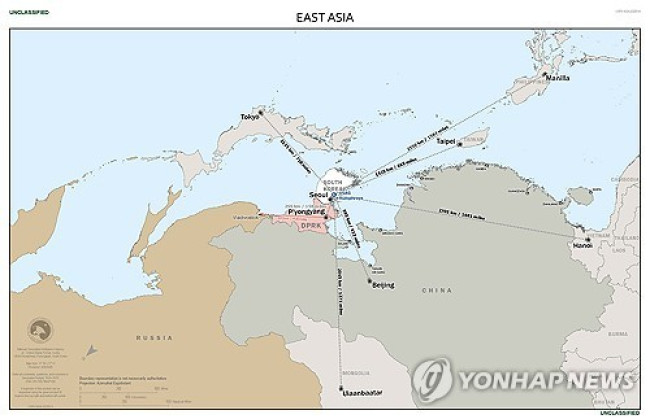 LaCamera: "If you flip the East Asian map, you can see the cooperation framework of South Korea, Japan, and the Philippines" (Seoul=Yonhap News) Gen. Paul LaCamera, commander of U.S. Forces Korea and Combined Forces Command, said on the 17th that if one flips the East Asian map, one can feel the strategic cooperation needs of South Korea, Japan, and the Philippines. He stated, "Perhaps the most important insight this map provides is the existence of a strategic triangle connecting South Korea, Japan, and the Philippines," adding, "If you view these three partner countries, which have mutual defense treaties with the U.S., as the vertices of a triangle, their collective potential becomes clear." The photo shows an inverted map of the Korean Peninsula. [Yonhap News]
In November last year, Commander LaCamera posted an inverted map of East Asia, used for educational purposes by U.S. Forces Korea, on the USFK website to emphasize the need for strategic cooperation among South Korea, Japan, and the Philippines.
At the time, he remarked that the most significant insight provided by the inverted East Asian map was the existence of a "strategic triangle" connecting South Korea, Japan, and the Philippines, adding, "The strategic triangle concept provides a useful cooperation framework for tripartite planning discussions beyond traditional bilateral alliance structures."

 Trump pressures for rate cut again ahead of FOMC... "Should be the lowest in the world"
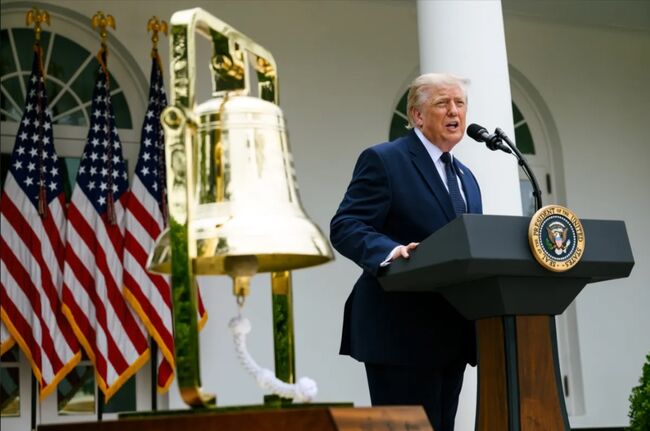
U.S. President Donald Trump. [Photo = The White House] U.S. President Donald Trump once again pressured the Federal Reserve, the U.S. central bank, to lower interest rates on the 27th (local time
Trump pressures for rate cut again ahead of FOMC... "Should be the lowest in the world"
U.S. President Donald Trump. [Photo = The White House] U.S. President Donald Trump once again pressured the Federal Reserve, the U.S. central bank, to lower interest rates on the 27th (local time
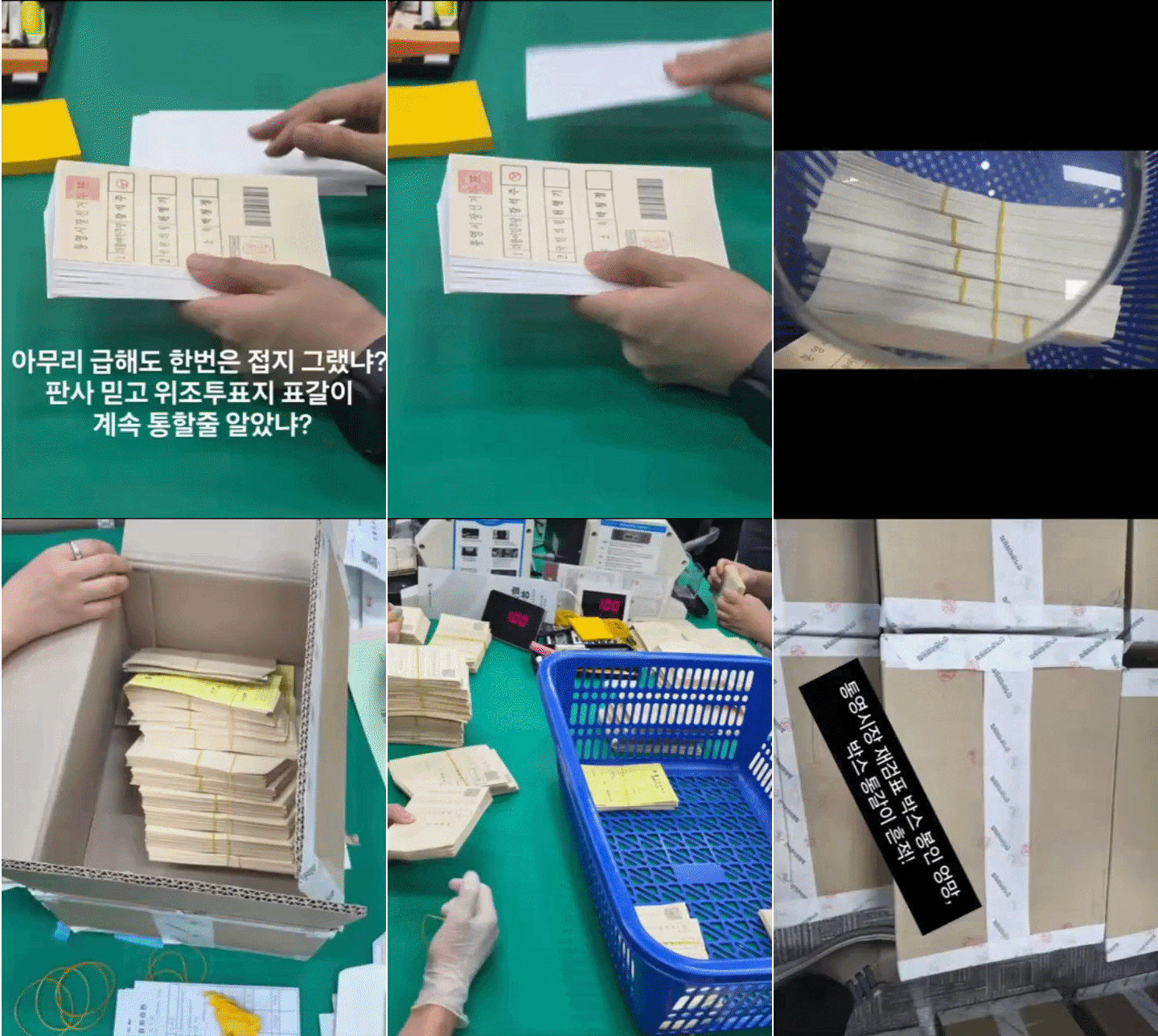 “Ignoring crisp ballots and damaged seals”… Tongyeong mayoral recount concludes with ‘no change in outcome,’ leaving suspicions and public outrage behind
Suspected counterfeit ballots discovered in Tongyeong [GIF from social media of Representative Hwang Kyo-ahn / Attorney Park Joo-hyun]During a recount of the Tongyeong mayoral election in South Gyeong
“Ignoring crisp ballots and damaged seals”… Tongyeong mayoral recount concludes with ‘no change in outcome,’ leaving suspicions and public outrage behind
Suspected counterfeit ballots discovered in Tongyeong [GIF from social media of Representative Hwang Kyo-ahn / Attorney Park Joo-hyun]During a recount of the Tongyeong mayoral election in South Gyeong
 President Yoon, regarding the first-instance ruling on the Public Official Election Act: “An excessive political verdict that distorts the facts… We will appeal immediately.”
The first-instance sentencing hearing for President Yoon Suk Yeol regarding violations of the Public Official Election Act is being broadcast live at Seoul Station on the 27th. [Photo=Yonhap News]Pres
President Yoon, regarding the first-instance ruling on the Public Official Election Act: “An excessive political verdict that distorts the facts… We will appeal immediately.”
The first-instance sentencing hearing for President Yoon Suk Yeol regarding violations of the Public Official Election Act is being broadcast live at Seoul Station on the 27th. [Photo=Yonhap News]Pres
 WSJ: "SK Hynix ADR Premium Is a Sign of AI Trading Overheat"
Advertisement for SK Hynix ADR listing in New York's Times Square [Reuters=Yonhap News file photo]The Wall Street Journal (WSJ) has pointed out that the price of SK Hynix’s American Depositary Recei
WSJ: "SK Hynix ADR Premium Is a Sign of AI Trading Overheat"
Advertisement for SK Hynix ADR listing in New York's Times Square [Reuters=Yonhap News file photo]The Wall Street Journal (WSJ) has pointed out that the price of SK Hynix’s American Depositary Recei
 'Godfather of Japanese Mystery Novels' Keigo Higashino Passes Away After Battle with Cancer at 68
Famous Japanese mystery novelist Keigo Higashino [AFP=Yonhap News]It has been belatedly reported that Keigo Higashino, the "godfather of Japanese mystery novels" and author of bestsellers such as "The
'Godfather of Japanese Mystery Novels' Keigo Higashino Passes Away After Battle with Cancer at 68
Famous Japanese mystery novelist Keigo Higashino [AFP=Yonhap News]It has been belatedly reported that Keigo Higashino, the "godfather of Japanese mystery novels" and author of bestsellers such as "The
 [Park Pil-kyu Security Column] To the Ignorant Trying to Clothe a Beast in Sheep's Clothing
Rep. Kim Byung-joo of the Democratic Party of Korea [Photo=Yonhap News]“The Air Force Academy doesn't teach you how to fly a plane!” “The Army, Navy, and Air Force academies are exactly the
[Park Pil-kyu Security Column] To the Ignorant Trying to Clothe a Beast in Sheep's Clothing
Rep. Kim Byung-joo of the Democratic Party of Korea [Photo=Yonhap News]“The Air Force Academy doesn't teach you how to fly a plane!” “The Army, Navy, and Air Force academies are exactly the
 [Issue Diagnosis] Two Effects of the Election Petition Review
 [Photo] Evidence of Election Fraud Flooding U.S. Media… Trump Had 2.7 Million Votes Stolen
 [Video] U.S. Semiquincentennial Air Show... 'Art in the Sky' streaks across New York
 [Editorial Cartoon] A Draconian Law That Undermines Freedom of Expression

 List
List