- Considering the reason for non-compliance with the trade agreement, are they now expanding the scope of retaliation following the review of troop reduction for US Forces Korea?
Korea, competing with the EU for the US market, may have an advantage for now, but it's difficult to be complacent.
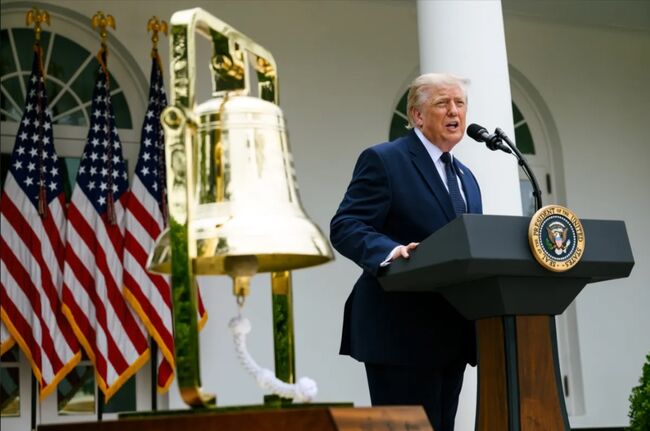
 U.S. President Donald Trump [UPI Yonhap News]
U.S. President Donald Trump announced on the 1st (local time) that he would increase tariffs on EU-made passenger cars and trucks to 25% starting next week.
Trump wrote on his social media platform Truth Social on the same day, "Based on the fact that the EU is not complying with the trade agreement that we have fully agreed upon, I am pleased to announce that I will be increasing the tariffs imposed on the EU for passenger cars and trucks entering the United States next week."
He added, "The tariff rate will rise to 25%."
President Trump also stated, "It is fully understood and agreed that no tariffs will be imposed if they (the EU) produce passenger cars and trucks in American factories."
In January of last year, President Trump, upon launching his second term administration, imposed a 25% ad valorem tariff on imported automobiles starting April 3rd of the previous year. Consequently, EU-made automobiles imported into the United States were subject to a total tariff of 27.5%, including the base tariff of 2.5%.
A day earlier, on April 2nd of the previous year, President Trump had announced a 20% reciprocal tariff (differentiated tariff by economic entity) on the EU.
In response, both the United States and the EU entered into negotiations for a new trade agreement. The tariffs were significantly lowered when President Trump and Ursula von der Leyen, President of the European Commission, met in Scotland on July 27th of the previous year and reached a trade agreement.
At that time, the agreement stipulated that the EU would purchase $750 billion worth of American energy and military equipment and invest an additional $600 billion in the U.S., in exchange for the U.S. lowering reciprocal tariffs on the EU to 15% and uniformly reducing ad valorem tariffs on items such as automobiles to 15%.
Ultimately, President Trump's announcement on this day signifies his intention to restore the ad valorem tariffs on EU-made passenger cars and trucks to their pre-trade agreement level by increasing them by 10 percentage points from 15%.
The sudden announcement of President Trump's tariff increase policy is interpreted as being related to his expressed dissatisfaction with the lack of cooperation from major European allies amid the ongoing war with Iran.
The relationship between the United States and NATO European member states was strained, as President Trump expressed considerable disappointment, stating he would "remember" that major member states of the North Atlantic Treaty Organization (NATO), a military alliance between the United States and its Western European allies, had refused his request to dispatch warships to the Strait of Hormuz and had not permitted the use of some European military bases for U.S. and Israeli aircraft.
Earlier, President Trump had also stated on the 29th of last month that he was considering reducing the number of U.S. troops stationed in Germany.
Following President Trump's announcement on this day, the EU is expected to be at a disadvantage in competing with Japanese and Korean companies, which are still subject to a 15% tariff in the U.S. auto market for the time being.
However, there are also views that it is too early to be reassured by President Trump's "indirect" retaliatory measures through tariffs, given that Japan and South Korea also did not actively respond to President Trump's requests for assistance.
What do you think of this article?

 Trump pressures for rate cut again ahead of FOMC... "Should be the lowest in the world"
U.S. President Donald Trump. [Photo = The White House] U.S. President Donald Trump once again pressured the Federal Reserve, the U.S. central bank, to lower interest rates on the 27th (local time
Trump pressures for rate cut again ahead of FOMC... "Should be the lowest in the world"
U.S. President Donald Trump. [Photo = The White House] U.S. President Donald Trump once again pressured the Federal Reserve, the U.S. central bank, to lower interest rates on the 27th (local time
 “Ignoring crisp ballots and damaged seals”… Tongyeong mayoral recount concludes with ‘no change in outcome,’ leaving suspicions and public outrage behind
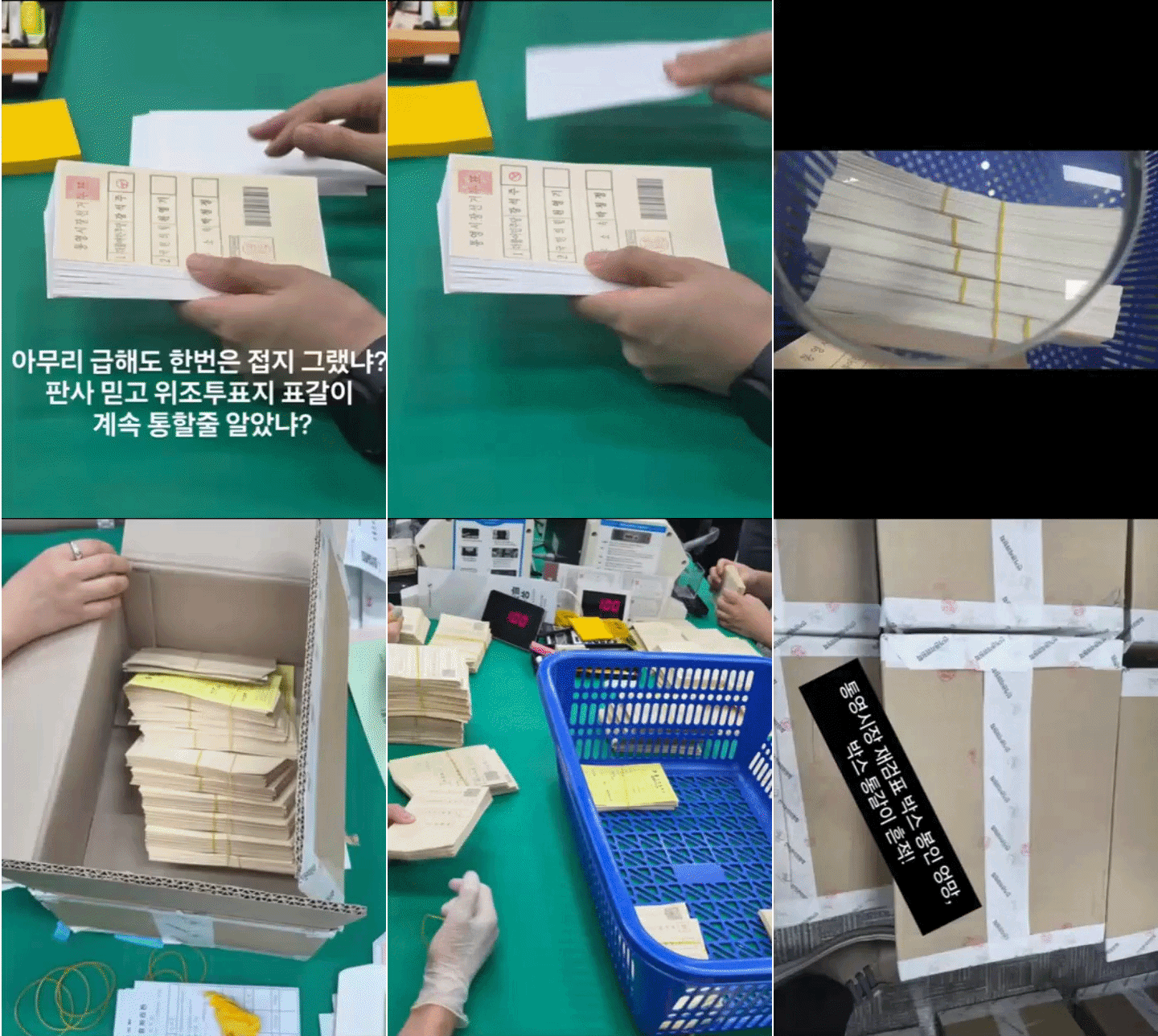
Suspected counterfeit ballots discovered in Tongyeong [GIF from social media of Representative Hwang Kyo-ahn / Attorney Park Joo-hyun]During a recount of the Tongyeong mayoral election in South Gyeong
“Ignoring crisp ballots and damaged seals”… Tongyeong mayoral recount concludes with ‘no change in outcome,’ leaving suspicions and public outrage behind
Suspected counterfeit ballots discovered in Tongyeong [GIF from social media of Representative Hwang Kyo-ahn / Attorney Park Joo-hyun]During a recount of the Tongyeong mayoral election in South Gyeong
 President Yoon, regarding the first-instance ruling on the Public Official Election Act: “An excessive political verdict that distorts the facts… We will appeal immediately.”
The first-instance sentencing hearing for President Yoon Suk Yeol regarding violations of the Public Official Election Act is being broadcast live at Seoul Station on the 27th. [Photo=Yonhap News]Pres
President Yoon, regarding the first-instance ruling on the Public Official Election Act: “An excessive political verdict that distorts the facts… We will appeal immediately.”
The first-instance sentencing hearing for President Yoon Suk Yeol regarding violations of the Public Official Election Act is being broadcast live at Seoul Station on the 27th. [Photo=Yonhap News]Pres
 WSJ: "SK Hynix ADR Premium Is a Sign of AI Trading Overheat"
Advertisement for SK Hynix ADR listing in New York's Times Square [Reuters=Yonhap News file photo]The Wall Street Journal (WSJ) has pointed out that the price of SK Hynix’s American Depositary Recei
WSJ: "SK Hynix ADR Premium Is a Sign of AI Trading Overheat"
Advertisement for SK Hynix ADR listing in New York's Times Square [Reuters=Yonhap News file photo]The Wall Street Journal (WSJ) has pointed out that the price of SK Hynix’s American Depositary Recei
 'Godfather of Japanese Mystery Novels' Keigo Higashino Passes Away After Battle with Cancer at 68
Famous Japanese mystery novelist Keigo Higashino [AFP=Yonhap News]It has been belatedly reported that Keigo Higashino, the "godfather of Japanese mystery novels" and author of bestsellers such as "The
'Godfather of Japanese Mystery Novels' Keigo Higashino Passes Away After Battle with Cancer at 68
Famous Japanese mystery novelist Keigo Higashino [AFP=Yonhap News]It has been belatedly reported that Keigo Higashino, the "godfather of Japanese mystery novels" and author of bestsellers such as "The
 [Park Pil-kyu Security Column] To the Ignorant Trying to Clothe a Beast in Sheep's Clothing
Rep. Kim Byung-joo of the Democratic Party of Korea [Photo=Yonhap News]“The Air Force Academy doesn't teach you how to fly a plane!” “The Army, Navy, and Air Force academies are exactly the
[Park Pil-kyu Security Column] To the Ignorant Trying to Clothe a Beast in Sheep's Clothing
Rep. Kim Byung-joo of the Democratic Party of Korea [Photo=Yonhap News]“The Air Force Academy doesn't teach you how to fly a plane!” “The Army, Navy, and Air Force academies are exactly the
 [Issue Diagnosis] Two Effects of the Election Petition Review
 [Photo] Evidence of Election Fraud Flooding U.S. Media… Trump Had 2.7 Million Votes Stolen
 [Video] U.S. Semiquincentennial Air Show... 'Art in the Sky' streaks across New York
 [Editorial Cartoon] A Draconian Law That Undermines Freedom of Expression

 List
List









