- To strengthen U.S. food security and national security, block land acquisition by individuals and companies of adversarial nations such as China and Russia.

The U.S. House of Representatives passed a bill on April 29th (local time) that strictly prohibits foreign adversarial forces from owning or purchasing agricultural land within the United States.
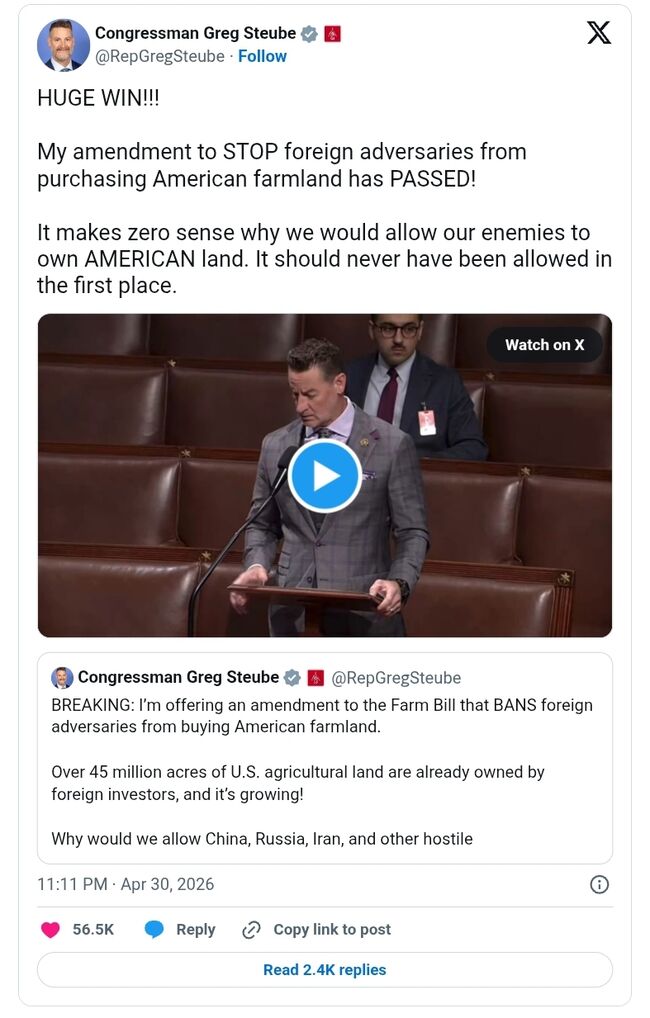
This measure was enacted after the 'Farm, Food, and National Security Act of 2026 (H.R. 7567),' which included an amendment proposed by Representative Greg Steube (Republican, Florida), was finally passed by the House plenary session.
The core of the passed 'Steube Amendment' is to establish a legal basis to prevent individuals or legal entities linked to 'Foreign Adversaries' that threaten U.S. national security, such as China, Russia, North Korea, and Iran, from acquiring U.S. agricultural land.
In a statement immediately following the bill's passage, Representative Greg Steube emphasized, "The encroachment of American farmland by foreign adversaries is not just a real estate transaction but a significant challenge to national security. This amendment will serve as a strong defense to protect our food supply chain and prevent adversarial forces from expanding their influence within U.S. territory."
According to the passed bill, companies owned by adversarial forces or individuals acting on their behalf are prohibited from newly purchasing or leasing agricultural land in the U.S. Furthermore, by redefining the agricultural sector as 'critical infrastructure' of the United States, any foreign investment will be subject to stricter scrutiny by the Committee on Foreign Investment in the United States (CFIUS).
Experts analyze this bill as a response, in particular, to China's increasing ownership of U.S. farmland. In recent years, controversies over espionage and security threats have arisen as Chinese companies have purchased farmland near U.S. military bases. Therefore, this legislation is expected to have significant repercussions on future diplomatic relations and the international investment market.
This bill, which will be recorded as one of the strongest measures to restrict foreign land ownership in the history of U.S. agricultural policy, passed the House with 224 votes in favor and 200 against. It will now proceed to the Senate for deliberation and legislative procedures.
While a bipartisan consensus on farmland protection and countering China exists within the Senate, heated discussions are anticipated regarding the specific scope of regulation and any exceptions.
Legislation of this nature has already been pursued at the state level. Texas's SB17 and SB147 went into effect on September 1, 2025. These bills, however, exempt legal permanent residents and citizens from their scope. They also stipulate that foreigners holding a valid U.S. visa may purchase residential real estate for their primary residence but not for investment purposes.
Florida's SB264 restricts citizens of 'countries of concern,' including China, from purchasing property near critical infrastructure or agricultural land, and includes provisions for imprisonment or heavy fines for violations.
At least 13 states have introduced or are considering legislation to restrict foreign ownership of land used for agriculture.
U.S. NNP=Chief Reporter Sung Ku Hong / Special Dispatch NNP info@newsandpost.com
What do you think of this article?

 Trump pressures for rate cut again ahead of FOMC... "Should be the lowest in the world"
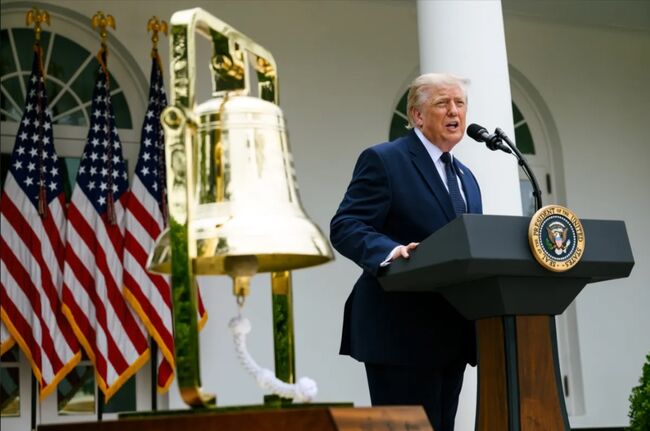
U.S. President Donald Trump. [Photo = The White House] U.S. President Donald Trump once again pressured the Federal Reserve, the U.S. central bank, to lower interest rates on the 27th (local time
Trump pressures for rate cut again ahead of FOMC... "Should be the lowest in the world"
U.S. President Donald Trump. [Photo = The White House] U.S. President Donald Trump once again pressured the Federal Reserve, the U.S. central bank, to lower interest rates on the 27th (local time
 “Ignoring crisp ballots and damaged seals”… Tongyeong mayoral recount concludes with ‘no change in outcome,’ leaving suspicions and public outrage behind
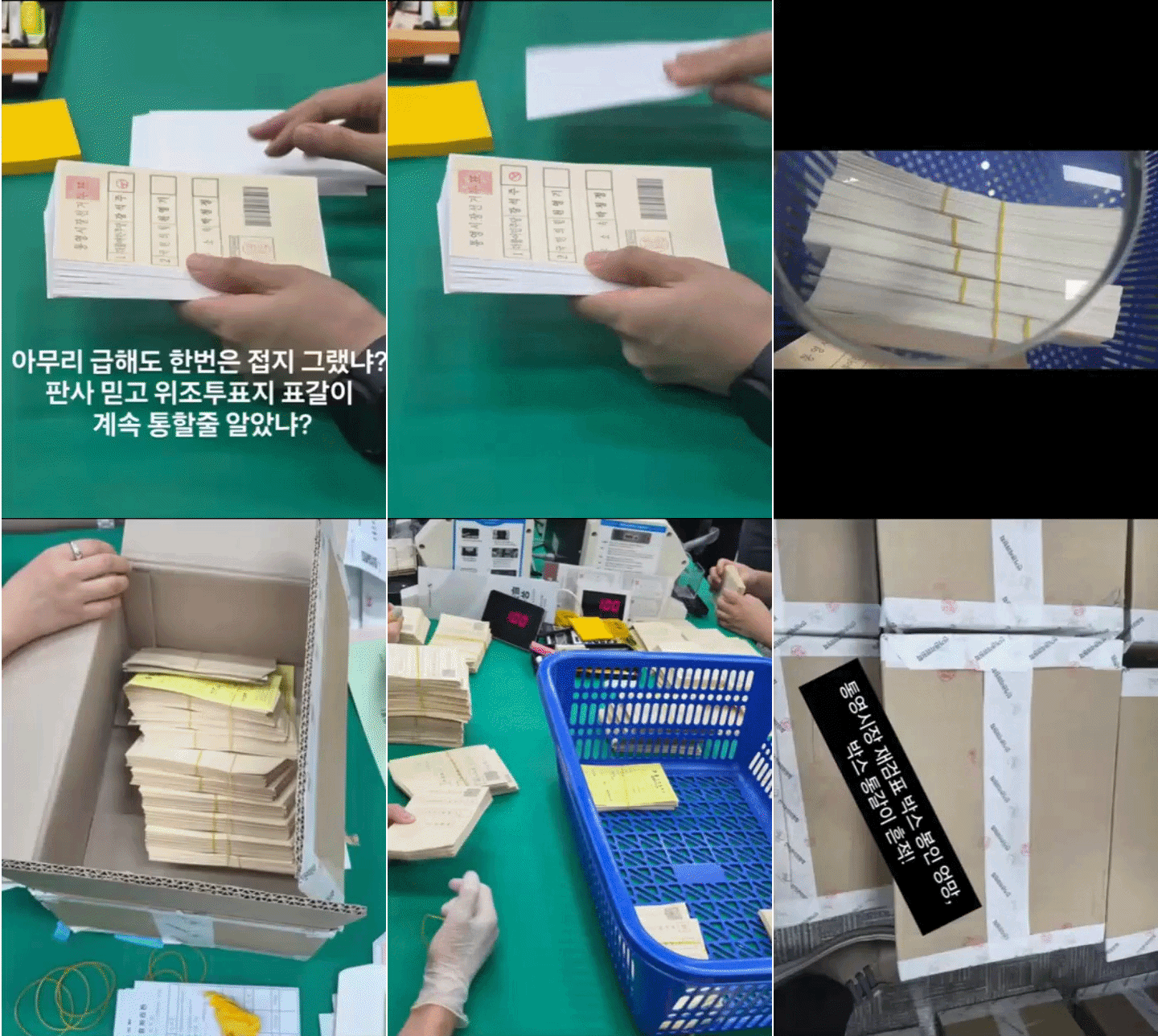
Suspected counterfeit ballots discovered in Tongyeong [GIF from social media of Representative Hwang Kyo-ahn / Attorney Park Joo-hyun]During a recount of the Tongyeong mayoral election in South Gyeong
“Ignoring crisp ballots and damaged seals”… Tongyeong mayoral recount concludes with ‘no change in outcome,’ leaving suspicions and public outrage behind
Suspected counterfeit ballots discovered in Tongyeong [GIF from social media of Representative Hwang Kyo-ahn / Attorney Park Joo-hyun]During a recount of the Tongyeong mayoral election in South Gyeong
 President Yoon, regarding the first-instance ruling on the Public Official Election Act: “An excessive political verdict that distorts the facts… We will appeal immediately.”
The first-instance sentencing hearing for President Yoon Suk Yeol regarding violations of the Public Official Election Act is being broadcast live at Seoul Station on the 27th. [Photo=Yonhap News]Pres
President Yoon, regarding the first-instance ruling on the Public Official Election Act: “An excessive political verdict that distorts the facts… We will appeal immediately.”
The first-instance sentencing hearing for President Yoon Suk Yeol regarding violations of the Public Official Election Act is being broadcast live at Seoul Station on the 27th. [Photo=Yonhap News]Pres
 WSJ: "SK Hynix ADR Premium Is a Sign of AI Trading Overheat"
Advertisement for SK Hynix ADR listing in New York's Times Square [Reuters=Yonhap News file photo]The Wall Street Journal (WSJ) has pointed out that the price of SK Hynix’s American Depositary Recei
WSJ: "SK Hynix ADR Premium Is a Sign of AI Trading Overheat"
Advertisement for SK Hynix ADR listing in New York's Times Square [Reuters=Yonhap News file photo]The Wall Street Journal (WSJ) has pointed out that the price of SK Hynix’s American Depositary Recei
 'Godfather of Japanese Mystery Novels' Keigo Higashino Passes Away After Battle with Cancer at 68
Famous Japanese mystery novelist Keigo Higashino [AFP=Yonhap News]It has been belatedly reported that Keigo Higashino, the "godfather of Japanese mystery novels" and author of bestsellers such as "The
'Godfather of Japanese Mystery Novels' Keigo Higashino Passes Away After Battle with Cancer at 68
Famous Japanese mystery novelist Keigo Higashino [AFP=Yonhap News]It has been belatedly reported that Keigo Higashino, the "godfather of Japanese mystery novels" and author of bestsellers such as "The
 [Park Pil-kyu Security Column] To the Ignorant Trying to Clothe a Beast in Sheep's Clothing
Rep. Kim Byung-joo of the Democratic Party of Korea [Photo=Yonhap News]“The Air Force Academy doesn't teach you how to fly a plane!” “The Army, Navy, and Air Force academies are exactly the
[Park Pil-kyu Security Column] To the Ignorant Trying to Clothe a Beast in Sheep's Clothing
Rep. Kim Byung-joo of the Democratic Party of Korea [Photo=Yonhap News]“The Air Force Academy doesn't teach you how to fly a plane!” “The Army, Navy, and Air Force academies are exactly the
 [Issue Diagnosis] Two Effects of the Election Petition Review
 [Photo] Evidence of Election Fraud Flooding U.S. Media… Trump Had 2.7 Million Votes Stolen
 [Video] U.S. Semiquincentennial Air Show... 'Art in the Sky' streaks across New York
 [Editorial Cartoon] A Draconian Law That Undermines Freedom of Expression

 List
List









