 U.S. President Donald Trump (left) and German Chancellor Friedrich Merz [Photo=Yonhap News]
The abrupt declaration in May 2026 of a significant reduction in U.S. forces stationed in Germany is not merely an administrative order. It is a signal flare, heralding the end of the "Atlantic-centric security concept and the existing order that has underpinned the global order since 1945, and the dawn of new changes.
The Trump administration's decision is a tangible manifestation of a pragmatic security perspective that "security is no longer free," and it poses an unavoidable question not only to Europe but also to South Korea, an ally in the Indo-Pacific region. Will South Korea be spared?
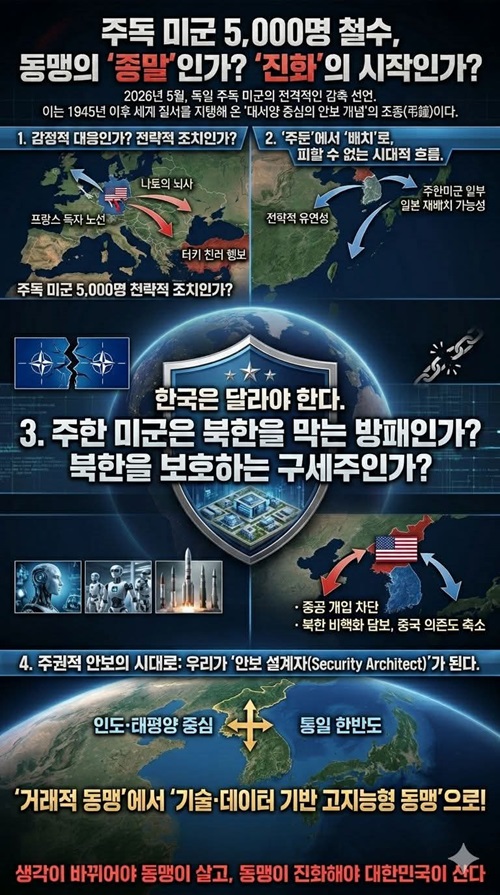
1. Withdrawal of Over 5,000 U.S. Troops from Germany: Emotional Reaction or Strategic Move?
Behind the U.S. Department of Defense's official announcement of the withdrawal of 5,000 U.S. troops from Germany (with potential for further increases depending on the situation) lies a political conflict with German Chancellor Merz. The U.S. had already judged that Germany was enjoying economic benefits under America's security umbrella without adhering to NATO's defense spending guidelines, and Germany's uncooperative stance on the Hormuz Strait deployment exacerbated the conflict.
The background of the conflict is multifaceted. Recently, the trend of some countries within NATO shifting towards pro-Islamic and anti-American sentiments, citing domestic Muslim population growth influencing votes and energy security, has pushed American patience to its limits. The "brain death of NATO," as evidenced by France's independent stance and Turkey's pro-Russian actions, has become a reality.
2. Shift in the Nature of U.S. Forces in Korea from "Stationed" to "Deployed"
The partial "punitive withdrawal" of U.S. forces from Germany carries significant implications for South Korea. It demonstrates that South Korea's reserved attitude towards deploying forces to the Hormuz Strait or difficulties in defense cost-sharing negotiations could at any time lead to the extreme measure of "redeployment of some U.S. forces in Korea to Japan." U.S. forces are stationed where needed and withdrawn for strategic reasons, but the specific strategic reasons are not always known.
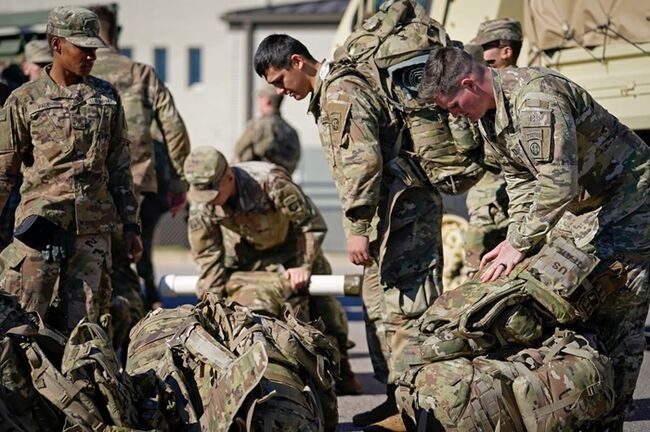 U.S. troops in Germany packing up. [Reuters=Yonhap News]
The current administration's declaration of "not relying on foreign forces" is closer to distorted anti-Americanism than to self-reliant defense. Such indirect statements inevitably complicate Pentagon calculations.
However, what is clear is that the global redeployment of U.S. forces to counter China is an inevitable trend of the times. The potential for a reduction in Germany's influence due to the partial withdrawal of U.S. forces there is a consequence of their failure in "security business negotiations" with the United States.
South Korea should seize the withdrawal of U.S. forces from Germany as an opportunity to strengthen the U.S. Forces Korea.
The U.S. may consider increasing the U.S. Forces Korea from the current 28,500 to 50,000 for "strategic flexibility," allowing immediate deployment to conflicts in the South China Sea or the Taiwan Strait, rather than confining them solely to the Korean Peninsula.
Conversely, if the current administration continues to adhere to anti-American and pro-China policies or responds with complacency, the U.S. may need to consider redeploying some forces from the Pyeongtaek base to Taiwan, Okinawa in Japan, or even Pyongyang. This is the "strategic uncertainty" we face, and if uncertainty becomes reality, the South Korean economy will experience significant volatility.
3. Are U.S. Forces in Korea a Shield Against North Korea or a Savior Protecting North Korea?
U.S. Forces Korea should now be redefined as "essential infrastructure protecting America's global supply chain and high-tech assets." The Pyeongtaek base should be transformed not merely into a military facility but into a "Global Defense Tech Valley" where American defense companies and South Korean AI companies collaborate.
When American companies' interests are deeply rooted in South Korean soil, Trump's business-oriented security perspective will paradoxically lead to the selection of South Korea as the safest base for their operations.
Changing our Perspective: U.S. Military Presence in Pyongyang as a Realistic Imagination
North Korea would also be well aware that if U.S. forces withdraw, China will directly intervene and turn North Korea into a vassal state. South Korea should be the first to propose a scenario to the U.S. and North Korea where some U.S. forces are stationed in Pyongyang. This could serve as a substantive guarantee for North Korea's denuclearization, a means to prevent North Korea's "subjugation by China," and a masterstroke to expand U.S. strategy deep into the Eurasian continent.
We need to formulate more audacious survival strategies and earth-shattering win-win strategies. By abandoning the fixed notion that U.S. Forces Korea must remain only "in the South," we can transform the crisis of U.S. troop redeployment into an opportunity to seize the initiative for a unified Korea.
4. Eradicating Anti-Americanism and Entering an Era of Sovereign Security
Sovereign security does not mean isolation, standing alone without U.S. forces. It means possessing the intellectual and strategic preparedness to "cooperate symbiotically" with U.S. forces in a direction that we desire.
The withdrawal of U.S. forces from Germany presents us with an opportunity to evolve from a "transactional alliance" to a "highly intelligent alliance based on technology and data."
South Korea must now become a "Security Architect" by transforming the Pyeongtaek base into a global MRO hub and an AI defense tech valley for the U.S. military, ensuring that American companies and military personnel generate substantial profits on South Korean soil.
Furthermore, if the U.S. achieves a decisive victory in the U.S.-China hegemonic war, the stationing of U.S. forces in Pyongyang will become a reality, not a radical fantasy. China will crumble, and we will seize the initiative for peaceful reunification.
If strategic thinking changes, the redeployment of U.S. forces will not be a crisis but a grand opportunity for the Korean Peninsula to soar from the edge of Eurasia to the center of the Indo-Pacific.
However, if we continue with the distorted anti-Americanism masquerading as self-reliant defense, as we are doing now, it will lead to irreversible disaster. Only by changing our mindset can the alliance survive, and only by evolving the alliance can South Korea survive.
We urge a forward-looking stance and a great awakening from the security leadership in the face of immutable truth.
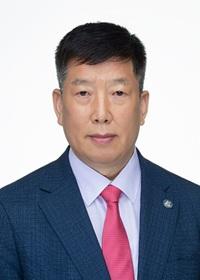
◆ Park Pil-kyu
Editor, Hankook Ilbo
40th Class, Korea Military Academy

 Iranian Foreign Ministry: "Continuing Message Exchanges with the U.S. and Activities of Mediating Countries"
Esmaeil Baghaei, Spokesperson for the Iranian Ministry of Foreign Affairs [Xinhua, Yonhap News file photo]Esmaeil Baghaei, spokesperson for the Iranian Ministry of Foreign Affairs, stated on the 26th
Iranian Foreign Ministry: "Continuing Message Exchanges with the U.S. and Activities of Mediating Countries"
Esmaeil Baghaei, Spokesperson for the Iranian Ministry of Foreign Affairs [Xinhua, Yonhap News file photo]Esmaeil Baghaei, spokesperson for the Iranian Ministry of Foreign Affairs, stated on the 26th
 President Yoon: "Do You Think You Are Safe from the Special Counsel?"... Final Statement Video Released
President Yoon Suk Yeol rebuking the special prosecutor on the 24th. [Court video / @birds_justice X account subtitle GIF] A video of President Yoon Suk Yeol's closing statement at his trial rega
President Yoon: "Do You Think You Are Safe from the Special Counsel?"... Final Statement Video Released
President Yoon Suk Yeol rebuking the special prosecutor on the 24th. [Court video / @birds_justice X account subtitle GIF] A video of President Yoon Suk Yeol's closing statement at his trial rega
 President Yoon, regarding the first-instance ruling on the Public Official Election Act: “An excessive political verdict that distorts the facts… We will appeal immediately.”
The first-instance sentencing hearing for President Yoon Suk Yeol regarding violations of the Public Official Election Act is being broadcast live at Seoul Station on the 27th. [Photo=Yonhap News]Pres
President Yoon, regarding the first-instance ruling on the Public Official Election Act: “An excessive political verdict that distorts the facts… We will appeal immediately.”
The first-instance sentencing hearing for President Yoon Suk Yeol regarding violations of the Public Official Election Act is being broadcast live at Seoul Station on the 27th. [Photo=Yonhap News]Pres
 WSJ: "SK Hynix ADR Premium Is a Sign of AI Trading Overheat"
Advertisement for SK Hynix ADR listing in New York's Times Square [Reuters=Yonhap News file photo]The Wall Street Journal (WSJ) has pointed out that the price of SK Hynix’s American Depositary Recei
WSJ: "SK Hynix ADR Premium Is a Sign of AI Trading Overheat"
Advertisement for SK Hynix ADR listing in New York's Times Square [Reuters=Yonhap News file photo]The Wall Street Journal (WSJ) has pointed out that the price of SK Hynix’s American Depositary Recei
 'Godfather of Japanese Mystery Novels' Keigo Higashino Passes Away After Battle with Cancer at 68
Famous Japanese mystery novelist Keigo Higashino [AFP=Yonhap News]It has been belatedly reported that Keigo Higashino, the "godfather of Japanese mystery novels" and author of bestsellers such as "The
'Godfather of Japanese Mystery Novels' Keigo Higashino Passes Away After Battle with Cancer at 68
Famous Japanese mystery novelist Keigo Higashino [AFP=Yonhap News]It has been belatedly reported that Keigo Higashino, the "godfather of Japanese mystery novels" and author of bestsellers such as "The
 [Park Pil-kyu Security Column] To the Ignorant Trying to Clothe a Beast in Sheep's Clothing
Rep. Kim Byung-joo of the Democratic Party of Korea [Photo=Yonhap News]“The Air Force Academy doesn't teach you how to fly a plane!” “The Army, Navy, and Air Force academies are exactly the
[Park Pil-kyu Security Column] To the Ignorant Trying to Clothe a Beast in Sheep's Clothing
Rep. Kim Byung-joo of the Democratic Party of Korea [Photo=Yonhap News]“The Air Force Academy doesn't teach you how to fly a plane!” “The Army, Navy, and Air Force academies are exactly the
 [Issue Diagnosis] Two Effects of the Election Petition Review
 [Photo] Evidence of Election Fraud Flooding U.S. Media… Trump Had 2.7 Million Votes Stolen
 [Video] U.S. Semiquincentennial Air Show... 'Art in the Sky' streaks across New York
 [Editorial Cartoon] A Draconian Law That Undermines Freedom of Expression

 List
List









