 From left to right in the back row: Keynes, Roosevelt, Stalin. Mao Zedong. In the front row: Lee Jae-myung. [AI Image]
President Lee Jae-myung recently put a definitive end to the extension of the capital gains tax surcharge grace period for owners of multiple homes, stating, "There is no government that can overcome the market, but there is also no market that can overcome the government."
During the 2022 presidential campaign, he also stated, "There is no government that can overcome the market, and no market that can go against government policy." He also claimed that there are countless means and methods to normalize the abnormal.
Remarks on Regulatory Omnipotence and Communist Ideology are Dangerous
He likely wanted to explicitly state, "There is no market that can overcome the government," but he made these calculated remarks to avoid controversy over potential infringements on the free market economy. This reveals that Lee Jae-myung possesses a belief in regulatory omnipotence, capable of regulating everything, which goes beyond Keynes's modified capitalism, and embodies communist philosophy.
It is not surprising, given his alleged association with the경기동부연합 (Gyeonggi Eastern Alliance), a stronghold of Juche ideology linked to Lee Seok-ki, and his continued association with Kim Hyun-ji, a comrade of unknown affiliation for decades, that Lee Jae-myung makes such statements.
Pro-North Korean leftists are those who follow North Korea's communist ideology and pursue a North Korean-style dictatorial people's democracy, not liberal democracy.
After securing a majority of seats in the National Assembly through an election with allegations of fraudulent voting, they are forcefully pushing for constitutional amendments to include the May 18th Gwangju Uprising in the preamble. Furthermore, not content with delaying the numerous trials pending against Lee Jae-myung for various criminal charges, including the illegal remittance of $8 million by Ssangbangul to North Korea for Lee Jae-myung's visit and violations of the Public Official Election Act, they are abusing legislative power through various legislative actions, parliamentary investigations, and the introduction of special prosecutors to pressure the court to withdraw the indictments in the pending cases. This is all to obstruct the trials of Lee Jae-myung, who has been convicted four times previously.
Despite the Supreme Court's ruling to overturn and remand the case concerning Lee Jae-myung's violation of the Public Official Election Act, he does not concede and instead pressures the Chief Justice Cho Hee-dae to resign, demanding a confirmation hearing and a special prosecution. To eliminate Lee Jae-myung's legal risks, they are pushing for dictatorial and communist policies that undermine democracy by misusing legislative power through the "Judicial Three Laws" (Court Review of Disposed Cases, Law Distortion Offense, and Increase in Supreme Court Justices), thereby destroying democracy using democracy itself.
Through amendments to the Broadcasting Act, they are attempting to control the media. Through real estate policies that severely infringe upon private property rights, and the arrest of Pastor Son Hyun-bo and Korea Communications Commission Chairman Lee Jin-suk, they are suppressing religion and ideology. These are actions that would be seen in a North Korean communist collective. The impeachment of President Park Geun-hye on charges of state affairs manipulation and the impeachment of President Yoon Suk-yeol on grounds of martial law and inciting rebellion are all results of the Democratic Party's propaganda and intimidation of the judiciary.
The reduction and suspension of joint ROK-US military exercises, the search and seizure of Osan Air Base, and remarks about North Korea's high-enriched uranium facilities have provoked official protests from the United States, leading to a halt in information sharing between the ROK and the US regarding North Korea, thus collapsing the ROK-US alliance. They are also reducing the frontline General Outpost (GOP) border patrol forces from the current 22,000 to 6,000. Furthermore, they argue that claims that South Korea, ranked fifth in military power by the American civilian website GFP (which is not even accounting for North Korea's nuclear weapons and is based on uncertain evidence), cannot defend itself without foreign military support are unacceptable.
All actions by Lee Jae-myung and the Democratic Party, such as undermining South Korea's defense posture through the hasty transition of wartime operational control, are in agreement with North Korea's demand for the withdrawal of US forces from Korea and constitute crimes of treason and foreign exchange violations. Anti-Americanism, anti-imperialism, and independent reunification are the three main tenets of the pro-North Korean Juche ideology. This has been the consistent South Korean policy of the North Korean communist regime since Kim Il-sung's era, aiming to isolate South Korea and achieve reunification through force after separating it from the United States and Japan.
'Economic Ignorance' is as Dangerous as the Philosophy of Regulatory Omnipotence
Lee Jae-myung's philosophy of regulatory omnipotence, which asserts that the government can overcome the market, is as dangerous as his ignorance of economics. He advocates for the introduction of unverified universal basic income, claims that South Korea has a high probability of being included among countries with reserve currencies, and suggests that the economy will revive if money circulates even if hotel reservations are canceled. His statements reveal a profound ignorance, to the point where he seems unaware of what he is saying.
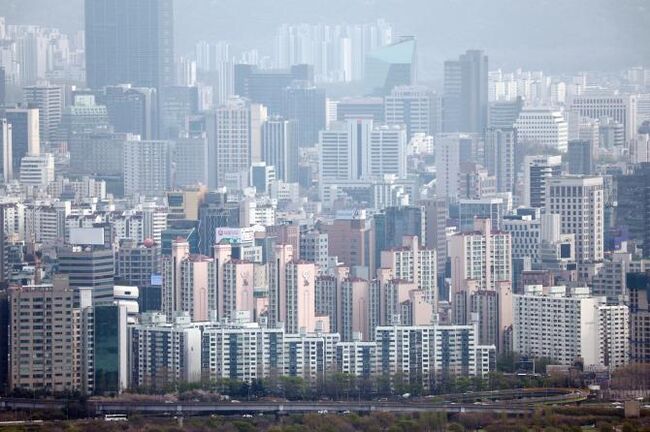 Following the Moon Jae-in administration's Rental Property Three Laws, regulations have led to more regulations. Despite 28 different measures and legislative actions during the Moon Jae-in administration's five-year term, real estate prices have doubled. [Photo=Yonhap News]
Unlike Lee Jae-myung, who is ruining the South Korean economy with his superficial economic knowledge and outdated leftist ideology, President Chun Doo-hwan, who has been demonized by pro-North Korean leftists since the enactment of the May 18th Special Act by Kim Young-sam, referred to Kim Jae-ik, the Senior Economic Secretary, as the "Economic President." He listened to the advisors and businessmen, and despite numerous difficulties and opposition, he contributed to the development of the nuclear power and semiconductor industries, as well as price stability and economic growth.
Despite the soaring real estate prices caused by the Moon Jae-in administration's relentless real estate regulation policies, Lee Jae-myung, with the bravado born of ignorance and arrogance, asserts that "no government can overcome the market" and that "there are countless means and methods," attempting to suppress the market through various regulations, taxes, and interest rate policies.
What the leftist governments of Roh Moo-hyun and Moon Jae-in demonstrated is short-term success through government regulation followed by the market's long-term victory. Unless South Korea adopts a communist system like China or North Korea, regulations created by a few hundred people, such as Lee Jae-myung, Democratic Party members, and public officials, cannot overcome the desires and strategies of tens of millions of market participants.
Following the Rental Property Three Laws of the Moon Jae-in administration, regulations have led to more regulations. Despite 28 different measures and legislative actions during the Moon Jae-in administration's five-year term, real estate prices have doubled.
If rising real estate prices are considered unearned income, is the capital gains from stock sales earned income? Whether it's real estate or stocks, they want to deny the free market economy, but since they cannot do so explicitly, they adopt a strategy of targeting only one victim, thus attacking the easily manageable real estate market.
Economics is about supply and demand. The solution is to find ways to increase supply where there is demand. However, by blocking redevelopment and reconstruction in Seoul, where demand is high, and building houses in the outskirts where people don't live, and by trying to suppress the real estate market through various regulations, taxes, and interest rate policies, they are engaged in futile efforts, yet Seoul apartment prices do not fall.
The Severe Harm of Militant Labor Unions Requires Labor Flexibility
In his Labor Day address, Lee Jae-myung, emphasizing his background as a child laborer, stated that workers are the main drivers of South Korea's development, that all workers should enjoy basic labor rights, that workers should not be forced into unilateral sacrifices solely for productivity improvement, and that he will create a normal country where workers do not have to risk death.
This sounds like a scene from student protests in the 1970s and 80s. The Democratic Party and pro-North Korean leftists are not progressives. They are regressive, stubborn, pro-North Korean leftists with minds stuck in the past, who were brainwashed in their ignorant student days decades ago and have failed to continuously update their thinking to match the changing times through reading and contemplation.
The current South Korea is not a country where workers' human rights or basic rights are a problem. Instead, due to excessively strong labor unions created by decades of leftist governments' pro-union, anti-corporate laws, South Korea has become a country that foreign investors avoid, and domestic companies are increasingly increasing their foreign investments.
We are at a point where corporate growth is being hindered, and unemployment is being generated, leading to concerns about economic collapse, due to anti-corporate laws and regulations from leftist governments that are strangling the South Korean economy. These include amendments to the Commercial Act, the Yellow Envelope Act, the Serious Accidents Punishment Act, the risk of governance due to excessive inheritance tax burdens, and the guaranteed iron rice bowls of aristocratic labor unions that disregard youth unemployment.
With the sharp increase in operating profits due to the semiconductor super-cycle, Samsung Electronics' union has announced a strike warning, demanding tens of trillions of won in performance bonuses. This trend is spreading to the bio-industry, such as Samsung Biologics, and other sectors.
If the funds for research and development investment and the acquisition of excellent research personnel are distributed in a communal manner to production line employees, as in communist equal distribution, advanced industries like semiconductors will lose their international competitiveness, employees will lose their jobs, and they will not even receive their monthly wages, let alone performance bonuses.
Even when SK Hynix recorded trillions of won in losses due to the semiconductor market downturn, it succumbed to union pressure and paid out bonuses. Large corporations and public enterprise unions have become "super-갑" (super-powers), interfering not only with wage increases and union member welfare demands but also with personnel and management rights.
This is due to labor laws that do not allow for labor flexibility. The current labor laws, which prohibit dismissal except for urgent business reasons, only enrich the aristocratic labor unions of large corporations, directed by the pro-North Korean Minjoo Labor Union, which represents only 10% of all workers in South Korea. The vast majority of other workers and young job seekers are marginalized.
Before talking about workers' basic rights, Lee Jae-myung should focus on legislative efforts that guarantee labor flexibility, the dismantling of various regulations to allow companies to freely hire and dismiss, and breaking the iron rice bowls of aristocratic labor unions to enable technological innovation.
The Limitations of Communist Systems as History Shows
The reason for America's rise as a superpower was the Taft-Hartley Act of 1947, which limited union power, and labor laws that allowed companies to hire and fire without special reasons, thereby opening the door for technological innovation. In systems that guarantee iron rice bowls and equal income and performance bonuses, there is no drive for effort or innovation. This is why the communist regimes of the Soviet Union and Eastern Europe collapsed.
The Industrial Revolution in 18th-century England, characterized by low wages, widespread worker exploitation, and human rights abuses, was the backdrop for the birth of Marxist communist theory. The first communist regime was established with Lenin's Russian Revolution in 1917.
The Great Depression in the United States in 1929 led to widespread skepticism about market economies and liberal democracy. Roosevelt, who won the presidential election in 1932, introduced Keynesian modified capitalism and intensified government intervention in the market, citing the Great Depression as the reason.
Roosevelt, who was even criticized as a communist, introduced the New Deal, Social Security Act, and labor laws. He also facilitated the forced internment of hundreds of thousands of Japanese Americans, provided unlimited economic aid to Stalin's Soviet communist regime during World War II, and allowed Soviet troops to enter North Korea after the withdrawal of German forces from Eastern Europe occupied by Hitler and Japanese forces after the war, thus aiding the international spread of Soviet communism.
Keynes argued that the Great Depression, which hit hard in the 1930s, could be overcome through modified capitalism, based on his "effective demand theory." This theory emphasized demand creation through active fiscal and monetary policies, leading to government intervention in the market, expansion of welfare, and demand creation, thereby abandoning laissez-faire.
"The central control, necessary to achieve full employment, will involve a great expansion of the traditional functions of government. I assume that the state will have to exercise an extended control over many departments of economic activity. If our central control is of the correct type and my assertion is correct that it can be directed to the achievement of full employment, it will be in its turn a new technique of the state. The classical theory...will return to its own province." (Translated by Jo Soon, John Maynard Keynes, 'The General Theory of Employment, Interest and Money')
Keynes's modified capitalism failed to work during the global economic crisis caused by the oil shock in the 1970s, leading to the emergence of Milton Friedman's neoliberalism.
Friedman argued that the Great Depression of the 1930s was not a failure of the market but a result of excessive monetary tightening by the Federal Reserve. He criticized the Fed's persistent focus on targeting the money supply and controlling inflation with high interest rates, suggesting that the Fed's prolonged monetary tightening turned a short economic downturn into the Great Depression.
The Fed's excessive tightening policies, driven by concerns about the rise in the value of real assets like stocks and real estate and excessive bank lending, fueled a collapse in asset values, an economic downturn, and the bankruptcy of banks and corporations, thus initiating the Great Depression.
"Full employment and economic growth have been the main excuses for increasing government intervention in economic problems over the past decades. This claim is entirely misleading. The Great Depression, like most other periods of severe unemployment, was not caused by the inherent instability of the private economy but by government failures.
The Federal Reserve, an institution established by the government at the time, was responsible for monetary policy. However, in 1930 and 1931, the Federal Reserve performed monetary policy so outrageously poorly that it turned what should have been a minor economic contraction into a catastrophe.
Similarly, today, government policies are the primary obstacles to American economic growth. Tariffs and other international trade regulations, high tax burdens and a complex and unfair tax structure, various regulatory agencies, government price and wage controls, and numerous other policies incentivize individuals to misuse resources and distort investment in new savings. What we urgently need for economic stability and growth is not an expansion of government intervention, but a reduction." (Translated by Shim Jun-bo, Byun Dong-yeol, Milton Friedman, 'Capitalism and Freedom')
In his 1931 essay "Economic Possibilities for Our Grandchildren," Keynes predicted that by 2030, a century later, the global economy would grow four to eightfold. He envisioned that people, having met their basic needs, would be freed from economic activities for wealth accumulation, and with reduced desire for additional consumption, a 15-hour workweek would be sufficient, allowing them to enjoy leisure and artistic activities in abundance.
However, despite becoming much wealthier and experiencing increased income due to technological innovation, people maintain a high propensity to consume and work long hours. In Keynes's era, the poor worked longer hours to support their families, while the wealthy, like landlords and capitalists, had leisure time.
"However, in the latter half of the 20th century, over the past 50 years, this inverse relationship between hourly wages and working hours has been reversed, at least in the United States. Workaholic rich people have taken the place of the leisured rich, and those who are highly paid now work longer hours than those who are paid less." (Translated by Kim Sung-ah, Lorenzo Pecchi et al., 'Revisiting Keynes')
The motivation for work is not solely about livelihood and wealth accumulation, but also about innovation for achievement and self-realization. This is why Joseph Schumpeter and Milton Friedman's neoliberalism, which emphasizes demand creation through innovation and free market economies in the late 20th century, emerged.
Keynesian modified capitalism, while believing in capitalism, is characterized by an ambivalence stemming from an inability to fully shed the illusions of Marxism and Leninism. This is evident in Keynes's writings after his trip to Stalin's Soviet Union in 1925, published in 'The Nation.'
"It feels like a laboratory of the real thing, despite its poverty, stupidity, and oppression." (Translated by Kim Sung-ah, Lorenzo Pecchi et al., 'Revisiting Keynes')
Keynes and Roosevelt, and others on the left, clung to communism because they were unaware of the reality of Soviet communism, manipulated by Stalin's control of the media and propaganda.
After Lenin's death in 1924, Stalin, after a power struggle that eliminated rivals like Trotsky, succeeded in modernizing the Soviet Union through the introduction of collective farms and industrialization.
However, in order to achieve economic development goals, millions of peasants died of starvation as agricultural products from collective farms were exported to fund industrialization. Millions more lost their lives due to ruthless purges.
Roosevelt was a primary contributor to the growth and spread of Stalin's Soviet communism, and Nixon and Kissinger were the primary contributors to the rise of the Chinese Communist Party regime.
While Roosevelt had Alger Hiss, a Soviet communist spy, as his foreign policy advisor, Nixon had Kissinger, a cunning and unprincipled individual known as a "long-time friend of the Chinese people."
At a time when Mao Zedong's Great Leap Forward and the Cultural Revolution led to the deaths of tens of millions and the decline of Chinese communism, Nixon emerged. Under the pretext of countering Soviet communism and ending the Vietnam War, he held a summit with Mao Zedong, leading to the normalization of relations between the US and China. Subsequently, the US emerged as the savior of a declining China.
After Mao Zedong's death in 1976, Deng Xiaoping came to power and succeeded in industrializing and modernizing China through reform and opening up, symbolized by his "hide your strength, bide your time" and "black cat, white cat" philosophies.
President Syngman Rhee and General MacArthur's Foresight
After North Korea's invasion of the South in 1950 triggered the Korean War, Syngman Rhee and MacArthur advocated for a full-scale war with China when the Chinese People's Volunteer Army intervened. MacArthur traveled to Taiwan to meet with Chiang Kai-shek, who had been driven to Taiwan after his defeat in the Chinese Civil War a year earlier. They agreed to launch a full-scale war against China with the combined forces of Chiang Kai-shek's 600,000 Nationalist troops and the US military.
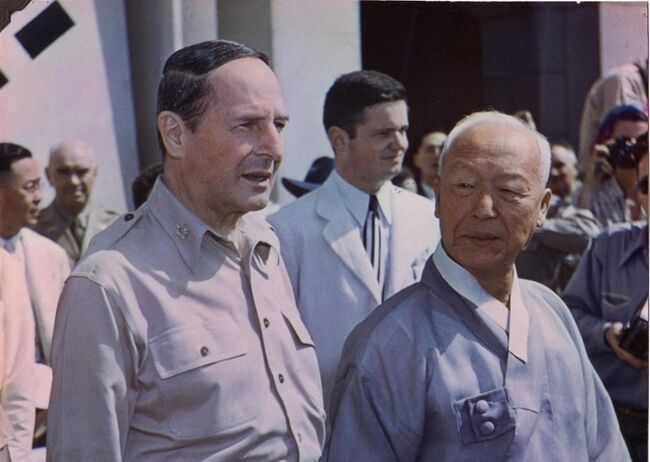 General MacArthur (left) and President Syngman Rhee attend the ceremony commemorating the establishment of the Republic of Korea government on August 15, 1948. [Photo=MacArthur Memorial]
Syngman Rhee and MacArthur warned that if the Chinese Communist regime was not collapsed in its early stages, the United States and liberal nations would face a difficult struggle against a greatly strengthened Chinese Communist Party in the future. The current new Cold War dynamic between the US and China is a consequence of the misjudgments by American leaders such as Truman and Nixon, who acted in the opposite direction, disregarding the insights of Syngman Rhee and MacArthur.
"Who could have predicted in 1971, when Nixon visited China, that the two countries would become such fierce competitors? The editorial board of the 'Greenfield Recorder' suggested that this move could be held responsible for plunging the world into military and economic chaos if Red China were to expand globally.
The assumption of the Western world that China would gradually embrace a market economy and become a less authoritarian state by participating in the global trade and systems has proven to be completely false." (Translated by Park Seul-ra, Nouriel Roubini, 'Megathreats')
This is from an article by John Mearsheimer in the November-December 2021 issue of 'Foreign Affairs.'
"The policy of engagement may be the worst mistake in recent history. There has never been a great power that actively fostered the growth of a peer competitor. And now, it is too late to take action.
Americans fearful of China have begun to blame Richard Nixon for creating Frankenstein. As concerns about China's geopolitical ambitions grew, the Obama administration made Asia its strategic pivot. The Trump administration's National Security Strategy designated China as a strategic competitor and a revisionist power challenging the world order built after World War II.
The Trump administration identified China and Russia as the greatest threats to US defense. It argued that China seeks hegemony in the Indo-Pacific region in the short term and global hegemony in the future. This has become a new consensus in Washington. All of this is akin to acknowledging the start of a new Cold War."
The Chinese government announced that its economy grew by 5.0% in the first quarter of this year. However, no one believes the Chinese government's statistics. This is according to Chinese Premier Li Keqiang.
"According to a secret cable '07BEIJING1760' from the US Embassy in Beijing, released by WikiLeaks, Li Keqiang, then Party Secretary of Liaoning Province, had dinner with the US Ambassador at the US Embassy on March 12, 2007, during the convocation of the National People's Congress.
He mentioned the economic situation in Liaoning Province and stated, 'China's GDP figures are unreliable because they are manipulated.' Li Keqiang evaluated Liaoning's economy by focusing on three data points: electricity consumption, railway freight volume, and loans.
Through these, he could obtain relatively accurate economic growth figures. Li Keqiang laughed and said, 'Other data, especially GDP statistics, are for reference only.'" (Translated by Gu Chun-seo, Hong Qing, 'The Helmsman of China's Continental Economy, Li Keqiang')
With Deng Xiaoping's "hide your strength, bide your time" and "black cat, white cat" philosophies representing innovation and efficiency, and following Xi Jinping's "China Dream" and the rise of China, reinforced by US containment, foreign investors' confidence has waned, and uncertainty in the Chinese economy has increased.
Risks of China's economic downturn are increasing, including a sluggish real estate market, declining exports, weak consumption, as well as emergency investigations into foreign companies, the application of the Anti-espionage Law, and the suspension of youth unemployment rate announcements, all of which stifle corporate innovation and autonomy.
China's GDP became the second largest in the world after the US in 2010, but its per capita GDP is one-sixth of that of the US. Due to a continuous population decline, it will soon lose its position as the most populous nation to India.
With slowing growth rates, the debt-to-GDP ratio has soared to 300%. Goldman Sachs estimates hidden debt, including that of Local Government Financing Vehicles (LGFVs) which have driven China's economic growth through infrastructure investment, at $23 trillion, indicating that excessive government debt has emerged as a critical issue for the Chinese economy.
Communism Inevitably Suffers from Chronic Corruption
The chronic corruption structure is another critical issue for the Chinese economy.
"China had already been moving in this anti-liberal direction long before Xi Jinping came to power in 2012. The process simply accelerated after Xi took office. This trend was also evident when the National Security Law was passed in Hong Kong in 2020.
The claim that the party prioritizes the collective over individual interests is a typical lie fabricated by the Chinese Communist Party. Westerners dissatisfied with the Western system's excessive emphasis on individual rights believe this fabricated illusion that the Chinese Communist Party focuses on the public interest.
However, the reality is that the party's true objective is to prioritize the interests of the children of revolutionaries. They, who form the link between China's economy and political power, are the greatest beneficiaries of the Chinese communist system." (Translated by Hong Seok-yun, Desmond Shum, 'Red Roulette')
In June 2012, Bloomberg News reported that the assets owned by Vice President Xi Jinping's relatives exceeded $400 million. On October 26, 2012, The New York Times reported that the assets of Premier Wen Jiabao's family reached $3 billion. In response, China blocked the websites of these media outlets and accused the US of baseless attacks on Chinese leaders. These reports are the result of power struggles among the "red aristocracy" within the Chinese Communist Party.
"That struggle was between Xi Jinping and Bo Xilai. Both hailed from the Youth Cadre Bureau, established in 1981 by Chen Yun, a senior CCP official.
The purpose of establishing the Youth Cadre Bureau was to ensure that the children of senior party officials secured good positions in the government and party. Chen Yun stated when establishing the Youth Cadre Bureau, 'If sons and daughters inherit power, at least they won't dig up our graves.'
Each family selected a future leader, and Xi Zhongxun and Bo Yibo nominated their sons, Xi Jinping and Bo Xilai, respectively. They subsequently rose rapidly within the party. Xi Jinping's father, Xi Zhongxun, was a hero in the civil war against Chiang Kai-shek in the 1930s and 1940s, and Bo Xilai's father, Bo Yibo, was another close associate of Mao Zedong who also fought against the Nationalist Party." (Translated by Hong Seok-yun, Desmond Shum, 'Red Roulette')
Following the success of the US Reagan administration, armed with Friedman's neoliberalism, and the long-term rule of British Prime Minister Margaret Thatcher's Conservative Party, which overcame "British disease," British Prime Minister Tony Blair of the Labour Party introduced "The Third Way," a center-left policy based on Anthony Giddens's theories, as a supplement to leftist policies.
Unlike traditional leftists, it pursues a pragmatic path, reducing the size of government, adopting tax cuts and labor market flexibility, scaling back excessive social welfare, and pursuing privatization of state-owned enterprises. "The Third Way" is a mere play on words that repackages the failures of Soviet communism and European leftist governments with verbose rhetoric, and it is a strategy created by the leftists who felt a sense of crisis to gain power.
"The argument that Tony Blair embraced the perspective of Thatcherism and recycled it into something new is understandable from that viewpoint. It is the left that stands to gain the most by claiming that old categories no longer have meaning." (Translated by Han Sang-jin, Park Chan-wook, Anthony Giddens, 'The Third Way')
"Giddens recognized that the Labour Party, the centrist left party in the UK, could no longer gain power by clinging to social democracy and the welfare state policies based on this ideology. He believed that social democracy needed to be reformed.
After the publication of 'The Third Way,' leftist theorists criticized it cynically as a surrender of socialism and an capitulation to neoliberalism.
The core argument is that policies such as the "social investment state," "active welfare," and "working welfare," which reform the welfare state, along with market-friendly policies such as free trade, deregulation, and privatization of state-owned enterprises, ultimately lead to capitulation to neoliberalism and globalization.
The Labour Party's failure to actively respond to the 2008 global financial crisis led to a decline in its support. In the general election of April 2010, the Labour Party lost to the Conservative Party, ceding power to a coalition government of the Conservatives and the Liberal Democrats. Following their general election defeat, the Labour Party abandoned the slogans of "The Third Way" and "New Labour" and attempted to return to their previous policies and direction." (Jeong Tae-seok, 'Reading Giddens's Third Way')
European socialist economies, characterized by high wages, welfare, pensions, and short working hours, lack innovative drive, leading to the label of a "sick Europe" without world-leading innovative companies like Microsoft, Apple, Nvidia, Amazon, Meta, and Tesla in the US.
In the US, with high labor market flexibility allowing for easy dismissal and hiring, the labor market recovered quickly after the COVID-19 pandemic. In contrast, due to a rigid labor market, Europe is slow to escape economic crises, and companies are slow to increase employment even as the economy recovers.
We Must Return to the 'Spirit of Presidents Syngman Rhee and Park Chung-hee' as Soon as Possible
What US President Trump is benchmarking are 'deregulation' and 'small government,' and 'President Reagan,' who rebuilt the US economy that was ruined by leftist governments. Trump appointed Elon Musk as Secretary of Government Efficiency and streamlined government agencies from 400 to 100, ordering deregulation and innovation from an entrepreneur's perspective.
Musk laments that it takes longer to obtain government permits and navigate regulations than it does to develop technology. Regulations have long since become the reason for bureaucrats' existence, and the most severe regulations that hinder corporate activity and lead to bankruptcy are high interest rates and high taxes.
What determines the fate of businesses and national economies is innovation, not routine labor that anyone can do. This is why the communist regimes of the Soviet Union and Eastern Europe, based on Marx's communist theory of class struggle between laborers and capitalists, collapsed.
"The motives that drive entrepreneurs are not narrow self-interest or greed for money, but the will for a private empire, the will to win, and the joy of creation. Keynes argues that demand shortage is a given condition and that the government must implement policies to expand effective demand.
On the other hand, Schumpeter argues that new goods and services must be created to replace saturated goods and services. Therefore, innovation is necessary, and he emphasizes that innovation is the role of the entrepreneur in a capitalist economy." (Byun Yang-kyun, 'Transition of Economic Philosophy')
Marx argued for the abolition of private property and criticized Adam Smith's "The Wealth of Nations" with the sophistry that the increase in capitalist profit and national wealth is the price of worker exploitation and poverty.
"The capitalist mode of production, the mode of accumulation, and capitalist private property can only be realized by abolishing private property based on the individual's own labor, which is the source of Adam Smith's increase in national wealth. In other words, capitalism requires depriving wage laborers of all the conditions for using their own labor, and therefore, to increase so-called national wealth, the majority of the nation must be impoverished." (Lee Jae-yu, 'Marx's Capital')
This is Schumpeter's refutation of Marx, who incites class struggle between laborers and capitalists.
"By making an unrealistically broad diagnosis that class consciousness, a concept of Marx, is the universal psychology of the general public, he undoubtedly distorted the psychological state of the workers. The actual desire of workers is to become petit bourgeois and to achieve that status with the help of political forces.
Marx greatly expanded and elevated the concept of class consciousness to spread his teachings widely. The stark division, where once a capitalist, always a capitalist, and once a proletarian, always a proletarian, is completely unrealistic.
Furthermore, it overlooks the characteristic features of social classes. Individual families are constantly moving into the upper echelons of society and also falling from them." (Translated by Lee Jong-in, Josef Schumpeter, 'Capitalism, Socialism and Democracy')
In today's world of infinite competition, where everything changes at the speed of light, we must confront pro-North Korean leftists who remain stuck in the mindset of the Juche student movement of the 1970s and 80s, differing from the leftists in Europe or the US. What is needed in South Korea is not Lee Jae-myung's outdated communist philosophy, nor the ambiguous centrist expansions of Lee Myung-bak's "pragmatic middle ground" or Park Geun-hye's "economic democratization." Instead, we must return to the "spirit of Presidents Syngman Rhee and Park Chung-hee" and advance toward national prosperity and the welfare of the people through innovation and growth with strong conservative policies that uphold the market economy of Reagan and Thatcher.
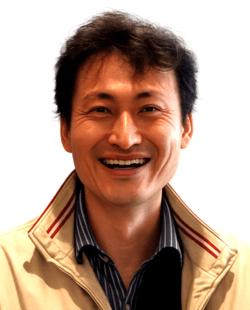
◆ Hwang Doo-hyong
Former Washington Correspondent for Yonhap News
Former Deputy Editor-in-Chief of Yonhap News

 Iranian Foreign Ministry: "Continuing Message Exchanges with the U.S. and Activities of Mediating Countries"
Esmaeil Baghaei, Spokesperson for the Iranian Ministry of Foreign Affairs [Xinhua, Yonhap News file photo]Esmaeil Baghaei, spokesperson for the Iranian Ministry of Foreign Affairs, stated on the 26th
Iranian Foreign Ministry: "Continuing Message Exchanges with the U.S. and Activities of Mediating Countries"
Esmaeil Baghaei, Spokesperson for the Iranian Ministry of Foreign Affairs [Xinhua, Yonhap News file photo]Esmaeil Baghaei, spokesperson for the Iranian Ministry of Foreign Affairs, stated on the 26th
 President Yoon: "Do You Think You Are Safe from the Special Counsel?"... Final Statement Video Released
President Yoon Suk Yeol rebuking the special prosecutor on the 24th. [Court video / @birds_justice X account subtitle GIF] A video of President Yoon Suk Yeol's closing statement at his trial rega
President Yoon: "Do You Think You Are Safe from the Special Counsel?"... Final Statement Video Released
President Yoon Suk Yeol rebuking the special prosecutor on the 24th. [Court video / @birds_justice X account subtitle GIF] A video of President Yoon Suk Yeol's closing statement at his trial rega
 President Yoon, regarding the first-instance ruling on the Public Official Election Act: “An excessive political verdict that distorts the facts… We will appeal immediately.”
The first-instance sentencing hearing for President Yoon Suk Yeol regarding violations of the Public Official Election Act is being broadcast live at Seoul Station on the 27th. [Photo=Yonhap News]Pres
President Yoon, regarding the first-instance ruling on the Public Official Election Act: “An excessive political verdict that distorts the facts… We will appeal immediately.”
The first-instance sentencing hearing for President Yoon Suk Yeol regarding violations of the Public Official Election Act is being broadcast live at Seoul Station on the 27th. [Photo=Yonhap News]Pres
 WSJ: "SK Hynix ADR Premium Is a Sign of AI Trading Overheat"
Advertisement for SK Hynix ADR listing in New York's Times Square [Reuters=Yonhap News file photo]The Wall Street Journal (WSJ) has pointed out that the price of SK Hynix’s American Depositary Recei
WSJ: "SK Hynix ADR Premium Is a Sign of AI Trading Overheat"
Advertisement for SK Hynix ADR listing in New York's Times Square [Reuters=Yonhap News file photo]The Wall Street Journal (WSJ) has pointed out that the price of SK Hynix’s American Depositary Recei
 'Godfather of Japanese Mystery Novels' Keigo Higashino Passes Away After Battle with Cancer at 68
Famous Japanese mystery novelist Keigo Higashino [AFP=Yonhap News]It has been belatedly reported that Keigo Higashino, the "godfather of Japanese mystery novels" and author of bestsellers such as "The
'Godfather of Japanese Mystery Novels' Keigo Higashino Passes Away After Battle with Cancer at 68
Famous Japanese mystery novelist Keigo Higashino [AFP=Yonhap News]It has been belatedly reported that Keigo Higashino, the "godfather of Japanese mystery novels" and author of bestsellers such as "The
 [Park Pil-kyu Security Column] To the Ignorant Trying to Clothe a Beast in Sheep's Clothing
Rep. Kim Byung-joo of the Democratic Party of Korea [Photo=Yonhap News]“The Air Force Academy doesn't teach you how to fly a plane!” “The Army, Navy, and Air Force academies are exactly the
[Park Pil-kyu Security Column] To the Ignorant Trying to Clothe a Beast in Sheep's Clothing
Rep. Kim Byung-joo of the Democratic Party of Korea [Photo=Yonhap News]“The Air Force Academy doesn't teach you how to fly a plane!” “The Army, Navy, and Air Force academies are exactly the
 [Issue Diagnosis] Two Effects of the Election Petition Review
 [Photo] Evidence of Election Fraud Flooding U.S. Media… Trump Had 2.7 Million Votes Stolen
 [Video] U.S. Semiquincentennial Air Show... 'Art in the Sky' streaks across New York
 [Editorial Cartoon] A Draconian Law That Undermines Freedom of Expression

 List
List









