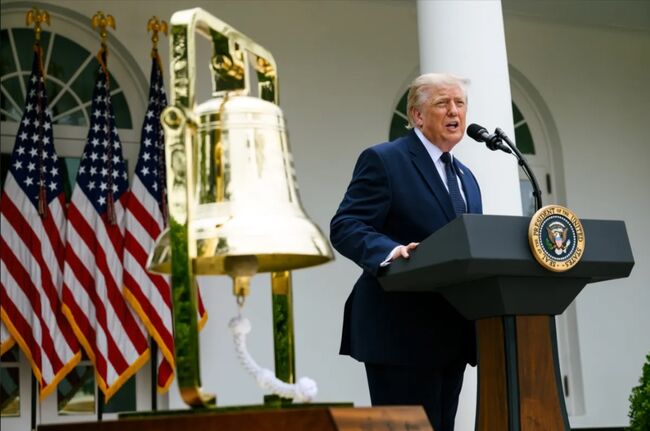
President Donald Trump making a fist. U.S. President Donald Trump boarding Air Force One at Palm Beach Airport in Florida on the 2nd (local time). [AP=Yonhap News]
U.S. President Donald Trump announced that an operation to safely assist third-country vessels trapped in the Strait of Hormuz will commence starting Monday morning, Middle East time.
As Iran has indicated it will consider this a 'ceasefire violation,' tensions are escalating between the two countries, who are maintaining a fragile truce.
In a post on the social media platform Truth Social on the 3rd (local time), President Trump stated, "Countries from all over the world have asked the United States to help them get their ships out of the Strait of Hormuz."
President Trump said that these countries and ships "are mostly not involved in the violent conflicts currently taking place in the Middle East" and that "they are simply neutral and innocent bystanders."
He added, "I told them that for Iran, the Middle East, and the United States, we will ensure that business continues freely and smoothly by getting the ships safely out of this restricted waterway (Strait of Hormuz)."
He also said, "I have informed them, through my delegation, that we will do our utmost to safely extract their ships and crews from the strait."
President Trump announced, "This process, 'Project Freedom,' will begin on Monday morning, Middle East time."
He emphasized, "This movement of ships is solely to liberate people, companies, and nations who have done nothing wrong. They are victims of the situation."
He also added, "Many of these ships are running low on food and all the necessities for large crews to live healthily and hygienically on board," calling it a "humanitarian gesture on behalf of the United States, Middle Eastern countries, and especially Iran."
President Trump stated that U.S. delegations are having "very positive discussions with Iran" and that he "well understands that these discussions can lead to very positive outcomes for everyone."
He said, "This is a way to show goodwill from the parties who have been fighting intensely for the past few months," adding, "If this humanitarian procedure is obstructed in any way, unfortunately, we will have no choice but to respond strongly to that obstruction."
 Vessels anchored and stopped in the Strait of Hormuz. [AP=Yonhap News File Photo]
This is interpreted as an indication that if the Iranian military, which controls the Strait of Hormuz, attacks during the operation, the U.S. military will retaliate, thereby accepting the resumption of conflict between the two countries, who are currently under a ceasefire.
The U.S. Central Command, which is leading the war against Iran, posted on its X (formerly Twitter) account, "We will begin supporting Project Freedom on the 4th to restore freedom of navigation for commercial vessels through the Strait of Hormuz."
It stated that this would involve destroyers equipped with guided missiles, over 100 land and sea-based aircraft, unmanned platforms, and 15,000 troops.
AP reported that one bulk carrier was attacked in the Strait of Hormuz on the same day, believed to be by Iran, and that there have been at least 24 instances of civilian vessel attacks in and around the strait during the Iran war.
It is estimated that approximately 2,000 vessels are currently trapped or grounded in and around the Strait of Hormuz, and approximately 20,000 sailors are reportedly facing food and water crises on board.
President Trump's announcement is seen as a humanitarian measure, as well as another 'game-changing move' in the Strait of Hormuz, the crucial battleground of the war, with Iran's blockade and the U.S. maritime blockade in confrontation.
It appears to aim at stabilizing international oil prices by allowing tankers and other vessels trapped by Iran's blockade of the Strait of Hormuz to exit, while also reducing, even partially, the leverage Iran holds (the blockade of Hormuz).
However, for the operation to succeed, Iran must not harm third-country vessels exiting the Strait of Hormuz under U.S. support or escort, making Iran's response a key factor.
From Iran's perspective, it may consider that if the ships exit, control of the strait could be handed over to the United States, and therefore, if resistance occurs, the current ceasefire could be at risk of collapse.
According to AFP, Ebrahim Azizi, a member of Iran's parliamentary National Security and Foreign Policy Committee, reacted on X, stating, "Any U.S. intervention in the new maritime order of the Strait of Hormuz will be considered a violation of the ceasefire."
When asked by reporters about the situation in Iran on the same day, President Trump simply replied, "It's going very well."

 Trump pressures for rate cut again ahead of FOMC... "Should be the lowest in the world"
U.S. President Donald Trump. [Photo = The White House] U.S. President Donald Trump once again pressured the Federal Reserve, the U.S. central bank, to lower interest rates on the 27th (local time
Trump pressures for rate cut again ahead of FOMC... "Should be the lowest in the world"
U.S. President Donald Trump. [Photo = The White House] U.S. President Donald Trump once again pressured the Federal Reserve, the U.S. central bank, to lower interest rates on the 27th (local time
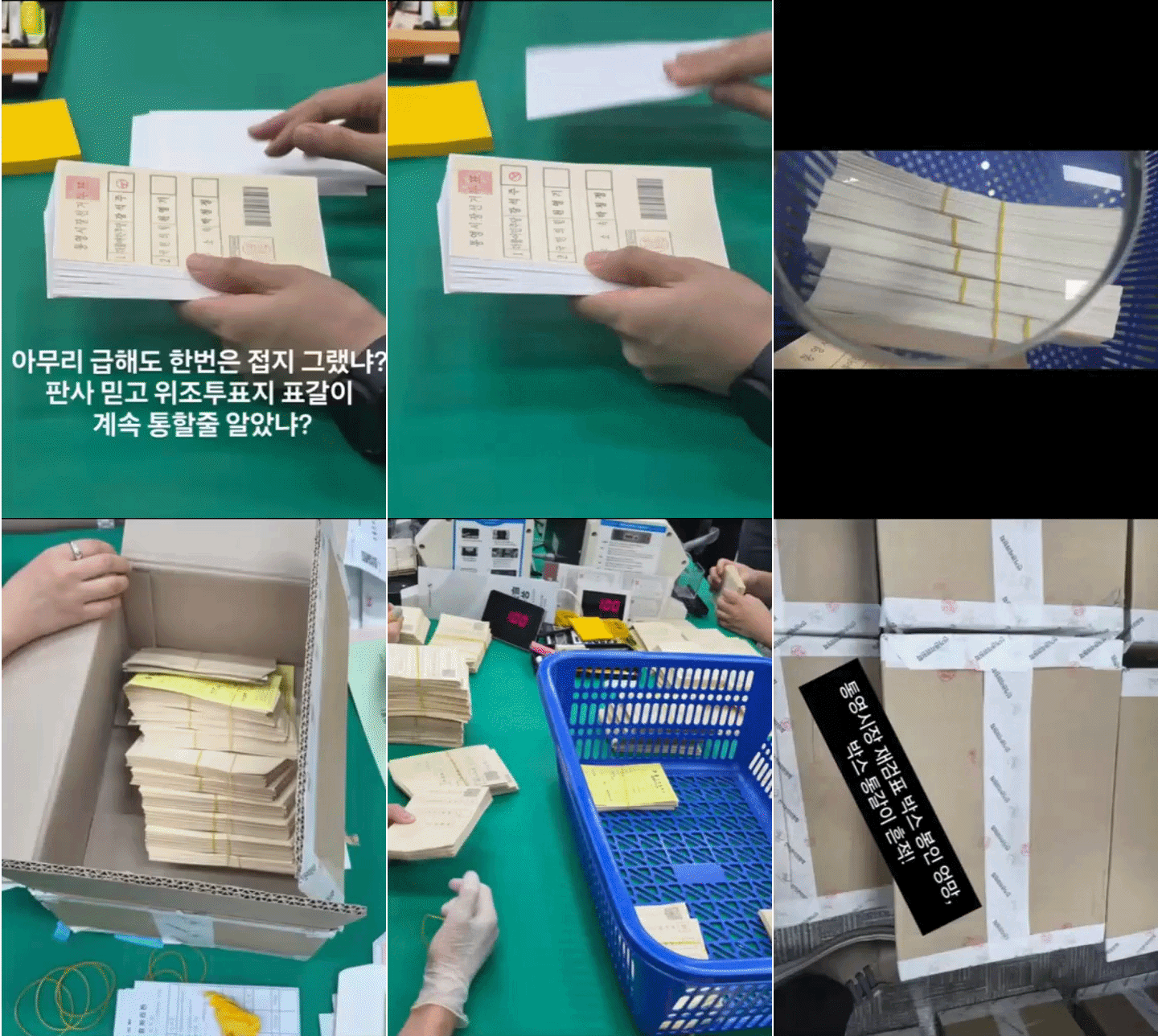 “Ignoring crisp ballots and damaged seals”… Tongyeong mayoral recount concludes with ‘no change in outcome,’ leaving suspicions and public outrage behind
Suspected counterfeit ballots discovered in Tongyeong [GIF from social media of Representative Hwang Kyo-ahn / Attorney Park Joo-hyun]During a recount of the Tongyeong mayoral election in South Gyeong
“Ignoring crisp ballots and damaged seals”… Tongyeong mayoral recount concludes with ‘no change in outcome,’ leaving suspicions and public outrage behind
Suspected counterfeit ballots discovered in Tongyeong [GIF from social media of Representative Hwang Kyo-ahn / Attorney Park Joo-hyun]During a recount of the Tongyeong mayoral election in South Gyeong
 President Yoon, regarding the first-instance ruling on the Public Official Election Act: “An excessive political verdict that distorts the facts… We will appeal immediately.”
The first-instance sentencing hearing for President Yoon Suk Yeol regarding violations of the Public Official Election Act is being broadcast live at Seoul Station on the 27th. [Photo=Yonhap News]Pres
President Yoon, regarding the first-instance ruling on the Public Official Election Act: “An excessive political verdict that distorts the facts… We will appeal immediately.”
The first-instance sentencing hearing for President Yoon Suk Yeol regarding violations of the Public Official Election Act is being broadcast live at Seoul Station on the 27th. [Photo=Yonhap News]Pres
 WSJ: "SK Hynix ADR Premium Is a Sign of AI Trading Overheat"
Advertisement for SK Hynix ADR listing in New York's Times Square [Reuters=Yonhap News file photo]The Wall Street Journal (WSJ) has pointed out that the price of SK Hynix’s American Depositary Recei
WSJ: "SK Hynix ADR Premium Is a Sign of AI Trading Overheat"
Advertisement for SK Hynix ADR listing in New York's Times Square [Reuters=Yonhap News file photo]The Wall Street Journal (WSJ) has pointed out that the price of SK Hynix’s American Depositary Recei
 'Godfather of Japanese Mystery Novels' Keigo Higashino Passes Away After Battle with Cancer at 68
Famous Japanese mystery novelist Keigo Higashino [AFP=Yonhap News]It has been belatedly reported that Keigo Higashino, the "godfather of Japanese mystery novels" and author of bestsellers such as "The
'Godfather of Japanese Mystery Novels' Keigo Higashino Passes Away After Battle with Cancer at 68
Famous Japanese mystery novelist Keigo Higashino [AFP=Yonhap News]It has been belatedly reported that Keigo Higashino, the "godfather of Japanese mystery novels" and author of bestsellers such as "The
 [Park Pil-kyu Security Column] To the Ignorant Trying to Clothe a Beast in Sheep's Clothing
Rep. Kim Byung-joo of the Democratic Party of Korea [Photo=Yonhap News]“The Air Force Academy doesn't teach you how to fly a plane!” “The Army, Navy, and Air Force academies are exactly the
[Park Pil-kyu Security Column] To the Ignorant Trying to Clothe a Beast in Sheep's Clothing
Rep. Kim Byung-joo of the Democratic Party of Korea [Photo=Yonhap News]“The Air Force Academy doesn't teach you how to fly a plane!” “The Army, Navy, and Air Force academies are exactly the
 [Issue Diagnosis] Two Effects of the Election Petition Review
 [Photo] Evidence of Election Fraud Flooding U.S. Media… Trump Had 2.7 Million Votes Stolen
 [Video] U.S. Semiquincentennial Air Show... 'Art in the Sky' streaks across New York
 [Editorial Cartoon] A Draconian Law That Undermines Freedom of Expression

 List
List