 U.S. warship blocks Iranian vessel operations [U.S. Central Command X]
Amid the U.S. naval blockade against Iran, which has lasted for nearly a month, Iran has reportedly been selling crude oil loaded on tankers in international waters to countries like China through ship-to-ship (STS) transfers.
The Washington Post (WP), analyzing private satellite imagery, reported on the 7th (local time) that at least 13 Iranian oil tankers have shown signs of selling crude oil via STS transfers since the U.S. naval blockade began.
STS involves transferring cargo from one vessel to another at sea without docking at a port, a smuggling method commonly used by countries under international sanctions, such as North Korea.
The U.S. military initiated the naval blockade against Iran on the 13th of last month and announced on the 16th that it would expand its operational scope to the Indian Ocean and the Pacific Ocean. The satellite imagery analyzed by WP was taken after the 16th.
The satellite images show two oil tankers side-by-side. This indicates the transfer of crude oil from Iranian tankers to other oil tankers.
The STS transfers are primarily occurring in the waters near Indonesia's Riau Islands. It is believed that oil tankers departing from Iran pass through the Strait of Malacca and Singapore and then rendezvous with other tankers in this area to transfer crude oil.
Of the 13 oil tankers photographed, six flew the Iranian flag, while the remaining seven had no flag or flew flags of other countries, all carrying Iranian crude oil, WP reported, citing the maritime data firm Kpler.
The crude oil sold this way amounts to 22 million barrels, which, at current market prices, represents $2 billion (approximately 2.9 trillion won) in war funding flowing into Iran.
The oil tankers that received the crude oil at sea are likely to be Chinese. This is plausible given that the transfer location is midway between China and Iran, and China purchases over 90% of Iran's crude oil.
WP pointed out, "China is buying (Iranian crude oil) at a significant discount, but it is still generating revenue that accounts for nearly half of the Iranian government's budget."
Iran's crude oil exports have been largely blocked due to the U.S. naval blockade. According to the White House, over 50 vessels, including oil tankers departing from Iran, have had their voyages intercepted since the blockade began.
However, oil tankers that departed before the blockade are still sailing or anchored. In early February, there were 90 million barrels of Iranian crude oil in the waters near the Riau Islands; this has since decreased to 42 million barrels, indicating that more than half have been sold.
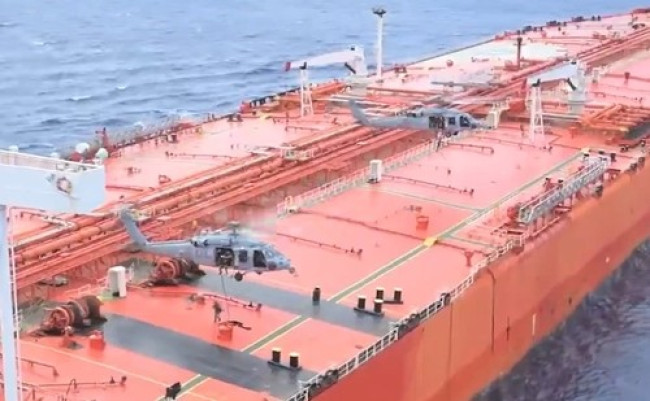 U.S. military apprehends Iran-linked vessel in Indo-Pacific region [U.S. Department of Defense video capture]
WP reported that the Tiffany and Majestic X, apprehended by the U.S. military in the Indian Ocean on the 21st and 24th of last month, respectively, are likely oil tankers that departed Iran before the naval blockade and were carrying crude oil for STS transfers.
Furthermore, when the U.S. military announced on the previous day that it had fired upon and disabled the Hasna, which was heading to an Iranian port, it is speculated that the oil tanker was returning after completing an STS transfer, as its tanks were empty.
"The longer the blockade persists, the less cargo Iran will be able to send to China," said Michelle Bockmann, a senior analyst at maritime intelligence firm Windward.
Payments for crude oil sold through STS transfers are largely opaque. According to the Royal United Services Institute (RUSI), some payments are made in advance, but it is common for payments to be settled after the oil tankers enter territorial waters or arrive at port.
The U.S. Treasury Department, under its "Economic Fury" operation, recently froze hundreds of millions of dollars in cryptocurrency believed to be linked to Iran and sanctioned Iranian exchange houses that handle billions of dollars annually.
This is interpreted as an attempt to block channels through which they receive cryptocurrency or Chinese yuan as payment for oil sales and utilize them for military funding.

 Trump pressures for rate cut again ahead of FOMC... "Should be the lowest in the world"
U.S. President Donald Trump. [Photo = The White House] U.S. President Donald Trump once again pressured the Federal Reserve, the U.S. central bank, to lower interest rates on the 27th (local time
Trump pressures for rate cut again ahead of FOMC... "Should be the lowest in the world"
U.S. President Donald Trump. [Photo = The White House] U.S. President Donald Trump once again pressured the Federal Reserve, the U.S. central bank, to lower interest rates on the 27th (local time
 “Ignoring crisp ballots and damaged seals”… Tongyeong mayoral recount concludes with ‘no change in outcome,’ leaving suspicions and public outrage behind
Suspected counterfeit ballots discovered in Tongyeong [GIF from social media of Representative Hwang Kyo-ahn / Attorney Park Joo-hyun]During a recount of the Tongyeong mayoral election in South Gyeong
“Ignoring crisp ballots and damaged seals”… Tongyeong mayoral recount concludes with ‘no change in outcome,’ leaving suspicions and public outrage behind
Suspected counterfeit ballots discovered in Tongyeong [GIF from social media of Representative Hwang Kyo-ahn / Attorney Park Joo-hyun]During a recount of the Tongyeong mayoral election in South Gyeong
 President Yoon, regarding the first-instance ruling on the Public Official Election Act: “An excessive political verdict that distorts the facts… We will appeal immediately.”
The first-instance sentencing hearing for President Yoon Suk Yeol regarding violations of the Public Official Election Act is being broadcast live at Seoul Station on the 27th. [Photo=Yonhap News]Pres
President Yoon, regarding the first-instance ruling on the Public Official Election Act: “An excessive political verdict that distorts the facts… We will appeal immediately.”
The first-instance sentencing hearing for President Yoon Suk Yeol regarding violations of the Public Official Election Act is being broadcast live at Seoul Station on the 27th. [Photo=Yonhap News]Pres
 WSJ: "SK Hynix ADR Premium Is a Sign of AI Trading Overheat"
Advertisement for SK Hynix ADR listing in New York's Times Square [Reuters=Yonhap News file photo]The Wall Street Journal (WSJ) has pointed out that the price of SK Hynix’s American Depositary Recei
WSJ: "SK Hynix ADR Premium Is a Sign of AI Trading Overheat"
Advertisement for SK Hynix ADR listing in New York's Times Square [Reuters=Yonhap News file photo]The Wall Street Journal (WSJ) has pointed out that the price of SK Hynix’s American Depositary Recei
 'Godfather of Japanese Mystery Novels' Keigo Higashino Passes Away After Battle with Cancer at 68
Famous Japanese mystery novelist Keigo Higashino [AFP=Yonhap News]It has been belatedly reported that Keigo Higashino, the "godfather of Japanese mystery novels" and author of bestsellers such as "The
'Godfather of Japanese Mystery Novels' Keigo Higashino Passes Away After Battle with Cancer at 68
Famous Japanese mystery novelist Keigo Higashino [AFP=Yonhap News]It has been belatedly reported that Keigo Higashino, the "godfather of Japanese mystery novels" and author of bestsellers such as "The
 [Park Pil-kyu Security Column] To the Ignorant Trying to Clothe a Beast in Sheep's Clothing
Rep. Kim Byung-joo of the Democratic Party of Korea [Photo=Yonhap News]“The Air Force Academy doesn't teach you how to fly a plane!” “The Army, Navy, and Air Force academies are exactly the
[Park Pil-kyu Security Column] To the Ignorant Trying to Clothe a Beast in Sheep's Clothing
Rep. Kim Byung-joo of the Democratic Party of Korea [Photo=Yonhap News]“The Air Force Academy doesn't teach you how to fly a plane!” “The Army, Navy, and Air Force academies are exactly the
 [Issue Diagnosis] Two Effects of the Election Petition Review
 [Photo] Evidence of Election Fraud Flooding U.S. Media… Trump Had 2.7 Million Votes Stolen
 [Video] U.S. Semiquincentennial Air Show... 'Art in the Sky' streaks across New York
 [Editorial Cartoon] A Draconian Law That Undermines Freedom of Expression

 List
List









