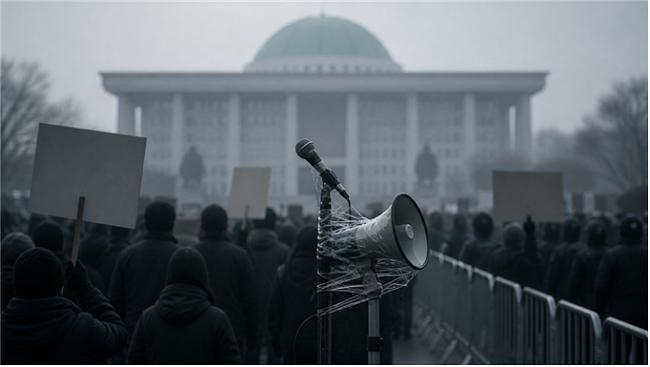
The controversy surrounding the revised Referendum Act is now being considered by the Constitutional Court and the courts. The issue is not simply the right to vote itself. It is the question of whether the right for citizens to speak, gather, sign, and persuade regarding constitutional amendments—the so-called 'right to public deliberation'—can actually be restricted.
Separate from the National Assembly's handling of the constitutional amendment bill, a more serious problem has already emerged. A law that could restrict assemblies, demonstrations, petitioning, and communication activities related to the amendment was implemented after the bill was publicly announced, and controversy over restrictions on assembly notifications has already arisen. Despite this, the establishment has only protested verbally and has not actively pursued legal action to protect citizens' 'right to speak.' While they have spoken out, they have only belatedly approached the Constitutional Court.
The Issue of the Right to Speak
The current Referendum Act came into effect on March 6, 2026. Article 22 of the Referendum Act defines 'referendum campaign' as "an act to persuade or dissuade on matters subject to a referendum or to support one of several matters." It simultaneously stipulates that mere expression of opinion or intent regarding matters subject to a referendum is not considered a referendum campaign.
The problem lies in Articles 37 and 114. Article 37 restricts acts such as marching in groups of more than five people, shouting consecutively, house-to-house visits, collecting signatures or seals, using telecommunication methods, holding assemblies, using loudspeakers or vehicles, and using recorders or video recorders. Article 114 stipulates that violations can be punished by imprisonment or fines.
What the Referendum Act should prevent are the dissemination of false information, the provision of money or goods, coercion, and violent mobilization. However, the current provisions are structured in a way that could broadly restrict even the core means by which citizens gather and disseminate opinions on constitutional amendments. If the right to speak, gather, and persuade before a vote is curtailed while the right to vote is guaranteed, referendums could be reduced from a deliberative process for sovereign citizens to a mere choice on a single voting day.
Restrictions Begin After Announcement
The interpretation by the National Election Commission is further fueling the controversy. The Election Commission's operational guidelines for the Referendum Act consider the commencement of referendum campaigning to be the date of the constitutional amendment bill's public announcement. The interpretation is that once the President announces the constitutional amendment bill according to Article 129 of the Constitution, the provisions restricting referendum campaigns can be applied.
If this interpretation holds, the announcement of the constitutional amendment bill becomes both the starting point for public deliberation and the starting point for restrictions on citizens' expression of intent. At the very time when citizens should be able to review the contents of the amendment bill and form opinions for or against it, major means of expression such as assemblies, petitioning, communication, recording, and video recording could be subject to the risk of criminal punishment.
Concerns have manifested into actual incidents. After the constitutional amendment bill was announced, the Free University, which was preparing an assembly to oppose the amendment, was reportedly informed by the Election Commission about the possibility of violating the Referendum Act. In protest, the Free University announced it would hold an assembly near Yeouido Station on May 2nd with the aim of 'allowing assemblies against the constitutional amendment.'
Investigations by the Hankookilbo have confirmed that the Korea Patriotism Association also attempted to organize an anti-amendment protest but was notified by the Election Commission of potential violations of the Referendum Act. Oh Sang-jong, head of the Korea Patriotism Association, told the Hankookilbo, "The subject of a referendum is only finalized after the amendment bill passes the National Assembly. The Election Commission's decision to set the effective date from the announcement of the bill is an overinterpretation," adding, "We have filed an administrative lawsuit."
These cases demonstrate that the controversy over the Referendum Act is escalating from an abstract legal issue to a matter of fundamental rights in reality. Even before the decision on whether to hold a referendum is finalized, assemblies and demonstrations expressing opinions for or against the constitutional amendment, after its announcement, have entered the realm of potential illegality. At a time when discussions on the pros and cons of the amendment should be most active, civic groups find themselves having to worry about whether their actions are legal.
The Vacuum in the Establishment
A more significant issue is the response from the establishment. When the National Election Commission provided its operational guidelines for the Referendum Act to each political party, there was a backlash from the political sphere. The People Power Party criticized the Election Commission, implying it was condoning the linkage of local elections with a constitutional amendment referendum. However, no party-level legal action, such as filing a constitutional complaint or seeking a provisional suspension of effect against the provisions restricting referendum campaigns, has been publicly confirmed.
When legal provisions that could openly restrict the freedom of assembly and demonstration have been implemented, and controversy over assembly restrictions has actually arisen, the issue transcends mere commentary. The role of political parties should not be limited to statements and criticisms. In light of the constitutional guarantees of freedom of expression and assembly, and the principle of popular sovereignty, legal action challenging the effectiveness of those provisions should have followed.
However, the current trend has been different. While the establishment raised their voices, legal action has belatedly commenced at the level of civic groups and individual legal professionals. Despite knowing that the Referendum Act could silence citizens and tie their hands, it was not the establishment's role to ask the Constitutional Court to rule on the law's effectiveness.
This is the background behind lawyer Park Ju-hyun filing a constitutional complaint against Articles 37 and 114 of the Referendum Act. In a phone call with the Hankookilbo on the 30th of last month, lawyer Park stated that the provisions could infringe upon citizens' freedom of expression, freedom of assembly, and the principle of popular sovereignty, and that she was preparing to file a constitutional complaint and a request for a provisional suspension of effect. Subsequently, lawyer Park submitted a constitutional complaint to the Constitutional Court challenging the effectiveness of the provisions restricting referendum campaigns.
Sovereignty Before the Vote
A referendum is different from a general election. While an election is a process for selecting candidates and parties, a constitutional amendment referendum is a process for sovereign citizens to decide whether to give final approval to the nation's fundamental norms. Therefore, citizens need more than just a single vote on election day. Before that, the right to know the contents of the amendment bill, to share opinions for or against it, to sign, to gather, and to persuade must also be guaranteed.
The Western Free Lawyers Association also issued a statement on the 30th of last month, raising concerns about the infringement of fundamental rights stemming from the Referendum Act and the Election Commission's interpretation. The association highlighted that Articles 37 and 114 of the Referendum Act broadly restrict citizens' means of expressing their intent, including assemblies, petitioning, communication, loudspeakers, and recording/video recording. Furthermore, they stated, "A referendum that silences and restrains sovereign citizens is not a referendum," and declared their intention to actively protect citizens harmed by the Referendum Act and the Election Commission's actions.
This issue is not about whether to support or oppose the constitutional amendment bill. Whether one is for or against the amendment, citizens must have the right to speak about the constitutional amendment bill. A referendum is not a process conducted in silence. It is a process where sovereign citizens make a final judgment after speaking, listening, refuting, and persuading.
Ultimately, the question facing the Constitutional Court and the courts is singular: In a referendum, are citizens merely people going to the polls, or are they sovereign beings who speak and judge regarding the fundamental norms of the nation? While the establishment has let go, citizens' 'right to speak' has arrived at the doorstep of the Constitutional Court and the courts.
This article was published in the Weekly Hankookilbo (First week of May, Issue No. 8).

 Trump pressures for rate cut again ahead of FOMC... "Should be the lowest in the world"
U.S. President Donald Trump. [Photo = The White House] U.S. President Donald Trump once again pressured the Federal Reserve, the U.S. central bank, to lower interest rates on the 27th (local time
Trump pressures for rate cut again ahead of FOMC... "Should be the lowest in the world"
U.S. President Donald Trump. [Photo = The White House] U.S. President Donald Trump once again pressured the Federal Reserve, the U.S. central bank, to lower interest rates on the 27th (local time
 “Ignoring crisp ballots and damaged seals”… Tongyeong mayoral recount concludes with ‘no change in outcome,’ leaving suspicions and public outrage behind
Suspected counterfeit ballots discovered in Tongyeong [GIF from social media of Representative Hwang Kyo-ahn / Attorney Park Joo-hyun]During a recount of the Tongyeong mayoral election in South Gyeong
“Ignoring crisp ballots and damaged seals”… Tongyeong mayoral recount concludes with ‘no change in outcome,’ leaving suspicions and public outrage behind
Suspected counterfeit ballots discovered in Tongyeong [GIF from social media of Representative Hwang Kyo-ahn / Attorney Park Joo-hyun]During a recount of the Tongyeong mayoral election in South Gyeong
 President Yoon, regarding the first-instance ruling on the Public Official Election Act: “An excessive political verdict that distorts the facts… We will appeal immediately.”
The first-instance sentencing hearing for President Yoon Suk Yeol regarding violations of the Public Official Election Act is being broadcast live at Seoul Station on the 27th. [Photo=Yonhap News]Pres
President Yoon, regarding the first-instance ruling on the Public Official Election Act: “An excessive political verdict that distorts the facts… We will appeal immediately.”
The first-instance sentencing hearing for President Yoon Suk Yeol regarding violations of the Public Official Election Act is being broadcast live at Seoul Station on the 27th. [Photo=Yonhap News]Pres
 WSJ: "SK Hynix ADR Premium Is a Sign of AI Trading Overheat"
Advertisement for SK Hynix ADR listing in New York's Times Square [Reuters=Yonhap News file photo]The Wall Street Journal (WSJ) has pointed out that the price of SK Hynix’s American Depositary Recei
WSJ: "SK Hynix ADR Premium Is a Sign of AI Trading Overheat"
Advertisement for SK Hynix ADR listing in New York's Times Square [Reuters=Yonhap News file photo]The Wall Street Journal (WSJ) has pointed out that the price of SK Hynix’s American Depositary Recei
 'Godfather of Japanese Mystery Novels' Keigo Higashino Passes Away After Battle with Cancer at 68
Famous Japanese mystery novelist Keigo Higashino [AFP=Yonhap News]It has been belatedly reported that Keigo Higashino, the "godfather of Japanese mystery novels" and author of bestsellers such as "The
'Godfather of Japanese Mystery Novels' Keigo Higashino Passes Away After Battle with Cancer at 68
Famous Japanese mystery novelist Keigo Higashino [AFP=Yonhap News]It has been belatedly reported that Keigo Higashino, the "godfather of Japanese mystery novels" and author of bestsellers such as "The
 [Park Pil-kyu Security Column] To the Ignorant Trying to Clothe a Beast in Sheep's Clothing
Rep. Kim Byung-joo of the Democratic Party of Korea [Photo=Yonhap News]“The Air Force Academy doesn't teach you how to fly a plane!” “The Army, Navy, and Air Force academies are exactly the
[Park Pil-kyu Security Column] To the Ignorant Trying to Clothe a Beast in Sheep's Clothing
Rep. Kim Byung-joo of the Democratic Party of Korea [Photo=Yonhap News]“The Air Force Academy doesn't teach you how to fly a plane!” “The Army, Navy, and Air Force academies are exactly the
 [Issue Diagnosis] Two Effects of the Election Petition Review
 [Photo] Evidence of Election Fraud Flooding U.S. Media… Trump Had 2.7 Million Votes Stolen
 [Video] U.S. Semiquincentennial Air Show... 'Art in the Sky' streaks across New York
 [Editorial Cartoon] A Draconian Law That Undermines Freedom of Expression

 List
List










