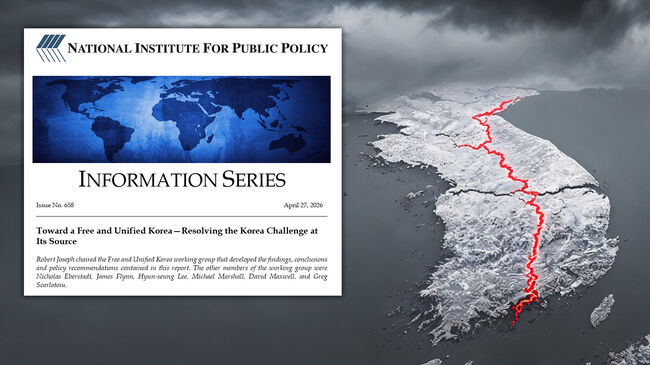
A comprehensive strategy report has been released by Korean Peninsula experts in Washington, directly refuting both North Korea's "hostile two-state theory" and South Korea's "peaceful coexistence theory."
In its policy report titled "Toward a Free and Unified Korea: Resolving the Korea Challenge at Its Source," released on April 27th, the National Institute for Public Policy (NIPP) emphasized that "unification" is the "completion of security policy" for the Korean Peninsula.
The report diagnosed the recent discussions of policies by both Koreas to abandon unification as a "dangerous trend."
North Korea's 'hostile two-state theory' is a declaration to perpetuate the division by deleting the unification clause from its constitution and designating South Korea as its primary hostile nation. The 'realistic two-state peaceful coexistence theory' proposed by the Lee Jae-myung administration argues for pursuing realistic peaceful coexistence, considering factors such as the cost and impact of unification.
In response, the report warns that although these two positions may appear different on the surface, they ultimately lead to the same conclusion: "the solidification of division." It posits that assuming the current system is a stable balance is inherently an error.
The report cautions, "A totalitarian dictatorship with nuclear weapons and an opaque succession structure cannot be a stable long-term balance. Allowing change without a plan only exacerbates the risks."
One of the report's most incisive analyses points out the failure of North Korean nuclear negotiations over the past 30 years. From the 1994 Geneva Agreed Framework to the Six-Party Talks and the Singapore Summit, agreements reached over decades have been broken, and negotiations have repeatedly resumed and collapsed. Despite this, North Korea's nuclear capabilities have accelerated.
The report attributes this to a structural error, stating, "The repeated failure of denuclearization negotiations stems from attempts to separate the nuclear issue from the nature of the regime possessing the weapons. The regime's political structure and nuclear weapons are inseparable."
The report refutes the five "myths" of "unification impossibility" that foster skepticism about unification.
Regarding the claim that "pursuing unification will lead to war," it counters that "the current system itself is already unstable," and "maintaining the status quo without a plan is more dangerous."
In response to the argument that "China will never allow it," it counters that "it is possible to alleviate concerns through precise diplomacy that considers China's interests."
Regarding the claim that "unification costs are unaffordable," it argues that in addition to "South Korea's 10 trillion dollar private assets," unification would create "an opportunity to leverage global capital markets."
In response to the assertion that "a unified Korea will distance itself from the U.S.," it retorts that because "unification will be achieved through international support," "unification will further strengthen the ROK-U.S. alliance."
Regarding the claim that "North Korean residents cannot accept freedom," it refutes that "the experiences and history of defectors prove otherwise."
One of the most notable aspects of this report is its economic analysis. Professor Nicholas Eberstadt, a leading authority on the North Korean economy, analyzes that North Korea's poverty is not due to inherent economic incompetence but is the result of decades of policy failures.
He states in the report, "The people of North Korea are Koreans. Their talents and entrepreneurial spirit are merely suppressed. Their potential, much like the underestimated potential of South Koreans prior to the ROK's economic takeoff, is still widely undervalued."
The report emphasizes that by combining North Korea's potential labor force, abundant natural resources, and its strategic geographical location, a unified Korea could become a strategic hub that strengthens the supply chains of the U.S. and its allies in the semiconductor, battery, and shipbuilding sectors.
Furthermore, the report criticizes the reality where human rights issues have been treated as secondary while the nuclear issue is central in negotiations with North Korea. Greg Scarlatoiu, Executive Director of the Committee for Human Rights in North Korea (HRNK), emphasizes that the North Korean regime's human rights abuses are not a byproduct but a core pillar of its regime maintenance.
Lee Hyun-seung, a former member of North Korea's special forces, also stresses that expanding the inflow of information into North Korea, supporting the voices of defectors, and strengthening records of crimes against humanity are not merely humanitarian activities but strategic tools to weaken the regime's information monopoly.
The report presents the following seven action items for U.S. and allied policymakers:
Formally stipulate as an official strategic objective in U.S.-ROK policy documents (jointly with Japan).
Integrate the human rights agenda as a security strategy on par with nuclear negotiations.
Establish a joint U.S.-ROK transitional planning body for WMD security, humanitarian response, and economic integration.
Strengthen government support for ROK-led civil society networks preparing for unification.
Dispel myths through public diplomacy based on economic modeling and strategic analysis related to unification.
Manage transition scenarios through diplomatic channels with China and other regional stakeholders.
Pre-design an international financial architecture for investment and reconstruction of a unified Korea.
In conclusion, the report reiterates that division is not a stable status quo and proposes unification as the only solution.
The report concludes that a free, democratic, and denuclearized unified Korea would remove one of the world's most dangerous nuclear flashpoints on the peninsula, strengthen the Indo-Pacific strategic structure, and fulfill the 70-year aspiration of the Korean people.
The report's contributors include Robert Joseph, former Under Secretary of State for Arms Control and International Security; Nicholas Eberstadt, Henry Wendt Chair in Political Economy at the American Enterprise Institute (AEI); David Maxwell, Associate Director of the Center for Asia-Pacific Strategy; Greg Scarlatoiu, Executive Director of the Committee for Human Rights in North Korea (HRNK); Lee Hyun-seung, founder of the North Korean Youth Leaders Conference; James Flynn, International Chairman of the Global Peace Foundation (GPF); and Michael Marshall, former Editor-in-Chief of UPI.
NNP=Hong Seong-gu, Chief Reporter / Special Contribution NNP info@newsandpost.com

 [Statement by the Seobeokka KMA Patriots Association] ㉛ Recount the ballots openly, as the previous recount covered up election fraud
Recount of the Tongyeong mayoral election [Photo=Yonhap News]South Korea's liberal democracy is dying. The National Election Commission (NEC), which has degraded into a criminal organization through t
[Statement by the Seobeokka KMA Patriots Association] ㉛ Recount the ballots openly, as the previous recount covered up election fraud
Recount of the Tongyeong mayoral election [Photo=Yonhap News]South Korea's liberal democracy is dying. The National Election Commission (NEC), which has degraded into a criminal organization through t
 What is the significance of the "Trump 2028" red hat that keeps reappearing?
It is noteworthy that while it is "highly likely" that President Donald Trump is "seriously considering" a run for the presidency in 2028, he is also "deliberately" fueling speculation regarding wheth
What is the significance of the "Trump 2028" red hat that keeps reappearing?
It is noteworthy that while it is "highly likely" that President Donald Trump is "seriously considering" a run for the presidency in 2028, he is also "deliberately" fueling speculation regarding wheth
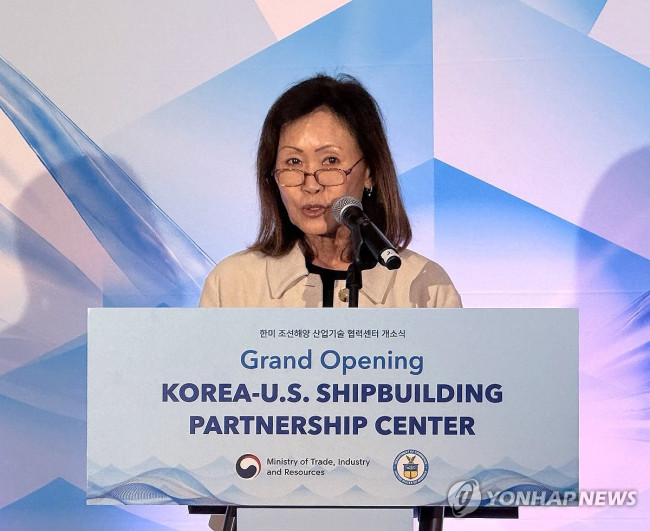 First U.S. Ambassador of Trump's Second Term to Arrive This Week… Will It Provide Momentum to Resolve Pending Issues?
U.S. Ambassador to South Korea Michelle Steel speaks at the opening ceremony of the Korea-U.S. Shipbuilding Cooperation Center held at the Mayflower Hotel in Washington, D.C., on the 23rd (local time)
First U.S. Ambassador of Trump's Second Term to Arrive This Week… Will It Provide Momentum to Resolve Pending Issues?
U.S. Ambassador to South Korea Michelle Steel speaks at the opening ceremony of the Korea-U.S. Shipbuilding Cooperation Center held at the Mayflower Hotel in Washington, D.C., on the 23rd (local time)
 President Yoon, regarding the first-instance ruling on the Public Official Election Act: “An excessive political verdict that distorts the facts… We will appeal immediately.”
The first-instance sentencing hearing for President Yoon Suk Yeol regarding violations of the Public Official Election Act is being broadcast live at Seoul Station on the 27th. [Photo=Yonhap News]Pres
President Yoon, regarding the first-instance ruling on the Public Official Election Act: “An excessive political verdict that distorts the facts… We will appeal immediately.”
The first-instance sentencing hearing for President Yoon Suk Yeol regarding violations of the Public Official Election Act is being broadcast live at Seoul Station on the 27th. [Photo=Yonhap News]Pres
 91% of Net Influx of MZ Generation Goes to Seoul Metropolitan Area… Population Migration Also Shows 'K-shaped Polarization' by Industry
[Provided by Leaders Index]Over the past four years, the MZ generation population has become increasingly concentrated in the Seoul metropolitan area and the Chungcheong region. While cities cen
91% of Net Influx of MZ Generation Goes to Seoul Metropolitan Area… Population Migration Also Shows 'K-shaped Polarization' by Industry
[Provided by Leaders Index]Over the past four years, the MZ generation population has become increasingly concentrated in the Seoul metropolitan area and the Chungcheong region. While cities cen
 'Godfather of Japanese Mystery Novels' Keigo Higashino Passes Away After Battle with Cancer at 68
Famous Japanese mystery novelist Keigo Higashino [AFP=Yonhap News]It has been belatedly reported that Keigo Higashino, the "godfather of Japanese mystery novels" and author of bestsellers such as "The
'Godfather of Japanese Mystery Novels' Keigo Higashino Passes Away After Battle with Cancer at 68
Famous Japanese mystery novelist Keigo Higashino [AFP=Yonhap News]It has been belatedly reported that Keigo Higashino, the "godfather of Japanese mystery novels" and author of bestsellers such as "The
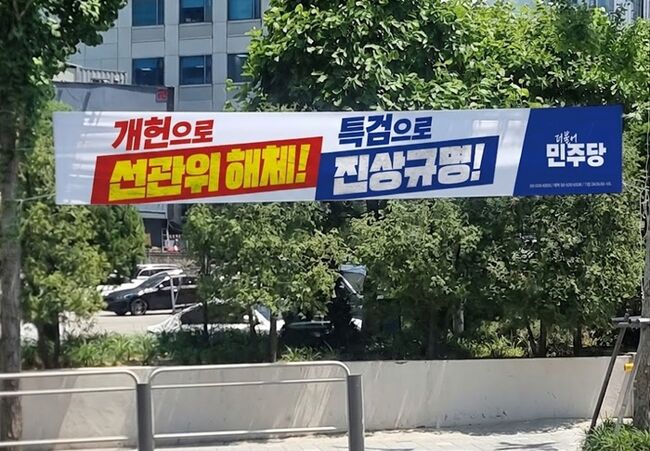 [Cho Yang-geon Column] The NEC: Facing a Fate of "Discarding the Dog After the Hunt"
Banner calling for the "dissolution of the NEC" posted by the Democratic Party. [AI-generated image]Banners calling for the "dissolution of the National Election Commission (NEC)" posted by the Democr
[Cho Yang-geon Column] The NEC: Facing a Fate of "Discarding the Dog After the Hunt"
Banner calling for the "dissolution of the NEC" posted by the Democratic Party. [AI-generated image]Banners calling for the "dissolution of the National Election Commission (NEC)" posted by the Democr
 [Photo] Evidence of Election Fraud Flooding U.S. Media… Trump Had 2.7 Million Votes Stolen
 [Video] U.S. Semiquincentennial Air Show... 'Art in the Sky' streaks across New York
 [Editorial Cartoon] A Draconian Law That Undermines Freedom of Expression

 List
List