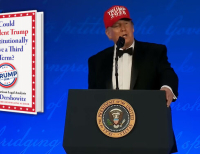
It is noteworthy that while it is "highly likely" that President Donald Trump is "seriously considering" a run for the presidency in 2028, he is also "deliberately" fueling speculation regarding whether he is actually eligible to do so.
The 22nd Amendment to the U.S. Constitution prohibits any person from being elected to the office of the President more than twice. Therefore, the general legal interpretation is that Trump, having been elected president in 2016 and 2024, cannot run for the presidency again in 2028.
Amending the Constitution requires two stages, as stipulated in Article V of the U.S. Constitution: "Proposal" and "Ratification."
The most common method is for a proposed amendment to be passed by a two-thirds vote in both the U.S. Senate and the House of Representatives. Alternatively, two-thirds of the state legislatures (at least 34 states) can request that Congress call a national convention to propose an amendment, although this method has never been successful in U.S. history.
Once proposed, the amendment must be ratified by the states. This requires the approval of at least three-fourths of the state legislatures (at least 38 states). Historically, all 26 amendments to the Constitution have been passed in this manner.
Another method is to hold special ratifying conventions in each state, with three-fourths of the states approving the amendment. This has been used only once, to pass the 21st Amendment, which repealed Prohibition.
However, given that nearly half of the states—24 in total—are currently led by the Democratic Party, ratification appears to be a practically impossible endeavor.
A more plausible, albeit unlikely, method would be for the U.S. Supreme Court to overturn the interpretation of the 22nd Amendment. Since the 22nd Amendment has never been subject to formal judicial review by the Supreme Court, some argue that an unconventional interpretation could potentially emerge.
However, given that the Supreme Court has previously interpreted the 14th Amendment’s birthright citizenship clause strictly according to its text, it seems highly unlikely that they would interpret the 22nd Amendment in a way that contradicts its explicit wording.
Meanwhile, Alan Dershowitz, professor emeritus at Harvard Law School, analyzed constitutional loopholes in his book, "Could President Trump Constitutionally Serve a Third Term?" and argued that it is possible for Trump to serve a third presidential term.
The 22nd Amendment states that "no person shall be elected to the office of the President more than twice." Professor Dershowitz argues that the Constitution only prohibits being "elected" (selected via voting), not "serving" (holding the office).
In other words, if one were to succeed to the presidency through another legal path without being elected to it, a third term would not be legally impossible under this interpretation.
The most frequently cited scenario involves Trump becoming Speaker of the House after his term ends, or being appointed Vice President in the next administration, and then automatically succeeding to the presidency in the event of a vacancy or resignation.
However, even this could be blocked if the Supreme Court rules that "succession through procedural loopholes violates the original intent of the Constitution and is therefore invalid."
Furthermore, considering that the 22nd Amendment was created following Franklin D. Roosevelt's four-term presidency out of a national consensus that "no one should hold power for more than eight years," the Republican Party could face a massive political backlash during the subsequent public and political scrutiny.
If so, why does Trump keep mentioning "Trump 2028"?
Political analysts suggest that Trump wants his brand effect to be seamlessly transferred to his successor. By keeping himself in the spotlight, he is sustaining a "Trump movement" to keep his MAGA base energized.
Additionally, by focusing media and political attention on himself, he effectively diverts attacks away from his potential successors. This has allowed individuals like Vice President JD Vance or Secretary of State Marco Rubio to face relatively fewer negative attacks.
This also serves to ensure continued loyalty from Trump's inner circle.
Professor Dershowitz noted in an interview with The Wall Street Journal last December that he explained the concept to President Trump as an "intellectually interesting legal issue," and did not believe that the President actually intended to force a run for a third term.
Nonetheless, it has been reported that President Trump did indeed express interest in Professor Dershowitz's book.
NNP (USA) = CEO/Reporter Hong Sung-gu / Special Correspondent for this publication, NNP info@newsandpost.com

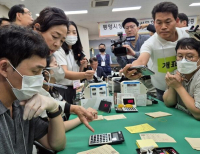
 [Statement by the Seobeokka KMA Patriots Association] ㉛ Recount the ballots openly, as the previous recount covered up election fraud
Recount of the Tongyeong mayoral election [Photo=Yonhap News]South Korea's liberal democracy is dying. The National Election Commission (NEC), which has degraded into a criminal organization through t
[Statement by the Seobeokka KMA Patriots Association] ㉛ Recount the ballots openly, as the previous recount covered up election fraud
Recount of the Tongyeong mayoral election [Photo=Yonhap News]South Korea's liberal democracy is dying. The National Election Commission (NEC), which has degraded into a criminal organization through t
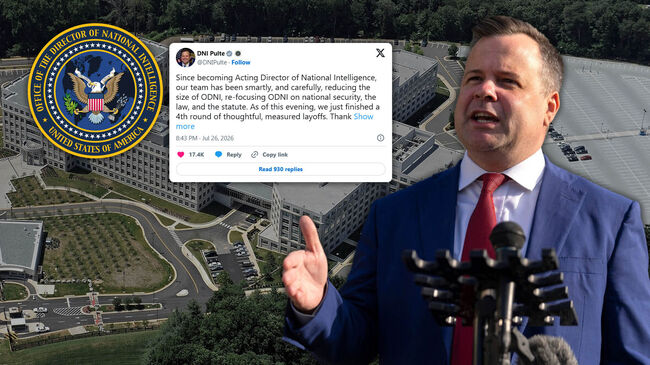 Bill Pulte to Restructure ‘Deep State’… Announces 4th Round of Layoffs at the Office of the Director of National Intelligence
Acting Director of National Intelligence Bill Pulte announced Sunday that he has carried out a fourth "deliberate and measured" reduction in personnel since taking office on June 19, as part of the Tr
Bill Pulte to Restructure ‘Deep State’… Announces 4th Round of Layoffs at the Office of the Director of National Intelligence
Acting Director of National Intelligence Bill Pulte announced Sunday that he has carried out a fourth "deliberate and measured" reduction in personnel since taking office on June 19, as part of the Tr
 First U.S. Ambassador of Trump's Second Term to Arrive This Week… Will It Provide Momentum to Resolve Pending Issues?
U.S. Ambassador to South Korea Michelle Steel speaks at the opening ceremony of the Korea-U.S. Shipbuilding Cooperation Center held at the Mayflower Hotel in Washington, D.C., on the 23rd (local time)
First U.S. Ambassador of Trump's Second Term to Arrive This Week… Will It Provide Momentum to Resolve Pending Issues?
U.S. Ambassador to South Korea Michelle Steel speaks at the opening ceremony of the Korea-U.S. Shipbuilding Cooperation Center held at the Mayflower Hotel in Washington, D.C., on the 23rd (local time)
 President Yoon, regarding the first-instance ruling on the Public Official Election Act: “An excessive political verdict that distorts the facts… We will appeal immediately.”
The first-instance sentencing hearing for President Yoon Suk Yeol regarding violations of the Public Official Election Act is being broadcast live at Seoul Station on the 27th. [Photo=Yonhap News]Pres
President Yoon, regarding the first-instance ruling on the Public Official Election Act: “An excessive political verdict that distorts the facts… We will appeal immediately.”
The first-instance sentencing hearing for President Yoon Suk Yeol regarding violations of the Public Official Election Act is being broadcast live at Seoul Station on the 27th. [Photo=Yonhap News]Pres
 91% of Net Influx of MZ Generation Goes to Seoul Metropolitan Area… Population Migration Also Shows 'K-shaped Polarization' by Industry
[Provided by Leaders Index]Over the past four years, the MZ generation population has become increasingly concentrated in the Seoul metropolitan area and the Chungcheong region. While cities cen
91% of Net Influx of MZ Generation Goes to Seoul Metropolitan Area… Population Migration Also Shows 'K-shaped Polarization' by Industry
[Provided by Leaders Index]Over the past four years, the MZ generation population has become increasingly concentrated in the Seoul metropolitan area and the Chungcheong region. While cities cen
 'Godfather of Japanese Mystery Novels' Keigo Higashino Passes Away After Battle with Cancer at 68
Famous Japanese mystery novelist Keigo Higashino [AFP=Yonhap News]It has been belatedly reported that Keigo Higashino, the "godfather of Japanese mystery novels" and author of bestsellers such as "The
'Godfather of Japanese Mystery Novels' Keigo Higashino Passes Away After Battle with Cancer at 68
Famous Japanese mystery novelist Keigo Higashino [AFP=Yonhap News]It has been belatedly reported that Keigo Higashino, the "godfather of Japanese mystery novels" and author of bestsellers such as "The
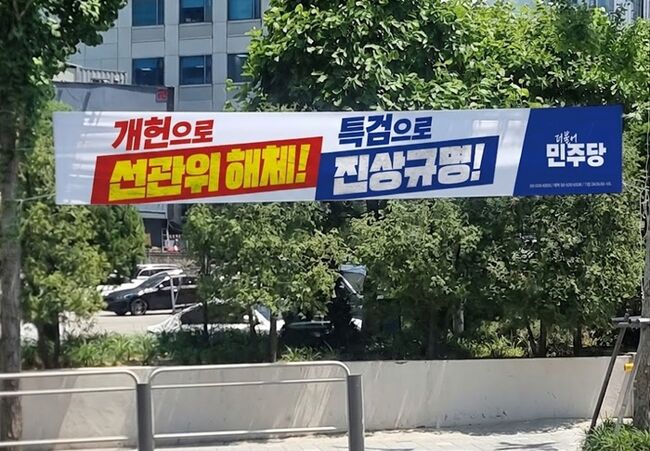 [Cho Yang-geon Column] The NEC: Facing a Fate of "Discarding the Dog After the Hunt"
Banner calling for the "dissolution of the NEC" posted by the Democratic Party. [AI-generated image]Banners calling for the "dissolution of the National Election Commission (NEC)" posted by the Democr
[Cho Yang-geon Column] The NEC: Facing a Fate of "Discarding the Dog After the Hunt"
Banner calling for the "dissolution of the NEC" posted by the Democratic Party. [AI-generated image]Banners calling for the "dissolution of the National Election Commission (NEC)" posted by the Democr
 [Photo] Evidence of Election Fraud Flooding U.S. Media… Trump Had 2.7 Million Votes Stolen
 [Video] U.S. Semiquincentennial Air Show... 'Art in the Sky' streaks across New York
 [Editorial Cartoon] A Draconian Law That Undermines Freedom of Expression

 List
List