US-China Summit [Photo=AP Yonhap News]
The public portion of the US-China summit held in Beijing on the 14th was about trade.
Based on the currently disclosed information, the US side's explanation of the summit and China's announcement of the summit's outcomes have been confirmed.
The US emphasized expanded market access, Chinese investment in the US, and purchases of agricultural and energy products, as well as the Strait of Hormuz issue. China, on the other hand, highlighted expanded cooperation in economy, trade, and agriculture, while placing the Taiwan issue front and center.
In essence, both sides conveyed different messages regarding the same meeting. The Chinese Ministry of Foreign Affairs separately announced the outcomes of the meeting between Chinese President Xi Jinping and US President Trump on the 14th, and foreign media reports also pointed out the difference in emphasis between the US explanation and China's announcement.
This difference precisely illustrates the nature of this summit.
The absence of a joint statement can be interpreted as the two sides being unable to even formulate a single mutually agreeable sentence, or at least not codifying sensitive agendas into a joint text.
While mutually agreeable transactions were explained individually, more sensitive structural issues were left outside the official announcement.
The US-China Trade Committee and the US-China Investment Committee discussions are prime examples of this.
In an interview with CNBC's 'Squawk Box' on the 14th, US Treasury Secretary Steven Mnuchin stated that both the US and China discussed the establishment of a 'Board of Trade' to manage bilateral trade and a separate 'Board of Investment' to handle non-sensitive investment areas.
Secretary Mnuchin explained that the Investment Committee could serve as a mechanism to pre-screen China's investment plans in the US, preventing them from being escalated to the Committee on Foreign Investment in the United States (CFIUS) jurisdiction.
This point is the hidden core of this summit.
Purchases of Boeing aircraft, imports of US crude oil, and expanded agricultural product purchases are transactions that can be announced with figures.
However, the Board of Trade and the Board of Investment are not one-off purchase lists. They are mechanisms to determine how US-China economic relations will be managed within an institutional framework going forward.
What was made public were the deals, but what was indirectly revealed was order.
A particularly noteworthy aspect is the composition of the US economic delegation.
Reuters reported on the 11th that President Trump's delegation to China included Tesla CEO Elon Musk, Apple CEO Tim Cook, Boeing CEO Kelly O'Toole, BlackRock Chairman Larry Fink, Blackstone Chairman Stephen Schwarzman, Citigroup CEO Jane Fraser, Mastercard CEO Michael Miebach, and Visa CEO Ryan McInerney.
The report also stated that the two countries were expected to agree on the establishment of a forum to promote mutual trade and investment.
In an analysis article sent on the 13th, Reuters pointed out that the US business delegation comprised companies seeking to resolve long-term business issues within China.
The report indicated that Mastercard and Visa are seeking to expand their presence in China's highly regulated payment market, and that US companies viewed this summit as a political opportunity to gain regulatory approval, market access, and expand investment opportunities.
The participation of Boeing and energy companies can be explained by aircraft and energy deals. However, the presence of financial, investment, and payment companies such as BlackRock, Blackstone, Citigroup, Visa, and Mastercard signals that the agenda extended beyond simple commodity trade.
Commodities were announcable deals, while capital was hidden in the list of the delegation.
Financial and payment companies are not businesses that move to secure purchase contracts for aircraft or agricultural products. BlackRock and Blackstone are connected to asset management and alternative investment markets; Citigroup and Goldman Sachs are connected to securities and investment banking operations; and Visa and Mastercard are connected to payment network access issues.
The fact that they all traveled to Beijing at once indicates that the summit's focus extended beyond commodity trade to issues of access to China's financial infrastructure and capital markets.
Therefore, it can be seen that what the US demanded of China in this summit was not merely an increase in imports.
The demand to buy more US crude oil and agricultural products is superficial. Beneath that, it is interpreted that there was a demand for China to open its markets not only for commodities but also for financial, payment, securities, and asset management sectors.
This interpretation is supported by Secretary Mnuchin's remarks about the Investment Committee and the list of Wall Street CEOs who accompanied the delegation.
Of course, based solely on the currently disclosed information, it is difficult to definitively state, "The US officially demanded the full opening of China's capital markets."
However, when considering the discussions on "expanded market access" and the "Investment Committee" alongside the full participation of Wall Street titans, it is clear that the US's interest was not limited to tariff reductions or product purchases.
It can be interpreted that the US sought to increase China's purchases of its products while simultaneously seeking to lower the hurdles for accessing China's financial and investment markets.
From China's perspective, it is difficult to include this agenda prominently in an official document. If the Investment Committee were to be publicly emphasized, it could appear as if China's capital investment channels to the US were being pre-coordinated under the US's national security review system.
Conversely, from the US perspective, while attracting Chinese investment and accessing China's capital markets are favorable for Wall Street, they can escalate into security debates in Washington politics, making them sensitive topics.
Therefore, it is interpreted that both sides prioritized transactions while deferring structural issues.
The tone of China's announcement also reflects this.
The Chinese Ministry of Foreign Affairs stated that President Xi Jinping mentioned expanding exchanges and cooperation in areas such as economy, trade, health, agriculture, tourism, people-to-people exchanges, and law enforcement during his meeting with President Trump.
Simultaneously, China designated the Taiwan issue as the most critical issue in US-China relations. The Guardian also reported, citing the Chinese Ministry of Foreign Affairs, that President Xi warned that mishandling the Taiwan issue could lead to conflict and friction between the US and China.
In contrast, the emphasis of the US explanation differed. According to the White House's summary of the meeting, it mentioned market access for US companies in China, fentanyl control, the opening of the Strait of Hormuz, and the possibility of China purchasing additional US crude oil.
While China placed Taiwan at the forefront, the US prioritized economic cooperation and energy flows.
Ultimately, this summit was an occasion to confirm each other's Achilles' heels.
China presented Taiwan as a red line. The US raised the issue of expanded market and capital access in China as a structural agenda.
While China spoke of national security sovereignty thresholds, the US inquired about market and capital thresholds.
The real question of this summit is not how many Boeings will be purchased. How much US crude oil China will buy is also secondary.
The core issue is "Under what institutional framework does the US seek to bring China's market and capital flows into?" and "To what extent will China seek to ease US pressure in exchange?"
What this US-China summit revealed were the transactions, and what it concealed was the structure.
There was no joint statement, and both sides presented summit explanations favorable to themselves.
However, Secretary Mnuchin's remarks about the Board of Trade and Investment, and the full contingent of Wall Street titans, bear witness to the fact that the essence of this summit was not a simple trade negotiation, but a tug-of-war over the opening of capital markets.
US-China relations are moving from a tariff war towards managed competition. The first name of that management mechanism is 'Board of Trade and Investment'.

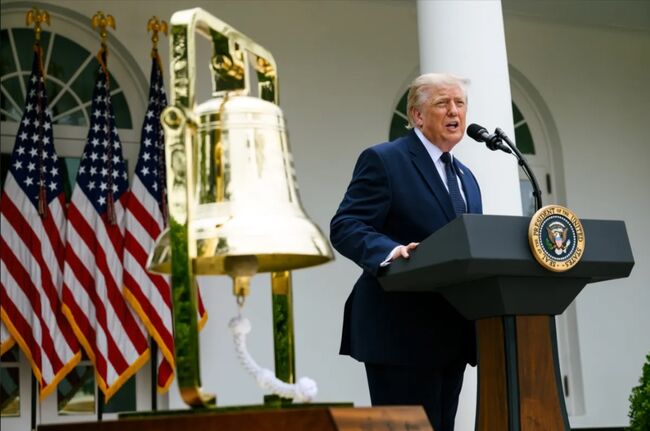 Trump pressures for rate cut again ahead of FOMC... "Should be the lowest in the world"
U.S. President Donald Trump. [Photo = The White House] U.S. President Donald Trump once again pressured the Federal Reserve, the U.S. central bank, to lower interest rates on the 27th (local time
Trump pressures for rate cut again ahead of FOMC... "Should be the lowest in the world"
U.S. President Donald Trump. [Photo = The White House] U.S. President Donald Trump once again pressured the Federal Reserve, the U.S. central bank, to lower interest rates on the 27th (local time
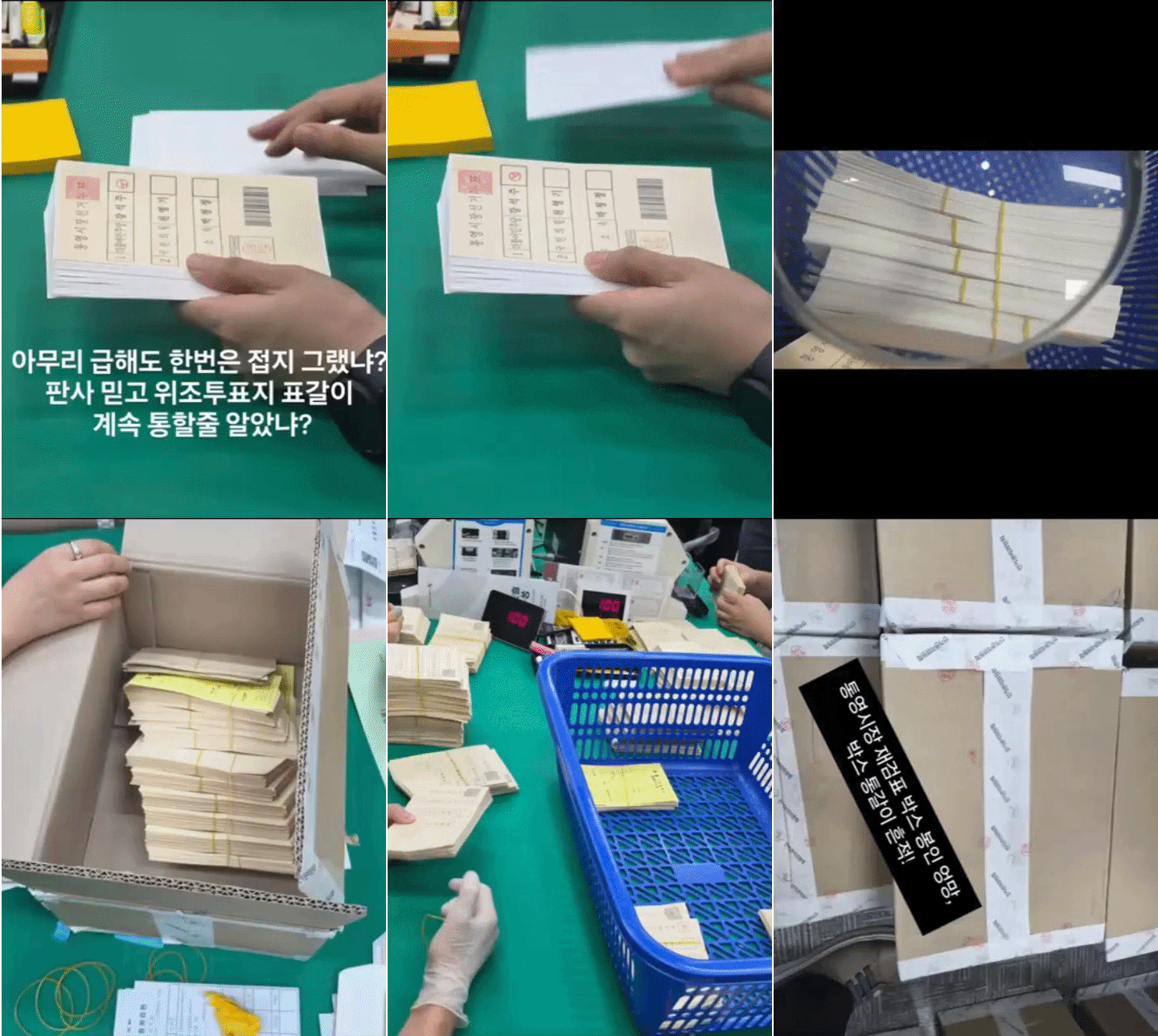 “Ignoring crisp ballots and damaged seals”… Tongyeong mayoral recount concludes with ‘no change in outcome,’ leaving suspicions and public outrage behind
Suspected counterfeit ballots discovered in Tongyeong [GIF from social media of Representative Hwang Kyo-ahn / Attorney Park Joo-hyun]During a recount of the Tongyeong mayoral election in South Gyeong
“Ignoring crisp ballots and damaged seals”… Tongyeong mayoral recount concludes with ‘no change in outcome,’ leaving suspicions and public outrage behind
Suspected counterfeit ballots discovered in Tongyeong [GIF from social media of Representative Hwang Kyo-ahn / Attorney Park Joo-hyun]During a recount of the Tongyeong mayoral election in South Gyeong
 President Yoon, regarding the first-instance ruling on the Public Official Election Act: “An excessive political verdict that distorts the facts… We will appeal immediately.”
The first-instance sentencing hearing for President Yoon Suk Yeol regarding violations of the Public Official Election Act is being broadcast live at Seoul Station on the 27th. [Photo=Yonhap News]Pres
President Yoon, regarding the first-instance ruling on the Public Official Election Act: “An excessive political verdict that distorts the facts… We will appeal immediately.”
The first-instance sentencing hearing for President Yoon Suk Yeol regarding violations of the Public Official Election Act is being broadcast live at Seoul Station on the 27th. [Photo=Yonhap News]Pres
 WSJ: "SK Hynix ADR Premium Is a Sign of AI Trading Overheat"
Advertisement for SK Hynix ADR listing in New York's Times Square [Reuters=Yonhap News file photo]The Wall Street Journal (WSJ) has pointed out that the price of SK Hynix’s American Depositary Recei
WSJ: "SK Hynix ADR Premium Is a Sign of AI Trading Overheat"
Advertisement for SK Hynix ADR listing in New York's Times Square [Reuters=Yonhap News file photo]The Wall Street Journal (WSJ) has pointed out that the price of SK Hynix’s American Depositary Recei
 'Godfather of Japanese Mystery Novels' Keigo Higashino Passes Away After Battle with Cancer at 68
Famous Japanese mystery novelist Keigo Higashino [AFP=Yonhap News]It has been belatedly reported that Keigo Higashino, the "godfather of Japanese mystery novels" and author of bestsellers such as "The
'Godfather of Japanese Mystery Novels' Keigo Higashino Passes Away After Battle with Cancer at 68
Famous Japanese mystery novelist Keigo Higashino [AFP=Yonhap News]It has been belatedly reported that Keigo Higashino, the "godfather of Japanese mystery novels" and author of bestsellers such as "The
 [Park Pil-kyu Security Column] To the Ignorant Trying to Clothe a Beast in Sheep's Clothing
Rep. Kim Byung-joo of the Democratic Party of Korea [Photo=Yonhap News]“The Air Force Academy doesn't teach you how to fly a plane!” “The Army, Navy, and Air Force academies are exactly the
[Park Pil-kyu Security Column] To the Ignorant Trying to Clothe a Beast in Sheep's Clothing
Rep. Kim Byung-joo of the Democratic Party of Korea [Photo=Yonhap News]“The Air Force Academy doesn't teach you how to fly a plane!” “The Army, Navy, and Air Force academies are exactly the
 [Issue Diagnosis] Two Effects of the Election Petition Review
 [Photo] Evidence of Election Fraud Flooding U.S. Media… Trump Had 2.7 Million Votes Stolen
 [Video] U.S. Semiquincentennial Air Show... 'Art in the Sky' streaks across New York
 [Editorial Cartoon] A Draconian Law That Undermines Freedom of Expression

 List
List