지난 5월12일 발행된 <주간 한미일보> 커버스토리입니다. [편집자 주]
 Handwritten testimonies from soldiers of the 1118th Field Engineering Group, 185th Engineering Battalion, who faced the terror of death surrounded by armed rioters during the May 18th Gwangju Uprising in 1980, have been released. Contrary to being labeled as perpetrators of a massacre, their accounts reveal a different perspective of the May 18th incident from the perspective of the martial law troops. [Composite image by Hankook Ilbo]
"It was like Viet Cong guerrilla warfare"... May 18th from a different perspective through the eyes of martial law troops
46 years branded as perpetrators... "We were just fleeing, a defeated force," the testimonies say
First confessions from the 'martial law troops' perspective to fill in the puzzle of May 18th truth, unspeakable sorrow
Handwritten testimonies, filled with the bloody cries of martial law soldiers who trembled in fear of death, surrounded by armed rioters wielding guns, swords, sickles, and pickaxes during the May 18th incident in 1980, are drawing attention for their potential to complete the puzzle of the May 18th truth.
The testimonies, revealing the profound sorrow of the martial law troops hidden behind the label of "perpetrators," create a stark contrast with the image of the martial law forces that has been portrayed as "mass murderers" for the past 46 years.
The "Accounts of the Chungjeong Operation to Suppress the Gwangju Incident," exclusively obtained by Hankook Ilbo two years ago, meticulously document the anguish, joy, and desperate cries of soldiers facing the terror of armed attacks by rioters, struggling for survival on the verge of death.
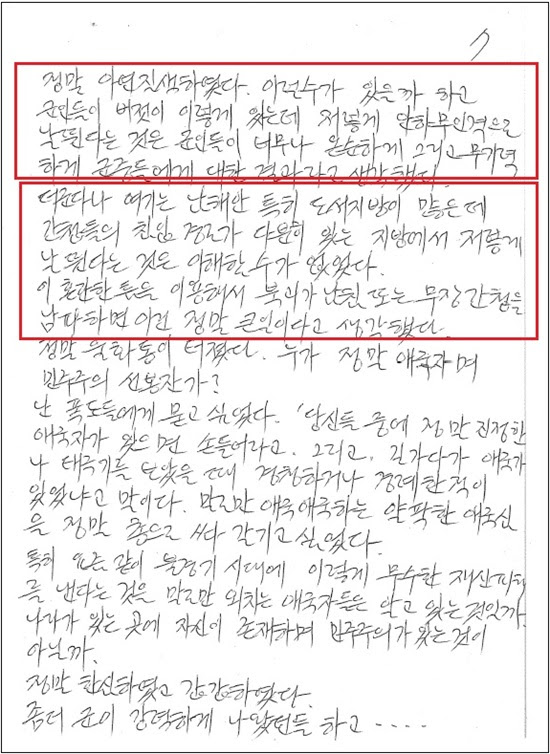 In his handwritten testimony, Sergeant Lee, of the 2nd Company, 185th Engineering Battalion, 1118th Field Engineering Group, who was surrounded and isolated by armed rioters during the May 18th incident in 1980, trembling in fear of death, expressed his anger: "For them to act so brazenly when soldiers are standing right here is a result of the soldiers being too gentle and powerless against the crowd." He continued, "Furthermore, if North Korea were to invade or send armed spies through the southern coastal islands, which are prone to infiltration by spies, taking advantage of the chaos, it would be a truly dire situation, and I was furious." He then asked, "Who are the true patriots and vanguards of democracy?" and confessed he "wanted to shoot them with a gun" for their superficial patriotism, expressed only in words, unable to hide his intense emotions.
Handwritten testimonies from 'victim' martial law soldiers revealed after half a century
The soldiers' testimonies vividly convey their guilt for not fulfilling their duties as soldiers, their humiliation at being disarmed, their fear of being killed by fellow citizens from Gwangju, and their despair, followed by relief at escaping the riot scene with the help of residents, and an overwhelming sense of defeat. These are the unadulterated and unvarnished original records from eyewitnesses who desperately struggled to survive during an armed uprising against the government.
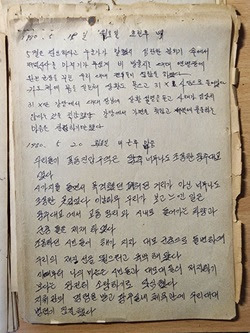 Faded handwritten testimonies from soldiers deployed for the Chungjeong Operation.
For this reason, the testimonies, which record the lament and sorrow of the martial law soldiers, can be considered a "reversal." This sharply contrasts with some claims that martial law troops, as part of a new military junta's power grab, were intent on massacring Gwangju citizens, even allegedly having used drugs. The poignant accounts of soldiers from Gwangju, worried about their families while suppressing their profound fear, evoke a heart-wrenching pain in the reader.
The soldiers' testimonies vividly describe their desperate situation of being unable to return to their unit, only 3 kilometers away, and being forced to flee 68 kilometers to another unit near Mokpo.
The soldiers poured out their unreserved anger, stating, "They turned into rioters every night," "For them to act so brazenly when soldiers are standing right here is a result of the soldiers being too gentle and powerless against the crowd," "If North Korea were to invade or send armed spies through the southern coastal islands, which are prone to infiltration by spies, taking advantage of the chaos, it would be a truly dire situation, and I was furious," and "Who are the true patriots and vanguards of democracy?"
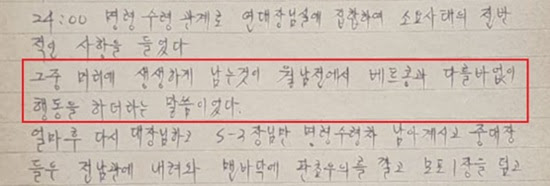 In his testimony, Captain Cho, of the 2nd Company, 185th Engineering Battalion, 1118th Field Engineering Group, wrote: "The regimental commander's words that the rioters acted no differently than the Viet Cong in the Vietnam War remain vividly in my mind."
The indirect testimony of Colonel Park Dong-jo, commander of the 96th Regiment, 31st Division, who is known to have served in Vietnam, stating that they "acted no differently than the Viet Cong in the Vietnam War," was also recorded. This appears to align with the inciting speech by Kim Dae-jung, then co-chairman of the National Alliance. On May 11, 1980, a week before the May 18th Gwangju Uprising, he incited the public in Jeongeup, North Jeolla Province, to "engage in urban and rural guerrilla warfare by infiltrating among the people in the style of Vietnam" and urged soldiers to disobey government orders. In its first ruling in 1981, the Supreme Court sentenced Kim Dae-jung to death, determining that he had "incited anti-government rebellion." Military experts analyze that the characteristics of urban guerrilla warfare indeed appeared in the May 18th incident.
The soldiers' handwritten testimonies, pressed firmly with ballpoint pens, raise sufficient doubt as to whether the claims of the democratization movement, which shouted for freedom against the violence of a dictatorial regime, are true. The discovery of the soldiers' experiential testimonies serves as a stark reminder that what is more fearsome than historical reality is human forgetfulness. It is not difficult to argue that the history of May 18th, steeped in political interpretations, has solely traced a trajectory of concealment and oblivion.
44 years of concealment and oblivion... Eyewitness accounts of the "scene of tragedy" uncolored by political considerations
The collection of testimonies vividly records a snapshot of the suppression operation in the Namgwangju area from May 18 to 23, 1980, when the 185th Engineering Battalion (Battalion Commander: Lieutenant Colonel Lee Myung-jae) of the 1118th Field Engineering Group (FEG), attached to the 31st Division and stationed in Gwangju city, was deployed as a suppression unit, broke through the rioters' encirclement, and returned. Thanks to the battalion commander, Lee Myung-jae, who unusually ordered the compilation and collected the testimonies from the soldiers, preserving them in their original form over the years, they have finally seen the light of day after 44 years.
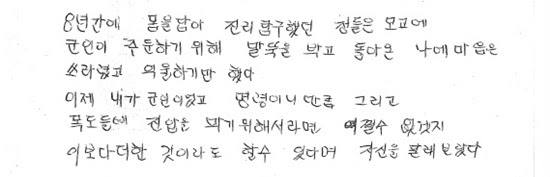 Sergeant Kim of the 185th Battalion's 2nd Company described his feelings upon being deployed to his alma mater, Chosun University, as a martial law soldier on May 18th.Sergeant Kim, of the 185th Battalion's 2nd Company, described his feelings upon being deployed to his alma mater, Chosun University, as a martial law soldier on May 18th. He wrote, "We were able to witness the actual atrocities of what we had only heard about as a riot... (omitted)... Upon arriving and setting up tents on the Chosun University field, we witnessed the horrific scene left by the rioters and could not contain our indignation." He continued, "My heart ached and felt indignant that I, who had sought truth for eight years, had returned to my alma mater to station soldiers and drive stakes into the ground. But now, as a soldier, and by order, and to prevent the suppression of the rioters, I had no choice. I tried to console myself, thinking I could do even more than this."
The soldiers' testimonies, devoid of arbitrary interpretations based on political advantage, record the scene of the May 18th tragedy as it was, without any embellishment.
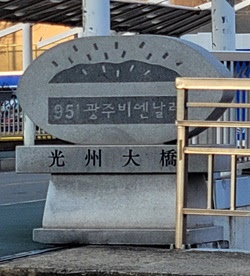 Gwangju Bridge in the defense area. © Reporter Heo Gyeom
Around 3 AM on the 20th, in the drizzling rain, Private Hong awoke and recorded his memories of the atrocities he witnessed as he deployed into Gwangju city in the darkness. Private Hong wrote, "The flower planters along the roadside were scattered chaotically on the road, making a mess, and pieces of brick, stones, and trash were strewn everywhere." He continued, "In front of the Gwangju Express Bus Terminal, many vehicles were burning, and plastic products thrown by rioters from nearby shops were broken, and the street was, literally, a battlefield." Private Park wrote, "The empty streets, with no people (in the early morning), were like complete ruins, so miserable." He added, "How severe were the demonstrations, riots, and chaos, as I saw the streets, the actions of those people vividly came to mind." He also noted that during the day, "The ongoing rioting in Gwangju's Chungjang-ro was visible from a distance, and if they swarmed behind us, we would be overrun, and our lives would not be guaranteed." He took a breath and said, "The citizens who were quiet during the day are like this at night. If I were to act out of anger, it would be a disgrace as a soldier." Private Park further wrote in his testimony that "because we fight with our bodies and minds to minimize damage, they attack us with all their might. That is why soldiers suffer so much damage," offering a glimpse into the operational tactics aimed at minimizing civilian casualties.
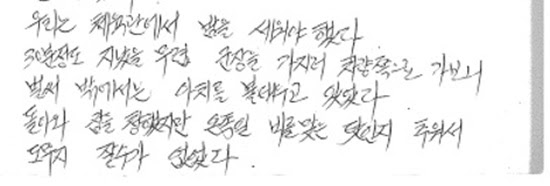 A soldier's testimony stating that it was difficult to sleep due to the cold after getting wet all day.
Captain Cho, the 2nd Company Commander, recorded in his testimony an account he heard from the regimental commander at midnight on the 19th. He wrote, "We gathered in the regimental commander's office to receive orders at 24:00 and heard about the overall situation of the disturbances. What remained vividly in my mind was the statement that they acted no differently than the Viet Cong in the Vietnam War." The next day, Captain Cho wrote, "We reached the point of blocking passage across the Gwangju Bridge, and the situation began to become somewhat serious from then on." He continued, "We received a radio report that the dispersed crowd was moving to Gwangju Park with Molotov cocktails. Looking back now, I feel there were radical elements."
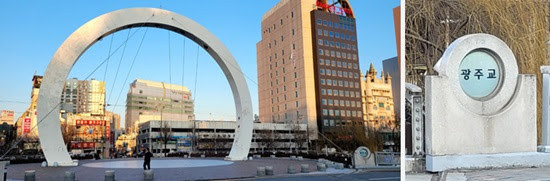 Gwangju Bridge, which the 185th Engineering Battalion attempted to defend. It is located opposite the Gwangju Indoor Gymnasium. © Reporter Heo Gyeom
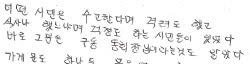 Record concerning citizens who worried about the martial law troops.Sergeant Kim, a radio operator from Gwangju serving in the 2nd Company, wrote on the 19th, "From the battalion commander, I received an explanation of the situation that the Gwangju MBC broadcasting station had been set on fire by rioters." He added, "As Gwangju is my hometown, I was concerned about the situation in the city, but I reassured myself that we could handle it if we were deployed, and I went to sleep." On the 20th, he described his eyewitness account: "Around 16:00 (4 PM), we explored methods to disperse the crowd through persuasion, and the company commander began persuasion efforts." He continued, "While a large portion of the crowd dispersed, some citizens, in a state of radical excitement, retreated and were inciting the rest of the crowd." He then added, "There were citizens who worried if we had eaten, and I learned one of them was the head of the Donghoe (neighborhood association)."
"Isn't it unfair to die at the hands of fellow citizens in my hometown?"
The terror for the FEG reached its peak that night. The soldiers who had controlled the four bridges over the Gwangju River in the early morning of the 20th were pushed back by the swelling tide of rioters and retreated to the Gwangju Indoor Gymnasium. That night, they suffered from the fear of arson by demonstrators and decided to escape the gymnasium on the morning of the 21st.
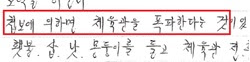 Captain Cho's testimony mentioning intelligence about the gymnasium being bombed.
Captain Cho wrote on the night of the 20th: "I didn't realize the atmosphere had become so hostile until we got on the bus. (Omitted)... The crowd was dense and trying to block our entry into the gymnasium. From then on, the battalion commander, the officers, and the soldiers were enveloped in indescribable terror." He added, "As time went on, the rioters' demonstrations intensified, and the ringing of the telephones inside, the shouts and atrocities of the rioters outside, and the arson that lit up the dark night like day, all these elements created an atmosphere of increasing fear for our officers."
The enlisted men felt the same fear. Sergeant Kim, and another soldier, wrote: "Even though it was past curfew at 21:00 (9 PM), the rioters gathered in front of Gwangju Park, shouting slogans and setting fires with gasoline." They specifically explained, "They poured gasoline and burned the tower that read 'National Sports Festival Jeonnam Preliminary Competition,' which was heartbreaking."
 A soldier's testimony stating that "rioters set fires with gasoline."There was also the story of soldiers who stayed awake all night, surrounded by rioters, desperately hoping for the gunfire to cease. Sergeant Kim of the 2nd Company wrote: "2 AM. I woke up to the sudden sound of an M60 firing through the air. Flames continued to erupt in various parts of the city, and the shouts and slogans of the rioters faded in and out." He continued, "I prayed to God that this situation would be resolved quickly so that my hometown of Gwangju would be free from destruction, arson, and slaughter." He then wrote, "I tried to force myself to sleep, hoping my comrades, brothers, and younger brothers would not join the rioters, but sleep wouldn't come, and my eyes grew even wider."
One soldier described his mindset of being prepared to sacrifice his life if the rioters attacked. He wrote: "The shouts of the rioters, and the flames visible in the distance, were all we could see and feel." He continued, "In the darkness of the gymnasium, we resolved to give our lives if the rioters attacked us, and we tried to fall asleep, but sleep wouldn't come." Private Hong wrote, "The crowd began to move like a mighty wave. We repeatedly shouted through the loudspeakers, 'Rioters, disperse!' 'Residents and citizens, go home!' but they wouldn't disperse." He added, "Outside, they were burning the arch. I came back and tried to sleep, but I was so cold, probably from getting wet all day, that I couldn't sleep at all."
A soldier's testimony stating that it was difficult to sleep due to the cold after getting wet all day.Sergeant Kim also described: "As dawn broke, the rioters' shouts intensified, and it seemed like the battalion commander, company commander, and all the staff officers were not sleeping." He wrote, "I felt a chill in my body and couldn't sleep at all."
The Gwangju Indoor Gymnasium, where they were stationed, was built in 1965 and demolished in 2008. The Bitgoel Citizen Cultural Center now stands in its place. From the night of May 20th to the morning of the 21st, the gymnasium was completely surrounded by rioters, and the martial law troops were militarily encircled.
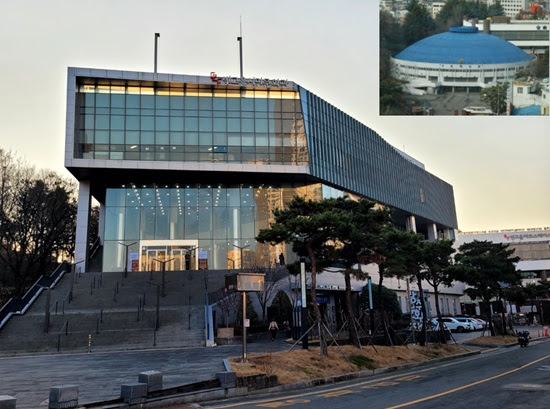 The Gwangju Indoor Gymnasium (small photo) was demolished in 2008, and the Bitgoel Citizen Cultural Center now stands in its place. © Reporter Heo GyeomWhile some hope to imprint the violence of the martial law troops in their hearts, reading the collection of testimonies more clearly depicts the collective madness within the demonstrators and the primal, evil instincts that underpin it.
There were also testimonies expressing fear of the terrifying situation of being killed by their own fellow citizens in their hometown. Sergeant Kim wrote in his testimony: "If we cannot escape this place, we will have no choice but to be sacrificed by the rioters... If I were to die a noble death as a soldier, fighting and dying while eradicating North Korean remnants, it would be an honor with no regrets, but how unfair it would be to die at the hands of rioters here? What's more, how unfair it would be to die at the hands of my own fellow citizens in my hometown?"
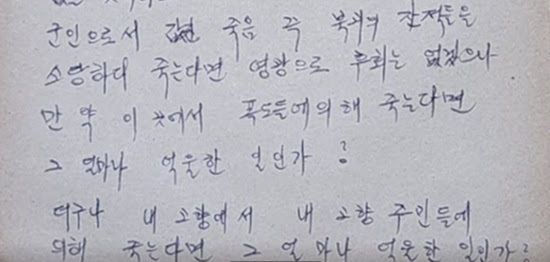 A testimony from a Gwangju-born martial law soldier worried about being killed by his hometown residents.
"The atrocities of rioters no different from the Viet Cong"... Even the regimental commander was furious
A desperate 65km escape... a "Kill them" car chase like in a movie Shivering all night in the gymnasium facing arson threats with unloaded guns Scary roadblocks scattered on the roads... continuous stone attacks from surrounding crowds Rioters acting like masters of the Gwangju-Mokpo road... forced to "applaud" Martial law soldiers shed tears of shame as military jeeps and civilian vehicles were seized indiscriminately
|
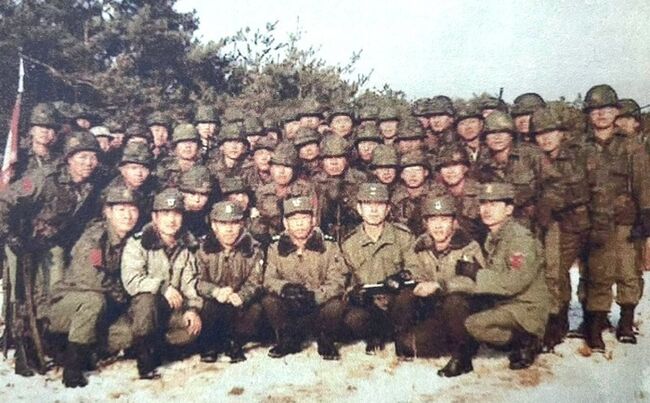 A commemorative photo taken by soldiers of the 185th Engineering Battalion just before May 18, 1980. Battalion Commander Lee Myung-jae is in the front row, center.
"Escaping with our lives... narrowly avoiding death by burning, or by sickle, shovel, pickaxe, and knife"
In the morning of May 21st, after just a day and a half, the nature of the riot changed 180 degrees, and the FEG made a desperate escape for survival. As the steel gate of the gymnasium, surrounded by rioters, opened, ambulances, vehicle No. 2, buses, vehicle No. 1, and military trucks sequentially broke through the encirclement and sped towards the west, towards the Wolsan-dong police substation.
Captain Cho (2nd Company Commander) wrote, "The thought that we had at least escaped death by burning or starvation, or being dragged away by rioters, having our guns confiscated, and being torn apart by farm tools like sickles, shovels, pickaxes, and knives, flashed through my mind." Sergeant Kim wrote, "Seeing the Wolsan-dong police substation burning, I felt a pang of bitterness."
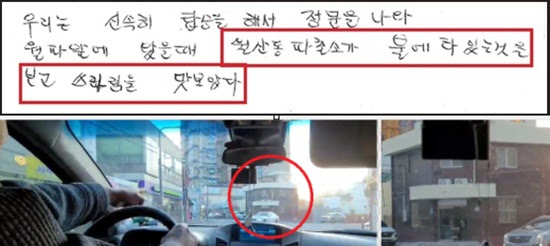 Soldiers' testimonies witnessing the burning Wolsan-dong police substation (above). Reporters Heo Gyeom and 5·18 researchers Choi Jong-won and Kim Deok-su visited the site of the 185th Engineering Battalion's escape route during the May 18th incident on February 16, 2024, and found the site of the Wolsan-dong police substation (red circle in the photo below left). The photo on the right below is an enlarged view.
Around 8:30 AM, the FEG vehicles, having witnessed the Wolsan-dong police substation, just a 2-3 minute drive from the gymnasium, engulfed in flames, sped towards the Combat Service Support Group (CSSG). This was about 30 minutes after the "Confiscation of Command Vehicle of the 20th Division by Army Cadets" incident (8:10 AM).
During their withdrawal, the FEG encountered a crowd of demonstrators at Dolgogae. The demonstrators hurled stones and pounded the vehicles with shovels and pickaxes. Around 8:50 AM, at the entrance to the industrial complex, they were confronted by burning vehicles, barricades, and a crowd of demonstrators whose numbers were impossible to gauge. At 9 AM, demonstrators armed with M16s driving military jeeps were sighted for the first time. Facing them, the FEG turned left and forcibly broke through the barricade at the Baegun-dong railway crossing.
Sergeant Kim vividly described the situation he witnessed at the time, recalling the details. He wrote, "As I reached Dolgogae and moved towards the unit's direction, rioters had broken down trees and created a barricade in the middle of the road. It was barely wide enough for one vehicle to pass. While traveling on the Gwangsong road, near the Public Officials Training Institute, a Dongyang Express bus carrying rioters came from the opposite direction, saw us, and turned around to chase us, shouting 'Kill them!'" Another Sergeant Kim described, "The rioters tried to throw gasoline bottles and explosives into our vehicles, and they chased us in stolen military jeeps, overtaking us."
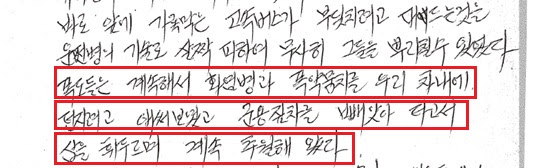 A soldier's handwritten testimony stating that rioters attempted to throw Molotov cocktails and explosives during a car chase.Unfortunately, vehicle No. 2 collided with the bus carrying the rioters and veered off the road. Radio operator Sergeant Kim wrote again, "After the rioters' bus pushed vehicle No. 2 off the road, armed rioters with M16 rifles in stolen jeeps appeared to be attacking us. The lead ambulance crashed into a large barricade at the entrance to the industrial complex and ran into a rice paddy. Vehicle No. 2 was pushed by the bus onto the sidewalk and barely managed to turn and escape, but the express bus continued to pursue us."
"Countless indignities while escaping Gwangju... I wanted to destroy them, dead or alive."
 Private Park of the 2nd Company likened the situation to "a scene from a movie."Private Park of the 2nd Company likened the situation to "a scene from a movie." Private Park recounted the moment of threat: "Stones kept flying. Everyone was getting agitated. They were driving around in four military jeeps, telling us to stop." He continued, "At that moment, if we had bullets, we probably would have fired them." He described, "The rioters' express bus took a curve and pushed the medical vehicle to the side of the road."
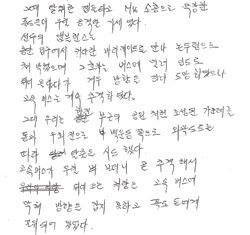 Testimony about being chased by a rioters' bus.
The escaping troops were divided into the first and second detachments. Their paths diverged at the entrance to the industrial complex. The vehicle carrying the 2nd Company Commander turned left, shouting "Left!", and headed towards Baegun-dong. Captain Cho recalled: "Behind us, rioters in jeeps were following alongside the bus, holding Molotov cocktails, shovels, and sickles, throwing Molotov cocktails, and from both sides of the road, stones were flying, breaking the windows. We threw two gas bombs (M7A3 tear gas) into their jeeps, and when they hit, their car swerved to the side, and we managed to shake them off."
At the Baegun-dong railway crossing, a vehicle was spewing black smoke, and flames were rising. Captain Cho said, "The rioters were blocking the crossing, but I shouted 'Pass through no matter what,' and the driver honked the horn and drove through the barricade, and the company members threw countless gas bombs as we passed the crossing."
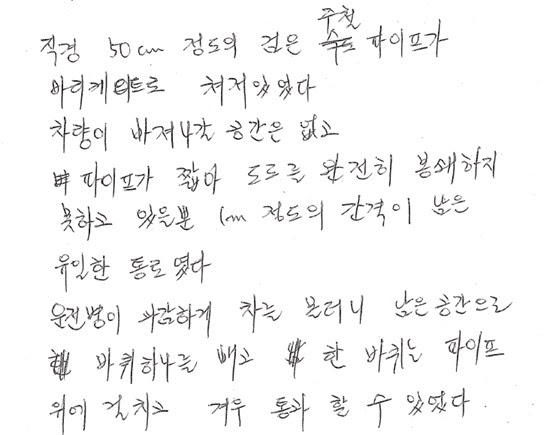 Testimony describing the process of forcibly breaking through a barricade in a tense situation.They testified that the railway crossing had a black cast iron pipe, about 50 cm in diameter, as a barricade. There was no space for vehicles to pass, and the pipe was too short to completely block the road, leaving a gap of about 1 meter – the only passage. A soldier riding in the vehicle wrote in his testimony: "The driver boldly drove the car, with one wheel in the remaining space and the other on top of the pipe, barely managing to pass. As the vehicle passed over the pipe with a clanking sound, scattered residents threw stones at the car." One soldier wrote in his testimony, "Are the blindly incited residents supporting the rioters with sound judgment?" distinguishing between citizens and rioters. He also lamented, "The superiors are providing us with tear gas as our only weapon to deal with armed rioters... Is our lives worth nothing?"
There were also testimonies from soldiers whose emotions were still running high. Sergeant Jeong expressed strong anger: "The moment a stone the size of my fist flew and shattered the window next to me, glass shards flew into my face, and blood began to stream from my eyes." He continued, "Wiping the blood from my eyes, I thought. I wanted to jump out right away and smash them, whether we lived or died." Private Park wrote, "We cursed them, feeling wronged that we couldn't kill them. Perhaps it's because we suffered so many indignities while escaping Gwangju."
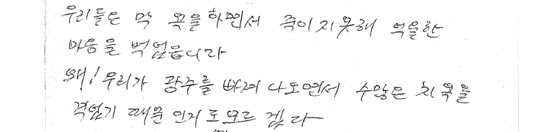 Private Park of the 2nd Company, 185th Engineering Battalion, wrote: "I felt wronged that we couldn't kill them. Perhaps it's because we suffered so many indignities while escaping Gwangju."Sergeant Lee of the 2nd Company wrote: "I was truly astonished. For them to act so brazenly when soldiers are standing right here is a result of the soldiers being too gentle and powerless against the crowd." He continued, "Furthermore, I couldn't understand why they were acting so wildly in these southern coastal areas, especially with so many islands, which are prone to infiltration by spies." He expressed his anger, "If North Korea were to invade or send armed spies through this chaos, it would be a truly dire situation, and I was furious. Who are the true patriots and vanguards of democracy?" He then added, "I wanted to ask the rioters: 'If there is a true patriot among you, raise your hand. And have you ever listened to the national anthem or saluted the Taegeukgi when you encountered them?' I wanted to shoot them with a gun for their superficial patriotism, expressed only in words."
"Defense soldiers, Mokpo was in ruins... Rioters forced residents to participate"
The first detachment, speeding towards Naju, encountered military vehicles and asked for directions to the nearest military base. Upon hearing that the 93rd Regiment was in Mokpo, they headed there again. Captain Cho wrote: "Shortly after, I witnessed four buses, led by an express bus, carrying rioters pass by the front of the military base, and I intuited that the situation was becoming increasingly serious, and my fear intensified." He continued, "After reassuring the soldiers, I waited in the regimental situation room and assessed the situation. We received news that riots, arson, and destruction were also occurring in Mokpo. In cooperation with the supply officer of the 93rd Regiment, we received 60 rounds of live ammunition per person." He added, "Meanwhile, the rioters continued to travel back and forth on the Gwangju-Mokpo road, shouting slogans and spreading all sorts of rumors."
Radio operator Sergeant Kim expressed dissatisfaction with the higher command's judgment: "We thought we had to block the Gwangju-Mokpo road to prevent the riot from spreading further. However, the 93rd Regiment did not implement this. At 10:30 AM, we witnessed rioters, on several buses led by an express bus, passing in front of the main gate of the 93rd Regiment towards Mokpo. Ultimately, this gave the rioters an opportunity to commit atrocities in Mokpo as well."
 The 2nd Company Commander wrote in his testimony that casualties occurred even after entering the 93rd Regiment in Mokpo.
The first detachment safely entered a military base about a 3-minute drive from the Mokpo sea. Captain Cho wrote the next day, the 22nd: "Rioters continued to pass by the front of the base, and news of firearms and live ammunition being seized in Mokpo, Gangjin, Haenam, Naju, and Muan was continuously received at the situation room." He added, "At around 4 PM, we were ordered to block the road and did so on the Gwangju-Mokpo route, but gunfire continued at the ambush sites, and casualties and injuries occurred."
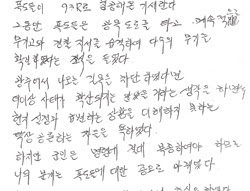 Soldiers also blamed the military leadership, unfamiliar with the local situation, for the delayed road blockades, which led to damage in Mokpo.They stated that they stood guard duty throughout the night due to intelligence that rioters would attack the base. The radio operator wrote: "We heard that the rioters had attacked armories and police stations along the Gwangmok road and secured a large quantity of weapons." He continued, "I cursed those who made armchair decisions, not understanding the local situation and the rapidly changing events. However, as soldiers must obey orders absolutely, my indignation turned into hatred towards the rioters. I cannot express how wronged I felt, thinking of the safety of my family in Gwangju." He then added, "When morning came, the defense soldiers who had just managed to leave Mokpo to come to work told us about the atrocities of arson, looting, and destruction that had occurred in Mokpo." He concluded, "If we had blocked the road when we arrived at the base, such atrocities would not have happened. It is unfair that Mokpo suffered damage as well."
The 2nd Company of the 185th Engineering Battalion, which escaped to the 93rd Regiment in Mokpo, returned to the CSSG by helicopter on the 23rd. The 2nd Company Commander concluded his experience by saying: "I cannot adequately express in words how overjoyed I was at that moment." He added, "Seeing the commander, battalion commander, staff officers, and company members who came to see us off, I felt that we had finally come home, and the days of anxiety and fear were replaced by a peaceful sense of relief as we arrived at the battalion parade ground."
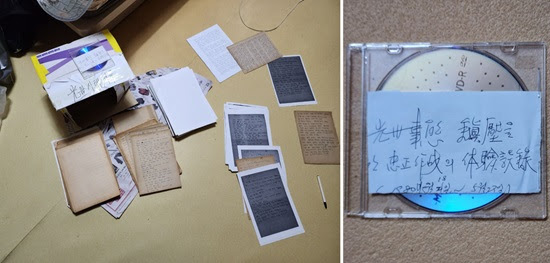 The collection of martial law soldiers' testimonies, which Lee Myung-jae, commander of the 185th Engineering Battalion, had preserved in CD and document form for 44 years, has now seen the light of day.
"No joy in being alive... with unloaded guns, we were not soldiers."
As the first detachment, who narrowly escaped, had feared, the second detachment, which proceeded straight forward from the entrance of the industrial complex, unfortunately had their escape thwarted in front of the Army cadet school. The rioters in Hwajeong-dong quickly surrounded the soldiers. Just an hour earlier, 14 command vehicles of the 20th Division had been disarmed by rioters here, unable to move. The 2nd detachment of the engineering group was no exception.
Sergeant Kim of the 2nd Company, who was not a radio operator, wrote in his testimony: "As we crossed Dolgogae, we saw a large number of rioters and citizens... I tried to wave, and express with gestures and movements that we would not treat you with hostility, but it was no use." He added, "They seemed to be trying to break all our equipment with sickles, shovels, pickaxes, and hammers, and they appeared to be indiscriminately seizing military jeeps and civilian vehicles."
Private Shin of the 3rd Company, belonging to the second detachment, wrote about the shameful memory of being disarmed. Private Shin stated, "As a soldier, surrendering to the rioters, I felt intense shame and weakness." He continued, "I believe the Gwangju riot incident was a very large-scale and tremendous event. As a soldier working in Gwangju, I deeply regret that such an incident occurred." He suppressed his emotions, saying, "Although I participated in the suppression as a member of the suppression force, I deeply regret that good citizens are suffering damage due to a very small number of malicious individuals. As a combat soldier involved in suppression, I suffered many attacks and damage from the rioters."
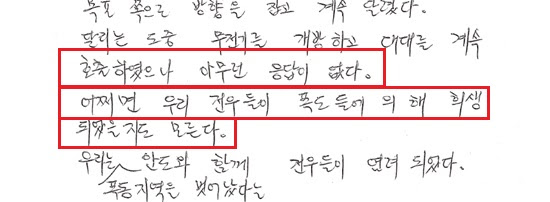 Testimony expressing worry that a comrade left behind might have been sacrificed.Sergeant Woo of the 3rd Company wrote in his testimony: "We had our vehicles seized and escaped on foot. The rioters must have seen the military as powerless. However, their assumption is wrong. They are not our enemies. As soldiers whose duty is to aim their rifles at the North Korean regime, how could we aim our guns at their chests? To the citizens of Gwangju! I only wish you would exercise more restraint and help the situation improve, so as not to leave a stain on the history of this beautiful peninsula."
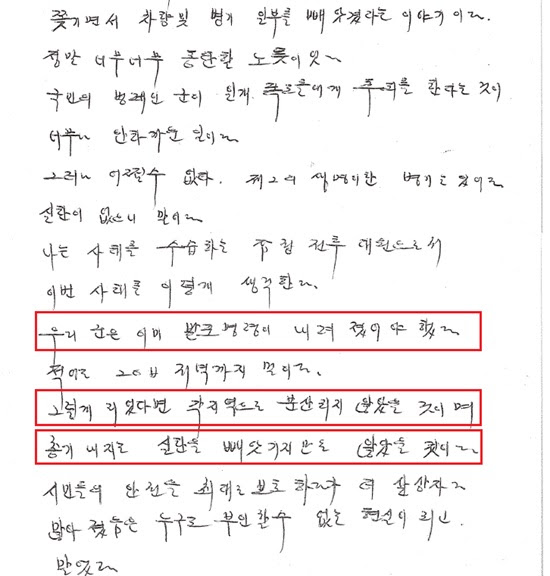 Private Hong, of the 3rd Company, submitted testimony analyzing the cause: "It is lamentable that vehicles and weapons were seized," and "Even with weapons, there were no live bullets, so there was nothing we could do." He added, "Our military should have been given the order to fire by now. At least by the evening of the 20th. If that had happened, we would not have been dispersed to various regions, and our firearms and live ammunition would not have been seized."There were also records stating that it was difficult to protect citizens' lives with unloaded guns and that there was no sense of relief even from being alive. Private Han of the 185th Battalion's 3rd Company wrote: "There was not a speck of joy in being alive. The thought that soldiers had to retreat, chased by citizens, shook my very being, and I leaned against a swaying truck, my eyes filled with tears due to my sense of duty as a soldier, not just as a person." He continued, "Under the ridge, with the road blocked, and citizens throwing stones while our military trucks were being smashed, it was a matter of life or death. The thought of calmly and rationally thinking and acting never left my mind." He wrote in his testimony, "I keenly felt that soldiers with unloaded guns were not soldiers meant to protect the lives of the people." He added, "All of this will likely be due to my discharge date, which constantly remains in my mind. I deeply resolved to forget the events in Gwangju, and I ran down the alleyways," expressing his desire to forget his experiences in Gwangju.
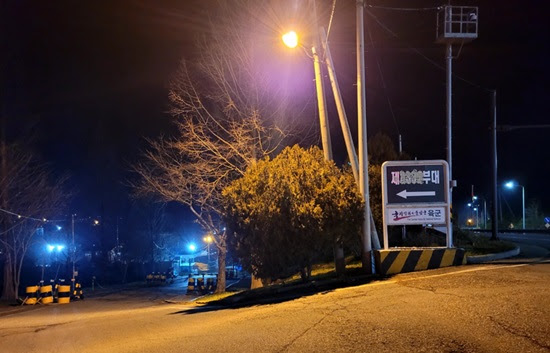 On February 16, 2024, reporters Heo Gyeom and 5·18 researchers Choi Jong-won and Kim Deok-su followed the escape route of the 185th Engineering Battalion during the May 18th incident and visited the site of the former 93rd Regiment unit, about a 3-minute distance from the Mokpo sea. Barricades are placed crisscrossed at the entrance to the unit, located on a secluded slope on the Gwangju-Mokpo expressway. © Reporter Heo Gyeom
Choi Jong-won, a researcher of the May 18th incident and a former company commander of the martial law troops who discovered the experiential testimonies, said, "We were supposed to protect the citizens, but the second detachment, who escaped with the help of Gwangju citizens, why could they not write detailed accounts? It was because they were ashamed of their failure to fulfill their duties as soldiers and felt humiliated, so they only wrote a few lines." He added, "They never harassed the citizens of Gwangju."
By Heo Gyeom

 Iranian Foreign Ministry: "Continuing Message Exchanges with the U.S. and Activities of Mediating Countries"
Esmaeil Baghaei, Spokesperson for the Iranian Ministry of Foreign Affairs [Xinhua, Yonhap News file photo]Esmaeil Baghaei, spokesperson for the Iranian Ministry of Foreign Affairs, stated on the 26th
Iranian Foreign Ministry: "Continuing Message Exchanges with the U.S. and Activities of Mediating Countries"
Esmaeil Baghaei, Spokesperson for the Iranian Ministry of Foreign Affairs [Xinhua, Yonhap News file photo]Esmaeil Baghaei, spokesperson for the Iranian Ministry of Foreign Affairs, stated on the 26th
 President Yoon: "Do You Think You Are Safe from the Special Counsel?"... Final Statement Video Released
President Yoon Suk Yeol rebuking the special prosecutor on the 24th. [Court video / @birds_justice X account subtitle GIF] A video of President Yoon Suk Yeol's closing statement at his trial rega
President Yoon: "Do You Think You Are Safe from the Special Counsel?"... Final Statement Video Released
President Yoon Suk Yeol rebuking the special prosecutor on the 24th. [Court video / @birds_justice X account subtitle GIF] A video of President Yoon Suk Yeol's closing statement at his trial rega
 President Yoon, regarding the first-instance ruling on the Public Official Election Act: “An excessive political verdict that distorts the facts… We will appeal immediately.”
The first-instance sentencing hearing for President Yoon Suk Yeol regarding violations of the Public Official Election Act is being broadcast live at Seoul Station on the 27th. [Photo=Yonhap News]Pres
President Yoon, regarding the first-instance ruling on the Public Official Election Act: “An excessive political verdict that distorts the facts… We will appeal immediately.”
The first-instance sentencing hearing for President Yoon Suk Yeol regarding violations of the Public Official Election Act is being broadcast live at Seoul Station on the 27th. [Photo=Yonhap News]Pres
 WSJ: "SK Hynix ADR Premium Is a Sign of AI Trading Overheat"
Advertisement for SK Hynix ADR listing in New York's Times Square [Reuters=Yonhap News file photo]The Wall Street Journal (WSJ) has pointed out that the price of SK Hynix’s American Depositary Recei
WSJ: "SK Hynix ADR Premium Is a Sign of AI Trading Overheat"
Advertisement for SK Hynix ADR listing in New York's Times Square [Reuters=Yonhap News file photo]The Wall Street Journal (WSJ) has pointed out that the price of SK Hynix’s American Depositary Recei
 'Godfather of Japanese Mystery Novels' Keigo Higashino Passes Away After Battle with Cancer at 68
Famous Japanese mystery novelist Keigo Higashino [AFP=Yonhap News]It has been belatedly reported that Keigo Higashino, the "godfather of Japanese mystery novels" and author of bestsellers such as "The
'Godfather of Japanese Mystery Novels' Keigo Higashino Passes Away After Battle with Cancer at 68
Famous Japanese mystery novelist Keigo Higashino [AFP=Yonhap News]It has been belatedly reported that Keigo Higashino, the "godfather of Japanese mystery novels" and author of bestsellers such as "The
 [Park Pil-kyu Security Column] To the Ignorant Trying to Clothe a Beast in Sheep's Clothing
Rep. Kim Byung-joo of the Democratic Party of Korea [Photo=Yonhap News]“The Air Force Academy doesn't teach you how to fly a plane!” “The Army, Navy, and Air Force academies are exactly the
[Park Pil-kyu Security Column] To the Ignorant Trying to Clothe a Beast in Sheep's Clothing
Rep. Kim Byung-joo of the Democratic Party of Korea [Photo=Yonhap News]“The Air Force Academy doesn't teach you how to fly a plane!” “The Army, Navy, and Air Force academies are exactly the
 [Issue Diagnosis] Two Effects of the Election Petition Review
 [Photo] Evidence of Election Fraud Flooding U.S. Media… Trump Had 2.7 Million Votes Stolen
 [Video] U.S. Semiquincentennial Air Show... 'Art in the Sky' streaks across New York
 [Editorial Cartoon] A Draconian Law That Undermines Freedom of Expression

 List
List










