 U.S. President Donald Trump (left) and Chinese President Xi Jinping [AFP Yonhap News Archive Photo]
A U.S. official present at the summit stated that U.S. President Donald Trump and Chinese President Xi Jinping agreed to maintain the goal of denuclearizing the Korean Peninsula during Trump's visit to China on November 14-15.
When asked by ABC News on November 17 (local time), "How would you respond to criticism that this (U.S.-China) summit lacked significant achievements? What was the most concrete outcome?" Jamie Gorelick, Deputy USTR Representative, responded.
Gorelick replied, "I would say there are several items. More specific details will be released in a 'fact sheet' in the coming days. Some of these are truly related to foreign policy, and President Trump and President Xi Jinping agreed to maintain the goal of denuclearizing the Korean Peninsula."
Gorelick added, "The two leaders also agreed that the Strait of Hormuz must be open and clear of tolls."
Gorelick accompanied President Trump on his visit to China and was present at all official meetings, including the summit on the 14th and the tea gathering and working lunch the following day.
Given North Korea's escalating nuclear capabilities and its outright refusal of denuclearization, the agreement between the U.S. and Chinese leaders to maintain the goal of denuclearizing the Korean Peninsula is interpreted as a consensus on the principle that North Korea's ambition to be recognized as a nuclear-armed state internationally is unacceptable.
However, given that China, which prioritizes Sino-North Korean relations, has been out of sync with South Korea, the U.S., and Japan in recent years by not cooperating with UN Security Council condemnations and strengthened sanctions against North Korea's ballistic missile launches, it remains uncertain whether the agreement between the U.S. and Chinese leaders will translate into increased pressure on North Korea.
The second Trump administration, which began in January last year, adheres to the goal of North Korean denuclearization, but amidst a multitude of other foreign policy issues, has yet to propose concrete dialogue or pressure strategies to achieve North Korean denuclearization.
While it was already known that the two leaders discussed the Korean Peninsula issue during their meeting in Beijing, China, the confirmation that they specifically agreed on 'denuclearization of the Korean Peninsula' is the first.
Previously, after the summit between President Trump and President Xi on November 14, China's Xinhua News Agency reported, "The two leaders exchanged views on significant international and regional issues such as the situation in the Middle East, the Ukraine crisis, and the Korean Peninsula."
In contrast, the official meeting results released by the White House did not mention any content related to the Korean Peninsula.
When asked, "What commitment did China make to opening the Strait of Hormuz?" Gorelick stated, "The President did not ask China to take action in the Strait of Hormuz during the meeting. The President was very focused on ensuring they (China) do not provide material support to Iran, and that is the commitment he obtained and confirmed."
When asked how President Trump is using arms sales to Taiwan in negotiations with China, Gorelick said, "The U.S. has a long history of selling arms to Taiwan, but there have also been times when we haven't. Former President Obama also suspended arms sales, as did former President Bush."
He continued, "Realistically, maintaining a stable relationship between the United States and China is very important. Arms sales to Taiwan is an issue that China has always raised, and the President is considering how to approach it."
Gorelick emphasized, however, "The most important thing is that there should be no change in the status quo in the Taiwan Strait, and the President has been very clear about this. There is no change in U.S. policy toward Taiwan. If President Xi tries to change this, it will certainly be a consideration. The President is very focused on ensuring that nothing happens there."
In an interview with CBS, Gorelick stated that in relation to the Section 301 investigation against countries including China and South Korea following the U.S. Supreme Court's ruling invalidating reciprocal tariffs, "China knows that we will impose a certain level of tariffs to control imports."
He added, "We cannot predetermine the results of the (Section 301) investigation," but "if the investigation reveals, as we expect, that there is a major problem with overproduction in China or other countries, we will certainly present options (tariffs, service fees, import quotas)."
He also highlighted the economic and trade achievements of the summit, stating, "In the past few days, we have seen China ease numerous non-tariff barriers on U.S. agricultural products such as beef and poultry. Therefore, we are seeing China already starting to take measures to facilitate imports of U.S. products."

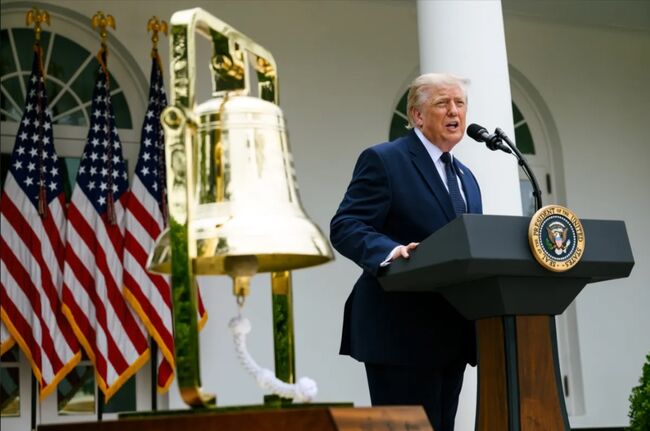 Trump pressures for rate cut again ahead of FOMC... "Should be the lowest in the world"
U.S. President Donald Trump. [Photo = The White House] U.S. President Donald Trump once again pressured the Federal Reserve, the U.S. central bank, to lower interest rates on the 27th (local time
Trump pressures for rate cut again ahead of FOMC... "Should be the lowest in the world"
U.S. President Donald Trump. [Photo = The White House] U.S. President Donald Trump once again pressured the Federal Reserve, the U.S. central bank, to lower interest rates on the 27th (local time
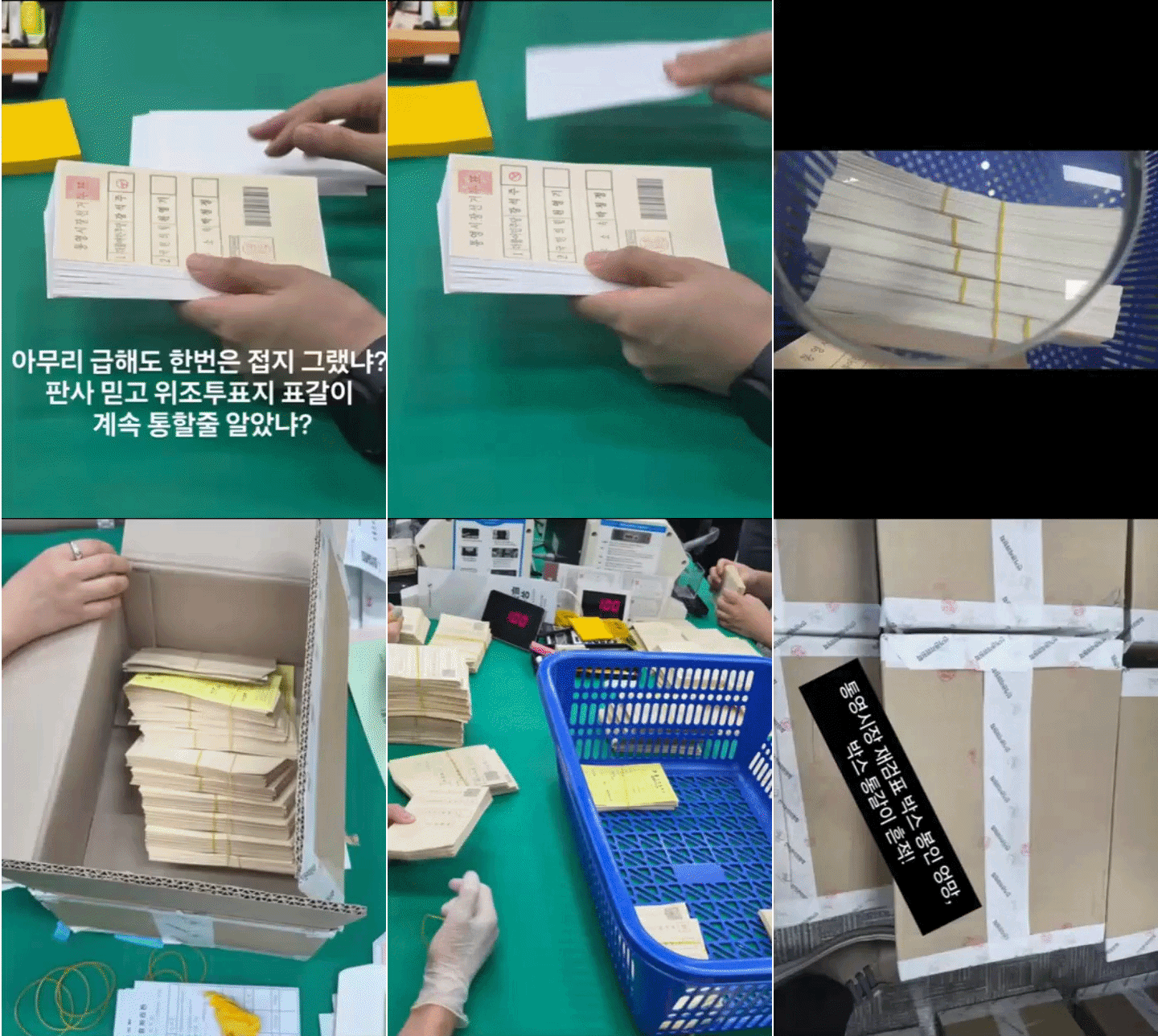 “Ignoring crisp ballots and damaged seals”… Tongyeong mayoral recount concludes with ‘no change in outcome,’ leaving suspicions and public outrage behind
Suspected counterfeit ballots discovered in Tongyeong [GIF from social media of Representative Hwang Kyo-ahn / Attorney Park Joo-hyun]During a recount of the Tongyeong mayoral election in South Gyeong
“Ignoring crisp ballots and damaged seals”… Tongyeong mayoral recount concludes with ‘no change in outcome,’ leaving suspicions and public outrage behind
Suspected counterfeit ballots discovered in Tongyeong [GIF from social media of Representative Hwang Kyo-ahn / Attorney Park Joo-hyun]During a recount of the Tongyeong mayoral election in South Gyeong
 President Yoon, regarding the first-instance ruling on the Public Official Election Act: “An excessive political verdict that distorts the facts… We will appeal immediately.”
The first-instance sentencing hearing for President Yoon Suk Yeol regarding violations of the Public Official Election Act is being broadcast live at Seoul Station on the 27th. [Photo=Yonhap News]Pres
President Yoon, regarding the first-instance ruling on the Public Official Election Act: “An excessive political verdict that distorts the facts… We will appeal immediately.”
The first-instance sentencing hearing for President Yoon Suk Yeol regarding violations of the Public Official Election Act is being broadcast live at Seoul Station on the 27th. [Photo=Yonhap News]Pres
 WSJ: "SK Hynix ADR Premium Is a Sign of AI Trading Overheat"
Advertisement for SK Hynix ADR listing in New York's Times Square [Reuters=Yonhap News file photo]The Wall Street Journal (WSJ) has pointed out that the price of SK Hynix’s American Depositary Recei
WSJ: "SK Hynix ADR Premium Is a Sign of AI Trading Overheat"
Advertisement for SK Hynix ADR listing in New York's Times Square [Reuters=Yonhap News file photo]The Wall Street Journal (WSJ) has pointed out that the price of SK Hynix’s American Depositary Recei
 'Godfather of Japanese Mystery Novels' Keigo Higashino Passes Away After Battle with Cancer at 68
Famous Japanese mystery novelist Keigo Higashino [AFP=Yonhap News]It has been belatedly reported that Keigo Higashino, the "godfather of Japanese mystery novels" and author of bestsellers such as "The
'Godfather of Japanese Mystery Novels' Keigo Higashino Passes Away After Battle with Cancer at 68
Famous Japanese mystery novelist Keigo Higashino [AFP=Yonhap News]It has been belatedly reported that Keigo Higashino, the "godfather of Japanese mystery novels" and author of bestsellers such as "The
 [Park Pil-kyu Security Column] To the Ignorant Trying to Clothe a Beast in Sheep's Clothing
Rep. Kim Byung-joo of the Democratic Party of Korea [Photo=Yonhap News]“The Air Force Academy doesn't teach you how to fly a plane!” “The Army, Navy, and Air Force academies are exactly the
[Park Pil-kyu Security Column] To the Ignorant Trying to Clothe a Beast in Sheep's Clothing
Rep. Kim Byung-joo of the Democratic Party of Korea [Photo=Yonhap News]“The Air Force Academy doesn't teach you how to fly a plane!” “The Army, Navy, and Air Force academies are exactly the
 [Issue Diagnosis] Two Effects of the Election Petition Review
 [Photo] Evidence of Election Fraud Flooding U.S. Media… Trump Had 2.7 Million Votes Stolen
 [Video] U.S. Semiquincentennial Air Show... 'Art in the Sky' streaks across New York
 [Editorial Cartoon] A Draconian Law That Undermines Freedom of Expression

 List
List









